Table of Contents
AI in Healthcare: How App Development Is Transforming Patient Care
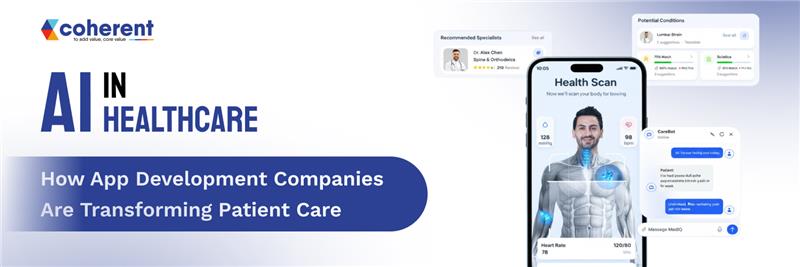
Artificial intelligence (AI) is no longer a futuristic concept in healthcare—it’s actively reshaping the way patients receive care. From predictive diagnostics to personalized treatment plans, AI-driven solutions are empowering healthcare providers and enhancing patient outcomes. Leading app development companies are at the forefront of this transformation, designing intelligent applications that streamline workflows, improve accuracy, and make healthcare more accessible.
These AI-powered apps can analyze vast amounts of medical data in real-time, detect anomalies early, and even assist doctors in making more informed decisions. Patients, on the other hand, benefit from smarter health tracking, remote monitoring, and instant access to medical insights—all from the convenience of their smartphones.
As the healthcare landscape evolves, the collaboration between AI technologies and innovative app development companies is proving to be a game-changer. This synergy ensures patients receive faster, safer, and more personalized care, setting a new standard in modern healthcare experiences.
Key Areas Where AI Improves Patient Care
AI is having a big effect on several areas of patient care in healthcare. AI for medical diagnosis is one of the most interesting uses of AI. It uses machine learning algorithms to look at a lot of patient data and find illnesses early.
How App Development Companies Implement AI in Healthcare Apps
To make useful AI healthcare applications,Ai app development company employs natural language processing (NLP) to read and understand patient information, voice instructions, and comments from doctors. This technology makes it possible to have AI prescription readers and AI doctor prescription reader, which helps reduce the number of pharmaceutical mistakes. To forecast patient hazards, suggest therapies, and improve hospital procedures, machine learning models are trained on big datasets. These firms are turning old healthcare systems into smart, connected, and patient-centered ecosystems by combining technology skills with an understanding of the field.
Real AI Healthcare App Use Cases
The use of AI in healthcare has led to the creation of several AI healthcare applications that are changing how patients are cared for, making operations more efficient, and improving how medical decisions are made. This makes diagnoses more accurate and saves human personnel time and effort.
Benefits of AI-Powered Healthcare Applications
The cost benefits are significant as well. AI in hospital management makes the best use of resources, cuts down on operational inefficiencies, and cuts down on mistakes.
Challenges in Building AI Healthcare Apps
Artificial intelligence in healthcare needs a lot of big, high-quality information to train algorithms for things like Predictive analytics in healthcare, diagnostics, and keeping an eye on patients. Developers also need to make sure that AI systems work well with the hospital's current systems, such as electronic health record (EHR) systems, lab management tools, and hospital administration software. Problems with compatibility or technical alignment may make deployment take longer, make apps less useful, and make healthcare workers angry.
In healthcare AI, models need to be clear and easy to understand. AI healthcare apps need a lot of confidence from both patients and doctors, which is different from consumer apps. Before acting on AI-generated patient care suggestions, doctors need to know how they were made. In therapeutic settings, people are generally skeptical of black-box models, which provide outputs without explicit justification. Healthcare app development businesses have a tough job of producing AI-powered healthcare solutions that are easy to understand and explain, yet being very accurate at predicting outcomes.
Apps may need to be audited and updated on a regular basis to be compliant, even after they are released. Getting permission for AI medical applications like AI prescription reader, AI symptom checker apps, or AI telemedicine apps takes a lot of time. It requires a lot of paperwork, clinical trials, and validation tests to show that they are safe and effective. To fix this, we need datasets that are varied and include everyone, as well as constant checking of AI results. AI-powered healthcare solutions must be fair, accurate, and morally responsible, according to healthcare developers.
Building Secure & Scalable AI Healthcare Apps: How Development Companies Do It
Healthcare app development companies use best practices to make sure that their AI healthcare applications are safe and can grow. The Healthcare app development process begins with thorough planning and the collection of requirements to make sure that patient demands, healthcare processes, and regulatory requirements are all clear.
Future of AI in Healthcare
AI for patient care will concentrate more and more on customization. AI-driven suggestions will be based on each patient's genetic profile, lifestyle, and medical history. AI telemedicine applications will work with AI-powered diagnostic tools to develop complete virtual care platforms that are as good as or better than in-person visits.
| Aspect | Current Role | Future Potential | Benefits |
|---|---|---|---|
| Diagnostics | AI assists in imaging and pathology analysis | Fully automated, real-time diagnostics | Faster, more accurate detection of diseases |
| Personalized Medicine | Limited predictive models based on patient data | AI-driven tailored treatment plans for individuals | Better outcomes, reduced side effects |
| Drug Discovery | AI helps identify candidate compounds | Accelerated drug development and testing | Cost-effective, shorter time to market |
| Patient Monitoring | Wearables and remote sensors track vital signs | Continuous AI monitoring with predictive alerts | Early intervention, improved patient safety |
| Administrative Tasks | Automating scheduling and record-keeping | Fully intelligent hospital management systems | Reduced workload, higher efficiency |
| Robotic Surgery | AI-assisted surgical tools | Autonomous surgical procedures with AI guidance | Precision, minimal invasiveness, faster recovery |
| Healthcare Accessibility | AI chatbots provide basic guidance | Virtual AI doctors available globally | Improved access, especially in remote areas |
Conclusion
AI healthcare applications are changing the way contemporary medicine works by bringing AI into healthcare. Getting the necessary approvals and following the rules might make it take a long time to launch an AI software.
Ready to transform your healthcare solutions with AI? Contact us today and discover smarter, faster, and more efficient care.
Frequently Asked Questions
Frequently Asked Questions
Q1. How much does it cost to develop an AI healthcare app?
Ans. The cost of developing an AI healthcare app depends on its features, AI complexity, platform, integrations, security requirements, and development team. A basic AI symptom checker or medical imaging solution may cost around $50,000–$100,000, while advanced healthcare platforms with predictive analytics, EHR integration, remote monitoring, and customized AI models can cost significantly more.
Q2. What is the future of AI in healthcare?
Ans. The future of AI in healthcare looks promising as technologies such as machine learning, natural language processing, computer vision, and medical imaging continue to evolve. Healthcare organizations are increasingly using AI to support diagnosis, patient monitoring, administrative automation, and personalized care. As AI becomes more reliable and integrated with healthcare systems, it can help doctors make faster, data-driven decisions.
Q3. Can AI reduce the workload for hospitals and medical staff?
Ans. Yes, AI can help reduce the workload for hospitals and medical professionals by automating repetitive and time-consuming tasks. AI healthcare applications can assist with appointment scheduling, patient data analysis, medical documentation, symptom assessment, and administrative workflows. By handling routine processes, AI allows doctors and staff to spend more time on patient care while improving operational efficiency.
Q4. What are the benefits of AI healthcare apps for patients?
Ans. AI healthcare apps can provide patients with faster access to health information, personalized recommendations, symptom assessment, appointment support, medication reminders, and remote monitoring. AI-powered medical imaging and detection tools can also assist healthcare professionals in identifying potential issues more efficiently. These applications can improve convenience, engagement, and access to healthcare while supporting better communication between patients and medical providers.
Q5. What is an AI prescription reader?
Ans. An AI prescription reader is an application that uses artificial intelligence and optical character recognition (OCR) to read and digitize printed or handwritten prescriptions. It can extract information such as medicine names, dosage, frequency, and instructions from prescription images. The information can then be converted into structured digital data, helping pharmacies, healthcare providers, and patients manage medication information more efficiently.
Q6. What AI technologies are used in healthcare applications?
Ans. AI healthcare applications can use several technologies depending on their purpose. Common technologies include machine learning, natural language processing, computer vision, optical character recognition, predictive analytics, and generative AI. These technologies can support medical imaging, symptom analysis, patient communication, documentation, personalized recommendations, and healthcare data processing. The appropriate technology depends on the application's requirements and intended clinical use.
Q7. How long does it take to develop an AI healthcare app?
Ans. The development timeline for an AI healthcare app depends on its complexity, features, AI models, integrations, platform requirements, testing, and security needs. A basic healthcare app may take around 3–5 months, while a medium or advanced AI healthcare platform can require 6–12 months or longer. Proper planning, data preparation, testing, and regulatory considerations can also influence the overall timeline.
Q8. How can businesses develop a secure AI healthcare app?
Ans. Businesses should focus on security and privacy from the beginning when developing an AI healthcare application. Important practices include encrypted data transmission, secure authentication, access controls, protected databases, regular security testing, audit logs, and responsible AI implementation. Healthcare regulations and applicable data protection requirements should also be considered. Working with an experienced healthcare app development team can help build a secure and scalable solution.

 +91 774-202-1725
 +1 (945) 3387904
 business@coherentlab.com
 +49 15223341304
 UK
UK