Table of Contents
AI in Real Estate: Benefits, Challenges, and Future Opportunities
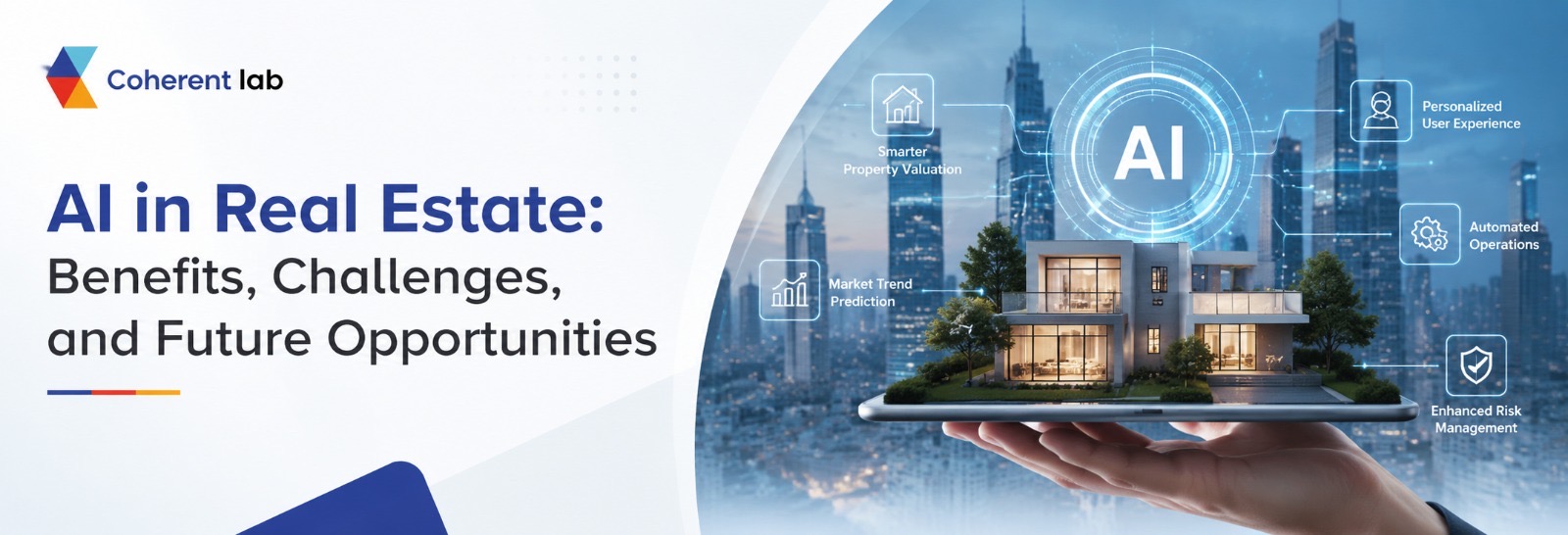
Artificial Intelligence (AI) is transforming the real estate industry by making property searches smarter, improving valuation accuracy, automating customer interactions, and enabling better investment decisions. Real estate companies, brokers, investors, and property managers are adopting AI-powered solutions to analyze large amounts of data, predict market trends, automate repetitive tasks, and deliver personalized experiences.
Technologies such as machine learning, predictive analytics, natural language processing (NLP), computer vision, and generative AI are helping businesses improve efficiency, reduce costs, and increase profitability. From AI-based property recommendations and virtual tours to automated valuation models and smart building management, artificial intelligence is creating new opportunities across residential and commercial real estate.
What Is AI in Real Estate and How Does It Work?
AI in real estate refers to the use of artificial intelligence technologies to automate and optimize property-related processes such as buying, selling, renting, valuation, marketing, and management. AI systems analyze historical data, customer behavior, market conditions, and property information to provide accurate predictions and smarter recommendations.
Role of Artificial Intelligence in Modern Real Estate
Artificial intelligence helps real estate businesses make faster and more accurate decisions by identifying patterns in property data. AI can analyze buyer preferences, predict property demand, automate communication, and improve customer engagement. This allows agents and companies to focus on strategic activities while AI handles time-consuming tasks.
AI Technologies Transforming the Real Estate Industry
Several advanced technologies power AI solutions in real estate, including machine learning for predictions, natural language processing for customer support, computer vision for property analysis, and predictive analytics for market forecasting. These technologies help create intelligent platforms that improve the overall property experience.
How AI Is Transforming the Real Estate Industry
AI is changing how properties are searched, valued, marketed, and managed. Traditional real estate processes often depend on manual research and human estimates, while AI-driven systems use real-time data analysis to provide faster and more accurate results.
AI-Powered Property Search and Personalized Recommendations
AI improves property searches by understanding buyer preferences such as budget, location, lifestyle needs, and previous searches. Intelligent recommendation systems suggest relevant properties, helping buyers find suitable options faster.
Benefits of AI property search include:
- Personalized property recommendations
- Smart search filters based on user preferences
- Faster matching between buyers and sellers
- Improved customer satisfaction
AI-Driven Property Valuation and Price Prediction
AI-powered valuation models analyze historical sales data, market trends, location factors, property features, and economic conditions to estimate accurate property prices.
AI property valuation helps businesses:
- Determine competitive pricing
- Reduce valuation errors
- Support better negotiations
- Identify market opportunities
Predictive Analytics for Real Estate Market Trends
Predictive analytics uses AI algorithms to forecast future market movements, property demand, rental trends, and investment opportunities. Real estate companies can use these insights to make better decisions and reduce financial risks.
AI Chatbots and Virtual Assistants for Customer Engagement
AI chatbots provide instant customer support by answering property inquiries, scheduling visits, and assisting buyers throughout the purchasing journey. Virtual assistants improve response time and provide 24/7 support.
Key AI Technologies Used in Real Estate
AI technologies work together to improve property operations, customer experiences, and investment decisions.
Machine Learning for Property Analysis and Forecasting
Machine learning algorithms identify patterns from large datasets to predict property prices, buyer behavior, and market trends. These models continuously improve as more data becomes available.
Natural Language Processing for Real Estate Customer Support
Natural Language Processing (NLP) allows AI systems to understand human language. Real estate businesses use NLP-powered chatbots to answer customer questions, process requests, and provide personalized assistance.
Computer Vision for Property Image Analysis
Computer vision analyzes property images and videos to identify features, evaluate property conditions, and improve virtual property tours. It helps buyers explore properties remotely and supports automated listing management.
Generative AI for Real Estate Automation
Generative AI helps create property descriptions, marketing content, reports, and customer communications. It reduces manual work and allows real estate companies to produce content faster.
Benefits of AI in Real Estate
AI provides multiple advantages for real estate companies by improving efficiency, reducing costs, and supporting data-driven decision-making.
Faster Property Transactions and Automated Workflows
AI automates paperwork, document processing, lead management, and communication workflows. This reduces delays and helps buyers and sellers complete transactions faster.
Improved Customer Experience Through AI Solutions
AI provides personalized recommendations, instant responses, and seamless digital experiences. Customers can receive property information anytime through chatbots and virtual assistants.
Better Real Estate Investment Decisions Using Predictive Analytics
AI analyzes market trends, rental income potential, and property performance to help investors identify profitable opportunities and manage risks effectively.
Reduced Operational Costs Through AI Automation
Automation reduces the need for repetitive manual tasks such as lead qualification, scheduling, reporting, and property monitoring. This improves productivity and lowers business expenses.
Challenges of Implementing AI in Real Estate
Although AI offers significant benefits, businesses must overcome several challenges before successful adoption.
Data Privacy and Cybersecurity Concerns
AI systems require large amounts of customer and property data. Companies must implement strong security measures to protect sensitive information and maintain customer trust.
High AI Implementation Costs
Developing and integrating AI solutions may require investment in software, infrastructure, and skilled professionals. Businesses need a clear strategy to achieve long-term returns.
Algorithm Bias and Data Quality Issues
AI predictions depend on the quality of available data. Incorrect or incomplete data can lead to inaccurate results and biased decisions.
Integration Challenges with Existing Real Estate Systems
Many companies use traditional software systems that may not easily connect with modern AI platforms. Proper planning is required for smooth integration.
AI Applications in Residential Real Estate
AI is improving residential property buying, selling, renting, and management processes.
Smart Property Recommendations for Home Buyers
AI analyzes user preferences and recommends homes that match budget, location, and lifestyle requirements.
Virtual Tours and AI-Powered Home Search
AI-powered virtual tours allow buyers to explore properties remotely, saving time and improving accessibility.
AI-Based Mortgage and Financing Assistance
AI tools help analyze financial information, estimate loan eligibility, and simplify mortgage processes.
AI Applications in Commercial Real Estate
AI is also transforming commercial properties through smarter management and investment analysis.
AI-Based Property Management and Tenant Analytics
AI helps property managers monitor tenant behavior, predict maintenance needs, and improve building operations.
Smart Building Management and Energy Optimization
AI-powered systems analyze energy usage, occupancy patterns, and equipment performance to reduce costs and improve sustainability.
Real Estate Portfolio Analysis Using AI
Investors use AI analytics to monitor property performance, evaluate risks, and optimize real estate portfolios.
Essential Features of AI Real Estate Solutions
Modern AI real estate platforms include advanced features that improve business performance and customer experiences.
Automated Property Valuation Models
AI valuation systems provide quick property price estimates using market data and property information.
Intelligent Lead Scoring and Customer Segmentation
AI identifies high-potential buyers and groups customers based on preferences and behavior.
Predictive Analytics Dashboards
AI dashboards provide real-time insights into market trends, sales performance, and investment opportunities.
AI-Powered Real Estate Chatbots
Chatbots provide instant customer assistance and automate communication throughout the property journey.
Future Opportunities of AI in Real Estate
The future of AI in real estate will bring smarter, faster, and more connected property experiences.
AI-Driven Smart Cities and Urban Planning
AI will support smart city development by analyzing traffic patterns, infrastructure needs, energy consumption, and land utilization.
Digital Twins for Intelligent Building Management
Digital twins create virtual models of buildings that help monitor performance, predict maintenance needs, and improve efficiency.
AI and Blockchain Integration for Secure Property Transactions
Combining AI with blockchain can improve transaction security, ownership verification, transparency, and fraud prevention.
Autonomous Buildings and Predictive Maintenance
Future buildings will use AI to automatically manage energy systems, detect issues, and optimize operations.
Best Practices for Implementing AI in Real Estate Businesses
Successful AI adoption requires proper planning, accurate data, and continuous improvement.
Build a Strong Data Strategy
Businesses should maintain clean, accurate, and secure data to achieve reliable AI results.
Choose the Right AI Real Estate Tools
Companies should select AI solutions based on business goals, scalability, and integration requirements.
Train Teams for AI Adoption and Optimization
Employee training helps organizations use AI effectively while maintaining human expertise in decision-making.
Conclusion: The Future of AI in Real Estate
AI is reshaping real estate by improving property search, valuation, customer engagement, investment analysis, and operational efficiency. While challenges such as data privacy, cost, and implementation complexity exist, the future opportunities are significant.
Real estate businesses that combine AI technology with human expertise will gain a competitive advantage through faster decisions, better customer experiences, and improved profitability. AI-powered smart cities, digital twins, predictive analytics, and blockchain integration will continue driving the next generation of intelligent real estate solutions.

 +91 774-202-1725
 +1 (945) 3387904
 business@coherentlab.com
 +49 15223341304
 UK
UK