Table of Contents
The Future of Video Editing: How AI Tools Like invideo Editor Are Changing the Industry
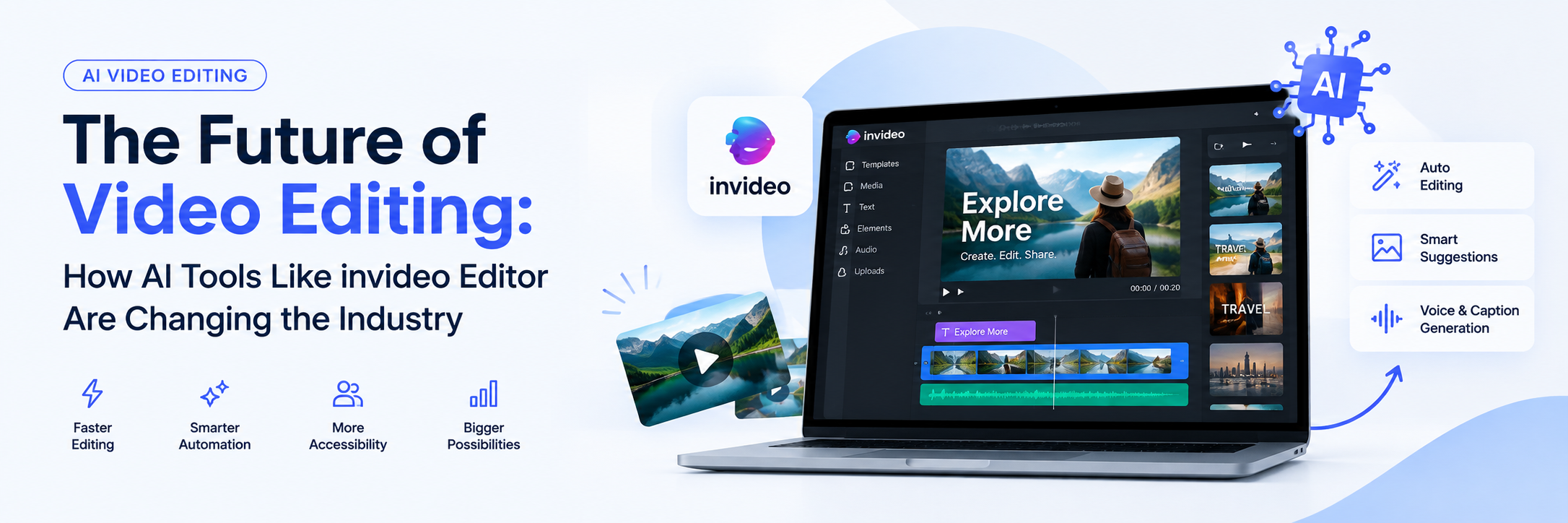
Video editing is entering a new era. Tasks that once required hours of manual work, technical knowledge, and complex software can now be completed much faster with AI video editing tools. From generating scenes and organizing footage to adding captions and refining content, artificial intelligence is changing how videos are produced.
For creators, marketers, startups, and businesses, this shift matters because it cuts down on repetitive work while making professional-quality video production accessible to people who aren't trained editors. Tools like invideo are a good example of where things are headed, they pair AI-assisted features with a full timeline editor, so users aren't just accepting whatever the AI generates. They can drop into the timeline, rearrange clips, fine-tune transitions, and adjust pacing exactly the way they would in a traditional editor, but with AI handling the heavy lifting upfront.
As generative AI continues to evolve, the future of editing is likely to focus less on repetitive manual tasks and more on ideas, storytelling, personalization, and creative decisions.
How AI Is Transforming Video Editing
Traditional video editing usually involves importing footage, reviewing clips, arranging them on a timeline, trimming scenes, adding transitions, creating subtitles, adjusting audio, and exporting the final video.AI can simplify several parts of this process. Modern AI tools for video editing can assist with tasks such as identifying important moments, generating captions, creating or modifying visual elements, improving audio, and speeding up repetitive editing work.
This doesn't necessarily remove the editor from the process. Instead, AI can act as an assistant that handles time-consuming tasks while the creator focuses on storytelling, brand consistency, pacing, and the overall quality of the video.
Why Creators Are Adopting AI-Powered Video Editing
The demand for video content continues across social media, advertising, education, product marketing, and business communication. Producing enough content manually can be challenging, especially for small teams.
AI-powered video editing can help creators:
- Reduce time spent on repetitive editing tasks
- Produce videos more efficiently
- Simplify complex editing workflows
- Create multiple versions of content
- Focus more time on creative decisions
What Is invideo Editor and How Does It Work?
invideo Editor is built around a real, professional timeline, not a stripped-down tool wrapped around an AI chat box. It's a browser-based, multitrack editor where every clip, caption, and sound sits on a track you can rearrange by hand, the same way you would in a desktop NLE. What makes it different is that you can assign editing work to AI agents directly on that timeline, in plain language, and they hand back a cut you're still free to edit frame by frame.
A few things stand out. The agents can watch your raw footage (not just a transcript) and handle jobs like building a first assembly from your best takes, cutting out silences and filler words, syncing multicam angles, and even cutting to the beat of a music track. If you have a video you like the pacing of, you can point the agents at it as a reference and they'll apply a similar structure to your own footage.
None of this locks you out of manual control; every AI-driven change lands on a frame-accurate timeline with keyframes, Bezier easing curves, a full color-grading suite (wheels, curves, LUTs, waveform scope), and a built-in audio mixer with separate tracks for voice, music, and effects.
Instead of manually handling every repetitive step, creators can hand off the time-consuming parts — logging footage, assembling a rough cut, removing dead air, matching a color grade, and then step in to fine-tune tone, pacing, and story.
This combination is what actually removes the technical barrier associated with traditional editing software: beginners get a usable first cut without learning an NLE from scratch, while experienced editors still get the frame-level control they're used to, plus the option to export an editable project straight into Premiere Pro, Final Cut Pro, or DaVinci Resolve if they want to finish elsewhere.
Key Benefits of AI Tools for Video Editing
AI video editing tools make content creation faster, easier, and more accessible. They automate repetitive tasks such as trimming, captions, transitions, audio enhancement, and scene selection. Creators can produce professional-looking videos with less technical expertise, while production teams can manage multiple projects efficiently. These tools also support creative experimentation, helping businesses, marketers, and individuals turn ideas into engaging video content.
| Key Benefit | How AI Video Editing Helps | Who Benefits |
|---|---|---|
| Faster Video Production | Automates repetitive editing tasks, helping creators turn raw footage into a usable first version more quickly. | Creators, marketers, production teams |
| Easier Editing for Beginners | Features like automatic transcription and text-based editing allow users to modify videos without mastering complex editing software. | Beginners, marketers, educators, entrepreneurs |
| Scalable Content Creation | Automatically adapts videos into vertical, square, and portrait formats while keeping the main subject in frame. | Businesses, social media teams, content creators |
| Agentic Video Editing | AI agents can handle multiple editing tasks, including reviewing footage, building timelines, removing pauses, and making revisions based on feedback. | Professional editors, creators, marketing teams |
| Connected Workflows | AI can support multiple stages, from ideation and production to editing and content repurposing, while users remain in control. | Businesses, agencies, creative teams |
Faster Video Production
AI can shorten parts of the editing process that normally require repetitive manual work. This can help creators move from raw content to a usable first version more quickly.
Easier Editing for Beginners
Professional editing software has a real learning curve. InVideo Editor cuts through that by transcribing your footage automatically; delete a sentence from the transcript, or type what you want changed, and the video trims itself to match.This lets marketers, entrepreneurs, educators, and content creators with limited editing experience participate more directly in video production, without learning a full NLE first.
Scalable Content Creation
Businesses often need different videos for Instagram, YouTube, ad campaigns, websites, product demos, and other platforms. With InVideo Editor, one edit can be reframed into vertical, square, or portrait formats automatically, keeping the subject in frame, making it easier to adapt content across channels without rebuilding every video from scratch.
Agentic video editing
Another shift worth watching is agentic video editing. Instead of using AI for a single task, you work with an AI agent that can take on a whole chunk of the job: reviewing footage, building a timeline, cleaning up pauses, and adjusting the edit as you give it feedback.
You still set the direction. The agent handles more of the execution, so it can help across ideation, production, editing, and repurposing rather than one isolated step. As these tools improve, the workflow gets more connected, with you steering and the agent doing the legwork.
AI Video Editing Use Cases
The value of AI video editing becomes clearer when looking at practical applications.Businesses and creators can use AI-assisted editing for:
- Social media reels and short-form videos
- YouTube content
- Product demonstrations
- Digital advertisements
- Educational videos
- Marketing campaigns
- Corporate presentations
- Explainer videos
- Short films and independent filmmaking
- Documentary and interview-based projects
- Multicam shoots (weddings, events, live performances)
- Trailers and highlight reels cut to music
Future Trends in Video Editing Technology
The next stage of AI editing is likely to move beyond individual automated features toward more intelligent and connected creative workflows.Several future trends in video editing technology are already shaping this direction.
AI Editing Agents and Automation
AI systems may become increasingly capable of handling multi-step editing tasks based on natural-language instructions.
Instead of adjusting every element manually, a creator could describe the intended result and use AI to generate an initial edit before making detailed changes.
This could make automated video editing more conversational and accessible.
Generative AI in Video Production
Generative AI is expanding beyond text and images into video creation.
Future editing platforms may combine generation and traditional editing more closely, allowing creators to generate scenes, modify existing elements, test different concepts, and refine content within a unified workflow.
This could make generative AI video editing an increasingly important part of professional content production.
Smarter Personalization and Creative Workflows
AI could also make video content more adaptable.
Businesses may be able to create different versions of a video based on audience, platform, language, campaign, or customer segment while maintaining consistent branding.
AI video editors such as invideo illustrate the broader direction of the industry: combining AI assistance with editable workflows rather than treating AI-generated output as the final step.
Will AI Replace Human Video Editors?
AI will probably help automate some of the technical editing tasks, yet video editing requires a lot more than just clipping videos. Effective videos require storytelling skills, emotional intelligence, rhythm, understanding of one’s audience and brand, all ad which require creativity and judgment – something that cannot be easily replaced by an automated system.
The true power of AI here does not lie in eliminating human judgment from the process; rather, it lies in safeguarding the time for it. As soon as the routine tasks get automated, more time is freed up for decision-making processes. This is what we should look forward to: not fewer editors, but more meaningful work from them.
Frequently Asked Questions
1. Will AI replace video editors?
No. AI can speed up repetitive tasks like cutting, captioning, and organizing footage, but storytelling, pacing, and creative judgment still require a human editor.
2. Is AI video editing only useful for professionals?
No, AI video editing can also be helpful for anyone new to video editing, for marketing purposes, and even for small business owners.
3. Can AI tools create different video versions for different platforms?
Yes, many AI-based editors allow you to reframe and produce different versions of a video for platforms such as Instagram, YouTube, and TikTok without starting from scratch.
4. What tasks can AI handle in video editing?
AI can help with footage organization, caption generation, removal of unnecessary words, multicam sync, and creation of rough cuts.
5. Is there generative AI in video editing?
Yes, generative AI is increasingly being used in video editing to create and modify visual components and even voiceovers.

 +91 774-202-1725
 +1 (945) 3387904
 business@coherentlab.com
 +49 15223341304
 UK
UK