Table of Contents
How to Build an 8 Ball Pool Game Like Miniclip: Features & Tech Stacks
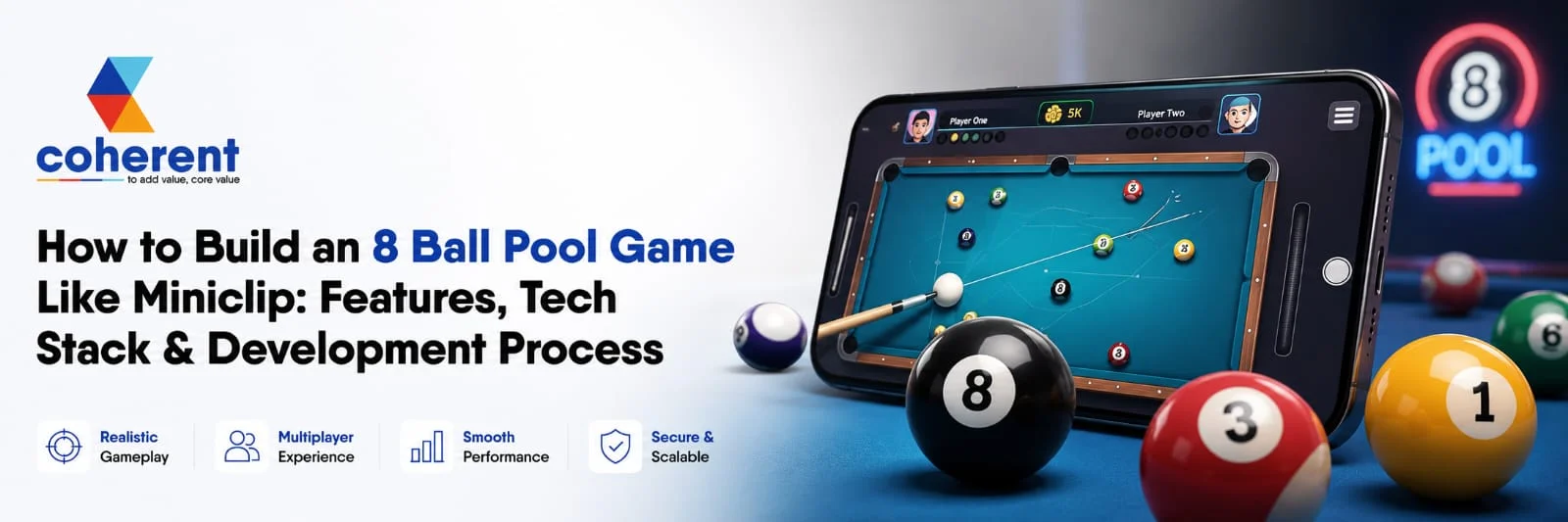
The success of Miniclip's 8 Ball Pool has transformed online billiards into one of the most popular multiplayer mobile gaming experiences worldwide. With millions of active players competing daily, the game has set a benchmark for realistic physics, smooth controls, engaging tournaments, and rewarding progression systems. Its popularity has inspired startups, gaming studios, and entrepreneurs to invest in developing similar skill-based multiplayer games that attract and retain players.
If you're planning to build an 8 Ball Pool game like Miniclip, understanding the complete development process is essential. From selecting the right game engine and technology stack to implementing real-time multiplayer, matchmaking, realistic ball physics, and monetization strategies, every decision plays a crucial role in the game's success.
In this guide, you'll learn everything you need to know about 8 Ball Pool game development, including must-have features, the best tech stack, estimated development costs, step-by-step development process, industry trends, common challenges, and best practices. Whether you're creating an MVP or a feature-rich multiplayer game, this comprehensive guide will help you build a scalable, engaging, and profitable pool game for Android, iOS, or cross-platform devices.
Key Takeaways
- Choose a powerful game engine such as Unity for faster cross-platform development.
- Realistic physics is the foundation of an engaging pool game.
- Multiplayer networking and low latency determine player satisfaction.
- Reward systems and tournaments increase long-term retention.
- Secure matchmaking and anti-cheat systems are essential.
- Monetization should enhance—not interrupt—the gaming experience.
- Regular updates keep players engaged and improve app ratings.
- Selecting an experienced game development company reduces technical risks.
How do you build an 8 Ball Pool game like Miniclip?
Building an 8 Ball Pool game involves designing realistic gameplay mechanics, selecting the right game engine, implementing multiplayer networking, integrating accurate physics, creating engaging UI/UX, developing a secure backend, testing across devices, and launching with a scalable monetization strategy. The right development team can significantly reduce development time while ensuring a high-quality gaming experience.
Why Are 8 Ball Pool Games More Popular Than Ever?
The popularity of 8 Ball Pool games continues to grow as players seek competitive, skill-based, and social gaming experiences. With mobile gaming becoming more accessible, games like Miniclip's 8 Ball Pool attract millions of active users through realistic gameplay, multiplayer competition, rewards, and engaging progression systems, making them a profitable opportunity for game developers and businesses.
Also Read: How much does mobile game development cost in Hong Kong in 2026?
What Makes an 8 Ball Pool Game Truly Engaging?
A successful 8 Ball Pool game combines realistic physics, intuitive controls, real-time multiplayer, exciting tournaments, and rewarding progression systems. Features like customization, leaderboards, daily rewards, and social interactions enhance user engagement, improve retention, and encourage players to spend more time and money within the game ecosystem.
- Realistic cue ball movement
- Smooth aiming controls
- Ball spin and power adjustments
- Different game modes
- Practice mode
Choosing the Right Technology Stack
Selecting the right technology stack is crucial for building a scalable, secure, and high-performance 8 Ball Pool game. From choosing game engines like Unity to backend technologies, multiplayer networking solutions, and cloud infrastructure, every technology decision directly impacts gameplay quality, development speed, maintenance, and long-term scalability.
Step-by-Step Process to Build an 8 Ball Pool Game
Developing an 8 Ball Pool game requires a structured approach, beginning with market research and planning, followed by UI/UX design, game development services, multiplayer integration, backend development, testing, deployment, and ongoing updates. Following a systematic development process ensures better performance, smoother gameplay, and a successful product launch.
| Step | Development Stage | Description | Key Activities |
|---|---|---|---|
| Step 1 | Research the Market and Your Competitors | Study top 8 Ball Pool games, analyze competitors, understand player expectations, and identify market opportunities to build a strong development strategy. | • Analyze leading pool games • Identify user expectations • Discover market gaps |
| Step 2 | Plan Your Game Concept | Define your game objectives, target audience, gameplay modes, monetization strategy, and supported platforms to create a clear development roadmap. | • Game modes • Target audience • Revenue model • Platform selection |
| Step 3 | Design Intuitive UI and Player Experience | Create a user-friendly interface with responsive controls, attractive visuals, and seamless navigation to enhance player engagement. | • Lobby screen • Matchmaking interface • Cue customization • Shop design |
| Step 4 | Create Game Assets and Animations | Design high-quality game assets, animations, and visual effects that deliver a realistic and immersive pool gaming experience. | • Pool tables • Cue sticks • Ball animations • Visual effects |
| Step 5 | Build Realistic Game Physics | Implement accurate ball movement, collision detection, cue mechanics, spin effects, and friction simulation for realistic gameplay. | • Ball collision • Friction • Spin mechanics • Shot prediction |
| Step 6 | Develop Multiplayer Functionality | Add real-time multiplayer, matchmaking, private rooms, tournaments, and leaderboards for smooth online gameplay. | • Real-time synchronization • Matchmaking • Private rooms • Tournament system |
| Step 7 | Build the Backend | Develop a secure and scalable backend to manage authentication, player data, cloud storage, and game sessions efficiently. | • User authentication • Cloud storage • Leaderboards • Player profiles |
| Step 8 | Integrate Payments and Monetization | Implement secure payment systems, in-app purchases, virtual currency, subscriptions, and ads to generate revenue. | • In-app purchases • Coins • Premium subscriptions • Ads |
| Step 9 | Test Every Aspect of the Game | Conduct comprehensive testing to ensure performance, security, multiplayer stability, and device compatibility before launch. | • Performance testing • Security testing • Multiplayer testing • Device compatibility |
| Step 10 | Launch, Market, and Improve Continuously | Publish the game, promote it through marketing campaigns, gather user feedback, and release regular updates to maintain engagement. | • App Store Optimization (ASO) • User feedback • Seasonal updates • LiveOps strategy |
How Much Does It Cost to Build an 8 Ball Pool Game?
The cost of developing an 8 Ball Pool game depends on factors such as game complexity, multiplayer functionality, graphics quality, supported platforms, backend infrastructure, and development team expertise. Estimating costs early helps businesses plan budgets effectively while balancing features, quality, and return on investment.
- Game complexity
- Multiplayer infrastructure
- Physics engine
- Graphics quality
- Number of supported platforms
- Backend scalability
- Third-party integrations
- Team size
Also Read: 8 Ball Pool Game App Development Guide 2026
Benefits of Developing an 8 Ball Pool Game
Building an 8 Ball Pool game offers significant business advantages, including recurring revenue, global audience reach, and high user engagement. For players, it delivers competitive entertainment, social interaction, and rewarding gameplay, making it one of the most sustainable and profitable game categories in today's mobile gaming industry.
If you're looking for a reliable development partner, Coherent Lab LLP specializes in custom game development, delivering high-performance multiplayer games with cutting-edge technologies, scalable backend architecture, and end-to-end support from concept to post-launch maintenance.
|
|
|
|
|
|
|
|
|
|
|
|
|
|
|
|
|
|
|
|
|
|
|
|
|
|
|
Best Practices for Building a Successful Pool Game
Creating a successful pool game requires focusing on responsive gameplay, optimized performance, secure multiplayer infrastructure, engaging progression systems, and continuous content updates. Listening to player feedback, improving game balance, and maintaining reliable servers contribute to higher retention rates, positive reviews, and long-term business success.
Benefits for gaming startups
- High user engagement
- Recurring revenue
- Global market reach
- Strong retention
Benefits for established gaming businesses
- Portfolio expansion
- Brand recognition
- Higher player loyalty
- Long-term monetization
Benefits for players
- Competitive gameplay
- Social interaction
- Skill improvement
- Cross-platform access
Also Read: Board Game App Development in 2026: The Ultimate Step-by-Step Guide
Conclusion
Building an 8 Ball Pool game like Miniclip requires careful planning, the right technology stack, engaging features, and a well-defined development process. By understanding market trends, investing in quality development, and partnering with experienced professionals, businesses can create a successful multiplayer game that attracts players and generates long-term revenue.
Ready to turn your game idea into reality? Contact us today.to discuss your 8 Ball Pool game development project. Our experienced game developers can help you build a feature-rich, scalable, and high-performance multiplayer pool game tailored to your business goals, ensuring a seamless gaming experience and long-term success.
Frequently Asked Questions
Q1. How much does it cost to develop an 8 Ball Pool game like Miniclip?
Ans. The cost of developing an 8 Ball Pool game like Miniclip depends on the game's complexity, features, platforms, and development team. A basic MVP with essential gameplay and multiplayer functionality may cost between $20,000 and $50,000. A mid-level game with tournaments, leaderboards, and in-app purchases can range from $50,000 to $120,000. An advanced version featuring realistic physics, AI-powered matchmaking, custom cue collections, cross-platform support, and cloud infrastructure may exceed $150,000. Additional expenses include UI/UX design, backend development, testing, maintenance, and post-launch updates, all of which contribute to long-term success and player retention.
Q2. How long does it take to build a multiplayer pool game from scratch?
Ans. Building a multiplayer 8 Ball Pool game typically takes 4 to 10 months, depending on the project's scope and complexity. A minimum viable product (MVP) with core gameplay and online multiplayer can be developed within four to six months. More advanced games featuring tournaments, player rankings, customization, live events, and cross-platform compatibility may require eight to ten months or longer. The timeline includes market research, game design, development, multiplayer integration, backend setup, testing, deployment, and optimization. Working with an experienced game development company and following an agile development approach can significantly reduce delays and improve overall quality.
Q3. Which game engine is better for developing an 8 Ball Pool game Unity or Unreal Engine?
Ans. Both Unity and Unreal Engine are excellent choices, but Unity is generally preferred for mobile-first 8 Ball Pool games. Unity offers faster development, excellent cross-platform support, a powerful physics engine, and a large ecosystem of tools and plugins. It is also cost-effective for startups and businesses targeting Android and iOS. Unreal Engine excels in delivering high-end graphics and advanced visual effects, making it suitable for premium gaming experiences. Your choice should depend on your project goals, budget, target devices, and desired visual quality, although Unity remains the industry favorite for multiplayer mobile sports games.
Q4. What features should an online 8 Ball Pool game include to compete with Miniclip?
Ans. To compete with Miniclip, your game should include realistic ball physics, intuitive controls, real-time multiplayer matches, skill-based matchmaking, tournaments, leaderboards, daily rewards, and player progression systems. Social features such as friend challenges, chat, clubs, and achievements enhance engagement. Monetization options like premium cue sticks, virtual currency, subscriptions, and rewarded ads help generate revenue without disrupting gameplay. Security features, including anti-cheat systems and secure authentication, are equally important. Cross-platform compatibility, cloud saves, regular seasonal events, and personalized experiences also improve player retention and keep your game competitive in the growing multiplayer gaming market.
Q5. How do real-time multiplayer and matchmaking work in billiards games?
Ans. Real-time multiplayer allows players from different locations to compete simultaneously using internet-based networking technologies such as Photon, Mirror, or PlayFab. The game continuously synchronizes player actions, cue movements, and ball physics between connected devices while minimizing latency. Matchmaking systems automatically pair players based on factors like skill level, ranking, region, or connection quality to ensure fair competition. Dedicated servers or cloud infrastructure manage game sessions, player profiles, and rankings securely. Efficient networking, optimized latency, and anti-cheat measures are essential to provide smooth gameplay and maintain a competitive, enjoyable experience for all players.
Q6. How can I monetize an 8 Ball Pool game without affecting user experience?
Ans. The best monetization strategy balances revenue generation with player satisfaction. Offer optional in-app purchases such as premium cue sticks, exclusive table designs, avatars, and virtual currency rather than forcing players to pay. Rewarded video ads allow users to earn coins or bonuses voluntarily, creating a positive experience. Premium memberships, battle passes, seasonal events, and cosmetic upgrades provide additional revenue opportunities without disrupting gameplay. Avoid excessive advertisements or pay-to-win mechanics, as these can reduce player retention. A well-balanced monetization model encourages long-term engagement while maximizing lifetime customer value and overall profitability.
Q7. What technologies are required to build a cross-platform pool game for Android and iOS?
Ans. Developing a cross-platform 8 Ball Pool game requires a combination of modern game development technologies. Unity is widely used for creating games for Android and iOS from a single codebase. Programming languages like C# support game logic, while multiplayer networking platforms such as Photon or Mirror enable real-time gameplay. Backend services using Node.js, Firebase, or .NET manage authentication, player data, and leaderboards. Databases such as MongoDB or PostgreSQL store user information securely. Cloud platforms like AWS or Google Cloud provide scalable infrastructure, while analytics tools monitor performance and player engagement after launch.
Q8. How do I choose the best 8 Ball Pool game development company for my project?
Ans. Selecting the right game development company requires evaluating its experience, technical expertise, and portfolio of multiplayer games. Review previous projects to assess gameplay quality, graphics, multiplayer functionality, and user experience. Ensure the company has expertise in Unity, backend development, cloud infrastructure, and real-time networking technologies. Ask about their development process, communication practices, testing approach, post-launch support, and maintenance services. Transparent pricing, flexible engagement models, and positive client reviews are also important indicators. Choosing a reliable development partner helps reduce project risks, accelerate delivery, and ensures your 8 Ball Pool game meets modern industry standards and business goals.

 +91 774-202-1725
 +1 (945) 3387904
 business@coherentlab.com
 +49 15223341304
 UK
UK