Table of Contents
How to Build a SaaS Product from Scratch in 2026
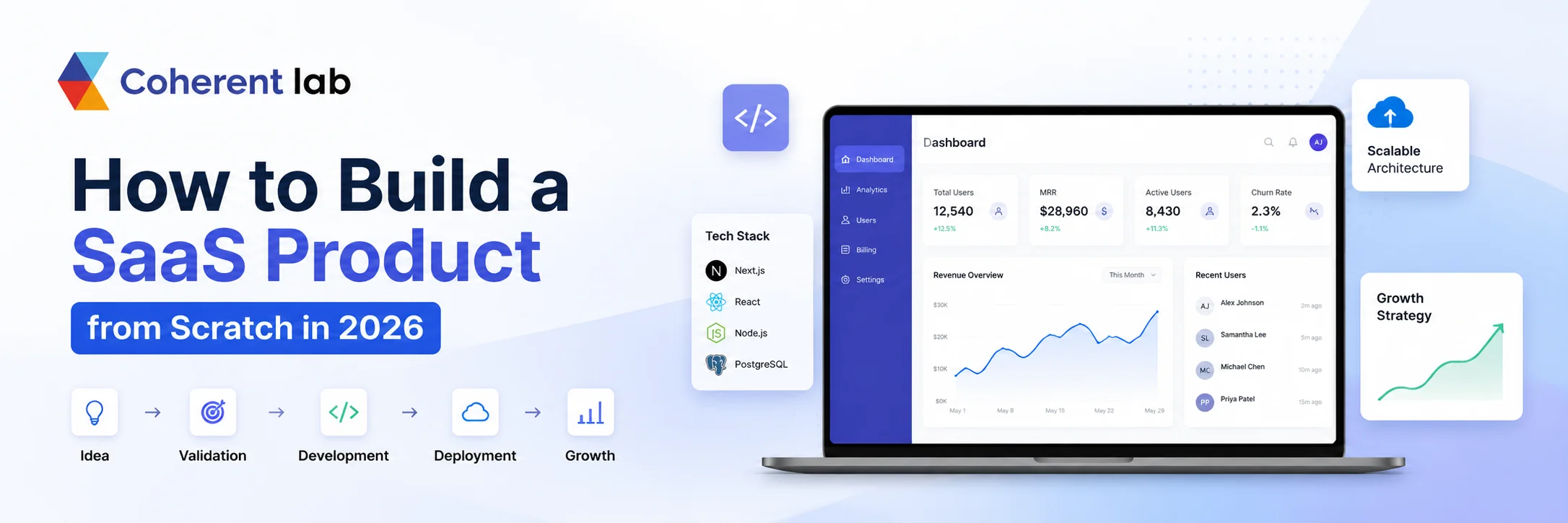
The SaaS industry is growing faster than ever in 2026. Businesses across healthcare, fintech, eCommerce, education, logistics, and AI automation are investing heavily in cloud-based software solutions to improve efficiency, reduce operational costs, and scale globally. From AI-powered CRMs to workflow automation tools, SaaS products are transforming how modern businesses operate. However, building a successful SaaS product requires more than just a great idea. You need the right SaaS development strategy, market validation, scalable technology stack, user-friendly UI/UX, cloud infrastructure, and SEO-driven marketing plan to compete in today’s crowded digital landscape. In this guide, you’ll learn how to build a SaaS product from scratch in 2026 using the latest SaaS trends, AI technologies, and growth strategies that help startups launch faster and scale successfully.
Understanding the SaaS Business Model
The SaaS (Software as a Service) business model delivers Software Development online on a subscription basis. Users can access the tools through web browsers, so they don’t need to install and maintain any software locally. It enables scalability, subscription revenue and cheaper upfront expenses for consumers. SaaS firms manage the updates, security and infrastructure, so it’s efficient for businesses to concentrate on growth with the help of flexible, cloud-based digital solutions.
What is a SaaS Product?
A SaaS (Software as a Service) product is cloud-based software that users access through the internet instead of downloading and installing it locally. SaaS applications operate on subscription-based pricing models and provide continuous updates, scalability, and remote accessibility.
- CRM software
- Project management tools
- AI automation platforms
- Accounting software
- Marketing automation tools
Why SaaS is Growing Rapidly in 2026
- AI-powered business automation
- Increased remote work adoption
- Rising demand for cloud computing
- Subscription-based business models
- Scalable enterprise solutions
Validate Your SaaS Product Idea
Before investing your time and resources into your SaaS product idea, you need to validate it. It helps you to check the market demand, analyse customer demands and find possible gaps in the sector. MVP testing and competitive analysis, surveys are ways to help you improve your idea and reduce risk. A thorough validation process results in a higher chance of success and makes sure your SaaS service provides real value to clients.
Identify a Real Market Problem
The first step in SaaS product development is solving a genuine business problem. Successful SaaS startups focus on pain points that affect productivity, communication, customer engagement, or workflow management.
- Analyze competitors
- Study customer frustrations
- Explore niche markets
- Research trending SaaS industries
- Identify gaps in existing solutions
Conduct SaaS Market Research
Strong market research helps you understand customer behavior and industry demand. `1Effective SaaS market research methods include:
- SEO keyword research
- Competitor analysis
- Reddit and community discussions
- Product review analysis
- User surveys and interviews
Plan Your SaaS MVP
Planning your SaaS MVP is the key to turn your idea into a scalable product, first of all. It helps you to see main features, target audience and company goals clearly. Prioritising key functionality decreases development time and costs. With a well-planned MVP, you can evaluate market demand, get user input and develop your product for long-term success and growth
What is an MVP in SaaS Development?
An MVP (Minimum Viable Product) is the simplified version of your SaaS application with only essential features. It helps startups launch quickly, collect real user feedback, and reduce development costs.
- Core functionality
- User experience
- Scalability
- Fast deployment
Essential SaaS MVP Features
- User registration and login
- Dashboard functionality
- Subscription billing system
- Payment gateway integration
- Notifications and alerts
- Admin panel
- Customer support features
Choose the Right Tech Stack for SaaS Development
Selecting the correct tech stack is essential for designing scalable, secure, and high-performing apps for SaaS development. This is why organisations should choose the correct mix of frontend, backend, database, and cloud technologies that meet the specific objectives of the project. A good stack accelerates development, reduces costs, and gives long-term flexibility, enabling organisations to provide seamless user experiences and compete sustainably in global marketplaces. At Coherent Lab, we help businesses choose and implement the most effective SaaS technology stack to build future-ready digital solutions.
Frontend Technologies
Modern SaaS applications require responsive and fast user interfaces. Popular frontend technologies include:
- React.js
- Next.js
- Vue.js
- Tailwind CSS
Backend Technologies
The backend powers your SaaS infrastructure and business logic. Top backend technologies for SaaS development:
- Node.js
- Python
- Django
- Laravel
- Express.js
Database and Cloud Infrastructure
Reliable infrastructure is critical for SaaS scalability. Best database solutions:
- PostgreSQL
- MongoDB
- Firebase
- AWS
- Google Cloud
- Microsoft Azure
Why AI-Powered SaaS is Dominating in 2026
AI integration has become one of the biggest SaaS trends in 2026. Businesses now expect intelligent automation, predictive analytics, and personalized experiences from software platforms.
AI features can include:
- AI chatbots
- Smart recommendations
- Workflow automation
- Predictive analytics
- AI-generated insights
Design a User-Friendly SaaS Application
A SaaS application is easy to work with, easy to learn and easy to navigate. The user interface is clean, the layout is simple and the design is responsive so users can quickly acquire functions without confusion. It is all about user experience, seamless onboarding, and quick performance to keep the engagement and retention. All users benefit from the SaaS solution being more efficient, scalable and pleasurable through smart workflows, regular feedback and little complexity.
Importance of SaaS UI/UX Design
Even powerful software can fail if the user experience is poor. A clean and intuitive design increases customer retention and product adoption.
- Simple navigation
- Mobile responsiveness
- Fast loading speed
- Interactive onboarding
- Clear dashboard layouts
Build Your SaaS Product
Build your SaaS Solution, with a scalable, secure, and user-friendly way to boost your business growth. We help you build powerful, modern market-expectations-ready cloud solutions from ideation and validation to development and implementation. Our SaaS application development methodology delivers flexibility, performance and a smooth user experience which enables startups and organisations to launch faster and grow efficiently in the digital age.
Use Agile SaaS Development
Agile development helps SaaS teams build products faster and improve continuously. Benefits of Agile methodology:
- Faster feature releases
- Better team collaboration
- Continuous testing
- Easier scalability
- Improved product quality
SaaS Security Best Practices
Security is one of the most important factors in SaaS development. Protect your application using:
- Data encryption
- Two-factor authentication
- Secure APIs
- GDPR compliance
- Role-based access control
Test and Launch Your SaaS Product
Testing and deploying your SaaS product is a crucial procedure to make sure that performance, security and user experience are properly fine-tuned before release. It’s about detecting problems, validating features and receiving input to improve functionality. A good launch helps to attract consumers, build confidence and establish a strong market presence successfully for long-term business growth and scalability and sustainable profitability over time.
Perform Comprehensive SaaS Testing
Before launch, test your SaaS product thoroughly to ensure performance and stability.
- Functional testing
- Security testing
- Load testing
- Mobile responsiveness testing
- Cross-browser compatibility testing
Create a SaaS Launch Strategy
A successful SaaS launch requires strong marketing and SEO planning. Effective SaaS launch strategies:
- SEO optimization
- Product Hunt launch
- LinkedIn marketing
- Content marketing
- Influencer outreach
- Email campaigns
Scale Your SaaS Business
Scaling a SaaS business requires a lot of focus on product innovation, customer retention and marketing strategies that work. Automate, scale your user base and increase recurring revenue with cloud infrastructure and data-driven decisions. SaaS solution platforms that are scalable and that draw on continuous improvement, user input and strategic alliances enable sustainable development and long-term success in a competitive digital marketplace.
Focus on Customer Retention
Retaining customers is more profitable than acquiring new ones.
Ways to improve SaaS retention:
- Personalized onboarding
- Fast customer support
- AI-powered automation
- Continuous feature updates
- User engagement campaigns
SaaS Growth Strategies for 2026
- International expansion
- Affiliate marketing
- Enterprise partnerships
- API integrations
- Automation systems
Common SaaS Startup Mistakes to Avoid
Many SaaS firms die due to avoidable faults like bad market research, imprecise value proposition, poor product-market fit. Other common faults are not listening to the consumer, over-building functionality and under-budgeting for marketing. The bad pricing approach and the lack of scalability also hindered growth. By avoiding these traps, companies can build successful, user-centric and sustainable SaaS businesses in a competitive market.
Building Too Many Features
Many startups fail by overcomplicating their product. Focus on solving one major problem effectively before expanding features.
Ignoring Customer Feedback
User feedback is essential for SaaS growth. Continuously improve your product based on customer behavior and reviews.
Weak SEO and Marketing
- SaaS SEO
- Content marketing
- GEO optimization
- Social media marketing
- Conversion optimization
Future of SaaS Development in 2026
SaaS development will be driven by low-code platforms, hyper-personalized user experiences, and AI integration in 2026. More and more companies are turning to cloud-native architectures due to their scalability, security and quick deployment. Automation and data-driven insights are making SaaS products smarter, more effective, and more cost-effective. This allows organisations to stay ahead of changing customer expectations in a competitive global digital landscape.
The future of SaaS will revolve around:
- AI-native applications
- No-code and low-code development
- Vertical SaaS solutions
- Hyper automation
- Micro SaaS startups
Final Thoughts
Building a SaaS product from scratch in 2026 requires a combination of smart planning, scalable development, AI integration, and strong digital marketing. The most successful SaaS startups focus on solving real business problems while delivering exceptional user experiences. Start with a validated idea, launch a lean MVP, use modern cloud technologies, and continuously improve based on customer feedback. With the right SaaS development strategy and SEO-focused growth plan, your product can generate recurring revenue and scale globally in today’s competitive digital market. If you’re planning to build a scalable SaaS platform, now is the perfect time to invest in cloud-based software development and AI-powered business solutions. Contact us today to get started and turn your idea into a powerful digital product.
Frequently Asked Questions
Q. 1. How much does it cost to build a SaaS product in 2026?
Ans. The cost of SaaS product development depends on features, complexity, development team, and technology stack. A basic SaaS MVP may cost between $15,000 and $50,000, while advanced AI-powered SaaS platforms can exceed $100,000. Expenses usually include UI/UX design, frontend and backend development, cloud infrastructure, security implementation, API integrations, testing, and ongoing maintenance. Proper planning helps reduce unnecessary development costs and improves scalability for long-term business growth.
Q. 2. What is the best tech stack for SaaS development?
Ans. The best SaaS tech stack depends on project requirements and scalability goals. Popular frontend technologies include React.js, Next.js, and Vue.js, while Node.js, Python, Laravel, and Django are commonly used for backend development. PostgreSQL and MongoDB are reliable database solutions. For cloud hosting, businesses often choose AWS, Google Cloud, or Microsoft Azure. A modern SaaS tech stack should prioritize performance, security, scalability, automation, and smooth integration capabilities.
Q. 3. How long does it take to build a SaaS product?
Ans. Building a SaaS MVP typically takes 3 to 6 months depending on features, development complexity, and team size. More advanced SaaS applications with AI integration, automation, enterprise dashboards, and custom APIs may require 9 to 12 months or longer. The timeline also depends on testing, UI/UX design, cloud setup, and post-launch optimization. Agile SaaS development methods help businesses launch faster and improve continuously using customer feedback.
Q. 4. Why is AI important in SaaS products in 2026?
Ans. AI has become a major part of modern SaaS development because businesses want automation, personalization, and data-driven insights. AI-powered SaaS platforms can automate repetitive tasks, improve customer support, provide predictive analytics, and deliver personalized user experiences. Features like AI chatbots, recommendation systems, workflow automation, and intelligent reporting improve efficiency and customer satisfaction. In 2026, AI integration helps SaaS businesses stay competitive and increase long-term user retention significantly.
Q. 5. What are the biggest challenges in SaaS development?
Ans. Some of the biggest SaaS development challenges include scalability, security, customer retention, performance optimization, and competition. Startups also struggle with feature prioritization, cloud infrastructure costs, and user acquisition. Poor UI/UX design and weak SEO strategies can negatively affect growth. To overcome these challenges, SaaS businesses should focus on customer feedback, scalable architecture, strong cybersecurity practices, agile development methods, and long-term digital marketing strategies that improve online visibility and conversions.
Q. 6. How do SaaS companies generate recurring revenue?
Ans. SaaS companies usually generate recurring revenue through subscription-based pricing models. Customers pay monthly or yearly fees to access the software platform. Common pricing strategies include freemium plans, tiered subscriptions, usage-based pricing, and enterprise licensing. Recurring revenue provides predictable cash flow and long-term business stability. SaaS businesses increase revenue by improving customer retention, offering premium features, upselling advanced plans, and expanding their customer base through SEO and digital marketing.
Q. 7. How can SEO help grow a SaaS business?
Ans. SEO plays a critical role in SaaS growth by improving search engine visibility and generating organic traffic. SaaS SEO strategies include keyword optimization, technical SEO, content marketing, link building, and GEO optimization. Ranking for high-intent keywords helps attract targeted users actively searching for software solutions. High-quality blogs, landing pages, and educational content improve brand authority and lead generation. Strong SEO reduces customer acquisition costs and supports long-term scalable growth for SaaS businesses.

 +91 774-202-1725
 +1 (945) 3387904
 business@coherentlab.com
 +49 15223341304
 UK
UK