
Table of Contents
The Four CRM Features That Matter More Than Price
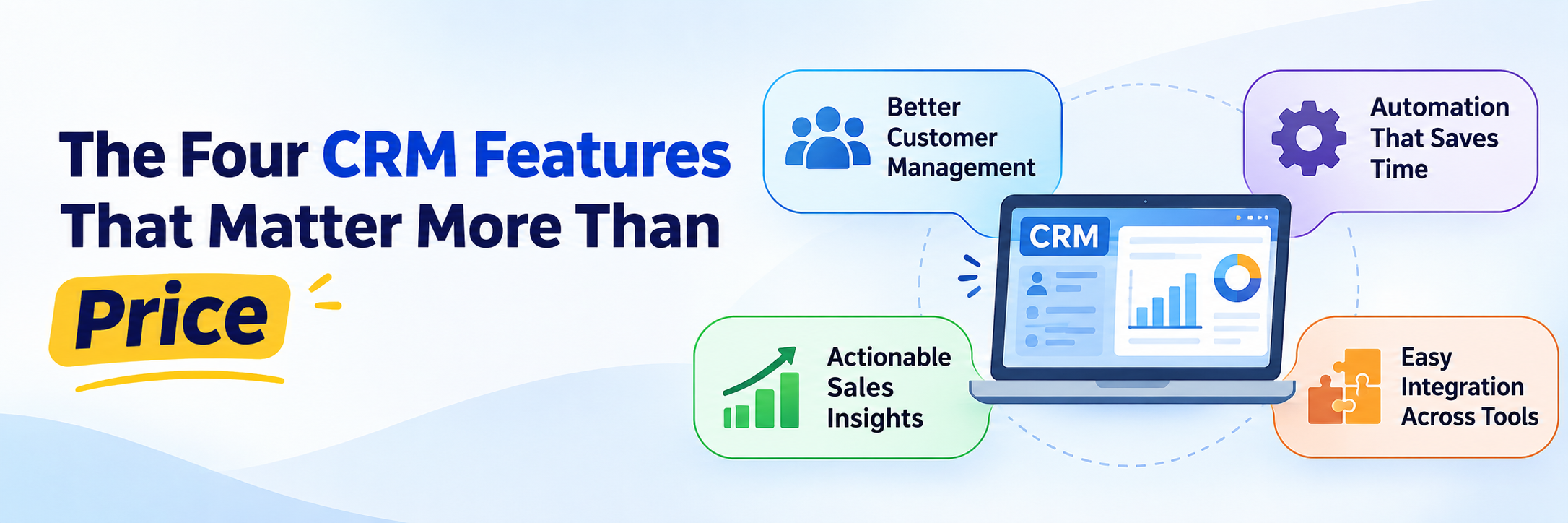
Nearly every team kicks off their CRM hunt by scrolling straight to the pricing page. They'll compare per-seat costs, weigh up annual discounts, skim through a feature matrix and go with whatever option looks easiest on the budget. Nobody can blame them for that, but it's also the reason so many CRM rollouts end up going sideways. Analyst estimates suggest that anywhere between 30% and 55% of CRM implementations miss their original targets, and Forrester research has pinned poor user adoption as the cause behind 43% of those failures.
The problem isn't that companies spend too much on the software, it's that they pick a platform based on price alone and then realise, a few months in, that it can't actually support the way their sales team works. Here are four features that will decide whether a CRM becomes a daily habit or just another tab nobody opens.
How Data Structure Shapes Everything Else
Your CRM's data model controls what you can track, how records connect to each other, what you can automate and how accurate your reports will look half a year from now. Rigid schemas that come pre-built will force teams to jam their sales process into someone else's logic, and the workarounds pile up quickly from there. Custom fields get layered on top of one another in ways that nobody planned for, duplicate records start creeping in, and before long your reports won't reflect what's actually happening.
Giving teams the ability to define their own objects, relationships and record types makes everything downstream work better. That lets the CRM reflect the way the business actually operates. When comparing platforms, review sites like GTM Tools rank CRMs on criteria like data modelling, workflow fit, integration depth and reporting flexibility, which tends to surface differences that pricing pages won't show you. That kind of side-by-side comparison can save weeks of back-and-forth demos.
Also read:Top Enterprise IT Consulting Companies in Dubai
Why Pipeline Visibility Breaks Down
Pipeline visibility seems like table stakes until you're stuck without it. A lot of CRMs default to a basic single-stage funnel view, which holds up fine when deals close fast, but it falls apart once cycles stretch longer or more stakeholders get pulled into the conversation. What usually happens next is that reps start exporting data into spreadsheets just to get a clear picture of where their deals actually stand.
Over time, the platforms that hold up will let you build custom pipeline stages, attach weighted forecasts, split views by rep or region and track deal velocity without having to bolt on extra tools. If a sales manager can't pull a reliable forecast straight from the CRM, the team will stop trusting the numbers inside it, and that's the point where adoption drops off hard.
Where Integrations Make or Break Adoption
Any CRM that doesn't connect to your email, calendar, marketing stack and billing system will create more admin than it removes. Reps end up toggling between tabs, copying data by hand, chasing down missing info and updating records after the fact. Each of those friction points gives someone one more excuse to skip the update altogether, and once people start skipping updates regularly the whole system goes out of date within weeks.
Strong native integrations and an open API aren't bonuses you can take or leave. They're what will keep data moving in and out of the CRM without anyone having to think about it, so your reps can spend their time actually selling instead of filling in fields that nobody reads.
Day-to-Day Usability Gets Overlooked Too Often
Speed, layout, search quality and click count all add up across a full sales team when someone needs to log a call or push a deal forward. If the interface is slow or cluttered, reps will dodge it. Most CRM evaluations skip usability entirely because you can't easily compare it on a spreadsheet the way you can with price or feature counts, but it's the single biggest factor in whether the tool sticks long-term.
Get trial access before you commit, and put your actual users on it, not just the ops lead who ran the procurement process. Have them test the workflows they'll run every day and pay close attention to what annoys them. A CRM that costs a bit more per seat but genuinely gets used across the team will deliver far more than a cheaper option that nobody logs into after the first month.
Also read:Top Enterprise IT Consulting Companies in London
What a CRM Decision Really Costs You
Price will always be part of the conversation, and nobody's saying you should ignore the budget entirely. But the real cost of a bad CRM choice shows up in wasted onboarding hours, abandoned data, frustrated managers and a sales team that quietly goes back to spreadsheets within a few months. That's what you're trying to avoid here.
Before you sign off on a platform, test it against the four areas above: data structure, pipeline visibility, integrations and usability. If it passes on all four, the per-seat price becomes an afterthought. If it doesn't, even the cheapest option on the market can end up costing more in the long run.
Final Thoughts
While price is a key consideration, focus on the features that will provide long-term value to your business when selecting CRM software. Customer relationship management, automation, integration, and reporting features are crucial for enhancing customer interactions and streamlining processes. At first glance, it sounds like a cheaper option, but a low-cost CRM might start to present problems when your company expands. Look for a solution that fits your organization's needs, enhances team productivity and will grow with them. These four key CRM capabilities can guide businesses in making informed investment decisions, enhancing customer interaction, and ensuring long-term growth.

 +91 774-202-1725
 +1 (945) 3387904
 business@coherentlab.com
 +49 15223341304
 UK

