Table of Contents
How to Build a Crypto Wallet Like Trust Wallet in 2026: Complete Development Guide
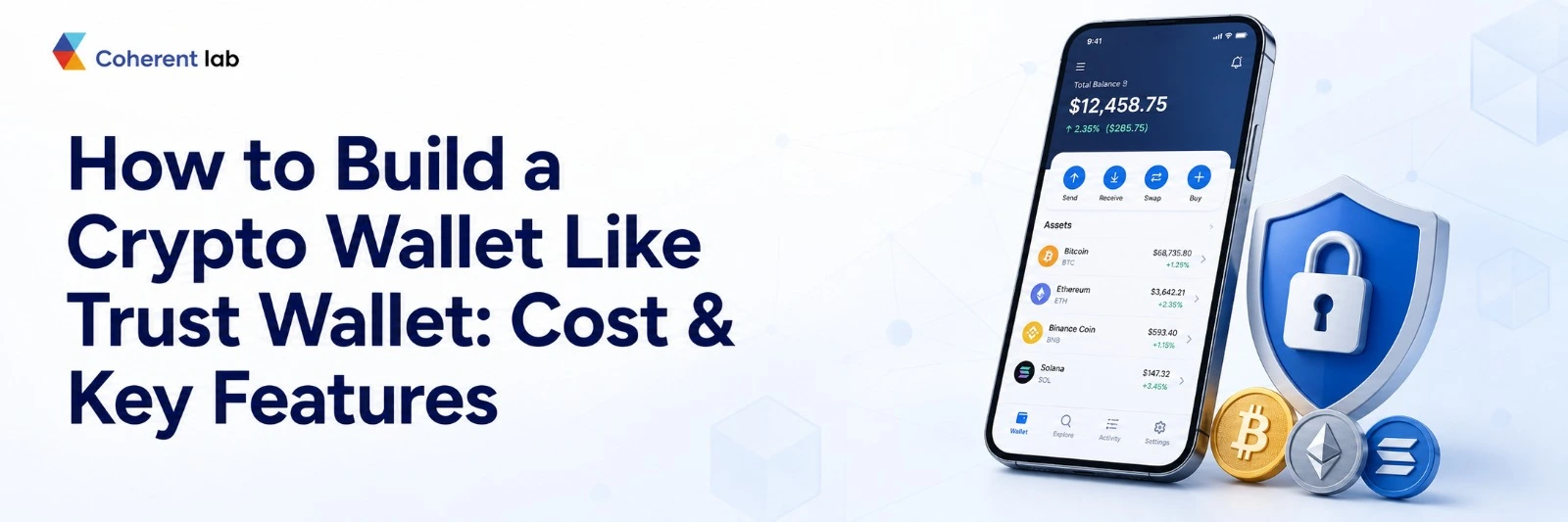
The crypto industry has moved far beyond simply buying and selling digital assets. Today, users want a secure and convenient way to store, send, receive, swap, stake, and manage cryptocurrencies from a single application. This growing demand has created strong opportunities for businesses looking to build a crypto wallet like Trust Wallet.
Trust Wallet is a popular example of a non-custodial crypto wallet that gives users control over their digital assets and supports a broad blockchain ecosystem.But building a successful crypto wallet is not simply about copying an existing application. A reliable wallet requires strong security architecture, blockchain integration, intuitive UX, scalable infrastructure, and careful compliance planning.
What Is a Crypto Wallet Like Trust Wallet?
A crypto wallet is a software application that allows users to interact with blockchain networks and manage their digital assets.A wallet generally does not store coins in the traditional sense. Instead, it manages the cryptographic keys that allow users to access assets recorded on blockchain networks.
- Cryptocurrency storage and management
- Sending and receiving crypto
- Token swaps
- Blockchain network support
- NFT management
Key Features of a Crypto Wallet Like Trust Wallet
Building a crypto wallet like Trust Wallet requires more than basic cryptocurrency storage. A successful wallet should combine strong security, multi-chain support, simple navigation, and useful Web3 functionality. These features help users manage digital assets, complete transactions, track portfolios, and interact with decentralized applications from one convenient platform.
1. User Registration and Wallet Creation
The onboarding experience should make wallet creation simple without compromising security. Users should have convenient options for creating, importing, or restoring wallets while maintaining complete control over sensitive recovery credentials and private keys.
- Create or import wallet
- Restore wallet securely
- Set PIN or password
- Enable biometric authentication
2. Multi-Currency Support
A modern multi-currency crypto wallet should support different blockchain networks and digital assets. Multi-chain functionality allows users to manage cryptocurrencies, tokens, stablecoins, and NFTs from a single application instead of switching between multiple wallets. Coherent Lab can help businesses build scalable, secure, and feature-rich blockchain and crypto wallet applications tailored to their specific business requirements.
- Support multiple blockchain networks
- Manage native cryptocurrencies
- Support ERC-20 and BEP-20 tokens
- Manage stablecoins and NFTs
3. Send and Receive Cryptocurrency
Sending and receiving crypto should be fast, transparent, and easy to understand. The wallet should clearly display addresses, networks, transaction amounts, and estimated fees before users confirm a blockchain transaction.
- Send and receive cryptocurrencies
- Scan wallet addresses with QR codes
- Select the correct blockchain network
- Track transaction status
4. Crypto Wallet Address Management
Effective address management makes cryptocurrency transactions easier and reduces avoidable mistakes. Users should be able to manage multiple wallet accounts, save frequently used addresses, and quickly verify destination information before completing transactions.
- Manage multiple wallet addresses
- Save trusted addresses
- Generate wallet QR codes
- Add labels to addresses
5. Real-Time Portfolio Tracking
A built-in crypto portfolio tracker gives users a clear overview of their digital assets. The dashboard can combine wallet balances, market prices, portfolio value, and asset performance to make cryptocurrency management more convenient.
- Display total portfolio value
- Track individual crypto balances
- Monitor token price changes
- View asset allocation
6. Crypto Swap
A built-in crypto swap feature allows users to exchange supported digital assets without leaving the wallet. Integrating decentralized exchanges, liquidity providers, or aggregators can provide convenient trading functionality and competitive exchange rates. For users who want to understand how crypto trading platforms work, you can also explore this guide on crypto exchanges.
- Display real-time swap rates
- Show network and transaction fees
- Configure slippage settings
- Maintain swap history
7. Staking
Staking functionality can allow users to participate in supported blockchain networks and potentially earn rewards. A well-designed staking interface should clearly explain available assets, validators, estimated rewards, staking periods, and unstaking conditions.
- Display supported staking assets
- Show estimated staking rewards
- Provide validator information
- Support staking and unstaking
8. NFT Wallet
An NFT wallet enables users to manage digital collectibles alongside their cryptocurrency holdings. Supporting NFT transfers, metadata, collections, and marketplace connectivity can make the wallet more valuable for users participating in the Web3 ecosystem.
- View NFT collections
- Send and receive NFTs
- Display NFT metadata
- Connect with NFT marketplaces
9. dApp Browser and Web3 Connectivity
Web3 connectivity allows users to interact with decentralized applications using their crypto wallet. This feature can connect users with DeFi platforms, NFT marketplaces, blockchain games, and other decentralized services.
- Connect with DeFi applications
- Access NFT marketplaces
- Support blockchain gaming
- Connect with Web3 applications
10. Transaction History
A detailed crypto transaction history helps users monitor wallet activity and verify blockchain transactions. The interface should organize transfers, swaps, staking activities, fees, and transaction statuses in an easy-to-understand format.
- View deposits and withdrawals
- Track swaps and staking transactions
- Display transaction fees
- Show blockchain transaction IDs
Read Also: How to Create a Successful Money Saving App Like Mint App: A Step-by-Step Guide
How to Build a Crypto Wallet Like Trust Wallet
Building a crypto wallet like Trust Wallet requires careful planning across blockchain development, mobile app development, security, backend infrastructure, and UX design. A successful wallet should begin with a focused business model and scalable architecture, then gradually add blockchain networks, Web3 integrations, security controls, testing, and post-launch improvements.
Step 1: Define Your Wallet Business Model
Before starting crypto wallet development, identify your target users, supported assets, wallet architecture, and revenue model. Decide whether you need custodial or non-custodial functionality and determine which features should be included in your MVP to control development time and cost.
- Identify target users and use cases
- Select supported cryptocurrencies and networks
- Choose custodial or non-custodial architecture
- Define monetization and MVP features
Step 2: Choose the Wallet Architecture
Choosing the right architecture directly affects security, scalability, compliance, and user experience. A non-custodial wallet gives users control over private keys, while a custodial wallet requires the platform to manage assets or credentials with stronger operational controls.
- Compare custodial and non-custodial models
- Plan secure key-management architecture
- Define recovery and authentication methods
- Consider compliance responsibilities
Step 3: Select Blockchain Networks
Choose blockchain networks according to your target audience and product requirements. Supporting Ethereum, Bitcoin, Solana, BNB Chain, Polygon, or Layer-2 networks can expand functionality, but every additional network increases development, testing, maintenance, and infrastructure requirements.
- Select networks based on user demand
- Evaluate blockchain transaction fees
- Consider RPC and node infrastructure
- Plan multi-chain scalability
Step 4: Design the UX/UI
Crypto applications should make complicated blockchain processes easy for everyday users. Design intuitive screens for onboarding, wallet creation, asset management, sending, receiving, swapping, NFTs, transactions, and security settings while clearly communicating fees and network information.
- Create simple onboarding flows
- Display network and transaction information
- Add confirmation screens for sensitive actions
- Use clear security warnings and error messages
Step 5: Develop the Wallet Core
The wallet core manages essential blockchain functionality, including key generation, wallet addresses, transaction signing, token balances, and network communication. For non-custodial wallets, private-key handling should follow a security-first architecture that minimizes unnecessary exposure of sensitive credentials.
- Implement secure key generation
- Generate and manage wallet addresses
- Add transaction signing
- Support balance and gas estimation
Step 6: Integrate Blockchain APIs and Nodes
Reliable blockchain connectivity is essential for retrieving balances, transaction data, network information, and broadcasting signed transactions. Depending on the product architecture, developers can use dedicated nodes, RPC providers, blockchain APIs, and indexing services.
- Integrate reliable blockchain RPC providers
- Connect blockchain APIs and nodes
- Add transaction broadcasting
- Monitor infrastructure reliability
Step 7: Add Exchange, Swap, and Web3 Integrations
Advanced wallet functionality can include crypto swaps, DeFi, Web3 connectivity, NFT marketplaces, price data, and fiat on-ramp services. Each third-party integration should be evaluated for API reliability, security, fees, performance, limitations, and regulatory considerations.
- Integrate DEX aggregators and liquidity providers
- Add Web3 and dApp connectivity
- Integrate price and NFT APIs
- Evaluate third-party security and reliability
Step 8: Implement Security
Security must be built into every layer of a cryptocurrency wallet app, rather than added after development. Protect sensitive credentials, secure communications, validate transactions, and conduct professional security testing before releasing the wallet to users.
- Use encrypted and secure key storage
- Implement biometric and PIN protection
- Protect APIs and user sessions
- Conduct security audits and penetration testing
Step 9: Test the Crypto Wallet
Comprehensive testing helps identify transaction failures, security vulnerabilities, compatibility issues, and performance problems before launch. Testing should cover wallet functionality, blockchain transactions, APIs, multiple devices, recovery processes, security, and high-load scenarios.
- Perform unit and integration testing
- Test blockchain transactions and APIs
- Conduct security and penetration testing
- Test recovery, performance, and multiple devices
Step 10: Launch and Continuously Improve
Launching a crypto wallet is only the beginning. After deployment, continuously monitor blockchain connectivity, transaction failures, application performance, security alerts, and user feedback. Regular updates help maintain reliability as blockchain networks, regulations, devices, and Web3 technologies evolve.
- Monitor transaction and API failures
- Track security alerts and application crashes
- Analyze user feedback and feature adoption
Also Read: Best Investment Apps: Invest Wisely for Financial Freedom
Recommended Technology Stack for Crypto Wallet Development
Choosing the right crypto wallet technology stack is essential for building a secure, scalable, and high-performance application. The stack should support blockchain integration, secure key management, real-time transactions, and cross-platform compatibility. Depending on project requirements, businesses can combine Flutter or native development with Node.js, secure databases, blockchain RPC providers, cloud infrastructure, and Web3 APIs.
| Layer | Technologies |
|---|---|
| Mobile App | Flutter, React Native, Swift, Kotlin |
| Android | Kotlin |
| iOS | Swift |
| Backend | Node.js, Go, Java |
| Database | PostgreSQL, MongoDB |
| Blockchain | Ethereum, Bitcoin, Solana, BNB Chain, Polygon |
| APIs | REST, GraphQL, RPC |
| Authentication | OAuth, Biometrics, Secure PIN |
| Cloud | AWS, Google Cloud, Azure |
| Security | Encryption, KeyStore, Secure Enclave |
| Web3 | WalletConnect, Blockchain SDKs |
| Testing | Postman, Automated Testing, Sec |
How Much Does It Cost to Build a Crypto Wallet Like Trust Wallet?
The cost to build a crypto wallet like Trust Wallet typically ranges from $25,000 to $200,000+, depending on features, supported blockchains, platforms, security requirements, and integrations. A basic MVP costs less, while advanced multi-chain wallets with swaps, staking, NFTs, Web3 connectivity, and enterprise-grade security require a larger investment. Development location and team expertise also affect the final cost.
| Wallet Type | Estimated Development Cost |
|---|---|
| Basic Crypto Wallet MVP | $25,000 – $50,000 |
| Multi-Currency Wallet | $50,000 – $100,000 |
| Advanced Multi-Chain Wallet | $100,000 – $200,000+ |
| Enterprise-Grade Wallet | $200,000 – $400,000+ |
Also read:Most Secure Blockchain Wallets in 2026 to Protect Your Digital Assets
Factors Affecting Crypto Wallet Development Cost
The final crypto wallet development cost depends on several technical, design, security, and business factors. Blockchain networks, supported platforms, wallet architecture, advanced features, UI/UX complexity, security requirements, and third-party integrations can significantly influence the overall budget, development timeline, maintenance expenses, and scalability of your cryptocurrency wallet application.
1. Number of Blockchain Networks
Supporting multiple blockchain networks increases development complexity because each ecosystem can have different transaction models, SDKs, APIs, fees, and technical requirements. A single-chain wallet generally requires less development effort than a sophisticated multi-chain crypto wallet supporting numerous networks.
- Number of supported blockchains
- Blockchain SDK and API requirements
- Transaction and gas-fee management
- Multi-chain testing requirements
2. Platform
The platforms you choose directly influence the development budget. Building for Android, iOS, web, or desktop requires additional development, testing, optimization, and maintenance. Cross-platform frameworks can sometimes reduce development effort when they meet the wallet's security and performance requirements.
- Android application
- iOS application
- Web wallet
- Desktop application
3. Wallet Type
Choosing between custodial and non-custodial architecture can significantly affect the crypto wallet development cost. Custodial wallets generally require more backend infrastructure, asset-management systems, operational security, and compliance controls than non-custodial wallets.
- Custodial wallet architecture
- Non-custodial wallet architecture
- Private-key management
- Backend and compliance requirements
4. Features
The number and complexity of features directly impact development time and investment. Basic wallet functionality requires fewer resources, while advanced features such as swaps, staking, NFTs, DeFi, dApps, analytics, and fiat gateways require additional development and integrations.
- Crypto swaps and trading
- Staking functionality
- NFT and DeFi support
- dApp and fiat integrations
5. UI/UX Complexity
A simple wallet interface is generally faster and less expensive to develop than a sophisticated Web3 platform. Custom animations, portfolio dashboards, advanced transaction screens, personalization, and complex user flows can increase both design and development requirements.
- Custom UI/UX design
- Advanced portfolio dashboards
- Interactive transaction flows
- User onboarding experience
6. Security Requirements
Security is one of the most important cost factors in crypto wallet app development. Secure key management, encryption, penetration testing, code audits, infrastructure protection, and compliance requirements can increase the initial investment but are essential for protecting users and digital assets.
- Private-key security
- Encryption and secure storage
- Penetration testing
- Security audits and compliance
7. Third-Party Integrations
Third-party integrations can add development and recurring infrastructure costs. Blockchain APIs, RPC providers, payment gateways, DEX aggregators, price feeds, NFT services, and Web3 providers may require different integration methods, subscriptions, maintenance, and monitoring.
- Blockchain APIs and RPC providers
- Payment and fiat gateways
- DEX aggregators
- Price and NFT APIs
How to Monetize a Crypto Wallet
A crypto wallet business model can generate revenue through transaction services, swap functionality, fiat partnerships, premium features, and institutional solutions. The best monetization strategy depends on your target audience, wallet architecture, supported services, applicable regulations, and the overall value your platform provides to users. For businesses planning to build and scale a secure wallet application, professional mobile application development expertise can help turn the concept into a reliable, user-friendly product.
Transaction Fees
A wallet can potentially generate revenue through service or transaction-related fees associated with supported activities. The fee structure should be transparent, competitive, and clearly communicated to users before transactions are confirmed.
- Transaction service fees
- Transparent fee disclosure
- Competitive pricing
- Activity-based revenue
Swap Fees
Integrated crypto swap functionality can provide a potential revenue stream through applicable service or routing fees. The business model should clearly disclose charges and consider the costs associated with liquidity providers, aggregators, and blockchain transactions.
- Swap service fees
- DEX aggregator integrations
- Transparent pricing
- Liquidity-related costs
Fiat On-Ramp Partnerships
Crypto wallets can integrate fiat on-ramp providers that allow users to purchase supported digital assets using traditional payment methods. Depending on the partnership structure, wallet businesses may generate revenue through referral or revenue-sharing arrangements.
- Fiat-to-crypto purchases
- Payment provider partnerships
- Revenue-sharing opportunities
- Regional payment support
Premium Features
A wallet can offer premium functionality for users who need advanced tools and enhanced capabilities. Potential features include portfolio analytics, advanced alerts, tax-related tools, business dashboards, and additional customization options.
- Advanced portfolio analytics
- Price and transaction alerts
- Premium reporting tools
- Business-focused features
Institutional Services
Crypto wallet businesses can develop specialized solutions for professional traders, organizations, funds, and Web3 companies. Institutional products may include advanced account management, transaction controls, reporting, security features, and dedicated support.
- Institutional wallet solutions
- Advanced transaction controls
- Business reporting
- Dedicated enterprise support
How to Choose a Crypto Wallet Development Company
Choosing the right crypto wallet development company is essential for building a secure, scalable, and user-friendly product. Evaluate the company's blockchain expertise, crypto wallet development portfolio, security practices, supported technologies, development methodology, pricing, communication, and post-launch support. Look for a team experienced in multi-chain integration, Web3, smart contracts, mobile development, and secure wallet architecture.
- Blockchain development experience
- Crypto wallet development portfolio
- Multi-chain expertise
- Smart contract knowledge
- Mobile app development capabilities
- Security engineering experience
Why Security and UX Matter More Than Simply Copying Trust Wallet
Building a crypto wallet like Trust Wallet should focus on creating a secure and user-friendly experience rather than simply copying another product. Strong security protects digital assets, while intuitive UX helps users understand complex blockchain transactions. Your wallet can stand out through easier onboarding, better portfolio management, faster transactions, transparent fees, reliable Web3 integrations, and responsive customer support.
- Better onboarding
- Simpler crypto transactions
- Stronger portfolio analytics
- Better Web3 discovery
- Faster transaction tracking
Final Thoughts
Building a crypto wallet like Trust Wallet is a complex project that combines blockchain technology, mobile app development, cybersecurity, backend engineering, and product design.The development cost can range from approximately $25,000 for a basic MVP to $200,000+ for an advanced multi-chain wallet, while enterprise-grade products can require significantly larger investments.
The most important factors are not simply the number of features. A successful crypto wallet needs a strong security architecture, reliable blockchain infrastructure, intuitive UX, scalable technology, and a clear business model.Contact us today !
Frequently Asked Questions
1. How Much Does It Cost to Build a Crypto Wallet Like Trust Wallet?
Ans.The cost to build a crypto wallet like Trust Wallet depends on features, supported blockchains, platforms, security requirements, and third-party integrations. A basic crypto wallet MVP may cost around 25,000–50,000, while an advanced multi-chain wallet can cost 100,000–200,000+. Enterprise-grade solutions may require 200,000–400,000+.
2. How Long Does It Take to Develop a Crypto Wallet?
Ans.A basic crypto wallet app can take approximately 3–5 months to develop. Advanced wallets supporting multiple blockchains, crypto swaps, staking, NFTs, Web3 connectivity, and enhanced security may require 6–12 months or longer. The timeline depends on features, platforms, integrations, testing, and security audits.
3. What Are the Most Important Features of a Crypto Wallet?
Ans.Essential crypto wallet features include wallet creation and import, private-key management, sending and receiving cryptocurrency, multi-chain support, portfolio tracking, transaction history, QR-code scanning, biometric authentication, and network fee information. Advanced functionality can include swaps, staking, NFTs, DeFi integrations, dApp connectivity, fiat on-ramp services, and price alerts.
4. Should I Build a Custodial or Non-Custodial Crypto Wallet?
Ans.The choice between a custodial and non-custodial crypto wallet depends on your business model, target users, technical architecture, and regulatory requirements. A non-custodial wallet gives users direct control over their wallet credentials, while a custodial wallet manages assets or keys on behalf of users and typically requires additional security, operational, and compliance measures.
5. Which Blockchain Networks Should a Crypto Wallet Support?
Ans.The best blockchain networks for a multi-chain crypto wallet depend on your target audience and product strategy. Common choices include Bitcoin, Ethereum, BNB Chain, Polygon, Solana, Avalanche, Arbitrum, and Optimism. Starting with strategically important networks can reduce initial development complexity while allowing your wallet to expand as user demand grows.
6. Is It Possible to Build a Crypto Wallet Using Flutter?
Ans.Yes, Flutter app development can be used to build cross-platform crypto wallet applications for Android and iOS when the required blockchain libraries and architecture are compatible. Native security capabilities should also be integrated where appropriate for protecting sensitive information. The technology choice should consider wallet architecture, blockchain integrations, security, performance, and scalability.
7. How Can I Make My Crypto Wallet Secure?
Ans.Security should be integrated throughout the crypto wallet development process, not added after development. Important practices include secure key management, encrypted storage, platform security mechanisms, biometric authentication, transaction confirmation, secure API communication, dependency monitoring, penetration testing, code reviews, and independent security audits. Users should also receive clear guidance about recovery phrases and private-key protection.
8. Can a Crypto Wallet Generate Revenue?
Ans.Yes, a crypto wallet business model can generate revenue through transaction or service fees, swap-related revenue, fiat on-ramp partnerships, premium features, and institutional services. However, every monetization strategy should be evaluated against applicable regulations, platform requirements, compliance obligations, and the wallet's technical architecture before implementation.

 +91 774-202-1725
 +1 (945) 3387904
 business@coherentlab.com
 +49 15223341304
 UK
UK