
Table of Contents
How to Develop an App Like Aviator in 2026: Features, Cost, and Complete Guide
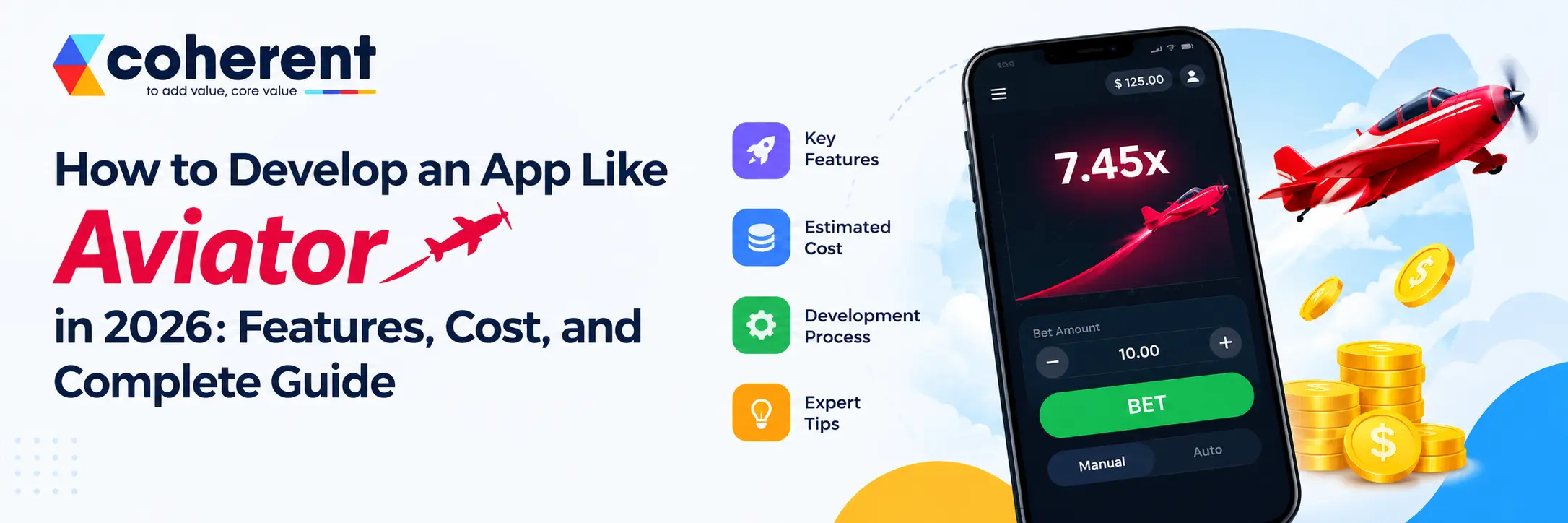
Developing an app like Aviator in 2026 requires a combination of engaging game mechanics, real-time performance, secure backend infrastructure, attractive UI/UX design, and responsible gaming features. The total development cost can range from $25,000 to $250,000 or more, depending on the game's complexity, platform requirements, multiplayer functionality, security standards, and regulatory obligations.
Aviator is known for its crash-game format, in which a multiplier increases during a flight and players must decide when to cash out before the round ends. Its simple interface and fast-paced gameplay have made this format recognizable in the online gaming industry.Businesses planning to build an Aviator-style game should focus on more than visual similarities.
What Is an Aviator-Like Game App?
An Aviator-like app is a digital crash game built around a rising multiplier. Players follow each round and, where permitted, choose when to cash out before the multiplier crashes. A higher multiplier may offer a larger potential payout, but waiting too long can result in losing the stake. Successful development requires transparent game logic, independently testable randomness where applicable, reliable real-time communication, secure transactions, and compliance with the laws of each target market. Businesses can explore AI app development services to understand how AI-powered technologies can support modern application development.
- Rising multiplier
- Cash-out functionality
- Round history
- Live game interface
How Does an Aviator-Style Crash Game Work?
An Aviator-style crash game features a rising multiplier that increases until the round ends. Players monitor the multiplier and, where permitted, attempt to cash out before the crash. Developing this type of game requires real-time communication, reliable backend processing, transparent gameplay rules, and accurate result recording to ensure a consistent and trustworthy experience. Businesses exploring gaming solutions can also learn from this guide on building a Fantasy Sports App Like Dream11.
1. Players Join a Round
Players enter the game interface and join an available round before the participation window closes. The application validates each action according to the game rules and displays the current round status. For real-money games, eligibility and transaction checks are also necessary.
- Display the active round and countdown.
- Validate player actions on the server.
- Confirm eligible participation.
- Enforce round deadlines consistently.
2. The Multiplier Starts Rising
Once a round begins, the multiplier increases while an animated aircraft or similar visual element moves across the screen. The backend controls the authoritative game state, and real-time updates keep connected clients synchronized.
- Animate the rising multiplier.
- Broadcast updates through WebSockets.
- Synchronize clients with server timestamps.
- Handle connection interruptions gracefully.
3. Players Cash Out
During gameplay, players may attempt to cash out before the round ends. The backend must validate each request against the round state and applicable deadlines. Clear processing rules help prevent inconsistent results caused by latency or duplicate messages.
- Provide an easy-to-use cash-out control.
- Validate requests on the server.
- Handle simultaneous requests consistently.
- Confirm successful actions clearly.
4. The Round Crashes
The round ends when the game reaches its predetermined crash outcome. The system then determines which actions qualify for settlement according to the published rules. Consistent outcome handling prevents discrepancies between displayed results and recorded transactions.
- Trigger the round-ending event.
- Freeze the final multiplier.
- Identify valid cash-out actions.
- Display the final result accurately.
5. Results Are Recorded
After each round, the backend stores the outcome, eligible player actions, and relevant settlement records. Maintaining reliable records supports troubleshooting, dispute resolution, auditing, and regulatory reporting where applicable.
- Store round results and timestamps.
- Maintain transaction and audit logs.
- Reconcile settlement records.
What Are the Essential Features of an Aviator-Like App?
An Aviator-like app requires reliable gameplay, secure user accounts, real-time multiplier updates, transparent results, and efficient administration. Essential features vary depending on whether the product is free-to-play or supports real-money gaming. Businesses should prioritize performance, security, usability, and regulatory compliance when planning the initial release and future upgrades. With professional mobile application development services, businesses can build scalable gaming applications tailored to their technical requirements and target audiences.
1. User Registration and Authentication
User registration should provide a smooth onboarding experience while protecting personal information and preventing unauthorized access. Developers should implement secure authentication and account recovery processes. For regulated gaming products, additional eligibility checks may be required before users access restricted features.
- Email or phone verification.
- Secure login and session management.
- Multi-factor authentication where appropriate.
2. Real-Time Multiplier Engine
The multiplier engine controls the central gameplay experience by coordinating round timing, multiplier progression, and round-ending events. The backend must remain authoritative so that every connected client receives consistent game-state information, even during heavy traffic or temporary network interruptions.
- Server-authoritative round management.
- WebSocket-based real-time updates.
- Reliable round-start and round-end events.
3. Secure Game Logic and Provably Fair Verification
Secure game logic helps maintain consistent outcomes and supports player trust. Depending on the design, developers can implement cryptographic commitments, auditable random-number generation, and independent testing. Any fairness claims should accurately describe the implemented verification process.
- Documented outcome-generation rules.
- Cryptographic verification where appropriate.
- Tamper-resistant audit records.
4. Wallet and Transaction Management
A wallet system is necessary when an application supports real-money transactions. It must accurately maintain balances, process approved payments, and preserve reliable transaction records. Free-to-play applications can instead use virtual credits without cash redemption, reducing initial payment infrastructure requirements.
- Deposit and withdrawal workflows where permitted.
- Secure balance and ledger management.
- Payment gateway integrations.
5. Automatic Cash-Out
Automatic cash-out lets players configure a target multiplier before or during an eligible round. The backend must validate the selected target and execute the request according to published game rules. The interface should communicate the setting's status and explain how deadlines and connection failures affect execution.
- Configurable target multiplier.
- Server-side request validation.
- Clear activation and status indicators.
6. Game History and Statistics
Game history allows users to review previous rounds and their own activity. Clear records improve transparency and help users understand their gameplay. Historical results should be presented accurately without suggesting that previous outcomes can reliably predict future random results.
- Previous round outcomes.
- Personal gameplay history.
- Transaction records where applicable.
7. Admin Dashboard
An admin dashboard gives authorized teams tools to manage users, monitor gameplay, review transactions, and investigate operational issues. Role-based permissions and audit logging are essential to prevent unauthorized changes and maintain accountability across administrative activities.
- User and account management.
- Game configuration and monitoring.
- Transaction review and reconciliation.
- Fraud alerts and suspicious activity reports.
8. Responsible Gaming Features
Responsible gaming features help users make informed decisions and manage their activity. These controls should be integrated during product design, especially for real-money gaming, where specific safeguards may be required by the applicable jurisdiction or licence.
- Deposit, spending, and session limits.
- Activity reminders and time notifications.
- Cooling-off periods.
- Self-exclusion options.
How to Develop an App Like Aviator: Step-by-Step Process
Developing an app like Aviator involves market research, feature planning, UI/UX design, backend development, testing, and launch preparation. A structured development process helps businesses control costs, minimize technical risks, and deliver a reliable gaming experience. By following these eight steps, businesses can plan a scalable crash-game application that meets user expectations and technical requirements. Coherent Lab LLP can help businesses explore software development solutions tailored to their project goals.
Step 1: Conduct Market Research
Market research helps identify your target audience, competitors, business goals, and technical requirements before development begins. It also helps determine whether your product should support free-to-play gameplay or real-money gaming.
- Analyze competing crash games and their features.
- Identify target users and supported devices.
- Select the initial launch markets.
Step 2: Define the MVP Scope
An MVP (Minimum Viable Product) includes essential features for testing your app's core gameplay and collecting user feedback. Defining the initial scope prevents unnecessary development expenses and helps businesses validate demand before investing in advanced functionality.
- User registration or guest access.
- Original crash-game mechanics.
- Virtual credits without cash redemption.
Step 3: Create UI/UX Designs
UI/UX design determines how users navigate the application, understand gameplay, and interact with its features. Designers should create wireframes and interactive prototypes before development starts to identify usability issues early and maintain consistency across mobile and web interfaces.
- Create a simple onboarding experience.
- Design a clear game lobby and gameplay screen.
- Make controls readable on smaller devices.
Step 4: Select the Technology Stack
Choosing the right technology stack supports application performance, scalability, security, and long-term maintenance. The selection should reflect your team's expertise, real-time communication requirements, hosting budget, and intended platforms rather than following a fixed technology combination.
- React or Next.js for web interfaces.
- Flutter or React Native for mobile apps.
- Node.js or Go for backend services.
- PostgreSQL for structured data.
Step 5: Build the Game Engine and Backend
The game engine and backend manage round progression, multiplier updates, player actions, and result settlement. Developers should implement a clearly defined state machine to ensure consistent outcomes, reliable communication, and predictable recovery when services fail or network connections are interrupted.
- Implement round scheduling and state transitions.
- Develop multiplier progression and outcome generation.
- Process eligible player actions consistently.
- Prevent duplicate requests and incorrect settlements.
Step 6: Integrate Payments and Compliance Systems
Real-money gaming requires additional legal, financial, and operational safeguards. Before integrating payment services, businesses must verify applicable gaming laws, licensing obligations, age restrictions, and distribution requirements in every target market.
- Identity and age verification.
- Approved payment gateway integration.
- Transaction monitoring and recordkeeping.
- Fraud prevention and anti-money-laundering controls.
Step 7: Test Security and Performance
Comprehensive testing helps identify defects, security vulnerabilities, and performance bottlenecks before public release. The testing process should cover normal gameplay, peak traffic, interrupted connections, and recovery scenarios to ensure the application behaves consistently across supported devices and environments.
- Functional and gameplay testing.
- Load and stress testing.
- Security and penetration testing.
- Network reconnection and duplicate-request testing.
Step 8: Launch, Monitor, and Improve
Launching the MVP to a controlled test audience or legally approved market helps businesses evaluate real-world performance before expanding. Continuous monitoring provides insights into technical reliability, usability, and operating costs, allowing teams to prioritize improvements based on measurable results.
- Monitor crashes, latency, and server availability.
- Track onboarding completion and user retention.
- Review support requests and user feedback.
- Analyze infrastructure and maintenance costs.
How Much Does It Cost to Develop an App Like Aviator in 2026?
The cost of developing an Aviator-like app depends on its features, platforms, real-time infrastructure, security, and regulatory requirements. A basic prototype costs approximately 10,000–25,000, while an advanced crash game may cost 50,000–100,000. These figures are estimates, not fixed quotations. Actual budgets vary based on project complexity, development team location, integrations, and compliance needs.
|
Development Level |
Estimated Cost |
Typical Scope |
|---|---|---|
|
Basic Prototype |
$10,000–$25,000 |
UI design, simulated gameplay, and basic animations |
|
Free-to-Play MVP |
$25,000–$50,000 |
Playable game, virtual credits, game history, and basic backend |
|
Advanced Crash Game |
$50,000–$100,000 |
Real-time infrastructure, enhanced UI, analytics, and admin tools |
|
Commercial Gaming Platform |
$100,000–$250,000+ |
High availability, advanced security, multiple integrations, and operational tools |
|
Regulated Real-Money Platform |
$150,000–$300,000+ |
Complex payment integrations, compliance systems, audits, and licensing-related implementation |
Which Monetization Models Work for an Aviator-Like Game?
Choosing the right monetization model helps businesses generate sustainable revenue while delivering a positive player experience. For an Aviator-like game, the best approach depends on the target audience, gameplay format, legal requirements, and business objectives. Free-to-play products can explore advertising and sponsorships, while real-money models require additional licensing and compliance checks.
1. Advertising-Based Monetization
Advertising-based monetization allows free-to-play crash games to earn revenue without requiring players to wager real money. Developers can integrate relevant advertisements into menus or offer optional rewarded ads for non-cash benefits. Revenue generally depends on active users, engagement, audience location, and advertising rates.
2. Premium Features or Subscriptions
A game can offer optional subscriptions for cosmetic customization, additional themes, or an ad-free experience.Premium benefits should improve convenience or presentation without misrepresenting the odds or providing deceptive promises of success.
3. Virtual Currency
A free-to-play product may use virtual credits to support gameplay. Clearly distinguish simulated credits from real money, particularly if users can purchase them.If virtual currency can be redeemed, transferred, or exchanged for money or valuable prizes, the product may fall under additional gambling, payments, consumer protection, or other regulatory requirements.
4. Licensed Real-Money Gaming
Where legally permitted, an operator may earn revenue under a licensed wagering model. This requires careful assessment of licensing, taxation, payment processing, player protection, game certification, and ongoing monitoring.Real-money wagering should not be treated as a simple monetization switch. The legal and operational requirements can significantly change the product architecture and cost.
What Should You Look for in an Aviator Game Development Company?
Choosing the right development partner can significantly affect product quality, delivery time, and long-term operating costs. Look for a company with proven gaming development experience, real-time backend expertise, and strong security practices. Evaluate its portfolio, technical capabilities, communication process, and post-launch support. For real-money gaming, confirm relevant licensing and compliance requirements before development begins. A reliable partner should understand your business goals, recommend suitable technologies, and build a scalable solution that supports future growth while maintaining a secure and user-friendly gaming experience.
|
Evaluation Factor |
What to Verify |
|---|---|
|
Relevant Experience |
Evidence of real-time games or comparable interactive products. |
|
Technical Expertise |
Backend architecture, synchronization, databases, and cloud infrastructure. |
|
Security |
Secure development practices, testing, and audit capabilities. |
|
Game Integrity |
Documented outcome logic and appropriate independent verification. |
|
Cost Transparency |
Itemized estimates, exclusions, and milestone-based payments. |
|
Compliance Awareness |
Experience with applicable licensing and regulatory requirements. |
|
Post-Launch Support |
Monitoring, maintenance, incident response, and upgrades. |
|
Communication |
Clear documentation, realistic milestones, and regular progress reports. |
What Legal and Compliance Requirements Should You Consider?
Before developing a real-money Aviator-style app, determine whether the intended game is classified as gambling, whether the proposed operator can obtain the necessary licence, and which jurisdictions can legally be served.Requirements vary by country, state, and product design. A game that is permitted in one jurisdiction may be prohibited or subject to different conditions in another.
- Applicable gambling and gaming licences.
- Age and identity verification.
- Know-your-customer and anti-money-laundering obligations where applicable.
- Responsible gaming and self-exclusion.
Conclusion
Developing an app like Aviator in 2026 requires much more than an animated multiplier and a simple user interface. Businesses need reliable real-time infrastructure, well-defined game logic, secure data handling, an intuitive mobile experience, and a sustainable business model.A reasonable starting budget for a free-to-play MVP is approximately $25,000–$50,000, while a more advanced or regulated platform may require $100,000–$300,000 or more.
These figures should be validated through a detailed project assessment, particularly when licensing, payments, and independent certification are involved.Start with market research, confirm the legal feasibility of your chosen model, define the MVP, and test the core gameplay before expanding the product. If you are planning a custom gaming product, explore , contact the team to discuss your project requirements and development budget.
Frequently Asked Questions
Q1. How much does it cost to develop an app like Aviator?
Ans.Developing an Aviator-like app may cost approximately $25,000–$50,000 for a free-to-play MVP, $50,000–$100,000 for a more advanced game, and $100,000–$250,000 or more for a commercial platform. A regulated real-money product may require a larger budget because of payment integrations, security, compliance, independent testing, and operational infrastructure. These estimates are indicative; the actual cost depends on features, platforms, development rates, and the target market.
Q2. How long does it take to build an Aviator-like game?
Ans.A basic prototype may take four to eight weeks, while a free-to-play MVP may require approximately eight to fourteen weeks. An advanced game can take three to six months, and a commercial or regulated platform may need six to twelve months or longer. The timeline depends on the team's size, game mechanics, backend complexity, security testing, third-party integrations, and regulatory approvals. A clearly defined MVP can help businesses validate the concept before committing to a larger development budget.
Q3. What features are essential in an Aviator-style app?
Ans.Essential features include a real-time multiplier, responsive gameplay, reliable round management, game history, and clear user controls. Depending on the product, additional features may include authentication, virtual credits, account management, transaction records, an administrative dashboard, and customer support. Real-money applications also need appropriate payment processing, eligibility verification, responsible gaming controls, fraud prevention, and regulatory reporting. The best feature set depends on the intended audience and business model rather than simply copying an existing game.
Q4. Which technology is best for Aviator game development?
Ans.The best technology depends on the project's performance requirements and the team's expertise. React or Next.js can support a web-based game interface, while Flutter or React Native can be considered for cross-platform mobile applications. Node.js or Go may be suitable for backend services, PostgreSQL for durable data storage, and WebSockets for real-time communication. Cloud infrastructure can support deployment, monitoring, and scaling. The final stack should be selected after evaluating concurrency, latency, reliability, security, and long-term maintenance requirements.
Q5. Can an Aviator-like game generate revenue?
Ans.A game can use advertising, subscriptions, optional cosmetic purchases, or virtual currency, depending on its design and applicable laws. Licensed real-money gaming may be another model in jurisdictions where it is permitted, but it introduces significant legal, financial, and operational responsibilities. Revenue is not guaranteed and depends on factors such as user acquisition costs, retention, operating expenses, market competition, and compliance. Businesses should validate the business model and legal feasibility before investing heavily in development.
Q6. Is it legal to develop an Aviator-like app in India?
Ans.The answer depends on the current legal framework, the game's design, its monetary features, the operator's activities, and applicable central and state requirements. Real-money gaming can involve substantial legal restrictions and compliance obligations. Developers and operators should obtain qualified legal advice before introducing deposits, cash prizes, withdrawals, or wagering. A free-to-play game with no cash redemption may present a different regulatory profile, but its precise classification still depends on the product and applicable law. Do not assume that copying an existing game establishes legality.
Q7. How can developers ensure fairness in a crash game?
Ans.Developers should use documented, server-authoritative game logic and an outcome-generation method appropriate to the product and its regulatory requirements. Where applicable, cryptographic commitments, independent random-number generator testing, and publicly documented verification procedures can improve transparency. The application should maintain auditable records and define how round timing, cash-out requests, and settlement work. Any claim that a game is provably fair must be supported by a working, testable implementation. Independent assessment may also be required before a regulated product can launch.
Q8. How do I choose the right Aviator game development company?
Ans.Choose a development company with relevant real-time application experience, strong backend engineering skills, transparent pricing, and a documented testing process. Ask for a detailed project proposal, realistic delivery milestones, security practices, maintenance terms, and evidence of comparable work. For real-money gaming, confirm that the vendor understands the relevant compliance requirements and can support independent testing where necessary. Compare proposals by their deliverables and long-term costs rather than the lowest initial quote. A reliable partner should communicate risks clearly and avoid guaranteeing rankings, profits, or regulatory approval.

 +91 774-202-1725
 +1 (945) 3387904
 business@coherentlab.com
 +49 15223341304
 UK

