Table of Contents
Why Enterprises Are Rebuilding Apps Instead of Maintaining Them
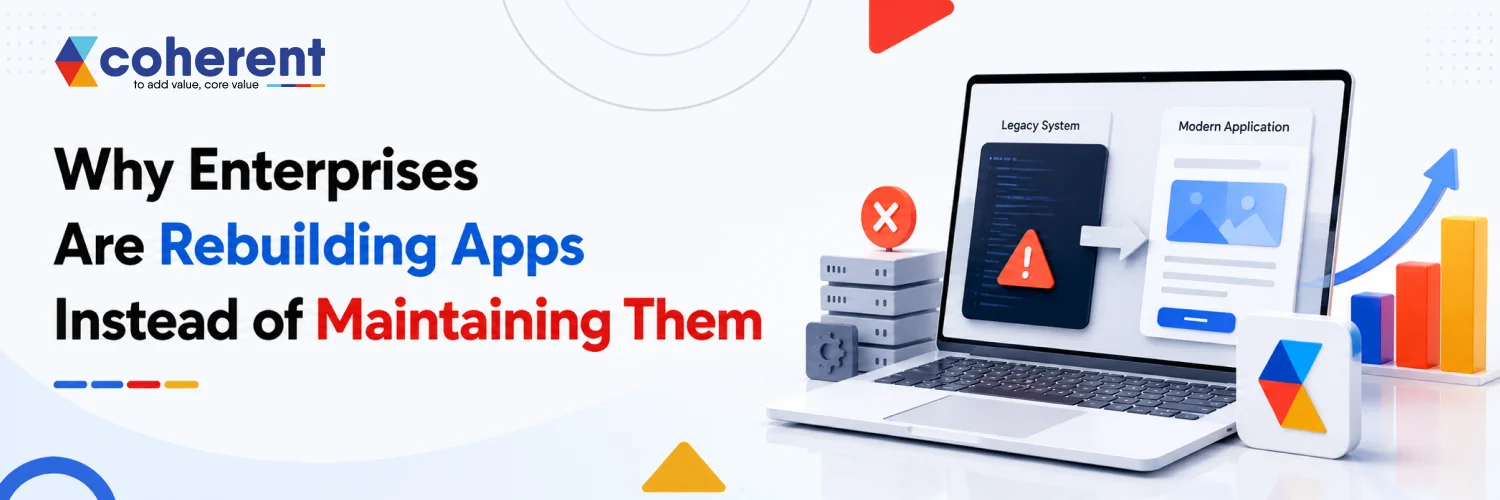
Enterprise application modernization has become a major priority for organizations in 2026. Many enterprises are no longer investing heavily in maintaining outdated software because legacy applications increase costs, create security risks, and slow innovation. Modern businesses need cloud-native, AI-ready, scalable, and secure applications that support digital transformation goals. As customer expectations continue to rise, enterprises are choosing application rebuilding strategies to improve performance, user experience, and operational efficiency.
Rebuilding an application allows companies to redesign architecture, adopt modern technologies, and reduce technical debt that accumulates over years of maintenance. Industries such as banking, healthcare, retail, logistics, and manufacturing are leading this shift. This article explains why enterprises are rebuilding apps instead of maintaining them, the business benefits of modernization, and how organizations can plan successful enterprise application transformation projects for long-term growth.
What Is Enterprise Application Rebuilding?
Enterprise application rebuilding involves redesigning and redeveloping legacy business applications using modern technologies and architectures. Instead of repeatedly patching outdated systems, organizations build new solutions that improve scalability, security, performance, and integration capabilities. Coherent Lab LLP helps businesses modernize applications through cloud migration, microservices adoption, modern UI/UX, API integration, and AI-ready development. This approach supports long-term digital transformation while reducing dependence on obsolete infrastructure and maintenance costs.
Difference Between Maintenance and Rebuilding
- Maintenance focuses on bug fixes, patches, and small feature updates.
- Rebuilding redesigns the application architecture for future business needs.
- Maintenance preserves existing technology while rebuilding adopts modern frameworks.
- Rebuilding improves scalability, security, and performance significantly.
The Rising Cost of Legacy Application Maintenance
Maintaining legacy enterprise applications often appears cheaper initially, but hidden costs increase rapidly over time. Organizations spend money on outdated infrastructure, specialized developers, security patches, downtime management, and integration workarounds. Technical debt grows with every temporary fix, making future changes slower and more expensive. Enterprises eventually realize that rebuilding provides better long-term ROI than continuing endless maintenance cycles.
Hidden Costs Enterprises Often Ignore
- Expensive legacy servers and infrastructure maintenance.
- Limited availability of skilled legacy technology developers.
- Frequent downtime and performance troubleshooting costs.
- Growing technical debt that increases future development expenses.
Maintenance vs Rebuild Cost Comparison
A rebuild requires a larger upfront investment, but it often reduces operational expenses over several years. Modern cloud-native applications lower infrastructure costs, automate deployments, improve developer productivity, and decrease support requirements. Enterprises that calculate total cost of ownership usually find that rebuilding becomes more economical within a few years, especially for mission-critical systems.
Why Enterprises Are Choosing to Rebuild Applications
Enterprises rebuild applications to support cloud adoption, AI app development, automation, and modern customer experiences. Legacy systems often cannot scale efficiently or integrate with emerging AI technologies. Rebuilding applications enables faster product delivery, stronger security compliance, improved analytics, and intelligent decision-making capabilities. Organizations also gain flexibility to adapt quickly to market changes, streamline operations through AI-driven automation, enhance customer engagement, and support future business expansion with a scalable, innovation-ready digital architecture.
Cloud-Native Scalability
- Applications can scale automatically during traffic spikes.
- Cloud infrastructure reduces hardware management effort.
- High availability improves business continuity and reliability.
- Faster deployment supports agile product development cycles.
AI and Automation Readiness
Modern enterprises want applications that can integrate with artificial intelligence, machine learning, robotic process automation, and advanced analytics. Legacy systems often lack APIs, data pipelines, and processing capabilities required for AI initiatives. Rebuilding creates a flexible foundation that supports automation, predictive analytics, intelligent workflows, and real-time decision-making across departments.
AI-Ready Enterprise Capabilities
- API-first architecture enables seamless AI integration.
- Real-time data processing improves business intelligence.
- Automation reduces repetitive operational tasks.
- Predictive analytics supports faster decision-making.
Improved User Experience and Customer Expectations
Improved user experience and rising customer expectations are major drivers of Android app development today. Businesses need fast, secure, and user-friendly mobile applications that perform smoothly across Android devices. Android app development cost depends on factors like app complexity, features, design, development time, and technology integrations. Proper budgeting helps businesses build quality apps while controlling expenses. Modern apps focus on personalization, speed, reliability, and better customer engagement.
Modern UX Improvements
- Responsive design works across all devices.
- Faster interfaces increase employee productivity.
- Simplified workflows reduce training requirements.
- Accessibility features improve inclusivity and compliance.
Security and Compliance Requirements
Cybersecurity threats and regulatory requirements have increased significantly in recent years. Legacy applications may contain unsupported components, weak authentication methods, and outdated encryption standards. Rebuilding helps enterprises implement modern security frameworks, zero-trust architecture, multi-factor authentication, secure APIs, and compliance controls for regulations such as GDPR, HIPAA, PCI DSS, and SOC 2.
Modern Security Enhancements
- Zero-trust access controls strengthen protection.
- Multi-factor authentication reduces unauthorized access.
- Secure API gateways protect enterprise integrations.
- Updated encryption standards improve data security.
Key Business Drivers Behind Enterprise App Modernization
Application rebuilding is not only a technical decision; it is a strategic business initiative. Enterprises modernize applications to accelerate innovation, support digital transformation, improve operational efficiency, and deliver better customer experiences. Competitive pressure and changing market expectations make modernization essential for sustainable growth.
Business Transformation Drivers
- Faster innovation and product delivery.
- Better customer engagement across digital channels.
- Improved operational efficiency and automation.
- Stronger competitive differentiation in the market.
Mergers, Acquisitions, and System Consolidation
During mergers and acquisitions, organizations often inherit multiple applications performing similar functions. Maintaining duplicate systems increases costs and operational complexity. Rebuilding provides an opportunity to consolidate platforms, standardize processes, centralize data, and create a unified technology ecosystem that supports enterprise-wide collaboration and reporting.
Consolidation Benefits
- Reduced licensing and infrastructure expenses.
- Unified customer and operational data.
- Standardized business processes across departments.
- Easier governance and compliance management.
Also Read :- Cross Platform App Development: Benefits, Tools & Tips.
Technologies Driving Enterprise Application Rebuilds
Modern application rebuilding relies on cloud platforms, microservices, containers, DevOps automation, and modern development frameworks. These technologies improve scalability, deployment speed, maintainability, and integration capabilities. Enterprises select technology stacks based on business goals, performance requirements, security standards, and long-term support availability.
Popular Modern Technology Stack
- React, Angular, or Vue.js for modern front-end development.
- Node.js, .NET, Java Spring Boot, or Python for back-end services.
- Microservices architecture for modular application design.
- Docker and Kubernetes for containerized deployment.
Signs Your Enterprise Application Needs a Rebuild
Many organizations continue maintaining applications long after they have become inefficient. Recognizing early warning signs helps enterprises avoid rising costs, security risks, and operational disruptions. When business teams struggle to launch new features or IT teams spend most of their time fixing problems, rebuilding may be the better strategic option.
Technical Warning Signs
- Frequent outages and recurring production incidents.
- Slow application performance during peak usage.
- Unsupported frameworks, databases, or operating systems.
- Complex integrations that require manual workarounds.
Business Warning Signs
Business warning signs are early indicators that a company may face financial, operational, or growth challenges. Common signs include declining revenue, rising costs, poor cash flow, customer complaints, missed deadlines, and high employee turnover. Identifying these warning signs early helps business owners take corrective action, reduce risks, improve performance, and protect long-term business stability and profitability.
Business Impact Indicators
- Rising maintenance budgets year after year.
- Long release cycles that delay new features.
- Low customer satisfaction and adoption rates.
- Difficulty integrating with modern digital platforms.
Enterprise App Rebuild Strategy: Step-by-Step
An enterprise app rebuild strategy in mobile app development helps organizations modernize outdated systems with minimal business disruption. The process includes assessing existing mobile applications, defining business goals, prioritizing features, selecting the right technology stack, rebuilding app modules in phases, testing performance and security, migrating data, and deploying gradually across devices. A structured mobile app development approach reduces risk, improves scalability, enhances user experience, and supports long-term digital transformation success effectively.
Assessment and Planning Steps
- Inventory all applications and dependencies.
- Evaluate technical debt and business criticality.
- Define modernization goals and success metrics.
- Create a phased implementation roadmap.
Migration and Testing Approach
A successful migration and testing approach ensures a smooth transition from legacy systems to modern platforms with minimal disruption. It includes data migration planning, application compatibility checks, performance validation, security testing, and user acceptance testing. By following a structured testing strategy, businesses can identify issues early, reduce risks, maintain data integrity, and ensure reliable application performance after deployment.
Safe Migration Practices
- Automated functional and regression testing.
- Secure data migration with validation checkpoints.
- User acceptance testing with business teams.
- Gradual rollout before full production launch.
Benefits of Rebuilding Enterprise Applications
Rebuilding enterprise applications helps businesses improve performance, security, scalability, and user experience. Modern enterprise application development and cross-platform app development enable faster updates, seamless cloud integration, lower maintenance costs, and consistent experiences across devices. By replacing outdated systems, organizations can improve operational efficiency, support digital transformation initiatives, and adapt quickly to changing customer expectations and market demands while ensuring sustainable long-term business growth and technology flexibility.
- Lower infrastructure and support costs.
- Reduced downtime and incident frequency.
- Faster deployment and release cycles.
- Improved developer productivity and collaboration.
Strategic Benefits
Beyond operational savings, rebuilding strengthens the organization’s competitive position. Modern applications enable faster experimentation, better customer experiences, and easier adoption of AI, analytics, and automation technologies that drive long-term business growth.
- Faster innovation and product development.
- Better customer retention and engagement.
- Easier integration with emerging technologies.
- Future-ready digital business architecture.
Key Features of Modern Enterprise Applications
Modern enterprise applications are designed to improve productivity, security, and scalability across organizations. Key features include cloud integration, real-time data access, automation, AI-driven analytics, mobile accessibility, secure authentication, and seamless third-party integrations. These capabilities help businesses streamline operations, enhance customer experiences, support remote teams, and make faster, data-driven decisions in a competitive digital environment.
- Cloud-native and scalable architecture.
- API-first integration framework.
- Built-in security and compliance controls.
- Real-time analytics and monitoring capabilities.
Major Benefits Enterprises Gain After Rebuilding
Rebuilding enterprise applications with modern iOS app development capabilities helps organizations improve performance, security, scalability, and user experience across Apple devices. A modern architecture reduces maintenance costs, accelerates feature delivery, and supports cloud, AI, and mobile integration. Enterprises gain better reliability, stronger compliance, faster business operations, and improved customer satisfaction through optimized iOS experiences. These benefits support long-term digital growth and a stronger competitive position in rapidly changing markets.
Enterprise Modernization Benefits
- Reduced total cost of ownership.
- Improved application performance and reliability.
- Stronger cybersecurity and compliance posture.
- Greater agility for future business expansion.
Also Read :- Mobile App Development Cost in 2026
When Maintenance Still Makes Sense
Application maintenance remains the right choice when the software is stable, secure, and continues to meet business needs without major performance issues. For systems with limited budgets, low user growth, or regulatory constraints, maintaining and optimizing the existing app can be more cost-effective than rebuilding. Regular updates, bug fixes, and security patches help extend software lifespan.
Hybrid Modernization Approach
Many enterprises choose a hybrid strategy that combines maintenance and rebuilding. Critical customer-facing modules may be modernized first, while less important components continue operating until a later phase. This approach balances cost, risk, and business priorities.
- Modernize high-value modules first.
- Maintain non-critical legacy components temporarily.
- Introduce APIs between old and new systems.
- Gradually retire legacy infrastructure over time.
How to Calculate ROI for an Enterprise App Rebuild
Executives often approve modernization projects based on financial and business impact. A clear ROI model helps justify investment and prioritize applications that will deliver the greatest value.
- Total cost of ownership reduction.
- Infrastructure and licensing savings.
- Lower support and maintenance expenses.
- Payback period and long-term ROI.
Business Metrics to Measure Success
Financial savings alone do not capture the full value of modernization. Enterprises should also measure operational and customer outcomes to understand the broader impact of rebuilding initiatives.
- Faster time-to-market for new features.
- Higher employee productivity.
- Improved customer satisfaction scores.
- Increased digital adoption and engagement.
Conclusion
Enterprises are rebuilding applications because maintaining legacy systems no longer supports modern business goals. Rising maintenance costs, technical debt, security risks, and limited scalability make legacy software increasingly difficult to justify. Rebuilt cloud-native applications deliver better performance, stronger security, improved user experiences, faster innovation, and greater operational efficiency. Organizations that follow a strategic modernization roadmap can reduce long-term costs while preparing for AI, automation, analytics, and future digital transformation initiatives. Rebuilding is a business investment in agility, competitiveness, and sustainable growth. Contact us today to discuss your application modernization strategy and accelerate your digital transformation journey.
Frequently Asked Questions
Q1. Why are enterprises rebuilding applications instead of maintaining them?
Ans. Enterprises rebuild applications because legacy systems become expensive to maintain, difficult to secure, and hard to scale. Modern business environments require cloud-native, AI-ready, and highly integrated platforms that support rapid innovation. Rebuilding reduces technical debt, improves performance, strengthens security, and enables faster feature delivery. Organizations also gain better long-term ROI and operational efficiency compared with continuing endless maintenance cycles.
Q2. What is the difference between application maintenance and application rebuilding?
Ans. Application maintenance focuses on bug fixes, patches, minor enhancements, and keeping existing software operational. Application rebuilding involves redesigning architecture, rewriting code, adopting modern technologies, improving user experience, and often migrating to the cloud. Maintenance preserves the current system, while rebuilding creates a future-ready platform designed for scalability, security, integration, and long-term business growth.
Q3. Is rebuilding an enterprise application more expensive initially?
Ans. Yes, rebuilding usually requires a higher upfront investment than maintenance. However, modern applications often reduce infrastructure costs, support costs, downtime, and development effort over time. When organizations calculate total cost of ownership across several years, rebuilding frequently becomes the more economical option, especially for mission-critical systems that require continuous enhancement and scalability.
Q4. Which industries are rebuilding enterprise applications most aggressively?
Ans. Banking, financial services, healthcare, retail, e-commerce, logistics, manufacturing, and telecommunications are among the industries investing heavily in application modernization. These sectors face strong competitive pressure, strict compliance requirements, increasing cybersecurity threats, and rapidly changing customer expectations, making modernization essential for maintaining operational efficiency and digital competitiveness.
Q5. How does cloud-native architecture help rebuilt applications?
Ans. Cloud-native architecture enables automatic scaling, high availability, faster deployments, better disaster recovery, and reduced infrastructure management. Enterprises can deploy updates more frequently, handle traffic spikes efficiently, and integrate new services quickly. Cloud-native platforms also support DevOps automation, monitoring, and continuous delivery practices that improve reliability and business agility.
Q6. What are the biggest risks during an enterprise application rebuild?
Ans. Common risks include budget overruns, scope creep, data migration issues, integration failures, performance problems, and user adoption challenges. Enterprises can reduce these risks through phased modernization, strong governance, automated testing, pilot deployments, clear business requirements, and continuous communication between technology teams and business stakeholders throughout the project lifecycle.
Q7. How long does an enterprise application rebuild usually take?
Ans. The timeline depends on application complexity, integrations, data volume, regulatory requirements, and modernization scope. Smaller applications may take a few months, while large enterprise platforms can require one to three years or more. Many organizations adopt phased delivery to release value incrementally instead of waiting for a complete system replacement.
Q8. When should an enterprise continue maintaining an application instead of rebuilding it?
Ans. Maintenance may be appropriate when the application is stable, low-risk, inexpensive to operate, and not critical to future business strategy. Systems nearing retirement, internal tools with limited users, or applications that already meet performance and compliance requirements may not justify a full rebuild. A business and technical assessment should guide the decision.

 +91 774-202-1725
 +1 (945) 3387904
 business@coherentlab.com
 +49 15223341304
 UK
UK