
Table of Contents
Healthcare and Fitness App Development in 2026: Features, Cost, and Complete Guide
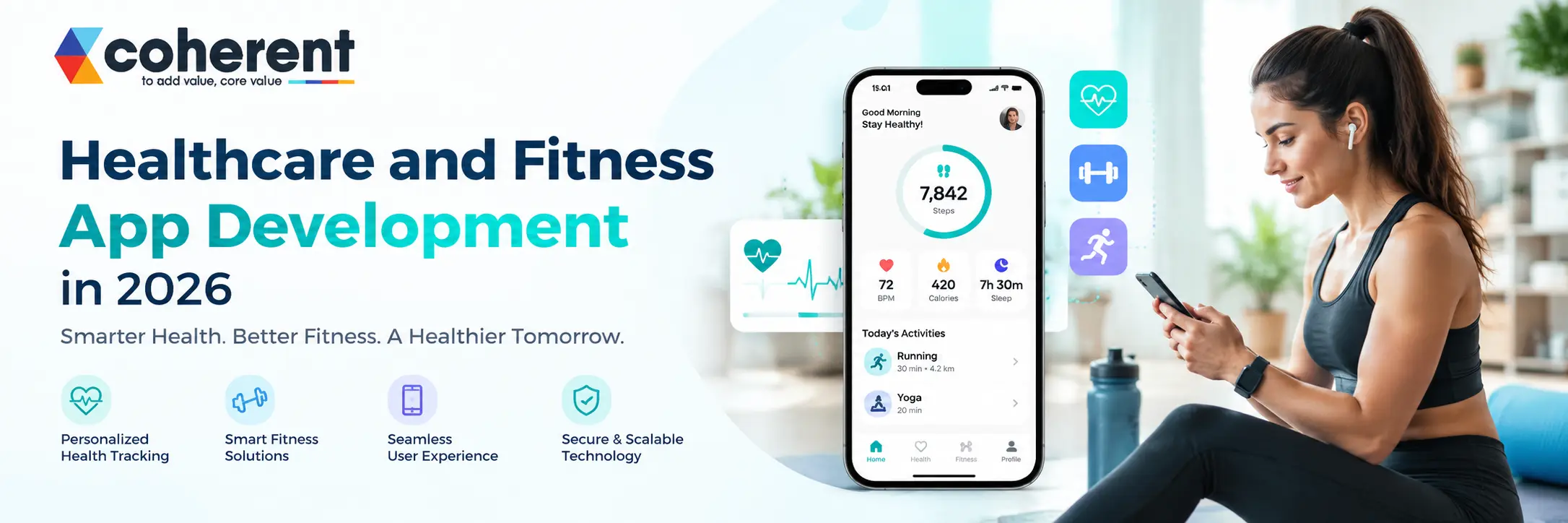
Healthcare and fitness app development in 2026 is helping businesses deliver more accessible healthcare services, personalized fitness experiences, and smarter patient engagement. From telemedicine and appointment booking to AI-powered workout recommendations and wearable device integration, mobile applications are changing how people manage their health and wellness.
For startups, hospitals, fitness brands, healthcare providers, and entrepreneurs, building a successful app requires more than an attractive interface. It involves choosing the right features, protecting sensitive health information, integrating reliable technology, and creating an experience that people can trust.In this guide, we explain how to develop a healthcare or fitness app, which features matter most, how much development costs, and which technologies can help your business succeed in 2026.
What Is Healthcare and Fitness App Development?
Healthcare and fitness app development is the process of designing, building, testing, and maintaining mobile or web applications that help people access healthcare services, monitor their health, improve physical fitness, and manage wellness activities.These applications can serve patients, doctors, hospitals, personal trainers, gym owners, nutritionists, and fitness enthusiasts.Healthcare applications typically focus on medical services and patient management, activity tracking, and personal wellness. Some platforms combine both categories to offer a more complete health management experience.
- Healthcare apps: Support appointment booking, telemedicine, electronic health records, and medication reminders.
- Fitness apps: Track workouts, daily steps, calories burned, and exercise progress.
- Personalized experiences: Use user data to provide fitness recommendations, health insights, and wellness plans.
- Remote monitoring: Help users track health metrics and share relevant information with healthcare professionals.
What Are the Different Types of Healthcare and Fitness Apps?
Healthcare and fitness applications serve different purposes, from virtual doctor consultations to workout tracking and nutrition planning. Choosing the right app category depends on your target audience, business objectives, required features, and monetization strategy. Understanding these categories helps startups and healthcare organizations select suitable features and build solutions that address real user needs. Explore our mobile application development services to turn your app idea into a reliable digital solution.
- Telemedicine and doctor consultation apps.
- Electronic health record and patient management apps.
- Fitness tracking and nutrition applications.
- Remote monitoring and mental wellness apps.
1. Telemedicine and Doctor Consultation Apps
Telemedicine apps enable patients to consult healthcare professionals remotely through video calls, audio calls, and secure messaging. They can simplify appointment booking, improve access to care, and support follow-up consultations. Developers should prioritize secure communication, reliable scheduling, and appropriate handling of patient information.
- Online doctor appointments.
- Video and audio consultations.
- Digital prescriptions where permitted.
- Patient profiles and medical histories.
2. Electronic Health Record and Patient Management Apps
Electronic health record (EHR) applications help authorized healthcare professionals manage patient information digitally. They can organize medical histories, laboratory results, appointments, and clinical documentation. Secure access controls, interoperability, and compliance with applicable healthcare regulations are essential when designing these systems.
- Digital medical record management.
- Appointment scheduling and reminders.
- Laboratory report access.
- Secure patient communication.
3. Fitness Tracking and Workout Apps
Fitness tracking applications help users monitor physical activity, follow exercise routines, and measure progress toward personal goals. They can support individuals, personal trainers, gyms, and wellness businesses. Integrations with compatible smartphones and wearable devices can provide additional activity data and improve the overall experience.
- Step and distance tracking.
- Personalized workout plans.
- Heart-rate monitoring through compatible devices.
- Fitness goals and progress dashboards.
4. Nutrition and Diet Planning Apps
Nutrition applications help users record meals, monitor dietary habits, and organize meal plans around their goals. Features such as food databases and hydration reminders can encourage consistent tracking. Recommendations should account for user needs and avoid presenting general nutrition information as individualized medical advice.
- Calorie and meal tracking.
- Food databases and nutrition information.
- Personalized meal planning.
- Hydration reminders and progress reports.
5. Mental Wellness and Meditation Apps
Mental wellness applications support relaxation, mindfulness, sleep routines, and everyday stress management. They may provide guided exercises and personalized wellness activities. Developers should protect sensitive user information, communicate limitations clearly, and provide appropriate professional support guidance when applications address more serious mental health concerns.
- Guided meditation sessions.
- Breathing and relaxation exercises.
- Sleep sounds and bedtime routines.
- Mood journals and wellness tracking.
6. Remote Patient Monitoring Apps
Remote patient monitoring apps collect health measurements through compatible medical devices and connected wearables. They can help authorized healthcare teams review trends and follow up with patients between appointments. Reliable device integration, appropriate clinical validation, secure data transmission, and regulatory assessment are important for medical applications.
- Health measurement tracking.
- Secure patient and clinician dashboards.
- Configurable alerts and notifications.
- Connected device integration and reporting.
7. Gym and Personal Training Apps
Gym and personal training applications connect fitness businesses with their members through digital management tools. They simplify membership administration, class scheduling, trainer communication, and progress tracking. These solutions can help gyms reduce repetitive tasks, improve member engagement, and deliver a more convenient fitness experience.
- Membership management and attendance tracking.
- Class booking and workout scheduling.
- Trainer profiles and communication.
- Subscription payments and progress reports.
Also read : Comprehensive Guide to Health Insurance App Development: Features, Technologies, and Best Practices
Why Invest in Healthcare and Fitness App Development in 2026?
Digital healthcare and fitness applications help businesses deliver convenient, accessible, and personalized services. They create opportunities to generate recurring revenue through subscriptions, premium features, and service partnerships. These apps also help businesses understand user needs, improve engagement, and build long-term customer relationships. With the right features, technology, security measures, and ongoing improvements, companies can develop sustainable digital health solutions that support business growth and user satisfaction.
- Convenient access: Users can book appointments, access health information, or follow workouts from their smartphones.
- Personalized experiences: Apps can adapt workout schedules, reminders, and wellness content to user preferences and activity.
- Better engagement: Progress tracking, notifications, and goal-setting tools can encourage consistent participation.
- Operational efficiency: Appointment booking, membership management, and routine reminders can automate repetitive tasks.
How Does AI Improve Healthcare and Fitness Applications?
Artificial intelligence helps healthcare and fitness applications deliver more personalized, efficient, and data-driven experiences. It can automate routine tasks, analyze user activity, and generate recommendations based on available information. However, AI effectiveness depends on data quality, appropriate validation, and privacy safeguards. Developers must ensure AI features are transparent, secure, and suitable for their intended purpose. Explore our AI app development services to build intelligent applications tailored to your business needs.
- Personalizes user experiences
- Automates routine activities
- Analyzes health and fitness data
- Supports informed decisions
AI in Healthcare App Development
AI improves healthcare apps by supporting administrative workflows, organizing medical information, and helping patients stay engaged with their care plans. These features can reduce repetitive work and improve access to information. However, AI should support—not replace—qualified medical professionals, particularly when applications involve diagnosis, treatment, or other clinical decisions.
- Answers routine questions through chatbots
- Summarizes and organizes medical documents
- Sends appointment and follow-up reminders
- Supports validated clinical workflows
AI in Fitness App Development
AI helps fitness applications adapt workouts and wellness recommendations to users’ goals, activity levels, and progress. By analyzing recorded activity and feedback, apps can suggest suitable training schedules and summarize performance. Recommendations should remain transparent, account for individual limitations, and avoid encouraging unsafe exercise practices.
- Recommends goal-based workouts
- Adjusts exercise schedules using user feedback
- Tracks progress and activity patterns
- Provides personalized wellness guidance
Also Read: The Ultimate Guide to the Best Healthcare Apps in 2026
How Much Does Healthcare and Fitness App Development Cost in 2026?
Healthcare and fitness app development costs vary depending on feature complexity, platform coverage, integrations, security requirements, design, and maintenance needs. A basic fitness tracker generally costs less than a telemedicine platform or an application with advanced AI capabilities. Actual costs depend on project scope, technology choices, and development team expertise. Explore our Healthcare App Development services to plan a solution aligned with your business goals and budget.
|
App Complexity |
Estimated Development Cost (USD) |
Typical Scope |
|---|---|---|
|
Basic MVP |
$15,000–$30,000 |
Core screens, user accounts, basic tracking or booking |
|
Standard App |
$30,000–$70,000 |
Backend, dashboards, payments, notifications, selected integrations |
|
Advanced App |
$70,000–$150,000 |
AI-assisted features, wearable integrations, analytics, complex workflows |
|
Enterprise Platform |
$150,000–$300,000+ |
Multiple user roles, extensive integrations, advanced security and scalability |
How to Develop a Healthcare or Fitness App Step by Step
Developing a healthcare or fitness app requires clear planning, user research, suitable technology, and reliable testing. A structured process helps businesses control development costs, reduce technical risks, and deliver useful features. Start by defining your audience and business model, then validate the idea, prioritize MVP features, design the interface, and build secure integrations. After launch, monitor performance and improve the application using user feedback and measurable results.
- Define the target audience and business objectives.
- Research the market and prioritize essential features.
- Develop, integrate, and test the application.
- Launch, monitor performance, and improve continuously.
Step 1: Define Your Target Audience and Business Model
Identify your intended users, the problem your app solves, and how the business will generate revenue. A telemedicine startup may prioritize remote consultations, while a fitness business may focus on workout subscriptions. Clear objectives help guide feature selection and development decisions.
- Identify your primary user group.
- Define the problem your app solves.
- Establish measurable success metrics.
- Select a suitable revenue model.
Step 2: Research the Market and Validate the Idea
Analyze competing applications, customer reviews, user expectations, and unmet needs before investing heavily in development. Interviews and prototype testing can help establish whether users value your proposed solution. Research also helps identify opportunities to differentiate your product and refine its positioning.
- Analyze competing apps and their features.
- Identify customer frustrations and unmet needs.
- Evaluate willingness to pay.
- Test your idea with potential users.
Step 3: Prepare the MVP Feature List
Create a minimum viable product (MVP) feature list that prioritizes essential functionality. Separate launch requirements from future enhancements and optional advanced capabilities. Starting with a focused feature set reduces complexity, helps control costs, and allows businesses to collect user feedback earlier.
- List essential launch features.
- Separate future improvements from core functions.
- Prioritize features by user value.
- Set a realistic development scope.
Step 4: Choose the Right Technology Stack
Choose technologies based on application requirements, integrations, security, and team expertise. Flutter and React Native support cross-platform development, while native technologies may suit platform-specific features. The backend could use Node.js, Python, Java, or .NET, depending on architecture and business needs.
- Select suitable mobile development technologies.
- Choose an appropriate backend framework.
- Plan secure APIs and integrations.
- Evaluate scalability and maintenance requirements.
Step 5: Design the User Experience and Interface
Create wireframes, prototypes, and user flows before full development begins. Healthcare interfaces should present important information clearly, while fitness apps should make exercises and progress easy to understand. Accessible typography, readable contrast, intuitive navigation, and user testing help improve usability.
- Create wireframes and interactive prototypes.
- Simplify navigation and user journeys.
- Follow accessibility and readability principles.
- Test designs with target users.
Step 6: Develop the Frontend and Backend
The frontend handles the interface, while the backend manages business logic, authentication, data processing, integrations, and storage. Development requirements vary by product, but sensitive health information must remain protected during transmission, processing, and storage.
- Implement secure authentication and permissions.
- Develop appointment or workout management.
- Configure protected data storage.
- Integrate payments and notifications when needed.
Step 7: Integrate Wearables, APIs, and AI
Integrations can extend app functionality by connecting compatible devices, healthcare systems, and intelligent services. Fitness applications may use Apple Health or Health Connect, subject to permissions and supported data types. Healthcare products may use HL7 FHIR where appropriate for interoperability and information exchange.
- Connect supported wearable devices.
- Integrate relevant healthcare APIs.
- Add AI features when they provide value.
- Test synchronization and permission handling.
Step 8: Test Security, Performance, and Usability
Comprehensive testing verifies that the application works reliably across supported devices and operating systems. Teams should evaluate functionality, accessibility, performance, data accuracy, and security. Healthcare applications also require assessment of intended clinical use and applicable regulatory obligations before release.
- Test features and third-party integrations.
- Check device compatibility and performance.
- Verify authentication and data protection.
- Validate data accuracy and recovery procedures.
Step 9: Launch and Monitor the Application
Prepare app store listings, onboarding materials, support channels, analytics, and feedback mechanisms before launch. After release, monitor technical reliability and user engagement. Healthcare products should also track relevant workflow quality and data integrity while maintaining patient privacy and appropriate access controls.
- Prepare store listings and support documentation.
- Monitor crashes and response times.
- Track retention and feature adoption.
- Review feedback and data integrity.
Step 10: Improve the Product After Launch
Continuous improvement helps keep healthcare and fitness applications useful, secure, and compatible with changing technologies. Use analytics and user feedback to prioritize updates, introduce valuable features, and fix usability issues. Regular maintenance supports long-term reliability and a better user experience.
- Analyze user feedback and product metrics.
- Improve features based on user needs.
- Update dependencies and security controls.
- Test compatibility after major updates.
Which Technologies Are Used for Healthcare and Fitness Apps?
Technology choices should align with the app’s features, performance goals, security needs, and long-term maintenance plans. The right technology stack helps developers build reliable, scalable, and user-friendly healthcare and fitness applications. Businesses should evaluate platform compatibility, integration requirements, development costs, and team expertise before making decisions. A well-planned stack also supports future upgrades, efficient troubleshooting, and consistent performance as user needs evolve.
|
Technology |
Common Use |
|---|---|
|
Flutter |
Cross-platform mobile app interfaces |
|
React Native |
Cross-platform iOS and Android development |
|
Swift |
Native iOS applications |
|
Kotlin |
Native Android applications |
|
Node.js |
Backend APIs and application services |
|
Python |
Data processing and AI/ML services |
|
PostgreSQL |
Structured application data |
|
Cloud Infrastructure |
Hosting, monitoring, storage, and scaling |
|
Apple Health and Health Connect |
Health and activity data integrations, subject to permissions |
|
HL7 FHIR |
Healthcare data interoperability where supported |
|
AI and Machine Learning |
Personalization, summarization, and selected analytical tasks |
How Can You Choose the Right Healthcare App Development Company?
Choosing the right development company helps businesses build secure, user-friendly, and scalable healthcare or fitness applications. Evaluate each potential partner based on relevant experience, technical capabilities, security practices, project transparency, and post-launch support. A structured selection process helps you compare proposals, understand delivery risks, and choose a team that aligns with your product goals and budget.
- Review relevant portfolios and case studies.
- Assess technical expertise and security practices.
- Compare transparent estimates and timelines.
- Confirm communication and ongoing support.
1. Review Relevant Portfolio
Examine the company’s previous healthcare, fitness, or wellness projects to understand its practical experience. Look for applications with similar features, user workflows, integrations, and complexity. Ask about the team’s specific contribution, challenges encountered, and results achieved rather than relying only on screenshots or general claims.
- Review comparable completed projects.
- Examine relevant features and integrations.
- Ask about technical challenges and outcomes.
- Request client references when available.
2. Evaluate Technical Expertise
A capable development partner should understand mobile platforms, backend architecture, APIs, cloud infrastructure, and relevant wearable integrations. For AI-enabled applications, assess experience with data processing, model evaluation, and responsible implementation. The team should explain its technology choices clearly and show how the proposed architecture supports reliability and future growth.
- Assess mobile and backend development skills.
- Check API and wearable integration experience.
- Review cloud architecture and scalability.
- Evaluate AI expertise when required.
3. Check Security and Compliance Knowledge
Healthcare applications may need to meet privacy, security, and regulatory obligations depending on their users, features, and operating regions. Ask prospective partners how they handle sensitive data, authentication, encryption, access permissions, and security testing. For clinical products, verify their understanding of applicable regulations and validation requirements.
- Review data protection practices.
- Ask about encryption and access controls.
- Confirm relevant regulatory experience.
- Examine security testing procedures.
4. Compare Estimates and Timelines
Request a proposal that separates features, development phases, integrations, testing, and ongoing expenses. A clear estimate should identify assumptions, exclusions, dependencies, and possible additional costs. Comparing proposals on scope and deliverables—not price alone—helps businesses avoid misunderstandings and make more realistic investment decisions.
- Request itemized development estimates.
- Compare deliverables and project milestones.
- Identify exclusions and potential extra costs.
- Confirm ongoing maintenance charges.
5. Confirm Communication and Support
Effective communication helps keep development aligned with business goals and reduces delays caused by unclear requirements. Before signing an agreement, confirm the project manager, reporting schedule, feedback process, and change-management approach. Discuss post-launch monitoring, bug fixes, security updates, and future enhancements to ensure support continues after release.
- Establish clear communication channels.
- Agree on progress reporting frequency.
- Define change approval procedures.
- Confirm post-launch maintenance and support.
Conclusion
Healthcare and fitness app development in 2026 offers businesses an opportunity to make digital health services more accessible, fitness programs more engaging, and routine workflows more efficient. The right solution depends on the target audience, business model, required integrations, privacy obligations, and the value the app delivers.
Start with a validated idea, prioritize essential features, select an appropriate technology stack, and build security and usability into the development process. If you are planning a healthcare, fitness tracking, telemedicine, or wellness application, connect with Coherent Lab to discuss your requirements, technical options, and development roadmap.
Frequently Asked Questions
Q1. What is healthcare and fitness app development?
Ans.Healthcare and fitness app development involves creating mobile or web applications for medical services, patient management, physical activity tracking, nutrition planning, workout programs, and wellness support. Depending on the product, an app may include appointment booking, telemedicine, wearable integrations, progress dashboards, or AI-assisted recommendations. The development process includes research, design, implementation, testing, security planning, deployment, and maintenance.
Q2. How much does healthcare and fitness app development cost in 2026?
Ans.The cost depends on complexity, platform coverage, integrations, and security requirements. As an initial planning estimate, a basic MVP may cost 15,000–30,000, a standard application 30,000–70,000, and an advanced product 70,000–150,000. Enterprise platforms can exceed 150,000–300,000. These are indicative ranges rather than verified market averages; a detailed scope is needed for a reliable quotation.
Q3. How long does it take to develop a healthcare or fitness app?
Ans.A basic MVP may take approximately three to five months, while a more feature-rich application may require five to nine months or longer. Enterprise healthcare platforms can take a year or more, depending on integrations, validation, and compliance needs. Discovery, design, development, testing, approvals, and third-party dependencies all affect the schedule. A phased release can help businesses launch core functionality before adding advanced capabilities.
Q4. What are the essential features of a healthcare mobile app?
Ans.Common features include secure registration, patient profiles, appointment booking, provider search, reminders, medical document access, and secure communication. Telemedicine apps may also include video consultations and digital prescriptions. Provider-facing features can include appointment management, reporting, and authorized record access. The final feature list should reflect the application's intended use, user needs, privacy requirements, and applicable healthcare regulations.
Q5. What are the essential features of a fitness app?
Ans.A fitness app may include workout plans, exercise instructions, activity tracking, goal setting, progress charts, nutrition logging, notifications, and wearable integrations. Subscription management and trainer dashboards may be important for commercial fitness platforms. Businesses should begin with features that deliver the app's main benefit and add advanced personalization or analytics after observing user behavior.
Q6. Can AI be integrated into healthcare and fitness apps?
Ans.Yes. AI can support selected tasks such as appointment assistance, document summarization, workout personalization, activity analysis, and wellness content recommendations. The appropriate use depends on the data, intended purpose, and level of risk. AI-generated medical guidance should not replace qualified professionals, and diagnostic or treatment-related features may require clinical validation and regulatory review.
Q7. Which technology is best for healthcare and fitness app development?
Ans.Flutter and React Native are common choices for cross-platform development, while Swift and Kotlin support native iOS and Android applications. Backend systems may use Node.js, Python, Java, or .NET, depending on requirements. Wearable APIs and healthcare interoperability standards can support connected experiences. There is no single best stack; the right choice depends on security, integrations, performance, maintainability, and team expertise.
Q8. How can I choose the best healthcare app development company?
Ans.Evaluate the company's relevant portfolio, mobile and backend expertise, integration experience, security practices, project communication, pricing transparency, and post-launch support. For medical applications, also assess experience with applicable compliance requirements, interoperability, and clinical validation. Request a detailed proposal with milestones, deliverables, exclusions, and maintenance costs. A discovery session can help determine whether the company understands your product and its users.

 +91 774-202-1725
 +1 (945) 3387904
 business@coherentlab.com
 +49 15223341304
 UK

