Say yes to Coherent Lab for high-performance mobile app development because we combine user-friendly design, feature-rich performance, and reliable security. At Coherent Lab, our experienced mobile application developers deliver reliable, high-quality apps on time, with continuous support and updates to ensure your application grows with your business requirements.

Table of Contents
Mobile App Development
How Mobile Application Developers Build High-Performance Apps
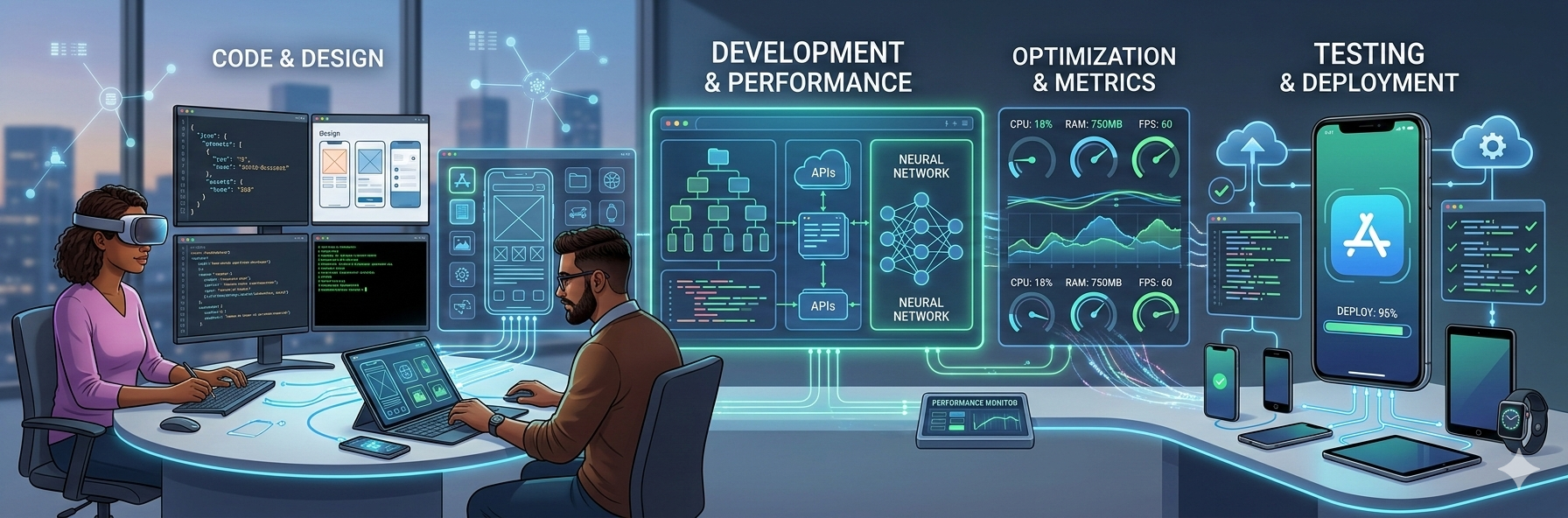
In today’s mobile-first world, users expect apps to be fast, smooth, and reliable. A slow or poorly optimized app can quickly lead to frustrated users, low ratings, and lost business opportunities. That’s why mobile application developers focus heavily on performance when building modern apps. High-performance mobile applications not only load quickly but also provide seamless navigation, efficient data handling, and strong security.
But building a high-performance app is not just about writing code—it involves smart architecture, optimized UI/UX design, efficient backend integration, and continuous testing. From choosing the right development framework to implementing advanced performance optimization techniques, experienced developers follow proven strategies to ensure apps run flawlessly across devices and platforms.
In this guide, we’ll explore how mobile application developers build high-performance apps, the key technologies they use, and the best practices that help create fast, scalable, and user-friendly mobile experiences in 2026.
Know User Requirements First
Mobile app development that performs well is created with complete knowledge of the user's needs at the time of development. The Mobile application developers will review the target users for their app, as well as what the target users expect from the application, and how they utilize similar applications. This aspect of knowledge allows them to determine which features must be included to meet user expectations and also helps them reduce the unnecessary complexity that may hinder performance.
Key focus areas:
- Client behavior analysis
- Defining required features
- Eliminating feature overload
- Properly setting performance benchmarks
When developers develop with clarity from the start, the application remains efficient and purpose-driven.
Choosing the Right Technology Stack
Being able to utilize the proper tools and technologies is crucial in Android app development to ensure its overall success. The type of Custom mobile app development created (hybrid, native, or cross-platform) can greatly affect the performance of that application in terms of speed and its ability to seamlessly grow in the future, as well as being easily and quickly supported.
|
|
|
|
|
|
|
|
|
|
|
|
|
|
|
|
When selecting the appropriate stack, be sure to consider the following:
- Programming Language (Swift, Kotlin, or JavaScript)
- Framework (Flutter or React Native)
- Backend Infrastructure
When these technologies are properly selected in iOS app development, they will allow your application to process data quickly and perform smoothly while providing for future scalability.
UI/UX Design for Speed & Simplicity
The speed of an Cross-platform app development isn’t solely determined by its backend performance; the overall user experience of the application plays a role in an application's speed experience as well. A clean and simple design will help lower load times and improve user friendliness. Additionally, the App development process will work to develop interfaces that are intuitive and minimize non-essential graphics and heavy graphical elements that will negatively impact application speed.
Good UI design is as follows:
- Minimalistic design
- Fast loading screens
- Optimized images and assets
- Clearly defined navigation paths
Effective UI design allows the end-user to stay fully engaged with the App while not hindering the overall performance of the application.
Performance Testing & Optimization
The testing phase allows abstract and functional performance elements to be evaluated and improved by loop-based cycles of Mobile application developers testing their applications on various hardware, software, and network configurations.
Mobile app optimization techniques used during development:
- Implementation and enhancement of the code
- Use of on-demand data loading access techniques
- Reducing the number of calls made to APIs
The different types of performance tests conducted include:
- Scalability testing
- Performance testing
- Performance benchmarks
By performing continuous testing, end-users are ensured a consistent experience across multiple devices and network conditions.
Security Without Compromising Speed
For developers, security features are more crucial than anything else for Scalable mobile applications. You should be able to apply strong measures for security without sacrificing too much performance.
Key features of good security practices include:
- Protecting data
- Applying safe API’s
- Managing authentication tools such as biometrics
The purpose of this is to keep user data safe while providing the best possible user experience.
Continuous Monitoring & Improvement
High-performance mobile apps are built continuously, not all at once. Developers continuously evaluate the performance of their applications during runtime and the user’s interactions with the application to enhance or modify them.
Strategies for this continuous development include:
- Performance insights
- Fault detection tools
- Regular updates and bugs corrections
- Incorporation of user feedback
This ongoing cycle allows applications to remain fast, current, and competitive.
Why Choose Us for Mobile App Development
-
Expert Developers & Modern Technology – Our skilled team builds high-performance mobile apps using the latest frameworks and industry best practices.
-
User-Focused UI/UX Design – We create intuitive, engaging, and visually appealing app experiences that keep users coming back.
-
Custom & Scalable Solutions – Every app is tailored to your business needs with scalable architecture for future growth.
-
End-to-End Development Support – From idea and design to development, testing, and launch, we provide complete mobile app development services.
Conclusion
Creating High-performance mobile apps requires the developer to manage several different areas at once, including, but not limited to, user experience, technology selection, and design optimization. While improving performance through speed, efficiency, and security, these developers should also implement effective strategies to create reliable, scalable mobile applications. That will help meet client needs as they change over time through continual measurement and monitoring of their strategic approach.
Ready to build a powerful mobile app for your business? Contact us today to turn your idea into a high-performance, secure, and user-friendly application with Coherent Lab’s expert mobile app developers.
Frequently Asked Questions (FAQs)
Q1. What makes a mobile app high-performance?
Ans. A high-performance mobile app loads quickly, runs smoothly without crashes, responds efficiently to user actions, and provides a seamless experience across different devices and operating systems. Mobile application developers achieve this through optimized code, reduced loading times, efficient APIs, responsive UI/UX design, proper memory management, and continuous performance testing. Regular monitoring also helps identify bottlenecks and maintain consistent app performance as the user base grows.
Q2. Which technologies are used to build high-performance mobile apps?
Ans. Developers use modern technologies such as Flutter, React Native, Swift, Kotlin, and advanced backend frameworks to build fast, scalable, and reliable mobile applications. Flutter and React Native support cross-platform development, while Swift and Kotlin are commonly used for native iOS and Android applications. The right technology depends on factors such as performance requirements, platform support, app complexity, scalability, integrations, development budget, and long-term maintenance needs.
Q3. How do developers improve mobile app speed and performance?
Ans. Mobile developers improve app performance by compressing images, reducing unnecessary code, implementing caching techniques, optimizing database queries, minimizing network requests, and improving API response times. Developers also use efficient algorithms and memory management techniques to reduce resource consumption. Regular performance testing, monitoring, and profiling help identify slow components, crashes, and bottlenecks so they can be fixed before they negatively affect the user experience.
Q4. Why is UI/UX design important for mobile app performance?
Ans. A well-designed UI/UX helps create smooth navigation, faster interactions, clear user flows, and better engagement. Mobile application developers focus on responsive layouts, simple navigation structures, optimized visual elements, and minimal loading delays to create a positive experience. Good UI/UX design can also reduce unnecessary interactions and make important features easier to access, helping users complete tasks efficiently across different screen sizes and devices.
Q5. How do developers ensure mobile app security and stability?
Ans. Developers implement secure authentication, data encryption, secure APIs, access controls, and regular updates to protect user data and maintain application stability. Security testing, vulnerability checks, performance monitoring, crash tracking, and timely bug fixes are also essential. Developers should regularly update dependencies, test different device configurations, and monitor application behavior after deployment to maintain a secure, stable, and dependable mobile experience.
Q6. How long does it take to develop a high-performance mobile app?
Ans. Development time depends on the app's features, design complexity, platform requirements, backend integrations, security needs, and testing scope. A simple application may take less time, while a feature-rich enterprise or consumer app can require several stages, including planning, UI/UX design, development, testing, deployment, and ongoing optimization. Proper project planning and clearly defined requirements can help teams establish a realistic development timeline.
Q7. How much does it cost to develop a high-performance mobile app?
Ans. Mobile app development costs vary according to features, technology stack, number of platforms, design requirements, backend infrastructure, third-party integrations, security, and maintenance. Businesses should consider both initial development expenses and ongoing costs for hosting, updates, monitoring, security improvements, and performance optimization. The overall budget can also change depending on whether the app requires advanced features such as AI, real-time communication, payment integration, or complex backend systems.
Q8. Can a mobile app be developed for both Android and iOS?
Ans. Yes, businesses can develop mobile applications for both Android and iOS using native or cross-platform technologies. Frameworks such as Flutter and React Native can help teams build applications for multiple platforms from a shared codebase, while Swift and Kotlin are commonly used for native iOS and Android development. The choice depends on performance requirements, platform-specific functionality, development resources, scalability, and long-term maintenance goals.

 +91 774-202-1725
 +1 (945) 3387904
 business@coherentlab.com
 +49 15223341304
 UK
UK