Table of Contents
How to Build a Zomato Clone App from Scratch in 2026
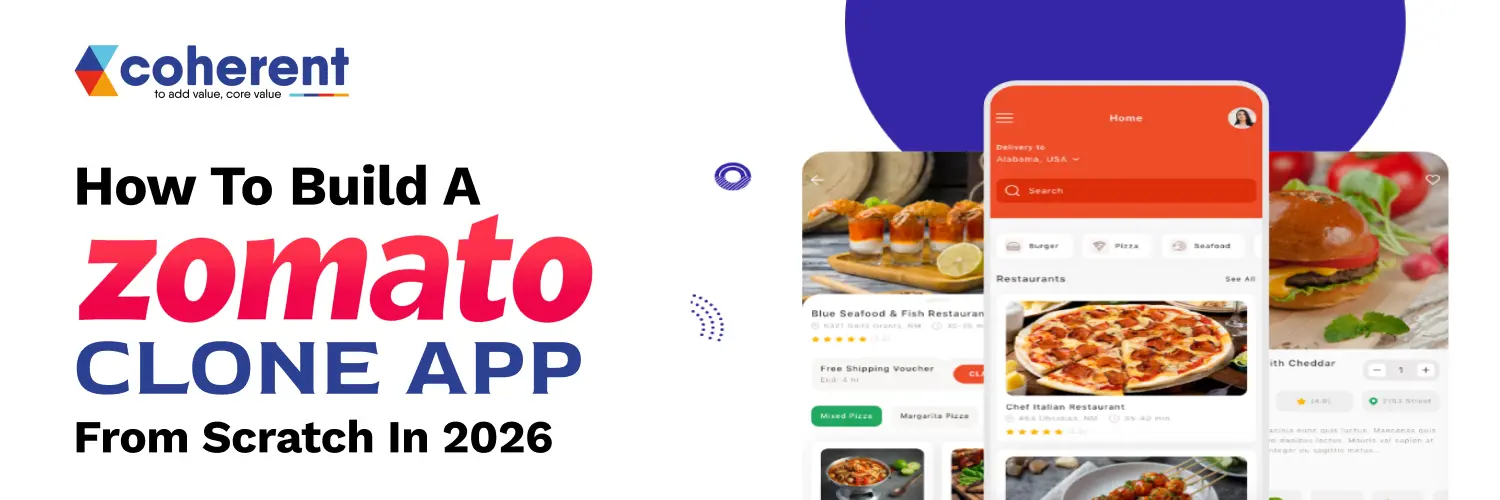
Building a Zomato clone app from scratch in 2026 starts with understanding the market and identifying user needs in the food delivery space. The first step is research, where you study competitors, target audience, and essential features like restaurant listings, order tracking, payments, and reviews. Next comes UI/UX design, where a simple and user-friendly interface is created to ensure smooth navigation. After design, the backend development begins using technologies like Node.js, Django, or Laravel, while the frontend can be built using Flutter or React Native for cross-platform support. APIs for payments, maps, and notifications are integrated to enhance functionality. Then comes testing, where bugs are fixed, and performance is optimized. Once everything is stable, the app is deployed on app stores. Post-launch, continuous updates, marketing, and user feedback help improve performance. With a proper mobile app development strategy, your Zomato clone can scale successfully in 2026.
Key Features of a Zomato Clone App
A Zomato clone app includes essential features like restaurant listings, real-time order tracking, user reviews, advanced search filters, secure payment integration, and delivery management. It enhances user experience with personalized recommendations, push notifications, and loyalty programs. These features help businesses build scalable, user-friendly food delivery platforms that attract customers, boost engagement, and increase revenue efficiently in today’s competitive market.
User App Features
- Easy registration (phone/email/social login)
- Smart restaurant search & filters
- Live order tracking with GPS
- Ratings & reviews system
- Secure payment integration (UPI, cards, wallets)
- Personalized food recommendations
Restaurant Panel Features
- Menu and pricing management
- Order acceptance/rejection system
- Real-time order tracking dashboard
- Sales analytics & performance reports
- Discount and coupon management
Delivery Partner App Features
- Auto order assignment system
- Google Maps navigation
- Delivery status updates in real-time
- Earnings and payout tracking
- Availability toggle system
Technology Stack for Zomato Clone App Development
Building a Zomato clone app requires a technology stack including React Native or Flutter for mobile apps, Node.js or Django for backend, MySQL or MongoDB databases, cloud hosting like AWS, real-time tracking APIs, secure payment gateways, and scalable microservices architecture.
- Frontend (Mobile App): Flutter / React Native
- Backend: Node.js / Django / Laravel
- Database: MongoDB / PostgreSQL
- Cloud Hosting: AWS / Google Cloud / Azure
- APIs: Google Maps API, Payment Gateway APIs (Razorpay, Stripe)
Step-by-Step Process to Build Zomato Clone App
The step-by-step process to build a Zomato clone app starts with market research, followed by UI/UX design, backend development, and API integration. Next comes testing, deployment, and app launch. In mobile app development, focusing on scalability, performance, and user experience is crucial. After launch, continuous updates, bug fixes, and marketing help improve engagement, retention, and long-term success in the food delivery industry.
Step 1: Market Research & Planning
Before development, analyze:
- Target audience (urban users, students, office workers)
- Competitors like Zomato and Swiggy
- Revenue model and niche strategy
Step 2: UI/UX Design
A good design increases user retention.
Focus on:
- Clean and minimal interface
- Easy navigation
- Mobile-first design
- Fast checkout experience
Step 3: App Development
This is the core phase:
- Frontend development for user interaction
- Backend setup for data handling
- API integration for payments and maps
- Admin panel creation
Step 4: Testing & Quality Assurance
Ensure smooth performance by testing:
- App speed and responsiveness
- Bug fixing and error handling
- Security testing (data protection & payments)
- Load testing for high traffic
Step 5: Deployment & Launch
- Publish app on Play Store & App Store
- Deploy backend on CloudD servers
- Run marketing campaigns
- Offer launch discounts to attract users
Cost to Build a Zomato Clone App
The cost to build a Zomato clone app depends on features, design, and complexity. A basic version starts around $5,000–$20,000, while advanced apps can go beyond $50,000+. Factors like UI/UX, backend system, and integrations impact the overall mobile app development cost. Custom features, real-time tracking, and scalability increase the budget but ensure better performance, user experience, and long-term business growth in a competitive market.
Basic App: $5,000 – $15,000
Mid-Level App: $15,000 – $40,000
Advanced App with AI Features: $40,000 – $100,000+
Factors affecting cost:
- UI/UX design complexity
- Number of features
- Technology stack
- Third-party integrations
- Developer experience
Monetization Strategies for Food Delivery App
Monetization strategies for food delivery apps focus on generating revenue through multiple channels. Key methods include restaurant commissions, delivery fees, in-app advertisements, subscription plans, and premium listings. These models help maximize profits while ensuring steady growth in a competitive market. Strong mobile app monetization strategies also improve user engagement and long-term business sustainability by balancing customer value and revenue generation effectively.
|
|
|
|
|
|
|
|
|
|
|
|
|
|
|
|
|
|
Challenges in Building a Food Delivery App
Challenges in building a food delivery app include managing real-time order tracking, ensuring fast delivery logistics, handling high user traffic, and maintaining app performance. Security of payments and smooth user experience are also critical factors. In food delivery app development, competition is intense, so retaining users and restaurants becomes difficult. Scalability, integration of multiple APIs, and cost management further add complexity to successful app development and long-term growth.
- High competition from big players
- Managing delivery logistics
- Maintaining app performance during peak hours
- Customer retention and loyalty building
- High operational costs
Future of Food Delivery Apps in 2026 and Beyond
The future of food delivery apps in 2026 and beyond is highly driven by AI, automation, and faster logistics. With increasing demand for convenience, businesses are investing in mobile app development to create smarter, scalable platforms. Features like real-time tracking, personalized recommendations, and instant payments will redefine user experience and make the industry more competitive and profitable globally in the future.
- AI-based food recommendations
- Drone and robot deliveries
- Voice-based ordering systems
- Hyperlocal instant delivery models
- Predictive analytics for customer behavior
Conclusion
Building a Zomato clone app in 2026 is not just about copying features—it’s about creating a smarter, faster, and more personalized food delivery experience. With the right technology stack, strong planning, and innovative features, you can build a scalable and profitable food delivery business. Ready to launch your Zomato clone app and grow your food delivery business? Our expert team is here to build scalable, feature-rich solutions tailored to your needs. Don’t wait to turn your idea into reality Contact Us Today and get started with powerful, result-driven development that boosts your success and revenue fast.
frequently asked questionsQ.1. How long does it take to build a Zomato clone app?
Ans. Building a Zomato clone app usually takes between 2 to 6 months depending on the features and complexity involved. A simple MVP with basic ordering and listing features can be developed quickly, while advanced versions with AI recommendations, real-time tracking, and payment integrations take longer. The timeline also depends on the size of the development team, experience level, and testing requirements for performance and scalability.
Q. 2. Is a Zomato clone app profitable in 2026?
Ans. Yes, a Zomato clone app can be highly profitable in 2026 due to the continuous rise in online food ordering and delivery demand. People prefer convenience, which boosts app usage in both urban and semi-urban areas. Revenue streams include restaurant commissions, delivery charges, in-app advertisements, and subscription models. With proper marketing and user retention strategies, such apps can generate strong and consistent long-term income.
Q.3. Which technology is best for building a food delivery app?
Ans. The best technology for building a food delivery app includes Flutter or React Native for the frontend, as they support cross-platform development and faster deployment. For backend development, Node.js or Django are widely preferred due to their scalability and performance. These technologies allow smooth user experience, real-time updates, secure transactions, and easy integration with APIs like payment gateways and mapping services for delivery tracking. -
Q.4. Can I build a Zomato clone app without coding?
Ans. Yes, it is possible to build a Zomato clone app without coding using no-code platforms or ready-made white-label solutions. These tools allow quick setup with drag-and-drop features and pre-built templates. However, while they are cost-effective and fast, they may have limitations in customization, scalability, and advanced features. For long-term growth and unique branding, custom-coded apps are generally a better option.Q.5. What is the minimum cost to develop a Zomato clone app?
Ans.The minimum cost to develop a Zomato clone app starts from around $5,000 for a basic version with essential features like user login, restaurant listing, and order placement. However, if you want advanced functionalities like real-time tracking, AI-based recommendations, multiple payment gateways, and analytics dashboards, the cost can increase significantly. Pricing also depends on developer expertise, design quality, and app complexity.Q.6. How do food delivery apps make money?
Q.7. What are the biggest challenges in food delivery app development?
Ans.Food delivery apps generate revenue through multiple channels. The main source is commission charged from restaurants on every order placed through the platform. Additional income comes from delivery fees, featured listings, in-app advertisements, and subscription plans for premium users. Some apps also earn through surge pricing during peak hours. A strong user base and high order volume directly increase overall profitability and business growth.
Ans.Developing a food delivery app comes with several challenges such as managing real-time logistics, ensuring fast and accurate deliveries, and handling high competition in the market. Scalability becomes crucial as user traffic grows. Maintaining customer satisfaction, reducing order delays, and integrating seamless payment systems are also major concerns. Additionally, retaining users and balancing restaurant partnerships require strong operational and technical strategies.

 +91 774-202-1725
 +1 (945) 3387904
 business@coherentlab.com
 +49 15223341304
 UK
UK