Table of Contents
Best Hyper Casual Game Engines for Developers in 2026 (Complete Comparison Guide)
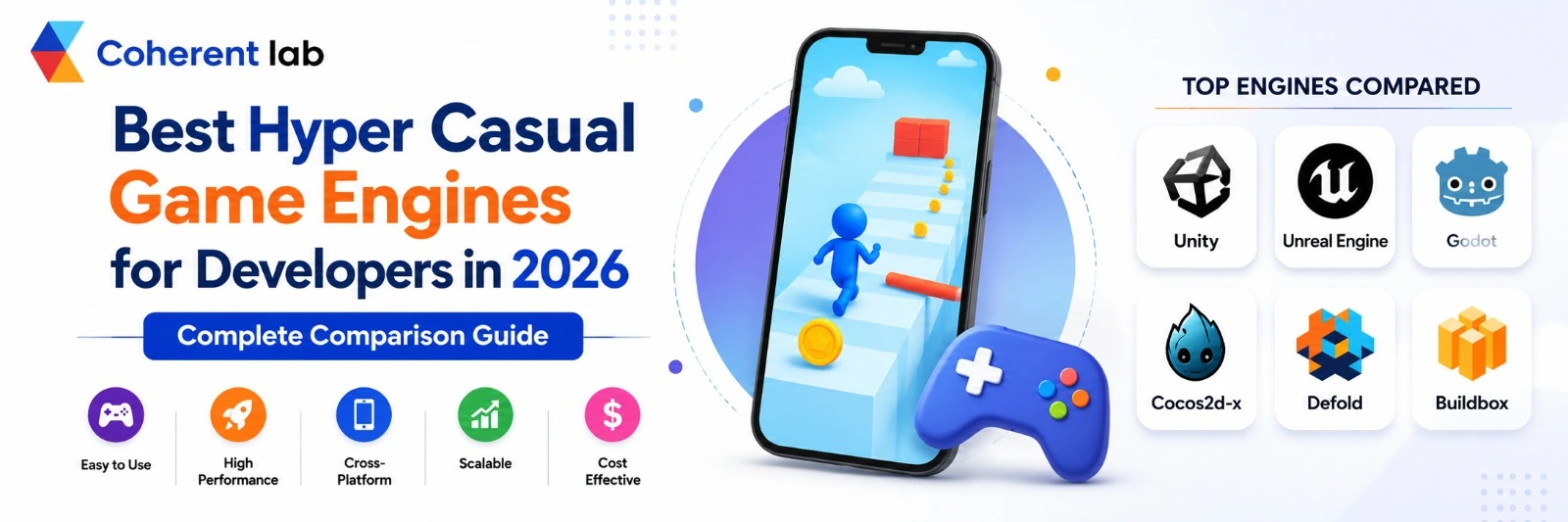
Hyper casual games continue to dominate the mobile gaming industry in 2026. Their simple gameplay, quick learning curve, and addictive mechanics make them a favorite among millions of players. However, creating a successful hyper casual game starts with one important decision—choosing the right game engine.The best hyper casual game engine helps developers build games faster, optimize performance for Android and iOS, integrate ad monetization, and launch across multiple platforms with minimal effort.
Whether you're an indie developer, startup, or established game development company, selecting the right engine can significantly reduce development time and improve your game's success.In this guide, we'll explore the best hyper casual game engines for developers in 2026, compare their features, discuss their pros and cons, and help you choose the ideal engine for your next mobile game.
What Is a Hyper Casual Game Engine?
A hyper casual game engine is a software platform used to design, develop, test, and publish lightweight mobile games with simple gameplay mechanics. These engines provide developers with essential tools for coding, animation, physics, UI design, asset management, and deployment.Unlike engines built primarily for large-scale AAA games, hyper casual game engines focus on speed, efficiency, and rapid prototyping.
Key Characteristics
- Fast game development
- Lightweight applications
- Cross-platform publishing
- Built-in physics and animation
- Easy advertising SDK integration
- Excellent mobile optimization
Also Read :- 10 Successful Hyper Casual Game Ideas for Startups to Build in 2026
Why Choosing the Right Game Engine Matters in 2026
The hyper casual market has become increasingly competitive. Players expect smooth gameplay, instant loading times, and engaging experiences. A poor choice of game engine can result in slow performance, larger app sizes, and higher development costs.
- Faster development cycles
- Better mobile performance
- Reduced development costs
- Easier monetization integration
- Cross-platform compatibility
- Improved scalability for future updates
Best Hyper Casual Game Engines for Developers in 2026
Discover the best hyper casual game engines for developers in 2026, including Unity, Unreal Engine, Godot, and Cocos Creator. Compare their features, performance, ease of development, and cross-platform capabilities to choose the ideal engine for building engaging, high-performance, and profitable mobile games. Professional game app development services can help accelerate development, optimize performance, and ensure scalable deployment across multiple platforms.
1. Unity
Unity remains the most popular engine for hyper casual game development in 2026. It combines ease of use, powerful tools, and extensive community support, making it the preferred choice for both beginners and professional studios.
Its extensive Asset Store, mobile optimization, and built-in monetization tools allow developers to build and launch games quickly. Many of today's top-performing hyper casual games are powered by Unity.
Best Features
- Cross-platform development
- Powerful 2D and 3D tools
- Built-in physics engine
- Unity Ads integration
- Large Asset Store
- Cloud collaboration
- Real-time analytics support
Pros
- Easy to learn
- Huge developer community
- Excellent documentation
- Strong mobile optimization
- Thousands of plugins
Cons
- Licensing costs for larger studios
- Can consume more system resources than lightweight engines
Best For
- Indie developers
- Startups
- Professional game studios
- Cross-platform mobile games
2. Godot Engine
Godot Engine has become one of the fastest-growing open-source game engines. Its lightweight architecture, flexibility, and zero licensing fees make it an excellent option for developers looking to build cost-effective hyper casual games.
Godot offers excellent performance for 2D games while also supporting 3D development. Since it's open source, developers have complete control over customization.
Best Features
- Completely free
- Open-source platform
- Excellent 2D engine
- Lightweight editor
- Fast prototyping
- Cross-platform publishing
Pros
- No licensing fees
- Small application size
- Fast development workflow
- Beginner-friendly scripting
- Active community support
Cons
- Smaller Asset Store than Unity
- Fewer third-party plugins
Best For
- Indie developers
- Budget-conscious startups
- Open-source enthusiasts
- Lightweight mobile games
3. Unreal Engine
Unreal Engine is best known for AAA-quality games, it is increasingly being used for premium hyper casual and hybrid casual games that require advanced graphics and immersive visual effects.
If your game relies on high-quality rendering, cinematic animations, or advanced physics, Unreal Engine offers unmatched capabilities.
Best Features
- Stunning graphics
- Blueprint visual scripting
- Advanced physics engine
- High-performance rendering
- Multiplayer support
- Cross-platform deployment
Pros
- Industry-leading visuals
- Powerful development tools
- Excellent scalability
- Advanced animation system
Cons
- Steeper learning curve
- Larger project sizes
- Overpowered for simple games
Best For
- Premium mobile games
- Hybrid casual games
- Large development studios
- High-end visual experiences
4. Buildbox
Buildbox is one of the easiest game engines available for creating hyper casual games. It allows developers to build complete games without extensive programming knowledge.
Using its drag-and-drop interface, creators can design gameplay, animations, levels, and UI elements in just a few hours, making it ideal for rapid prototyping and MVP development.
Best Features
- No-code development
- Drag-and-drop editor
- Built-in templates
- Quick publishing
- Mobile optimization
- Easy monetization integration
Pros
- Beginner-friendly
- Extremely fast development
- No coding required
- Ideal for testing game ideas
Cons
- Limited customization
- Subscription pricing
- Not suitable for complex games
Best For
- Beginners
- Solo developers
- Entrepreneurs
- Rapid game prototyping
5. Cocos Creator
Cocos Creator is a lightweight yet powerful game engine designed primarily for 2D mobile game development. It is widely used by developers building fast-loading hyper casual games because of its small build size and excellent performance.
Its JavaScript and TypeScript support, along with an intuitive editor, makes it an attractive option for developers who want flexibility without sacrificing speed.
Best Features
- Optimized for 2D games
- Lightweight builds
- JavaScript and TypeScript support
- Cross-platform publishing
- Fast rendering engine
- Open-source framework
Pros
- Excellent mobile performance
- Small application size
- Easy scripting
- Free to use
- Ideal for lightweight games
Cons
- Limited 3D capabilities
- Smaller community than Unity
Best For
- 2D arcade games
- Puzzle games
- Endless runners
- Small development teams
6. Defold
Defold is another excellent free game engine that has gained popularity among indie developers. It offers a simple workflow, fast development environment, and impressive optimization for Android and iOS.
Because Defold creates compact applications, it's perfect for hyper casual games where quick downloads and smooth performance are essential.
Best Features
- Free forever
- Lightweight editor
- Excellent mobile optimization
- Lua scripting
- Cross-platform support
- Fast compilation
Pros
- Small game size
- Easy to learn
- Excellent performance
- Great documentation
Cons
- Limited third-party plugins
- Smaller developer community
Best For
- Indie developers
- Mobile-first games
- Lightweight projects
7. GameMaker
GameMaker has remained one of the easiest engines for creating 2D games. It provides drag-and-drop tools alongside its scripting language, allowing both beginners and experienced developers to work efficiently.
Many successful indie mobile games have been created using GameMaker because of its simple development workflow.
Best Features
- Beginner-friendly interface
- Drag-and-drop development
- Powerful scripting language
- Excellent 2D tools
- Cross-platform export
Pros
- Easy to learn
- Fast prototyping
- Strong 2D support
- Large learning resources
Cons
- Limited advanced 3D features
- Export licenses can be expensive
Best For
- Indie studios
- Beginners
- 2D mobile games
8. Solar2D
Solar2D is an open-source framework that focuses on rapid mobile application and game development. Developers can build simple hyper casual games quickly using the Lua programming language.
Its lightweight architecture makes it suitable for games requiring small download sizes and smooth gameplay.
Best Features
- Open-source platform
- Lightweight framework
- Lua scripting
- Fast deployment
- Cross-platform support
Pros
- Quick development
- Easy programming language
- Small builds
- Free to use
Cons
- Smaller ecosystem
- Fewer plugins than Unity
Best For
- Simple mobile games
- Casual game developers
- Indie projects
Also Read :- How to Build a Hyper Casual Game App in 2026
Hyper Casual Game Engine Comparison
Compare the top hyper casual game engines, including Unity, Unreal Engine, Godot, and Cocos Creator. Explore their features, performance, ease of use, cross-platform support, and development benefits to choose the best engine for creating engaging, scalable, and high-performing hyper casual mobile games with faster development and optimized player experiences.
| Engine | Best For | Difficulty Level | Pricing |
|---|---|---|---|
| Unity | Overall Game Development | Medium | Free & Paid Plans |
| Godot | Open Source Projects | Easy | Free |
| Unreal Engine | Premium Graphics & AAA Games | Advanced | Royalty-Based Model |
| Buildbox | No-Code Game Development | Very Easy | Subscription |
| Cocos Creator | Lightweight 2D Games | Easy | Free |
| Defold | Small Mobile Games | Easy | Free |
| GameMaker | Indie Game Developers | Easy | Paid |
| Solar2D | Rapid Prototyping & Mobile Games | Easy | Free |
How to Choose the Best Hyper Casual Game Engine
Learn how to choose the best hyper casual game engine by comparing performance, ease of development, cross-platform support, scalability, graphics, community resources, and budget. Selecting the right engine helps developers build engaging, high-performing, and profitable mobile games while reducing development time and improving efficiency. Professional mobile app development services can further streamline the development process and support long-term growth in the competitive gaming market.
Consider Your Development Experience
- Beginners should consider Buildbox or GameMaker.
- Intermediate developers may prefer Unity or Godot.
- Experienced teams can leverage Unreal Engine for advanced projects.
Evaluate Performance
Your game engine should deliver:
- Fast loading times
- Stable frame rates
- Low battery consumption
- Small app size
Check Monetization Support
Look for engines that support:
- Google AdMob
- Unity Ads
- Rewarded video ads
- In-app purchases
- Analytics SDKs
Think About Scalability
As your game grows, you may need:
- Multiplayer features
- Live events
- Cloud saves
- AI-powered gameplay
- LiveOps integration
Hyper Casual Game Development Trends in 2026
Explore the latest hyper casual game development trends in 2026, including AI-powered gameplay, hybrid monetization, cloud gaming, LiveOps, cross-platform development, and data-driven optimization. Coherent Lab LLP leverages these innovations to help businesses build engaging, scalable, and profitable mobile games that enhance player retention, improve user experience, and achieve long-term success in the competitive gaming industry.
- AI-assisted game development
- Hybrid casual gaming mechanics
- Procedural level generation
- Cloud-based development tools
- LiveOps updates
- Privacy-focused ad monetization
- Predictive player analytics
- Cross-platform game publishing
Hyper Casual Game Development Cost
Understand hyper casual game development costs by exploring key factors such as game complexity, design, features, technology, development team, testing, and post-launch support. Reviewing a detailed mobile app development cost guide can help you budget effectively, optimize development expenses, and build engaging, scalable, and profitable mobile games while maximizing your return on investment.
Cost Factors
- Game complexity
- Platform (Android, iOS, or both)
- UI/UX design
- Animations
- Multiplayer functionality
- Backend services
- Testing and QA
- Maintenance and updates
Conclusion
Hyper casual game development continues to evolve as new technologies, changing player expectations, and innovative monetization strategies reshape the mobile gaming industry. Choosing the right game engine, following the latest development trends, and avoiding common mistakes can significantly improve your game's performance and long-term success.
Whether you're building a simple one-tap experience or expanding into hybrid casual gameplay, careful planning and the right development partner make all the difference. By focusing on engaging gameplay, smooth performance, data-driven optimization, and scalable architecture, businesses can create successful games that attract more players, increase retention, and generate sustainable revenue in an increasingly competitive global mobile gaming market.Contact Us Today.
Frequently Asked Questions
Q1. Which is the best hyper casual game engine in 2026?
Ans:Unity is widely considered the best hyper casual game engine in 2026 because of its cross-platform compatibility, large asset marketplace, strong developer community, excellent mobile optimization, and built-in monetization tools. It enables developers to create high-quality games quickly while supporting Android, iOS, and other platforms efficiently.
Q2. Is Godot better than Unity?
Ans:Godot is a powerful open-source engine that works well for lightweight 2D hyper casual games and independent developers. However, Unity offers a larger ecosystem, better third-party integrations, stronger monetization options, and broader industry adoption, making it the preferred choice for commercial mobile game development.
Q3. Which engine is easiest for beginners?
Ans:Buildbox is one of the easiest game engines for beginners because it features a drag-and-drop interface with little to no coding required. It allows new developers to create simple hyper casual games quickly while learning basic game design and publishing workflows.
Q4. Can Unreal Engine be used for hyper casual games?
Ans:Yes. Unreal Engine can be used for hyper casual games, especially those requiring advanced graphics, visual effects, or hybrid casual gameplay. Although it has a steeper learning curve than Unity, it delivers exceptional visual quality and powerful development tools for ambitious projects.
Q5. Which engine provides the best mobile performance?
Ans:Unity, Cocos Creator, and Defold all deliver excellent mobile performance when optimized correctly. These engines support lightweight builds, smooth gameplay, efficient memory management, and fast loading times, making them ideal for creating responsive hyper casual games on Android and iOS devices.
Q6. How long does it take to develop a hyper casual game?
Ans:A basic hyper casual game usually takes between 4 and 12 weeks to develop. The timeline depends on gameplay complexity, graphics, features, testing, and team size. More advanced games with custom mechanics or multiplayer functionality typically require additional development time.
Q7. Which engine is best for ad monetization?
Ans:Unity is a leading choice for ad monetization because it supports Unity Ads, Google AdMob, mediation platforms, analytics tools, and rewarded video ads. These features help developers maximize advertising revenue while maintaining a smooth and engaging player experience.
Q8. Should I hire a professional hyper casual game development company?
Ans:Hiring a professional hyper casual game development company is a smart choice for commercial projects. Experienced developers can deliver optimized gameplay, attractive visuals, effective monetization strategies, faster development, quality testing, and post-launch support, helping your game succeed in a competitive mobile gaming market.

 +91 774-202-1725
 +1 (945) 3387904
 business@coherentlab.com
 +49 15223341304
 UK
UK