Table of Contents
How to Integrate AI Agents Into Existing Business Software
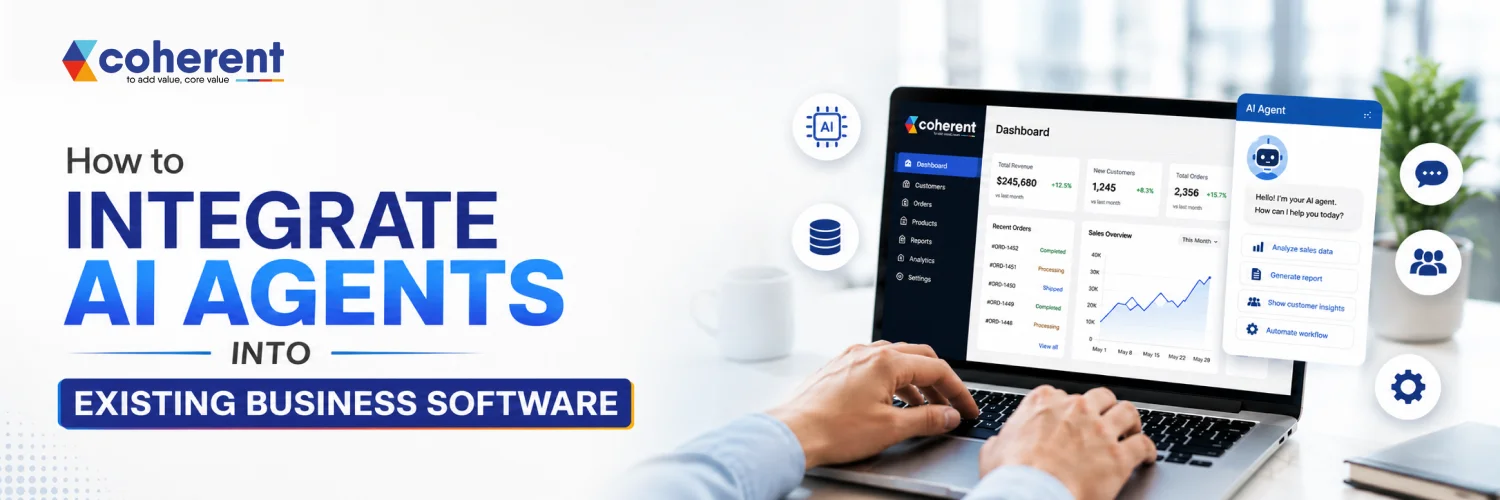
Businesses do not always need to replace their existing software to take advantage of artificial intelligence. In many cases, the smarter approach is to integrate AI agents into existing business software, allowing current systems to become more automated, intelligent, and responsive.From CRM and ERP platforms to customer support tools, HR systems, and internal applications, AI agents can work alongside existing technology to automate repetitive tasks, retrieve information, analyze data, and support employees in completing complex workflows.
However, successful AI agent integration requires more than connecting an AI model to an API. Businesses need the right use case, secure access to data, reliable integrations, human oversight, and ongoing monitoring.This guide explains how businesses can integrate AI agents into existing software without unnecessarily rebuilding their entire technology stack.
What Are AI Agents in Business Software?
AI agents are software systems designed to understand goals, process information, make decisions, use tools, and perform actions with varying levels of autonomy. Unlike basic chatbots, they can interact with multiple systems to complete tasks efficiently. Modern AI agent and AI app development often combine machine learning, natural language processing, automation tools, APIs, and cloud platforms to create intelligent applications that improve business productivity and user experiences.
- Large language models (LLMs)
- APIs and third-party integrations
- Business databases
- Retrieval-augmented generation (RAG)
- Workflow automation
- Agent memory
- Enterprise knowledge bases
- Authentication and permission systems
How AI Agents Work
An AI agent typically receives a request or trigger, understands the objective, gathers relevant information, determines an appropriate next action, interacts with authorized tools, and returns a result or completes a workflow.For sensitive or high-impact actions, businesses can keep humans in the approval loop rather than allowing the agent to operate completely independently.
AI Agents vs Traditional Automation
Traditional automation generally follows predefined rules: when X happens, perform Y. AI agents can handle less structured situations by interpreting natural-language requests, reasoning over contextual information, selecting tools, and deciding the steps needed to achieve a goal. Traditional automation remains valuable for predictable workflows, while AI agents are especially useful in mobile app development, where user interactions, changing requirements, connected systems, and real-time decisions require greater flexibility and intelligence.
Why Businesses Are Integrating AI Agents Into Existing Software
Businesses are integrating AI agents into existing software and software development workflows to automate repetitive tasks, improve customer support, accelerate decision-making, and enhance operational efficiency. AI agents can work with CRM, ERP, and other business systems to analyze data, generate insights, and perform actions with minimal human intervention. This integration helps companies reduce costs, increase productivity, deliver personalized experiences, and scale operations faster in today’s competitive digital market.
Automate Repetitive Business Processes
AI agents can assist with activities such as data entry, document processing, lead qualification, ticket classification, report preparation, information retrieval, and routine follow-ups.Employees can then spend more time on work requiring judgment, creativity, relationships, and strategic decision-making.
Improve Decision-Making With AI
When securely connected to relevant business information, AI agents can help teams analyze data and surface useful insights. For example, an agent could summarize sales performance, identify unusual patterns, compare historical results, or retrieve information from multiple internal sources for an employee. The final business decision can remain with a human while AI accelerates the research and analysis behind it.
Enhance Customer and Employee Experience
Employees often lose time moving between applications to find information or complete basic processes. An integrated AI agent can provide a conversational interface across approved systems, making information and workflows easier to access. The same principle applies to customer experiences. Properly designed agents can answer common questions, retrieve account information, route complex cases, and support customer service teams.
Also Read :- How to Build an AI Agent for Your Business
How to Integrate AI Agents Into Existing Business Software
Learn how to integrate AI agents into existing business software to automate workflows, improve decision-making, and boost productivity. This guide explains key integration methods, APIs, data connectivity, security considerations, and best practices for CRM, ERP, HR, and customer support systems. Discover practical steps businesses can follow to add AI capabilities without replacing their current software infrastructure.
1. Identify the Right AI Agent Use Cases
Start by identifying repetitive, time-consuming, or information-heavy workflows.Strong initial use cases may include customer support assistance, CRM updates, internal knowledge retrieval, document analysis, sales support, employee onboarding, or reporting.Avoid introducing AI simply because it is popular. Define the expected business outcome first.
2. Evaluate Your Existing Software and Data
Before building an integration, evaluate the current technology environment. Review your CRM, ERP, databases, APIs, internal applications, authentication systems, cloud infrastructure, and data architecture.Businesses should understand where relevant information lives, whether systems expose suitable APIs, what permissions are required, and whether the underlying data is reliable enough for the intended AI use case.
3. Choose the Right AI Agent Technology
The technology stack should match the use case rather than forcing every problem into the same architecture. Depending on requirements, an AI agent solution might include an LLM, retrieval system, vector database, orchestration layer, API gateway, monitoring tools, and existing enterprise applications. Organizations should evaluate factors including performance, privacy, scalability, integration flexibility, latency, cost, and model capabilities. For specialized requirements, custom AI agent development can provide greater control over workflows and system integrations.
4. Connect AI Agents Using APIs and Integrations
APIs provide one of the most practical ways for an AI agent to communicate with existing software.Where direct APIs are unavailable, businesses may need middleware, integration platforms, database connectors, or carefully controlled automation.
An agent might use authorized APIs to:
- Retrieve customer records
- Search product information
- Create or update support tickets
- Read approved documents
- Generate reports
- Update CRM records
- Trigger existing workflows
5. Integrate AI Agents With Business Workflows
Connecting systems technically is only part of the job. The agent must fit naturally into existing workflows. Define when the agent is activated, what information it receives, which tools it can use, when it should request approval, and what happens when it encounters an error.For example, an AI customer service agent might handle routine requests automatically but escalate billing disputes or unusual account problems to a human representative.
6. Test, Monitor, and Optimize AI Agents
AI agent testing should cover more than whether the system produces a reasonable answer. Test tool selection, API calls, permissions, edge cases, failure handling, output accuracy, security controls, response times, and escalation behavior. Organizations should also evaluate the agent against realistic business scenarios before broad deployment. After launch, monitor important metrics such as task completion rate, error rate, escalation rate, latency, cost, user satisfaction, and business outcomes.
7. Scale AI Agent Integration Across the Business
Once the first use case demonstrates measurable value, the architecture can be expanded carefully. A business might begin with an internal knowledge agent and later introduce agents for sales, customer service, HR, finance, or operations. Scaling gradually gives teams time to improve governance, security, monitoring, and reusable integration components.
Also Read :- How AI Is Changing Software Development
Best Business Software for AI Agent Integration
AI agents can potentially work with many categories of enterprise software.CRM systems: Agents can assist with lead research, customer summaries, CRM updates, follow-ups, and sales workflow automation. ERP software: AI can help employees retrieve operational information, analyze records, and automate selected administrative workflows.
Customer support platforms: Agents can classify tickets, draft responses, retrieve knowledge, summarize conversations, and escalate difficult cases.
HR and recruitment software: AI agents can support candidate information processing, employee onboarding, internal HR queries, and administrative tasks while appropriate human oversight remains in place.
Project management tools: Agents can summarize project activity, prepare updates, organize information, and help teams identify overdue or blocked work.
Best Practices for Successful AI Agent Integration
A successful implementation usually starts small and expands based on evidence. Choose a clearly defined problem, establish measurable KPIs, use secure API integrations, apply least-privilege access, maintain audit logs, validate important outputs, create fallback mechanisms, and keep humans involved in sensitive decisions. Businesses should also continuously evaluate agent performance. AI agent integration is not simply a one-time software deployment; models, workflows, data, and business requirements can evolve over time.
Cost of Integrating AI Agents Into Existing Software
There is no universal price for AI agent integration because complexity varies significantly.Cost can depend on the number of systems being connected, quality of existing APIs, AI models used, volume of requests, custom development requirements, data infrastructure, security requirements, workflow complexity, and ongoing monitoring.
A relatively focused internal agent connected to one well-documented system will generally require less development than an enterprise agent coordinating workflows across multiple legacy platforms.
Benefits of AI Agent Integration for Businesses
AI agent integration helps businesses automate repetitive tasks, improve customer support, and increase operational efficiency. AI agents can analyze data, respond instantly, manage workflows, and support decision-making in real time. This reduces manual effort, lowers costs, and enhances productivity across departments. Businesses also gain faster response times, better customer experiences, and scalable operations, making AI agent integration a valuable investment for long-term digital growth and competitiveness.
- Reduce repetitive manual work
- Improve access to business knowledge
- Speed up selected workflows
- Deliver faster customer support
- Connect information across multiple systems
- Support employees with contextual assistance
- Scale automation without immediately replacing core software
Also Read :- The Top AI Agent Development Companies in the USA for 2026
Why Choose Coherent Lab for AI Agent Development and Integration?
Successful AI agent development and integration require an understanding of AI, software architecture, APIs, business workflows, data, and security. Coherent Lab helps businesses design and develop AI solutions that can work with existing digital ecosystems. Instead of treating AI as a standalone feature, the focus should be on building practical integrations around real business needs. Whether you want to introduce an internal AI assistant, automate workflows, connect AI with existing applications, or build an AI agent for a specialized business process, a well-planned implementation can make adoption more scalable and useful.
Key Features to Consider When Integrating AI Agents
Successful AI agent integration depends on choosing capabilities that match your existing software, business processes, and user requirements. Rather than adding unnecessary AI features, businesses should focus on functionality that improves automation, connectivity, security, and decision-making while ensuring the agent works smoothly within existing workflows and technology infrastructure.
- Natural Language Understanding: Enables AI agents to understand employee and customer requests in conversational language.
- API Integration: Connects AI agents securely with CRM, ERP, HR, support, and other business applications.
- Workflow Automation: Automates repetitive processes and coordinates tasks across multiple software systems.
- Contextual Awareness: Helps agents use relevant business data and previous interactions to provide more useful responses.
- Role-Based Access Control: Restricts agents to authorized information and actions based on user permissions.
- Real-Time Monitoring: Tracks agent performance, errors, activities, and outcomes to support continuous optimization.
Popular Use Cases of AI Agents in Business Software
AI agents can support different departments by automating routine activities and making business information easier to access. The most effective use cases focus on processes where employees regularly search for information, move data between systems, or complete repetitive tasks, helping organizations improve productivity without replacing their existing software infrastructure.
- Customer Support: Answer common questions, summarize conversations, classify tickets, and route complex issues.
- Sales Automation: Qualify leads, prepare customer summaries, schedule follow-ups, and update CRM information.
- HR Operations: Support onboarding, employee queries, document management, and routine administrative processes.
- Finance Workflows: Assist with invoice processing, financial data retrieval, reporting, and expense-related workflows.
- Internal Knowledge Management: Search company documents and provide employees with relevant information quickly.
- IT Support: Troubleshoot common technical issues, categorize requests, and automate selected service desk tasks.
Also Read :- Top AI Agentic Development Companies in India | Best Firms
Future of AI Agents in Business Software
AI agents are likely to become increasingly embedded within everyday business applications. Instead of employees manually navigating several systems for every task, AI-powered interfaces may help coordinate information and actions across authorized tools. The future is also likely to involve more specialized agents designed around specific departments and workflows rather than one general-purpose agent controlling everything. As capabilities grow, governance will become equally important. Businesses will need strong controls around permissions, data access, monitoring, transparency, security, and human oversight.
Final Thoughts
Integrating AI agents does not require rebuilding your entire software environment. With the right APIs, architecture, security controls, and workflow design, businesses can add intelligent automation to the systems they already use. Start by identifying one high-value problem, define clear boundaries for what the agent can and cannot do, and connect only the data and tools it truly needs. Thorough testing and performance measurement are essential to ensure reliable business outcomes. When implemented carefully, AI agent integration creates a more connected, efficient, and intelligent digital ecosystem. Get in Touch to explore the best integration approach for your business.
Frequently Asked Questions
Q.1. Can AI agents integrate with existing business software?
Ans. Yes. AI agents can integrate with many existing business applications through APIs, databases, middleware, and other connectors. The exact approach depends on the software's architecture, available integration options, security requirements, and the tasks the AI agent needs to perform.
Q.2. How do you integrate an AI agent with an existing application?
Ans. The process typically involves defining the use case, evaluating existing systems, selecting an AI model and architecture, connecting relevant APIs or data sources, defining permissions, designing workflows, testing the agent, and monitoring performance after deployment.
Q.3. Can AI agents work with legacy software?
Ans. Yes, but legacy applications can require additional integration work. If modern APIs are unavailable, developers may use middleware, custom connectors, database integrations, or controlled automation. Security and reliability should be evaluated carefully before allowing an agent to interact with older systems.
Q.4. How much does AI agent integration cost?
Ans. AI agent integration costs vary based on complexity, connected systems, data requirements, AI models, security controls, workflow design, infrastructure, and customization. A simple single-system integration may cost considerably less than a multi-agent enterprise solution involving several applications.
Q.5. How long does AI agent integration take?
Ans. Implementation time depends on the scope and existing technology stack. A focused proof of concept may be developed relatively quickly, while production-grade enterprise integrations can require significantly more time for development, security reviews, testing, governance, and deployment.
Q.6. Are AI agents secure for enterprise software?
Ans. They can be designed with strong enterprise security controls, but security is not automatic. Organizations should implement authentication, authorization, encryption, least-privilege permissions, audit logging, data protection policies, monitoring, and human approval for sensitive actions.
Q.7. What business processes can AI agents automate?
Ans. AI agents can support customer service, sales operations, reporting, document processing, knowledge retrieval, CRM management, employee support, onboarding, and other information-heavy workflows. The best candidates are usually processes with clear goals, accessible data, and measurable outcomes.
Q.8. Do businesses need custom AI agent development?
Ans. Not always. Existing AI platforms may handle straightforward requirements. However, custom AI agent development can be valuable when a business needs specialized workflows, proprietary data integrations, stronger control over security, unique user experiences, or connections with complex existing software.

 +91 774-202-1725
 +1 (945) 3387904
 business@coherentlab.com
 +49 15223341304
 UK
UK