
Table of Contents
IoT App Development: A Complete Guide for Businesses
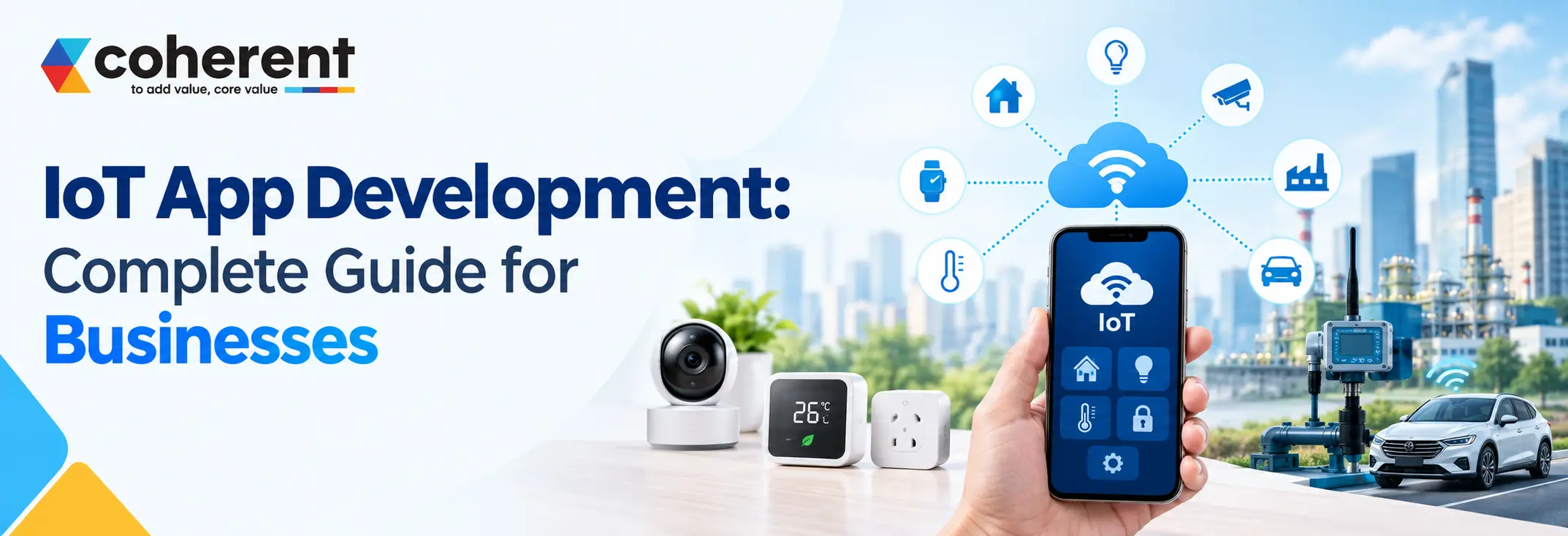
IoT app development connects physical devices, sensors, machines, and equipment with mobile or web applications so businesses can monitor data, automate operations, control devices, and make faster decisions. A successful IoT application typically combines IoT hardware, mobile app development, cloud infrastructure, APIs, real-time communication, analytics, and security.
For businesses, IoT app development can support use cases ranging from smart homes and healthcare monitoring to industrial automation, fleet tracking, agriculture, retail, logistics, and connected consumer products.The key is not simply connecting a device to an app. The real value comes from creating a reliable system that can collect data, process it securely, turn it into useful insights, and allow users or businesses to take action.
What Is IoT App Development?
IoT app development is the process of building software applications that communicate with Internet of Things devices and connected hardware. An IoT application can receive information from sensors, display real-time device status, send commands to hardware, generate alerts, analyze historical data, and automate predefined actions. These applications help businesses connect physical devices with mobile apps, web dashboards, cloud platforms, and backend systems to improve monitoring, efficiency, and operational decision-making.
- Monitor machine temperature.
- Track equipment status.
- Receive maintenance alerts.
- View production data.
What Are the Main Components of IoT App Development?
IoT app development combines connected hardware, communication networks, cloud infrastructure, backend systems, APIs, and mobile or web applications. Unlike traditional mobile development, an IoT solution must manage communication between physical devices and digital platforms. A reliable architecture should support secure data transmission, device management, real-time monitoring, scalability, analytics, and future integrations based on the business use case. Businesses can also explore IoT & Smart-Connected Apps to understand how connected technologies can support modern digital solutions.
1. IoT Hardware
IoT hardware includes sensors, machines, wearables, cameras, smart appliances, and connected equipment that collect or transmit physical-world data. Hardware selection depends on the application's environment, accuracy, power requirements, connectivity, and business objectives. Choosing compatible and reliable devices helps create a stable foundation for the complete IoT ecosystem.
- Temperature and motion sensors
- GPS and RFID devices
- Cameras and wearables
- Smart meters and appliances
2. Connectivity
Connectivity enables IoT devices to exchange information with applications, gateways, and cloud platforms. The appropriate communication technology depends on factors such as distance, bandwidth, power consumption, network availability, and operating environment. Selecting the right connectivity method can improve reliability, device performance, and scalability throughout the IoT deployment lifecycle.
- Wi-Fi
- Bluetooth Low Energy
- 4G/5G
3. IoT Gateway
An IoT gateway connects devices with cloud or backend infrastructure and can perform important processing before data reaches the cloud. Gateways are particularly useful when systems involve multiple communication protocols or require local processing. They can also improve security, reduce unnecessary network traffic, and support edge computing for connected environments.
- Aggregate device data
- Translate communication protocols
- Process data locally
- Improve security
4. Cloud Infrastructure
Cloud infrastructure provides the scalable computing environment required to store, process, analyze, and manage IoT data. It can support device authentication, application services, databases, monitoring, analytics, and remote device management. Businesses can use public cloud platforms or custom infrastructure depending on scalability, compliance, security, integration, and operational requirements.
- AWS IoT
- Microsoft Azure IoT
- Google Cloud
5. Backend and APIs
The backend connects the IoT platform, databases, devices, and user-facing applications. It manages business logic, authentication, device registration, commands, notifications, permissions, subscriptions, and data processing. Well-designed APIs allow mobile applications, dashboards, and external systems to communicate efficiently with connected devices while maintaining security and scalability.
- User authentication
- Device registration
- API management
6. Mobile or Web Application
The mobile or web application provides the interface through which users interact with connected devices and IoT data. Depending on the product, businesses may require Android, iOS, cross-platform applications, web dashboards, or administrative portals. A clear interface helps users monitor devices, control equipment, review analytics, receive alerts, and manage settings.
- Android application
- iOS application
- Flutter or React Native app
What Are the Key Features of an IoT Mobile App?
IoT mobile applications typically combine device management, real-time monitoring, remote control, notifications, analytics, and secure authentication. The exact feature set depends on the industry and connected devices. Businesses should prioritize features around their core use case rather than adding unnecessary functionality. A focused feature set can simplify development, improve usability, and support faster MVP validation.
1. User Registration and Authentication
Secure authentication ensures that only authorized users can access connected devices and sensitive information. IoT applications may support traditional credentials, OTPs, biometrics, multi-factor authentication, or enterprise SSO. Authentication should be designed alongside authorization so users receive access appropriate to their role, device ownership, and business responsibilities.
- Email and password
- OTP verification
- Biometric authentication
2. Device Pairing and Provisioning
Device onboarding should make it simple for users to connect compatible hardware with the application. Pairing can involve Bluetooth, QR codes, Wi-Fi configuration, or cloud-based provisioning. A streamlined onboarding process reduces setup friction and helps users correctly register, name, organize, and manage connected devices from the beginning.
- Device scanning
- Bluetooth pairing
- QR-code pairing
3. Real-Time Device Monitoring
Real-time monitoring allows users to view current device conditions and operational data through dashboards. Different industries monitor different metrics, including health readings, machine conditions, vehicle locations, environmental measurements, or energy consumption. Effective dashboards should present important information clearly while allowing users to identify abnormal conditions quickly.
- Healthcare: vital signs
- Manufacturing: machine status
- Logistics: GPS and routes
4. Remote Device Control
Remote control allows authorized users to send commands to connected equipment through an IoT application. This capability is useful for smart homes, industrial equipment, lighting, vehicles, and other connected systems. Commands should include appropriate authentication, authorization, confirmation, and error handling to prevent unintended actions and improve operational reliability.
- Turn devices on or off
- Adjust thermostats
- Control lighting
5. Push Notifications and Alerts
Notifications help users respond quickly when an IoT system detects important events or abnormal conditions. Alert rules can be configured around device status, thresholds, locations, security events, battery levels, or operational failures. Businesses should design alerts carefully to provide useful information without overwhelming users with unnecessary notifications.
- Machine overheating
- Low battery
- Unauthorized access
6. Data Visualization and Analytics
IoT platforms generate large volumes of device data that can be difficult to interpret without effective visualization. Dashboards can transform raw information into charts, graphs, reports, KPIs, and historical trends. Analytics can help businesses identify patterns, monitor performance, understand operational conditions, and make data-informed decisions.
- Charts and graphs
- Real-time dashboards
- Historical reports
- KPI cards
7. Geolocation and GPS Tracking
Location tracking is an important IoT feature for applications involving vehicles, assets, deliveries, wearables, and field operations. GPS data can support real-time tracking, geofencing, route monitoring, and location-based alerts. Businesses should also consider battery consumption, location accuracy, privacy requirements, and connectivity conditions when implementing location-based IoT functionality.
- Fleet tracking
- Asset monitoring
- Delivery tracking
8. Device Management
Device management allows businesses to control and monitor connected hardware from a centralized platform. Enterprise IoT systems may need capabilities for provisioning, grouping, firmware updates, health monitoring, permissions, and device history. Effective device management becomes increasingly important as the number of connected devices grows across locations and business operations.
- Add or remove devices
- Update firmware
- Group devices
Native vs Cross-Platform IoT App Development: Which Should You Choose?
There is no universal technology choice for IoT application development. The right approach depends on device integration requirements, communication protocols, performance expectations, security needs, scalability, development-team expertise, and budget. Businesses should also consider cloud infrastructure, real-time data processing, hardware compatibility, maintenance, and future expansion. Evaluating these factors together helps determine the most suitable architecture, framework, and technology stack for the project. For better planning, understanding the IoT App Development Cost can also help businesses estimate their investment.
| Factor | Native | Cross-Platform |
|---|---|---|
| Android/iOS Optimization | High | High with proper implementation |
| Code Sharing | Low | High |
| Development Speed | Moderate | Often faster |
| Hardware-Specific Features | Strong | Depends on SDK/plugin support |
| Maintenance | Separate codebases | Shared codebase possible |
| Performance | Excellent | Strong for most applications |
| Ideal For | Complex, platform-specific IoT applications | Standard mobile IoT applications requiring Android and iOS support |
| Development Cost | Often higher | Often lower |
Which Industries Use IoT App Development?
IoT app development supports numerous industries by connecting physical devices with software, cloud platforms, and analytics systems. Healthcare, manufacturing, logistics, agriculture, smart homes, and retail are common examples. Each industry has different device, connectivity, security, and regulatory requirements, so the application architecture and features should be designed around the specific operational environment.
IoT App Development for Healthcare
Healthcare IoT applications connect wearable devices, monitoring equipment, and healthcare platforms to support data collection and remote monitoring. These systems can provide dashboards, alerts, and historical information for authorized users. Because healthcare data can be sensitive, projects should carefully address security, privacy, access control, data handling, and applicable regulatory requirements.
IoT App Development for Manufacturing
Industrial IoT applications help manufacturers connect machines, sensors, production systems, and operational dashboards. Businesses can monitor machine conditions, production output, energy consumption, downtime, and maintenance indicators. Sensor data can also support condition-based or predictive maintenance workflows when combined with appropriate analytics and machine-learning models.
IoT Apps for Logistics and Fleet Management
IoT applications help logistics businesses connect vehicles, GPS systems, sensors, drivers, and cloud platforms. These systems can provide live location information, route visibility, vehicle monitoring, and maintenance alerts. Fleet managers can use connected data to monitor operations, track deliveries, and identify events requiring attention.
IoT App Development for Agriculture
IoT applications support smart agriculture by collecting environmental and equipment data from farms and connected agricultural systems. Sensors can monitor soil moisture, temperature, humidity, water levels, and other conditions. Applications can then provide dashboards, alerts, and automated controls to support irrigation and resource-management decisions.
IoT Applications for Smart Homes
Smart-home IoT applications connect household devices through a centralized mobile or web interface. Users can monitor and control lighting, locks, cameras, thermostats, appliances, and sensors. The application can also support automation rules, notifications, scheduling, and remote access while maintaining appropriate authentication and device security.
IoT for Retail
Retail IoT applications can connect inventory systems, smart shelves, refrigeration equipment, sensors, and other store infrastructure. Connected data can help businesses monitor assets, inventory conditions, cold-chain environments, and operational activity. Retail applications can combine real-time monitoring with dashboards and alerts to support store management and operational workflows.
Also read:IoT App Development Companies in Dubai
How Do You Build an IoT Mobile App?
Building an IoT mobile application requires coordination between hardware, connectivity, cloud infrastructure, backend services, and the user-facing application. Businesses should begin with a clearly defined problem and then design the complete ecosystem before development. Structured planning helps teams identify dependencies, test hardware-software communication, address security requirements, and create a scalable foundation for future device expansion.
Step 1: Define the Business Problem
Start by identifying the operational problem the IoT solution should solve. Instead of beginning with a specific technology, determine what needs to be monitored, controlled, automated, or improved. Clear objectives help teams identify the right devices, data requirements, users, workflows, and measurable outcomes for the application.
- Define the core problem
- Identify target users
- Determine required data
Step 2: Define the IoT Ecosystem
Map every major component before development begins, including devices, sensors, connectivity, gateways, cloud services, backend systems, mobile applications, dashboards, and external integrations. A complete ecosystem map helps identify technical dependencies and ensures that hardware and software teams work toward a consistent architecture.
- Devices and sensors
- Connectivity
- Gateways
Step 3: Select Hardware and Communication Protocols
Hardware and communication technologies should be selected according to the project's operating environment and technical requirements. Consider power consumption, network availability, communication range, data frequency, environmental conditions, device availability, and security. The selected hardware should also support future maintenance, firmware updates, and planned deployment volumes.
- Power requirements
- Network availability
- Communication range
Step 4: Design the IoT Architecture
The architecture defines how devices, gateways, communication protocols, cloud infrastructure, backend services, APIs, and applications interact. A common architecture may follow IoT Device → Gateway → MQTT → Cloud IoT Platform → Backend → API → Mobile App. Edge processing can also be introduced when local data processing is required.
- Device communication
- Gateway architecture
- Cloud services
Step 5: Build the Backend
The backend provides the business logic and services required to connect devices with applications. Development may include authentication, device registration, APIs, databases, data processing, notifications, permissions, and business workflows. A scalable backend architecture is important when the number of connected devices or frequency of incoming data may increase significantly.
- Authentication
- Device registration
- API development
Step 6: Develop the Mobile Application
The mobile application provides users with access to device information and controls. Depending on requirements, developers can use native Android or iOS development or cross-platform technologies such as Flutter and React Native. Core functionality may include login, device onboarding, dashboards, real-time status, controls, alerts, reports, and settings.
- User login
- Device onboarding
- Monitoring dashboards
Step 7: Integrate Hardware and Software
Hardware-software integration connects physical devices with the digital ecosystem. Teams should verify connectivity, data transmission, command execution, offline behavior, reconnection, sensor accuracy, battery performance, and security. Early integration testing can help identify hardware or communication problems before the application reaches production.
- Device connectivity
- Data transmission
- Command execution
Step 8: Test the IoT Ecosystem
IoT testing must cover both software and physical device behavior. Beyond standard application testing, teams should test connectivity, hardware compatibility, APIs, security, network failures, battery usage, device loads, firmware updates, and offline scenarios. Comprehensive testing helps identify problems that may only appear under real-world environmental or network conditions.
- Hardware testing
- Connectivity testing
- API testing
Step 9: Launch and Monitor
IoT deployment does not end when the application reaches production. Businesses should continuously monitor device connectivity, API performance, cloud usage, errors, security events, user activity, and device health. Continuous monitoring helps development and operations teams identify problems early and maintain reliable performance across both physical devices and software infrastructure.
- Device connectivity
- API performance
- Cloud usage
Conclusion
IoT app development is not simply about building a mobile application that connects to a smart device. It involves designing an entire connected ecosystem that combines hardware, mobile applications, security, analytics, and sometimes AI.For businesses, the most effective approach is to begin with a clear problem, identify the devices and data required, test with real hardware, and then expand into advanced analytics and automation.
With the right architecture and development strategy, an IoT application can become a central platform for real-time monitoring, automation, predictive insights, remote management, and smarter business operations. Build a scalable IoT solution aligned with your goals and future growth. Contact us today!
Frequently Asked Questions
Q1. What is IoT app development?
Ans. IoT app development involves creating mobile or web applications that communicate with connected devices, sensors, machines, and hardware. These applications can collect and visualize device data, control equipment, generate alerts, automate workflows, and connect physical systems with cloud platforms and backend infrastructure. IoT applications are commonly used across manufacturing, healthcare, logistics, smart homes, retail, and other industries.
Q2. How much does it cost to develop an IoT app?
Ans. IoT app development can cost approximately $25,000 to $250,000+, depending on project complexity. Costs can increase with custom hardware integration, multiple device types, cloud infrastructure, real-time communication, security requirements, backend development, analytics, AI features, and large device fleets. Businesses should define their MVP requirements, integrations, platforms, and scalability needs before estimating the final development budget.
Q3. How long does IoT app development take?
Ans. A basic IoT MVP can take approximately 3–5 months, while medium-complexity platforms may require 5–8 months. Advanced IoT ecosystems can take 8–12 months or longer, particularly when they involve custom hardware, firmware, complex cloud infrastructure, real-time communication, extensive testing, security requirements, regulated industries, or large numbers of connected devices.
Q4. Which technologies are used to build IoT applications?
Ans. IoT applications commonly use technologies such as MQTT, HTTP, WebSocket, Bluetooth, Wi-Fi, 4G/5G, LoRaWAN, AWS IoT, Azure IoT, Google Cloud, Python, Node.js, Kotlin, Swift, Flutter, React Native, PostgreSQL, MongoDB, and REST APIs. The technology stack should be selected according to device capabilities, connectivity requirements, application architecture, security needs, scalability, and business objectives.
Q5. Can an IoT app work without an internet connection?
Ans. Yes, some IoT applications can operate without continuous internet connectivity. Depending on the architecture, devices can communicate through Bluetooth, local networks, gateways, or edge computing systems. Data can be processed locally and synchronized with cloud infrastructure when connectivity becomes available. Offline capabilities are particularly useful for industrial, logistics, remote-area, healthcare, and field-service IoT applications.
Q6. Can IoT apps integrate with AI?
Ans. Yes, IoT applications can integrate AI and machine learning to analyze real-time and historical device data. Common applications include anomaly detection, predictive maintenance, demand forecasting, intelligent alerts, energy optimization, computer vision, and automated decision support. AI becomes particularly valuable when organizations have sufficient high-quality data and a clear business objective that can be addressed through intelligent analysis.
Q7. Is IoT app development suitable for startups?
Ans. Yes, startups can develop IoT products by beginning with a focused MVP rather than building an entire ecosystem immediately. A startup can initially connect a limited number of devices, develop a core mobile or web application, establish essential cloud infrastructure, and implement one valuable workflow. This approach can help validate the product, collect user feedback, and plan future expansion.
Q8. How do I choose an IoT app development company?
Ans. When choosing an IoT app development company, evaluate its experience with hardware integration, mobile applications, MQTT, cloud platforms, APIs, device management, security, real-time communication, and scalable backend systems. Review relevant case studies and technical portfolios. Also discuss hardware testing, firmware integration, data protection, scalability, monitoring, maintenance, development methodology, timelines, and post-launch support before signing an agreement.

 +91 774-202-1725
 +1 (945) 3387904
 business@coherentlab.com
 +49 15223341304
 UK

