Table of Contents
How Manufacturing Website Development Increases B2B Sales
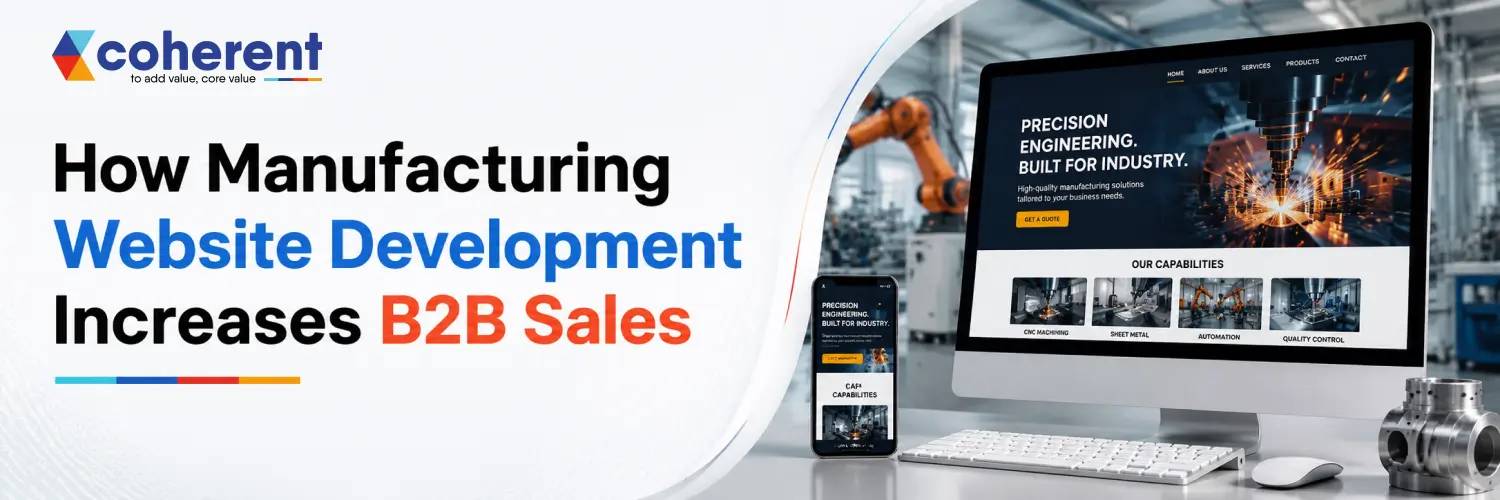
Having a professional website in today's competitive manufacturing industry is more than just an online presence it's a powerful sales and marketing tool. These B2B buyers investigate suppliers, compare products and check supplier credibility before they buy. With a properly designed manufacturing website, it's possible to present the skills, certifications, product catalogues, and also apply SEO, RFQ forms, and digital marketing tactics to help generate qualified leads. From industrial machinery to auto parts, electronics to textiles, and medical devices to more, a responsive and SEO-optimized website enhances your visibility, fosters trust, and drives sustainable growth. The use of advanced technologies, user experience optimisation, and Answer Engine Optimisation (AEO) and Generative Engine Optimisation (GEO) can bring international buyers to manufacturers' websites, boost inquiries, and turn website visitors into loyal customers. This guide will outline the benefits of manufacturing website development to improve B2B sales and business success.
How Website Development Impacts B2B Manufacturing Sales
| Website Feature | Business Benefit | Sales Impact |
|---|---|---|
| Responsive Design | Delivers a seamless experience across desktop, tablet, and mobile devices | Increases user engagement, enquiries, and lead generation |
| SEO Optimisation | Improves search engine rankings and online visibility | Generates more qualified B2B leads and organic traffic |
| Product Catalogue | Makes products easy to browse, compare, and evaluate | Speeds up buying decisions and increases conversions |
| RFQ (Request for Quote) Forms | Simplifies the enquiry process with quick quote requests | Increases conversion rates and sales opportunities |
| CRM Integration | Streamlines lead tracking, nurturing, and follow-up | Improves sales efficiency and customer relationship management |
| Live Chat | Provides instant assistance to potential customers | Enhances customer satisfaction and boosts conversions |
| Fast Loading Speed | Reduces page abandonment and improves user experience | Increases conversion rates and search performance |
| Case Studies | Showcases successful projects, expertise, and client results | Builds buyer confidence, trust, and higher-value sales |
Why Manufacturing Companies Need a Modern Website
Coherent Lab LLP A modern manufacturing website is like a virtual showroom that is open 24 hours per day to promote your business. It allows potential customers to browse products, compare capabilities, inquire for quotes and reach out to your sales staff without any boundaries. As competition grows and digital procurement becomes more prominent, manufacturers must rely on an online platform to grow trust, market their products and services and enhance the customer journey – all while generating ongoing business-to-business leads.
Challenges Faced by Traditional Manufacturers
- The challenge of being less visible online in more competitive markets.
- Relying on off-line sales and referrals
- Challenges in securing international buyers.Problems in finding overseas buyers.
- A lack of brand awareness and good lead generation.
Benefits of a Professional Manufacturing Website
- Confidently creates good quality B2B enquiries
- Establishes relationships based on certifications and case studies
- Promotes traffic to the website by optimizing for search engines (SEO)
- Goes the extra mile to enable global business expansion
What Is Manufacturing Website Development?
Manufacturing website development is the process of creating and building a website that is tailored specifically for an industrial business to showcase their products, services, manufacturing abilities, certifications, and technical knowledge. The aim of these websites is to boost customer engagement, ease communication process, create good B2B leads and help with SEO, digital marketing, and business growth strategies.
Key Features of a Manufacturing Website
- Product catalogue including details and specifications.
- Easy-to-use Request for Quote (RFQ) forms
- Mobile-responsive and fast-loading design
- Ensure contact and enquiry management is secure.
Industries That Benefit Most
- Automobile and auto component companies
- Industrial machinery & equipment businesses.
- Or electronics and electrical manufacturers.
- Manufacturers of textiles, chemicals and drugs
How Manufacturing Website Development Increases B2B Sales
A well-designed manufacturing website doesn't just showcase your products; it's your business's salesperson all day, everyday. It makes it easier to connect with decision-makers, AI app development ,gain visibility in the web, establish trust and transform web visitors in qualified B2B leads. User-centric design, SEO, and digital marketing can help manufacturers reduce the buyer's journey and boost conversion rates.
Better Search Engine Visibility
- Boost higher ranking for manufacturing and industrial keywords
- Optimize for continuous organic visitors, using technical SEO!
- Reach out to B2B buyers in your area, your country, and the rest of the world.
- Increase brand awareness with content marketing
Builds Buyer Trust
- Show information about the company's ISO certification and industry standards.
- Display customer feedback and case studies.Share customer success stories and testimonials.
- Demonstrate manufacturing facilities and capabilities
- Emphasize years of experience and projects finished
Essential Features Every Manufacturing Website Should Have
Learn what every manufacturing website needs to engage B2B buyers, enhance the user experience, gain qualified leads and boost online visibility. Discover why responsive design, product catalogues, technical specifications, SEO optimisation, enquiry forms, certifications and fast loading speed are essential to trust-building and growing business in the highly competitive
User Experience (UX) Features
- The site is designed to be mobile and responsive.Design is Mobile friendly and responsive.
- Ensure pages load quickly to boost engagement.Optimize page loading speeds to enhance engagement.
- A clear navigation and user-friendly menus.
- Easy-to-navigate structure for all devices.
Business Features
- Online RFQ and enquiry forms
- CMS and CRM integration.CRM and ERP integration.
- Catalogue of products with brochures available for download.
- The website is available in multiple languages and currencies.Website is available in multiple languages and currencies.
SEO Strategies for Manufacturing Websites
Make your industrial business an SEO star with proven methods for industrial websites. Know how to boost search ranking, generate quality B2B leads, optimise technical SEO, target high-intent keywords, optimise website performance and drive more organic traffic. Learn how manufacturers can use practical SEO strategies to increase their online presence, get more enquiries and ensure profitable growth.
On-Page SEO
- Use titles, meta descriptions, and headings for optimum results.
- Include manufacturing related keywords in a natural way.
- Link other products and services in the website.
- Optimise images using alternative text attributes that describe the text.
Technical SEO
- Take steps to enhance Core Web Vitals and page speed.Make Core Web Vitals and page speed improvements.
- The structured data, (Schema Markup), is implemented.
- Make sure the website is secure (HTTPS).
- Develop XML sitemaps and optimise robot.txt file.
GEO & AEO Optimisation for Manufacturing Businesses
Ensure your manufacturing company is visible with the proper GEO and AEO optimisation. Discover how to get ready for AI-powered search engines, voice search and local discovery, whilst also optimising user experience, generating qualified B2B leads and achieving sustainable organic growth. Get ahead of the curve with future-proof SEO strategies that are tailored for modern manufacturing companies.
GEO (Generative Engine Optimisation)
- Make topic clusters for manufacturing services.
- Employ semantic keywords and entity-based content.
- Show a high level of knowledge and understanding through case studies and guides
- Provide complete, authoritative information
AEO (Answer Engine Optimisation)
- Address frequently asked questions about buying
- Include FAQ Schema and How-To Schema.
- Write succinct, factual writing
- Optimise for featured snippets and voice search.
Best Website Design Practices for Manufacturing Companies
Boost your manufacturing business visibility with good GEO and AEO optimization strategies. Discover how to leverage AI for search engine optimisation, voice search and local discovery, improve user experience and boost qualified B2B leads and sustainable organic growth. Make sure you're one step ahead with future-proof SEO strategies tailored for modern manufacturing businesses.
Homepage Essentials
- Effective value proposition, based on industry knowledge.
- Large Request a Quote and contact button
- Positive customer reviews, trust marks.
- Featured products, services, and certifications
Product & Service Pages
- Product details and technical documents.
- Excellent visuals, videos, and downloadable literature.
- Industry certifications and compliance information
- Lead generation related products and enquiry forms
Manufacturing Website Technologies
Learn the latest manufacturing website technologies that help increase performance, security and the user experience. Understand how these key elements impact their businesses, including the advantages of responsive design, the incorporation of AI, the connection with IoT, moblie app development , integration with ERP systems, and optimization for SEO, and see how they help manufacturers create scalable, future-proof websites that drive business growth and customer interaction.
Recommended Tech Stack
- The code is created with WordPress for flexible content management.
- Laravel is used for building secure custom web applications.Laravel is used to develop secure custom web applications.
- For fast, interactive interfaces, use React or Next.js.Use React or Next.js for fast, interactive interfaces.
- ASP.NET for enterprise grade manufacturing solutions
Business Integrations
- A CRM integration for managing leads.CRM lead management system integration.
- Fulfilling the integration of ERP with inventory and production.The ERP integration with inventory and production.
- Google Analytics and Search Console
- Live chat, WhatsApp Business and email marketing tools
Common Mistakes That Reduce B2B Sales
Prevent the common pitfalls that negatively affect B2B sales and discover practices that will enhance your lead generation, website performance,Web development services , user experience, SEO and conversion strategy. Learn how to overcome sales obstacles, establish rapport with business buyers, and boost the number of qualified leads. Elevate your digital footprint to gain steady B2B growth and improved conversion rates in tough B2B markets.
Website Errors
- The slow loading time of pages and the lack of performance on mobile devices are cited as issues.
- The site's design and navigation is outdated.
- The buttons for the call to action may be missing or not clear.
- The product/service description is incomplete.The product/service description is missing.
SEO Mistakes
- Duplicate or thin content – plagiarized content or thin content.
- Lack of meta titles & descriptions
- There are poor internal linking structures.
- There is no Schema Markup or technical optimisation.
Measuring Website Success
Utilize website success metrics like traffic, user engagement, conversions, bounce rate, website page speed, and website SEO performance. Understand how analytics tools can be used to monitor visitor behaviour, uncover growth opportunities, enhance the user experience, and optimise your website to meet the business goals, boost your rankings, generate leads and achieve long-term success in the digital world.
Key Performance Indicators (KPIs)
- The list of the key performance indicators (KPIs).
- The growth of organic search traffic.An increase in organic search traffic.
- The number of B2B leads generated was sufficient to qualify.
- Submissions = RFQ, contact form.
Essential Analytics Tools
- Google Analytics 4 (GA4)
- Google Search Console
- CRM reporting dashboards
- Heatmaps and tracking of user behaviour.
Also Read :- How AI Manufacturing Websites Are Transforming Industrial Businesses in 2026
Future Trends in Manufacturing Website Development
Dive into the evolving landscape of website design for manufacturing, featuring AI-driven experiences, Industry 4.0 integration, IoT connectedness, responsive design, voice search optimization, data-driven experiences, and advanced automation. Discover how today's manufacturing websites enhance the customer experience, simplify B2B transactions, build brand trust, and support businesses in the dynamic digital manufacturing industry.
Emerging Technologies
- Customer support chatbots powered by AI.
- Demonstrations of Augmented Reality (AR) products.
- A visit to the factory in the virtual world.
- Customer insights through predictive analytics.
Future Marketing Trends
- Voice search optimisation
- AI-generated personalised experiences
- Interactive product configurators
- For B2B buyers, the concept of account-based marketing is about to become a reality.
Conclusion
For businesses aiming at boosting their B2B sales and enhancing their online visibility, manufacturing website development has emerged as a vital investment. A fast, responsive, and SEO-optimized website can support manufacturers to display products, establish credibility, draw in qualified leads, and drive customers to become loyal. By using state of the art technologies, ergonomic design, GEO and AEO plans and continuous SEO optimisations, businesses can draw both home and overseas buyers. Contact us today By investing in a professional manufacturing website today, you'll build a foundation for sustainable growth and conversion rates, and success in a more competitive global marketplace.
Frequently Asked Questions
Q1. What is manufacturing website development?
Ans. Manufacturing Website Development is creating and building websites for manufacturing companies. These websites highlight products, services, certifications, production capabilities, and company information, and include SEO, responsive design, and lead generation elements like RFQ forms. Manufacturers can boost online visibility, reach B2B buyers and grow sales opportunities by having a professionally built website.
Q2. How does a manufacturing website increase B2B sales?
Ans. A manufacturing website enhances B2B sales by making it easier for the search engine to find it, showing off products professionally, gaining customer trust, and making it easy for customers to request a quotation. Elements such as product catalogues, case studies, contact form, live chat, and CRM integration facilitate businesses in generating more qualified leads and turning visitors into paying customers effectively.
Q3. Why is SEO important for manufacturing companies?
Ans. When customers are looking to buy industrial products or services, SEO can improve the ranking of manufacturing companies in search engine results. Improved visibility leads to more organic traffic, attracting the right B2B buyers, building brand credibility, and lowering paid advertising costs. Long-term business growth and lead generation is supported by Technical SEO, keyword optimisation and quality content.
Q4. What features should a manufacturing website include?
Ans. Responsive design, quick loading speed, product catalogues, RFQ forms, contact details, customer reviews, certifications, downloadable brochures, case studies and secure hosting are all features of a manufacturing website. This is complemented by CRM and ERP integrations, ensuring smooth data flow and boosting business efficiency, as well as SEO optimisation and intuitive navigation, which improve user experience.
Q5. How much does manufacturing website development cost?
Ans. Websites cost different amounts to produce, depending on the complexity of the project, design needs, how many pages, integrations, and custom functionality it requires. The basic website is less costly, whereas a website that integrates ERP, supports multiple languages, has sophisticated SEO and custom features is a more significant investment. The choice of the right development partner is a way to optimize value for long-term.
Q6. Can a manufacturing website integrate with ERP and CRM systems?
Ans. Yes, Modern manufacturing websites can be integrated with ERP and CRM systems, which can automate enquiries, manage customer relationships, synchronise inventory, and streamline sales processes. The integrations limit manual tasks, enhance the efficiency of operations and offer a smooth experience for both customers and internal teams.
Q7. How long does it take to develop a manufacturing website?
Ans. The timeline for development will vary based on the size and complexity of the website. It will take four to eight weeks on an average manufacturing website and it can take weeks to months for a large enterprise website with custom features, integrations, and multilingual options. With proper planning, testing, and implementation of SEO, a successful launch is ensured.
Q8. How do GEO and AEO improve manufacturing website visibility?
Ans. By making content more accessible to AI search engines and answer platforms, Generative Engine Optimisation (GEO) and Answer Engine Optimisation (AEO) enhance its visibility. Established headings, FAQs, schema, semantic keywords, and authoritative content boost the possibility of higher ranking on AI-powered answers, featured snippets, and voice searches, which leads to better quality traffic and B2B leads.

 +91 774-202-1725
 +1 (945) 3387904
 business@coherentlab.com
 +49 15223341304
 UK
UK