Table of Contents
How Mobile app Development Outsourcing Works: Process, Costs, and Risks
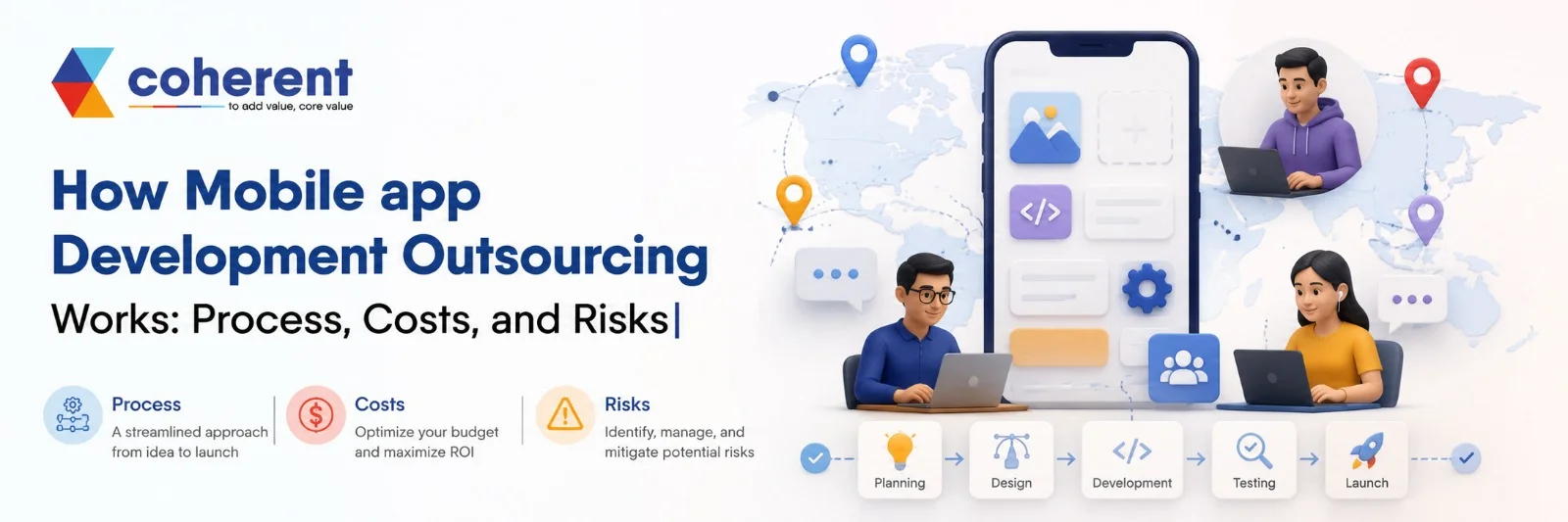
Building a mobile app is no longer reserved for large enterprises with extensive in-house development teams. Today, businesses of all sizes—from startups to global organizations—are turning to mobile app development outsourcing to bring their ideas to market faster and more cost-effectively.
By partnering with experienced external developers, companies can access specialized skills, reduce recruitment challenges, and focus on their core business objectives while experts handle the technical work. However, outsourcing mobile app development involves more than simply hiring a team and waiting for the final product. Businesses need to understand the outsourcing process, evaluate potential costs, identify possible risks, and choose the right development partner to ensure project success.
Factors such as communication, project management, security, and long-term maintenance can significantly impact outcomes. In this guide, we'll explore how mobile app development outsourcing works, break down the typical development process, examine cost factors, discuss common risks, and share best practices for selecting a reliable outsourcing partner. Whether you're planning your first mobile app or looking to scale development efficiently, this article will help you make informed decisions and maximize your investment.
Key Takeaways
- Outsourcing can reduce development costs significantly.
- Access specialized mobile app expertise without hiring in-house.
- Project success depends heavily on vendor selection.
- Communication and documentation are critical.
- Security and intellectual property protection should be planned from day one.
- Outsourcing offers scalability and faster development cycles.
- AI tools are changing how outsourced teams build apps.
- Long-term support matters as much as initial development.
Why Choose Coherent Lab
Coherent Lab is a trusted mobile app development partner committed to delivering innovative, scalable, and high-performance mobile applications. Our experienced team combines technical expertise with a deep understanding of business needs to create solutions that drive growth and user engagement. We follow an agile development approach, ensuring transparency, faster delivery, and continuous collaboration throughout the project. From strategy and UI/UX design to development, testing, deployment, and post-launch support, we provide end-to-end services under one roof. With a strong focus on quality, security, and customer satisfaction, Coherent Lab helps businesses turn ideas into successful digital products.
A Partner Focused on Business Outcomes
- Experienced mobile app developers across industries
- Transparent communication and reporting
- Agile and scalable development process
- Strong focus on security and compliance
- End-to-end development and support
- Proven track record of successful app launches
How Does Mobile App Development Outsourcing Work?
Mobile app development outsourcing involves hiring an external agency or dedicated development team to design, develop, test, and maintain a mobile application. The process typically begins with defining project requirements, selecting a development partner, agreeing on costs and timelines, and managing the project through regular communication. Businesses benefit from expertise, scalability, and faster development cycles.
- What outsourcing means
- How companies hire external development teams
- Typical timeline, costs, and outcomes
Why Businesses Are Turning to Mobile App Development Outsourcing
The demand for mobile and AI app development applications continues to grow across industries, making it difficult for businesses to hire and retain skilled developers internally. Outsourcing provides access to experienced professionals, faster project execution, and lower development costs. It also enables companies to focus on strategic business activities while experts handle technical implementation and ongoing product development.
- Healthcare
- FinTech
- E-commerce
- Education
- Logistics
- SaaS
Also Read: Top AI App Development Companies (May 2026 Updated List)
What Exactly Happens When You Outsource an App Project?
Outsourcing a mobile app project involves several stages, from planning and vendor selection to development, testing, and deployment. Businesses collaborate with external teams that provide technical expertise and project management support. Depending on project needs, companies can choose offshore, nearshore, onshore, or dedicated team models that offer varying levels of involvement and flexibility.
| Stage | What Happens | Key Deliverables |
|---|---|---|
| 1. Requirement Discovery | You share your app idea, business goals, target audience, and desired features with the outsourcing partner. | Project brief, feature list, business requirements document |
| 2. Project Planning & Proposal | The development company analyzes requirements, estimates costs, timelines, and recommends the best technology stack. | Project proposal, cost estimate, development roadmap |
| 3. Team Allocation | A dedicated team is assigned, including project managers, designers, developers, QA engineers, and business analysts. | Team structure, communication plan |
| 4. UI/UX Design | Designers create wireframes, user flows, and visual prototypes to define the app’s appearance and user experience. | Wireframes, mockups, interactive prototypes |
| 5. Development Phase | Developers build the frontend, backend, APIs, and database while following agreed milestones. | Functional app modules, progress reports |
| 6. Quality Assurance & Testing | QA specialists test the app for bugs, performance issues, security vulnerabilities, and usability concerns. | Bug reports, tested application build |
| 7. Client Review & Feedback | The client reviews completed features and provides feedback for improvements or adjustments. | Revision requests, updated versions |
| 8. Deployment & Launch | The app is deployed to servers and submitted to platforms such as the App Store and Google Play. | Live application, deployment documentation |
| 9. Post-Launch Support | The outsourcing company provides maintenance, updates, monitoring, and technical support after launch. | Performance reports, updates, ongoing support |
Step 1: Turning Your App Idea into Clear Requirements
Every successful mobile application begins with a clearly defined vision and roadmap. Before contacting development companies, businesses should identify their goals, target audience, core features, and technical requirements. Proper documentation minimizes misunderstandings, improves project estimates, and helps development teams deliver solutions aligned with business objectives and user expectations.
Step 2: Finding the Right Mobile App Development Partner
Selecting the right outsourcing partner can determine the success or failure of a project. Businesses should evaluate agencies based on experience, technical expertise, portfolio quality, communication practices, and client feedback. A reliable development partner will understand business goals, provide transparent processes, and demonstrate the ability to deliver projects on time and within budget.
Step 3: Planning Budgets, Timelines, and Contracts
Proper planning ensures both parties have clear expectations regarding project scope, timelines, deliverables, and costs. Outsourcing contracts should outline milestones, payment schedules, intellectual property ownership, confidentiality agreements, and support responsibilities. Establishing these details early helps reduce disputes, manage risks effectively, and create a strong foundation for successful collaboration.
How Much Does Mobile App Development Outsourcing Cost?
The cost of outsourcing mobile app development varies significantly depending on app complexity, features, technology stack, development location, and engagement model. Simple apps generally require smaller budgets, while enterprise-grade solutions involve larger investments. Businesses should also consider hidden costs such as maintenance, cloud services, third-party integrations, security enhancements, and future updates.
- Third-party APIs
- Cloud hosting
- Maintenance
- Security testing
- App store fees
- Future upgrades
Also Read: Mobile App Development Process: Step-by-Step Guide for Businesses
What Happens During the Design and Development Phase?
During this phase, designers create user-friendly interfaces while developers build the application's frontend and backend components. Most outsourcing teams follow Agile methodologies, allowing businesses to review progress through regular sprints and feedback sessions. This collaborative approach ensures transparency, flexibility, and continuous improvements throughout the development lifecycle until launch readiness.
- UI mockups
- Working prototypes
- Sprint reports
- Development updates
- Test builds
Testing, Launching, and Maintaining the App
Before launch, applications undergo extensive testing to identify bugs, performance issues, and security vulnerabilities. Once approved, the app is submitted to relevant app stores and released to users. However, development does not end there. Continuous maintenance, feature updates, performance monitoring, and security enhancements are essential for long-term application success and user satisfaction.
The Biggest Benefits of Outsourcing Mobile App Development
Outsourcing offers numerous advantages, including cost savings, faster development cycles, access to experienced specialists, and improved scalability. Businesses can quickly assemble skilled teams without lengthy recruitment processes. Additionally, outsourcing enables organizations to leverage advanced technologies and industry best practices while focusing internal resources on growth, innovation, and customer engagement.
- Faster releases
- Better product quality
- Reduced hiring burden
- Improved ROI
Best Practices for a Successful Outsourcing Experience
Successful outsourcing requires clear objectives, comprehensive documentation, and consistent communication between stakeholders and development teams. Businesses should establish performance metrics, conduct regular progress reviews, and prioritize security throughout the project. Building a collaborative partnership rather than a transactional relationship often results in better outcomes, stronger accountability, and higher-quality applications.
- Defined goals
- Detailed documentation
- Dedicated point of contact
- Regular reporting
- Testing milestones
- Long-term maintenance plan
Also Read: Top Mobile App Development Companies in India – May 2026 Updated List
Mobile App Outsourcing Statistics and Market Insights
The global mobile app outsourcing market continues to expand as businesses seek cost-effective ways to accelerate digital transformation. Organizations increasingly rely on external development teams to access specialized skills and emerging technologies. Industry data shows growing adoption of Agile methodologies, AI-assisted development, and remote collaboration models that improve efficiency and project success rates.
Conclusion
Mobile app development outsourcing can be a cost-effective and efficient way to bring your app idea to life without the challenges of building a large in-house team. By choosing the right development partner, defining clear requirements, and maintaining strong communication throughout the project, businesses can reduce risks and achieve faster time-to-market. Whether you're a startup looking to validate an idea or an established company planning digital transformation, outsourcing provides access to skilled talent, advanced technologies, and scalable development resources.
Ready to turn your app idea into a successful mobile application? Contact us today to discuss your project requirements, explore the best development approach, and discover how our experienced team can help you build, launch, and grow a high-performing mobile app that meets your business goals.
Frequently Asked Questions
Q1. How much does it cost to outsource mobile app development?
Ans. The cost of outsourcing mobile app development depends on the app's complexity, features, design requirements, and development location. A simple app may cost between $10,000 and $30,000, while more advanced applications can exceed $100,000. Additional expenses such as maintenance, third-party integrations, cloud hosting, and security enhancements should also be considered when planning the overall budget.
Q2. Is outsourcing mobile app development worth it for startups?
Ans. Yes, outsourcing is often a smart choice for startups because it reduces hiring costs and provides access to experienced developers. Startups can launch products faster without building an in-house team from scratch. Outsourcing also allows founders to focus on business growth, fundraising, and customer acquisition while technical experts handle development and project execution efficiently.
Q3. What are the risks of outsourcing app development overseas?
Ans. Overseas outsourcing may involve communication challenges, cultural differences, time zone gaps, and varying quality standards. Security concerns and intellectual property protection can also become issues if contracts are unclear. These risks can be minimized by selecting reputable vendors, establishing clear communication processes, signing legal agreements, and conducting regular project reviews throughout development.
Q4. How long does it take to build an outsourced mobile app?
Ans. Development timelines vary based on app complexity and feature requirements. A basic mobile application may take two to four months, while medium-sized projects often require four to eight months. Complex enterprise applications can take a year or longer. Proper planning, clear requirements, and consistent communication help reduce delays and keep development on schedule.
Q5. Which country is best for outsourcing mobile app development?
Ans. There is no single best country, as the ideal choice depends on budget, expertise, and project goals. India remains a leading outsourcing destination due to its large talent pool and competitive pricing. Countries such as Poland, Ukraine, Vietnam, and the Philippines are also popular for offering skilled developers, quality services, and strong technical capabilities.
Q6. Can an outsourced team handle app maintenance after launch?
Ans. Yes, most mobile app development companies provide ongoing maintenance and support services after launch. These services often include bug fixes, security updates, performance monitoring, operating system compatibility updates, and feature enhancements. Long-term maintenance ensures the application remains stable, secure, and competitive while continuing to meet changing user expectations and business needs.
Q7. How do companies protect app ideas when outsourcing development?
Ans. Businesses typically protect app ideas through Non-Disclosure Agreements (NDAs), intellectual property clauses, and legally binding contracts. These documents establish ownership rights and confidentiality obligations before development begins. Working with reputable development partners, limiting access to sensitive information, and maintaining proper documentation further reduce the risk of idea theft or unauthorized use.
Q8. What should I look for when choosing a mobile app development company?
Ans. When selecting a mobile app development company, evaluate its portfolio, industry experience, technical expertise, communication practices, and client reviews. Look for transparent pricing, strong project management processes, and proven success with similar projects. A reliable partner should also offer post-launch support, security-focused development practices, and a clear understanding of your business objectives.

 +91 774-202-1725
 +1 (945) 3387904
 business@coherentlab.com
 +49 15223341304
 UK
UK