Table of Contents
Top Features Every Modern Astrology App Should Have
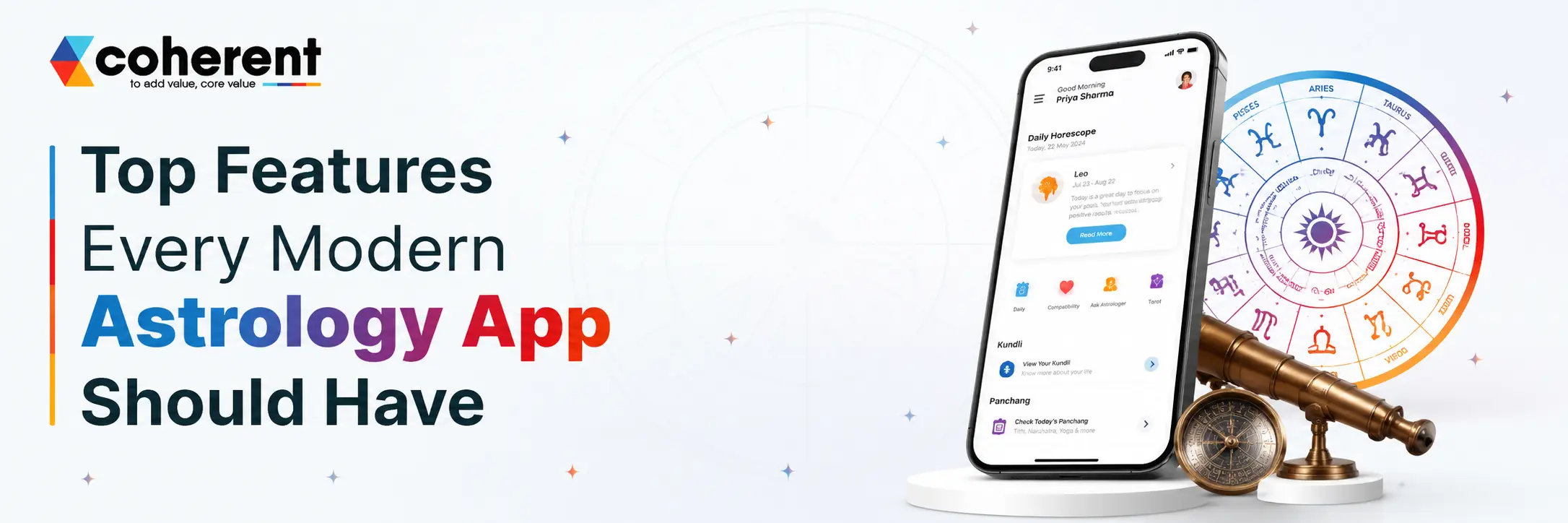
Astrology has moved far beyond newspaper horoscopes and occasional consultations with astrologers. Today, people use mobile apps to check daily horoscopes, explore birth charts, understand planetary movements, book astrologers, and receive personalized astrological guidance—all from their smartphones. This shift has created new opportunities for startups, professional astrologers, and businesses looking to build an astrology app in 2026.
However, developing a successful astrology application is no longer just about creating an attractive interface. Modern users expect fast performance, accurate astrology calculations, personalized recommendations, AI-powered insights, real-time notifications, secure payments, and seamless astrologer consultations. Features such as Kundli generation, compatibility matching, planetary transit tracking, multilingual support, and voice-based assistance can further improve the overall experience.
Why Are Astrology Apps Becoming Popular?
The growing use of smartphones has made astrology more accessible than ever. Instead of visiting an astrologer physically, users can now generate their Kundli online, read personalized horoscopes, consult astrologers through chat or video calls, and receive astrology reports within minutes.Modern astrology apps are especially attractive because they combine traditional astrology practices with technologies such as artificial intelligence, machine learning, voice assistants, cloud computing, and real-time notifications.
- Growing demand for personalized horoscope readings
- Easy access to professional astrologers
- AI-powered astrology recommendations
- Online Kundli and birth chart generation
Top Features Every Modern Astrology App Should Have
A modern astrology app should offer much more than generic horoscope content. Users now expect personalized experiences, accurate birth charts, AI-powered insights, instant astrologer consultations, secure payments, and useful notifications. Whether you're targeting users in India, the USA, UAE, or global markets, the right combination of features can improve engagement, retention, and monetization. A successful astrology app should combine traditional astrology practices with modern mobile technology and an intuitive user experience. Coherent Lab LLP can help businesses turn these requirements into a scalable, user-friendly astrology application.
1. User Registration and Personalized Profiles
A simple registration process gives users a convenient way to create and manage their astrology profiles. The app should securely store essential birth information and preferences so users do not have to enter the same details repeatedly. A personalized profile can also help deliver relevant horoscopes, reports, recommendations, and consultation services based on individual user requirements.
- Name and date of birth
- Exact birth time
- Birthplace
2. Accurate Birth Chart and Kundli Generation
Kundli and birth chart generation is one of the most important features of an astrology app, especially for users in India and South Asian markets. Users should be able to enter their date, time, and birthplace and receive a digital chart quickly. Reliable calculations, location data, and time-zone handling are essential for creating consistent and useful astrological reports.
- Janam Kundli
- Natal chart
- Lagna chart
- Navamsa chart
3. Daily, Weekly, and Monthly Horoscopes
Horoscopes remain one of the most popular reasons people regularly open astrology applications. Instead of offering identical content to every user, modern astrology apps can provide personalized horoscope experiences based on zodiac signs, birth information, preferences, or selected astrology systems. Fresh and relevant horoscope content can encourage frequent app visits while creating opportunities for premium content and personalized recommendations.
- Daily horoscope
- Weekly horoscope
- Monthly horoscope
4. AI-Powered Astrology Insights
Artificial intelligence can make astrology applications more interactive and personalized. An AI-powered astrology app can process birth-chart information and provide easy-to-understand explanations based on configured astrology rules, datasets, and models. AI can also help users explore complex concepts conversationally, making the application more accessible to beginners while providing advanced users with faster access to relevant information.
- AI horoscope generation
- Personalized recommendations
- AI astrology chatbot
5. Live Astrologer Consultation
Many users prefer speaking directly with an experienced astrologer rather than relying entirely on automated content. Offering live consultations can turn an astrology application into a complete digital marketplace. Users should be able to discover astrologers, compare their profiles, check availability, select consultation methods, and make secure payments. This feature can also create recurring revenue opportunities for astrology businesses.
- Live chat
- Voice calls
- Video calls
- Scheduled appointments
6. Astrology Compatibility Matching
Compatibility analysis is a major use case for astrology applications, particularly for relationship and marriage-related services. A modern app can compare the birth information of two people and generate an easy-to-understand compatibility report. Indian astrology apps may focus on Kundli matching and Guna Milan, while Western astrology platforms can offer synastry and zodiac-based compatibility analysis.
- Kundli matching
- Guna Milan
- Marriage compatibility
- Dosha analysis
7. Real-Time Planetary Transit Tracking
Advanced astrology users often want to understand how current planetary movements relate to their individual birth charts. Real-time transit tracking can make the application more useful by presenting planetary positions, retrogrades, moon phases, and other astronomical events. Personalized transit alerts can further improve engagement by notifying users about relevant events according to their selected astrology system.
- Current planetary positions
- Planetary transits
- Retrograde alerts
- Moon phases
8. Push Notifications and Personalized Alerts
Push notifications can help astrology applications maintain regular user engagement. However, excessive promotional messages can quickly become annoying. A better approach is to send useful, personalized alerts based on user preferences and activity. Notifications can remind users about daily horoscopes, upcoming consultations, new reports, important planetary events, or subscription-related activities.
- Daily horoscope reminders
- New astrology reports
- Planetary event alerts
- Consultation reminders
9. Multilingual and Regional Language Support
Language support is especially important for astrology applications targeting India and other multilingual markets. Astrology terminology can be difficult to understand, so providing content in familiar regional languages can improve accessibility and engagement. Businesses targeting Indian audiences can consider supporting Hindi and major regional languages while maintaining English for international users and broader market expansion.
- English
- Hindi
- Marathi
- Gujarati
10. Secure Online Payments
If an astrology app offers paid consultations, premium reports, subscriptions, or digital services, secure payment functionality is essential. Users should be able to complete transactions quickly without unnecessary steps. Supporting popular local and international payment options can make the application more convenient for different markets while helping businesses manage purchases, subscriptions, refunds, and transaction records efficiently.
- Credit and debit cards
- UPI
- Digital wallets
- Net banking
11. Astrology Content and Learning Resources
Not every astrology app user is looking for a paid consultation. Many people use these platforms to learn about zodiac signs, planets, Kundli concepts, Nakshatras, and astrology terminology. An educational content hub can improve engagement while creating opportunities for organic search traffic. Regularly publishing useful, original content can also strengthen an app's broader digital marketing and SEO strategy.
- Astrology blogs
- Zodiac sign guides
- Planet explanations
- Nakshatra guides
12. Voice-Based Astrology Assistant
Voice interaction can make an astrology application easier to use, particularly when users want quick answers without typing. A voice-enabled AI astrology assistant can convert spoken questions into text, understand the user's request, retrieve relevant information, and provide a conversational response. This can create a more natural experience for users who prefer speaking over navigating multiple screens.
- Tell me today's horoscope.
- Explain my birth chart.
- What does my Saturn placement mean?
- When is my next major transit?
13. Personalized Astrology Reports
Personalized reports can provide users with deeper insights while creating an important premium monetization opportunity. Instead of showing only short horoscope content, the app can generate detailed reports based on the user's birth information and selected topic. Reports should be clearly organized, easy to understand, and accessible through the user's account for future reference.
- Birth chart report
- Career report
- Marriage report
- Love compatibility report
14. Location-Based Astrology Features
Location information can be important for astrology calculations because birthplace, coordinates, and time-zone information can affect chart generation. A modern astrology application should make location selection simple and accurate. Users can search for their birthplace or select an available location, while the application handles relevant geographic and time-zone information required by its calculation system.
- Birthplace selection
- Time-zone calculation
- Geographic coordinates
- Sunrise and sunset information
15. Ratings, Reviews, and Astrologer Profiles
Trust is particularly important when an astrology application connects users with paid astrologers. Detailed astrologer profiles allow users to compare professionals before starting a consultation. Ratings and reviews can provide additional social proof, while transparent information about experience, specialization, languages, availability, and pricing can help users choose an astrologer who matches their requirements.
- Profile photo
- Name
- Experience
- Specialization
Advanced Features for an AI Astrology App
In 2026, businesses building an AI astrology app can go beyond traditional horoscope functionality by introducing intelligent personalization and conversational experiences. Advanced AI features can help users understand complex birth-chart information in simpler language while improving content discovery and engagement. The technology should complement the astrology experience rather than present automated interpretations as guaranteed outcomes. Businesses can leverage Mobile App Development Services to build secure, scalable, and user-friendly astrology applications with modern AI capabilities.
AI Astrology Chatbot
An AI astrology chatbot can provide users with a conversational way to explore astrology-related questions. It can use stored profile information and relevant birth-chart data to provide contextual explanations. The chatbot should clearly communicate that its responses are informational interpretations rather than guaranteed predictions, helping maintain transparency and user trust.
- Conversational question answering
- Birth-chart explanations
- Horoscope discussions
- Astrology terminology explanations
Personalized Recommendation Engine
A recommendation engine can analyze user preferences and interactions to suggest relevant astrology content and services. For example, users interested in relationships may receive compatibility reports or related educational content. Personalization can reduce unnecessary browsing and help users discover features that are more relevant to their interests.
- Astrology reports
- Horoscope content
- Astrologers
- Educational articles
AI-Based Birth Chart Interpretation
AI can transform complex birth-chart information into simpler explanations that beginners can understand. Instead of displaying technical astrology terminology without context, the application can explain planetary positions, houses, signs, and other chart elements in conversational language. Businesses should use consistent astrology rules and quality controls to keep generated interpretations reliable and transparent. An experienced AI App Development Company can help integrate intelligent AI features while maintaining a user-friendly and scalable astrology experience.
- Planetary interpretation
- House explanations
- Zodiac analysis
Predictive Analytics
Predictive analytics can help astrology app businesses understand user behavior and improve the overall product experience. By analyzing engagement patterns, businesses can identify popular features, content preferences, subscription behavior, and areas where users leave the application. These insights can support smarter product decisions and more relevant personalization.
- User engagement
- Feature usage
- Content performance
Natural Language Processing
Natural Language Processing, or NLP, allows users to communicate with an astrology application using everyday language. Instead of selecting predefined questions, users can type or speak naturally. NLP can identify the user's intent and connect the request with relevant astrology information, reports, or application features.
- Natural-language questions
- Voice queries
- Intent recognition
- Conversational search
Smart Content Personalization
Smart content personalization can ensure that users see information that matches their interests, astrology profile, and previous interactions. Instead of displaying identical content to every user, the application can prioritize relevant horoscopes, articles, reports, notifications, and astrologers. This can create a more engaging experience while helping users discover valuable features.
- Horoscope recommendations
- Astrology articles
- Personalized alerts
- Expert content
Must-Have Astrology App Admin Panel Features
The user-facing mobile application is only one part of a complete astrology platform. A powerful admin panel gives business owners and administrators control over users, astrologers, content, payments, consultations, subscriptions, and analytics. A well-designed dashboard can simplify daily operations, monitor business performance, and provide the controls needed to manage a growing astrology marketplace efficiently. An experienced Android App Development Company can help build a scalable astrology platform with a robust admin panel and seamless mobile experience.
- User management
- Astrologer management
- Kundli records
- Horoscope management
Recommended Technology Stack for Astrology App Development
Choosing the right technology stack is important for building an astrology application that performs reliably as its user base grows. The ideal stack depends on the app's functionality, target platforms, AI requirements, expected traffic, integrations, and budget. A scalable architecture can make it easier to introduce new features, improve performance, and support future business expansion.
Frontend Technologies
For cross-platform development, Flutter and React Native can help businesses build applications for multiple platforms using shared development resources. Native technologies such as Swift and Kotlin can be considered when platform-specific performance or functionality is a priority. The frontend should focus on responsive design, accessibility, performance, and a simple astrology-focused user experience.
- Flutter
- React Native
- Swift
- Kotlin
Backend Technologies
The backend manages authentication, user profiles, astrology calculations, consultations, payments, notifications, reports, and integrations. The best backend technology depends on project requirements and the development team's expertise. A well-structured backend should also support APIs, secure data handling, scalability, and future AI integrations.
- Node.js
- Python
- Java
- PHP
Database Technologies
An astrology application may need to store user profiles, birth information, astrologer details, consultations, reports, transactions, subscriptions, and content. Database selection should depend on the application's data structure and scalability requirements. Caching technologies can also improve performance when frequently accessed information needs to be delivered quickly.
- PostgreSQL
- MySQL
- MongoDB
- Redis
Cloud and Infrastructure
Cloud infrastructure provides the scalability and flexibility required for modern astrology applications. Cloud services can support application hosting, databases, file storage, notifications, analytics, and AI workloads. Containerization and orchestration technologies can also help development teams manage deployments and scale services efficiently as application traffic increases.
- AWS
- Microsoft Azure
- Google Cloud
- Docker
AI Technologies
AI can support astrology chatbots, content personalization, natural-language interactions, automated reports, and other intelligent features. Businesses should select AI technologies based on their specific requirements rather than adding AI simply for marketing purposes. Proper testing, monitoring, privacy controls, and human oversight are important when AI is used in user-facing experiences.
- Machine Learning
- Generative AI
- Natural Language Processing
Third-Party Integrations
Third-party integrations can reduce development time and add important functionality to an astrology platform. Depending on the product model, businesses may integrate payment services, communication tools, maps, notifications, analytics, and astrology calculation services. Each integration should be evaluated for reliability, security, pricing, scalability, and compatibility with the application architecture.
- Payment gateways
- Astrology APIs
- Video calling APIs
- SMS services
How Much Does It Cost to Build an Astrology App?
The cost to develop an astrology app depends on its features, platforms, UI/UX complexity, integrations, AI capabilities, development location, security requirements, and maintenance needs. A basic horoscope application will generally require a smaller budget than an advanced astrology marketplace with live consultations, AI functionality, subscriptions, and customized reports.The final budget should be calculated after defining the required features, technology stack, target platforms, third-party integrations, and long-term scalability requirements.
| Astrology App Type | Estimated Cost |
|---|---|
| Basic Astrology App | $15,000–$30,000 |
| Medium-Level Astrology App | $30,000–$60,000 |
| Advanced Astrology App | $60,000–$120,000+ |
| AI-Powered Astrology Platform | $80,000–$150,000+ |
| Large Astrology Marketplace | $120,000–$250,000+ |
Common Challenges in Astrology App Development
Building an astrology app involves more than designing horoscope screens and integrating astrology APIs. Developers must handle calculation accuracy, AI reliability, data security, scalability, user trust, and content quality. Addressing these challenges early can help businesses create a stable, trustworthy, and user-friendly platform. A well-planned development strategy also makes it easier to deliver personalized astrology experiences while supporting future growth and new technology integrations.
Calculation Accuracy
Accurate calculations are essential for astrology applications because even small errors in birth time, date, location, or time-zone information can affect the generated chart. Developers should use reliable calculation systems and thoroughly test different geographic locations and time zones to maintain consistency across Kundli, planetary positions, Nakshatras, and other astrology-related features.
AI Reliability
AI can make astrology apps more interactive, but automatically generated interpretations require careful design and monitoring. AI responses should be based on clearly defined rules, reliable data, and appropriate safeguards. Businesses should avoid presenting AI-generated interpretations as guaranteed predictions and should provide users with transparent information about how AI-powered features work.
Data Privacy
Astrology applications may collect sensitive personal information such as names, birth dates, birth times, locations, consultation records, and payment information. Protecting this data should be a priority throughout development. Strong authentication, encryption, secure APIs, appropriate access controls, and responsible data-management practices can help reduce security risks and build greater confidence among users.
Scalability
As an astrology application attracts more users, its infrastructure must be capable of handling increasing traffic, consultations, reports, notifications, and API requests. A scalable architecture helps prevent slow loading times and service interruptions. Cloud infrastructure, efficient databases, caching, load balancing, and modular backend architecture can help businesses prepare for future growth.
User Trust
Trust is especially important when users pay for astrology consultations or share personal birth information. An app should clearly communicate pricing, consultation terms, privacy practices, and service limitations. Detailed astrologer profiles, genuine reviews, transparent policies, secure payments, and appropriate disclaimers can create a more trustworthy environment for both users and service providers.
Content Quality
High-quality content is essential for keeping users engaged with an astrology application. Repetitive or generic horoscope content can quickly make the app feel uninteresting. Businesses should provide fresh, useful, and well-structured content across horoscopes, astrology guides, reports, and educational resources. Original content can also support long-term SEO and organic search visibility.
Final Thoughts
A modern astrology app should be much more than a digital horoscope reader. Users increasingly expect personalized experiences, instant access to information, professional consultations, accurate birth charts and convenient digital payments.Whether you're a startup planning an astrology app development project or an established business expanding into digital astrology, the right combination of features can make a major difference.
The most important principle is simple: technology should make astrology easier to understand and more convenient to access—not unnecessarily complicated.With thoughtful UX, reliable astrology calculations, AI-powered personalization, strong security, and scalable technology, businesses can build an astrology application that users actually want to return to. If you’re planning to build a modern astrology app and need expert guidance on features, technology, development cost, or implementation, Talk to Our Experts to turn your idea into a scalable digital solution.
Frequently Asked Questions
Q1. What are the most important features of an astrology app?
Ans. The most important astrology app features include user registration, personalized profiles, accurate Kundli and birth chart generation, daily horoscopes, AI-powered insights, astrologer consultations, compatibility matching, push notifications, secure payment gateways, astrology reports, and multilingual support. These features help create a convenient, personalized, and engaging experience while giving users easy access to astrology services from their smartphones.
Q2. How can AI improve an astrology app?
Ans. AI can make an astrology app more personalized and interactive by analyzing user preferences and birth-chart information. AI can power astrology chatbots, personalized horoscope generation, automated reports, birth-chart explanations, content recommendations, and voice-based assistants. With natural language processing, users can ask astrology-related questions conversationally and receive easy-to-understand responses within the application.
Q3. How much does it cost to develop an astrology app?
Ans. The cost of developing an astrology app generally depends on features, platform, design complexity, integrations, and development team location. A basic astrology app may cost around $15,000–$30,000, while an advanced or AI-powered application can range from $60,000–$150,000+. Custom features, astrologer consultations, payment systems, APIs, and ongoing maintenance can further affect the overall development budget.
Q4. Should an astrology app offer live astrologer consultations?
Ans. Yes, live astrologer consultations can significantly improve the value of an astrology application. Users can connect with professional astrologers through chat, audio calls, or video consultations. Features such as astrologer profiles, ratings, availability, booking, and secure payments can create a complete astrology marketplace. For businesses, consultations can also provide an important revenue stream through commissions or service fees.
Q5. Is multilingual support important for an astrology app in India?
Ans. Yes, multilingual support is particularly valuable for an astrology app targeting the Indian market. Supporting languages such as Hindi, English, Tamil, Telugu, Bengali, Marathi, Gujarati, Kannada, and Malayalam can make the platform accessible to more users. Regional language support also helps users understand complex astrology concepts more comfortably and can improve engagement, retention, and local market reach.
Q6. Can an astrology app generate Kundli automatically?
Ans. Yes, an astrology app can automatically generate a Kundli when users provide their birth date, exact birth time, and birthplace. An appropriate astrology calculation engine or API can process this information to generate birth charts, planetary positions, houses, Nakshatras, Dashas, and other relevant details. Accurate time-zone, location, and astronomical calculations are important for producing reliable chart results.
Q7. What technology is best for building an astrology app?
Ans. The ideal technology stack depends on the application's features, scalability requirements, and target platforms. Flutter or React Native can support cross-platform mobile development, while Node.js, Python, Java, or .NET can power the backend. PostgreSQL, MySQL, or MongoDB can manage application data. Cloud platforms, AI technologies, payment gateways, and astrology APIs can be integrated as required.
Q8. How can I build a successful astrology app?
Ans. To build a successful astrology app, start by identifying your target audience and defining a clear product concept. Develop essential features such as Kundli generation, personalized horoscopes, astrologer consultations, secure payments, and notifications. Focus on simple UI/UX, accurate calculations, strong data security, multilingual support, and scalable technology. After launch, use user feedback and analytics to continuously improve the application.

 +91 774-202-1725
 +1 (945) 3387904
 business@coherentlab.com
 +49 15223341304
 UK
UK