
Table of Contents
Why Your Paid Ads Get Clicks but No Conversions—and How to Fix It
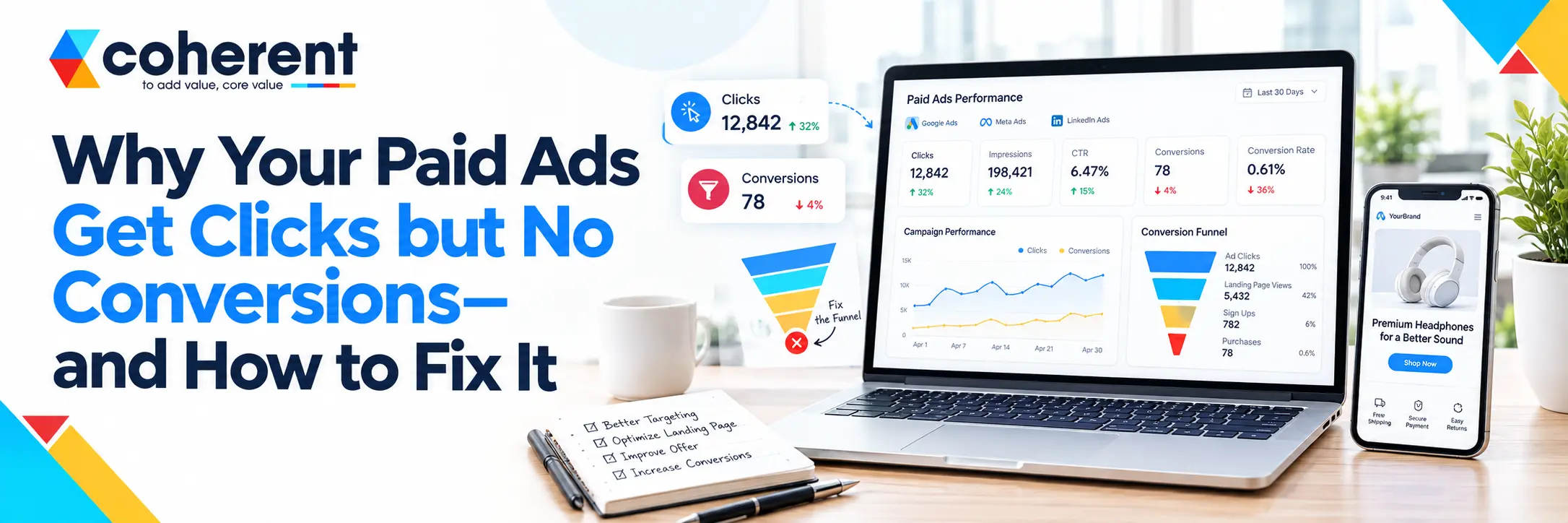
You are spending money on Google Ads, Facebook Ads, or other paid advertising campaigns. Your ads are getting clicks, website traffic is increasing, and people are visiting your landing pages. However, the leads, sales, and enquiries you expected are nowhere to be found.Why do your paid ads get clicks but no conversions? The most common reasons include targeting the wrong audience, using weak ad messaging, sending visitors to poorly optimized landing pages, offering an unclear value proposition, creating a slow website experience, or tracking conversions incorrectly.
The good news is that more advertising budget is not always the answer. In many cases, improving your audience targeting, landing page experience, offer, and conversion tracking can help you generate better results from your existing ad spend.Whether you run Google Ads for a local business, manage Facebook advertising for an e-commerce store, or generate leads through LinkedIn Ads, this guide explains how to identify the problem and fix it step by step.
What Does It Mean When Paid Ads Get Clicks but No Conversions?
When paid advertising campaigns generate clicks but no conversions, visitors show interest in your ads but do not complete the desired action. This may indicate problems with audience targeting, landing page relevance, website usability, offer quality, or conversion tracking. Identifying the cause helps improve campaign performance and reduce wasted advertising spend.
- Purchasing a product from your online store.
- Filling out a lead generation form.
- Booking a consultation or product demonstration.
- Calling your business.
Why Are Your Paid Ads Getting Clicks but No Conversions?
Paid ads can generate clicks without conversions when campaigns attract the wrong audience, target low-intent keywords, or direct visitors to landing pages that fail to meet their expectations. Slow websites, weak offers, unclear calls to action, and inaccurate conversion tracking can also affect performance.To improve results, businesses should review audience targeting, keyword intent, landing page relevance, website usability, offer quality, and tracking accuracy. Measuring qualified leads, purchases, and customer acquisition costs helps identify which campaigns deliver meaningful business results.
1. Are You Targeting the Wrong Audience?
Audience targeting determines whether your advertisements reach people who are likely to become customers. Even compelling ads may generate clicks without conversions when they attract users whose interests, needs, or budgets do not match your offer.For example, a software development company targeting free coding tutorials may attract students instead of businesses seeking custom software solutions.
- Refine location, demographic, and audience settings where appropriate.
- Separate high-intent audiences from informational visitors.
- Create dedicated campaigns for different customer segments.
- Review display and social advertising placements regularly.
2. Does Your Ad Promise Something Your Landing Page Does Not Deliver?
Your landing page should fulfil the expectations created by your advertisement. When visitors cannot find the advertised offer, pricing, or relevant information, they may leave without converting. Maintaining consistency between ad copy and landing page content builds trust and helps users understand the next step.
- Display the advertised offer prominently.
- Explain relevant benefits, features, and pricing.
- Add a clear call to action near the top.
- Direct visitors to relevant service or product pages instead of a generic homepage.
3. Is Your Landing Page Failing to Convert Visitors?
A poorly designed landing page can prevent interested visitors from becoming customers. Excessive text, confusing navigation, weak messaging, and complicated forms create unnecessary friction. Your page should communicate its value quickly and make completing the desired action straightforward.
- Display one prominent primary call to action.
- Add genuine testimonials and relevant trust signals.
- Remove unnecessary distractions.
- Optimize the experience for mobile users.
4. Is Your Website Too Slow on Mobile Devices?
Slow-loading landing pages can frustrate visitors and cause them to leave before viewing your offer. Mobile users may experience additional delays because of network conditions or device limitations. Improving page speed and usability helps create a smoother experience, although faster loading alone cannot guarantee more conversions.
- Enable effective browser caching.
- Use reliable hosting and a CDN where appropriate.
- Test landing pages on real mobile devices.
- Monitor Core Web Vitals, including LCP, INP, and CLS.
5. Is Your Call to Action Too Weak or Confusing?
A call to action (CTA) guides visitors toward the next step. Generic labels or unclear instructions may leave users uncertain about what happens after clicking. A specific, relevant CTA communicates value and helps visitors complete actions that match their buying intent.
- E-commerce: Shop the Collection.
- Local businesses: Get a Quote.
- SaaS products: Start Your Free Trial.
- Professional services: Discuss Your Project.
6. Is Your Offer Strong Enough to Convince Customers?
Your offer must give potential customers a compelling reason to choose your business. If the benefits are unclear, pricing seems unjustified, or competitors provide more relevant value, visitors may leave without taking action. Explain how your product or service addresses customer problems and what makes your solution different.
- Address concerns about cost, risk, and implementation.
- Provide transparent pricing where appropriate.
- Offer relevant consultations, demonstrations, or trials.
- Support claims with genuine testimonials and documented results.
7. Are You Attracting Clicks From Low-Intent Keywords?
Keywords attract visitors at different stages of the buying journey. Someone searching for “what is CRM software” may want information, while someone searching for “CRM software pricing for small businesses” may be comparing solutions. Understanding this difference helps businesses align advertising budgets with commercial intent.
- Separate informational and high-intent campaigns where appropriate.
- Exclude irrelevant searches using negative keywords.
- Align advertisements with search intent.
- Measure qualified leads, conversions, and customer acquisition costs.
8. Is Your Conversion Tracking Working Correctly?
Your campaigns may generate enquiries or purchases without recording them accurately in advertising dashboards. Incorrect conversion actions, duplicate tags, broken events, and analytics integration issues can distort performance reports. Reliable tracking helps businesses evaluate campaign effectiveness and make informed budget decisions.
- Confirm that tracking tags and analytics events fire correctly.
- Identify and eliminate duplicate conversion events.
- Compare advertising reports with CRM and order records.
- Review consent settings, attribution windows, and reporting delays.
Also Read:- Decoding the Dynamic Duo: SEO meets AI for Unbeatable Online Success
How Can You Fix Paid Ads That Generate Clicks but No Leads?
To fix paid ads that generate clicks but no leads, identify where potential customers drop off in your advertising funnel. Review search terms, refine audience targeting, and ensure your landing page matches the advertised offer. Improve page speed, simplify forms, and test different headlines and calls to action. Verify conversion tracking to ensure enquiries are recorded accurately. Monitor qualified leads, conversion rates, and cost per lead before making further campaign adjustments.
How Can You Fix Paid Ads That Generate Clicks but No Leads?
|
Step |
Action |
Expected outcome |
|---|---|---|
|
1. Analyze the advertising funnel |
Review clicks, landing page visits, conversions, and cost per lead. |
Identify where visitors drop off. |
|
2. Review search terms |
Exclude irrelevant searches using suitable negative keywords. |
Reduce wasted advertising spend. |
|
3. Optimize landing pages |
Improve headlines, offers, forms, and calls to action. |
Encourage more visitors to convert. |
|
4. Run A/B tests |
Compare different headlines, CTAs, and page layouts. |
Identify effective campaign elements. |
|
5. Improve mobile experience |
Fix loading issues, simplify forms, and test mobile usability. |
Reduce friction for mobile visitors. |
|
6. Verify conversion tracking |
Test forms, tags, and conversion events. |
Ensure conversions are recorded accurately. |
|
7. Measure lead quality |
Compare qualified leads, sales, and acquisition costs. |
Focus on valuable business outcomes. |
Step 1: Analyze Your Advertising Funnel
Your advertising funnel shows how visitors move from seeing an advertisement to becoming potential customers. Reviewing each stage helps identify whether the problem lies in ad relevance, landing page traffic, conversion tracking, or lead quality.
- Conversion rate: Measures conversions relative to the relevant traffic or interactions.
- Cost per lead: Calculates advertising spend per recorded lead.
- Customer acquisition cost: Measures the total cost of acquiring a paying customer.
- ROAS: Compares attributed advertising revenue with advertising spend.
Step 2: Review Your Google Ads Search Terms Report
The search terms report reveals the actual queries that trigger your advertisements. Reviewing this data helps identify irrelevant searches that consume your budget without attracting potential customers. Focus on commercial intent, keyword relevance, and lead quality before making significant campaign changes.
- Review keyword match types and search intent.
- Separate campaigns for distinct services where appropriate.
- Compare conversion performance across keywords.
- Consider conversion delays before excluding non-converting terms.
Step 3: Improve Your Landing Page Conversion Rate
Your landing page should help visitors understand your offer, recognize its value, and take the next step. Even relevant advertising traffic may fail to convert when the page contains confusing messaging, complicated forms, or insufficient trust signals. Focus on removing friction and making the desired action obvious.
- Keep forms short and relevant.
- Add genuine testimonials and case studies.
- Improve loading speed and mobile usability.
- Test forms and conversion tracking regularly.
Step 4: Run A/B Tests Instead of Guessing
A/B testing compares different versions of an advertisement or landing page to determine which performs better. Rather than relying on assumptions, test specific changes and evaluate their effect on meaningful business outcomes. Use a consistent measurement approach and allow sufficient data to accumulate before choosing a winner.
- Define the primary conversion metric beforehand.
- Avoid drawing conclusions from very few conversions.
- Measure qualified leads and revenue, not just submissions.
- Document findings and apply successful changes systematically.
Step 5: Improve Your Website's Mobile Experience
Mobile visitors may abandon your landing page if buttons are difficult to tap, forms are hard to complete, or content loads slowly. Review the entire journey on smartphones, from the initial landing page to form submission or checkout, to identify usability issues that may prevent conversions.
- Ensure headlines and buttons fit smaller screens.
- Make forms simple to complete.
- Use clickable phone numbers where relevant.
- Prevent pop-ups from blocking essential content
How Can You Improve Paid Ads ROI Without Increasing Your Budget?
You can improve paid advertising ROI without increasing your budget by reducing wasted clicks, fixing conversion barriers, and prioritizing campaigns that attract qualified customers. Focus on improving the performance of your existing campaigns before increasing spend. Track revenue and lead quality to understand which changes deliver meaningful business results. Businesses looking to improve their digital experiences can also explore Coherent Lab’s mobile app development services to build user-focused mobile applications that support their business goals.
- Connect advertising data with CRM and sales outcomes.
- Review campaign performance using sufficient data.
- Reallocate spending toward effective campaigns when appropriate.
Which Tools Can Help You Identify Paid Advertising Conversion Problems?
Paid advertising tools help you understand traffic quality, visitor behaviour, website performance, and conversion tracking. You do not need every available platform. Start with tools that answer specific questions about campaign performance and user behaviour, then use the findings to prioritize practical improvements.
- Google Ads: Review search terms, campaign performance, and conversions.
- Google Tag Manager: Manage and troubleshoot supported tracking tags.
- Microsoft Clarity: Examine supported session recordings and heatmaps.
- PageSpeed Insights: Identify website performance issues.
How Can You Identify Where Visitors Drop Off?
A conversion funnel helps you identify where potential customers stop progressing toward a desired action. Examine each stage, from the initial advertisement click to the completed enquiry or purchase. This makes it easier to distinguish advertising problems from landing page, form, and sales process issues.
- CTA clicks: Review messaging, offer clarity, and button visibility.
- Form starts: Check form usability and required fields.
- Form submissions: Investigate technical errors and unnecessary friction.
- Sales outcomes: Evaluate lead quality and follow-up effectiveness.
Why Are Your Paid Ads Generating Leads but Not Sales?
Paid advertising campaigns can generate enquiries without producing revenue when leads lack buying intent or the sales process fails to convert them. Common causes include poor qualification, slow follow-ups, unclear value propositions, and pricing concerns. Connect advertising performance with actual sales outcomes to identify where potential customers are being lost.
- Prospects do not understand your product's value.
- Pricing does not meet customer expectations.
- Follow-up communication is inconsistent.
- Campaigns prioritize inexpensive leads over qualified prospects.
How Can You Improve Lead Quality From Paid Ads?
Improving lead quality starts with defining the characteristics of a potential customer who is likely to purchase. Align your advertisements, landing pages, and qualification process with that profile. Evaluate campaigns based on qualified leads and sales outcomes rather than relying exclusively on enquiry volume or cost per lead.
- Respond promptly to new enquiries.
- Track which campaigns generate paying customers.
- Share qualified-lead data with your advertising team.
- Compare cost per qualified lead and lead-to-customer conversion rates.
How Long Does It Take to Fix Paid Ads That Are Not Converting?
The time needed to fix underperforming paid ads depends on the underlying problem, traffic volume, and sales cycle. Technical errors may be resolved quickly, while audience refinement and landing page testing require more data. Use a structured review process to prioritize fixes and evaluate their impact without making unnecessary campaign changes.
|
Time frame |
Recommended action |
|---|---|
|
Day 1 |
Check tracking, URLs, forms, and checkout functionality. |
|
Days 2–3 |
Review search terms, targeting, and landing page relevance. |
|
Days 4–7 |
Implement priority fixes and establish a performance baseline. |
|
Weeks 2–3 |
Test selected landing page elements and ad messaging. |
|
Weeks 3–4 |
Review lead quality, acquisition costs, and early revenue results. |
Conclusion
When your paid ads generate clicks but no conversions, the answer is not always to increase your advertising budget or create more advertisements. The real issue may be audience targeting, keyword intent, landing page design, website speed, an unclear offer, or inaccurate conversion tracking.Start with the fundamentals. Confirm that your tracking works, review the searches and audiences generating traffic, improve the landing page experience, and make the next step obvious for potential customers.
Then monitor conversion rate, cost per qualified lead, customer acquisition cost, and revenue to determine whether your changes are making a meaningful difference. If your business needs help improving its website experience, landing pages, or digital marketing performance, explore the services offered by connect with our experts to discuss your business goals.
Frequently Asked Questions
Q1. Why are my Google Ads getting clicks but no conversions?
Ans.Your Google Ads may receive clicks without conversions because your keywords attract the wrong audience, your landing page does not match the advertisement, your offer is unclear, or your website makes it difficult to complete an action. Incorrect conversion tracking can also hide genuine results. Start by reviewing search terms, landing page performance, conversion tracking, and form functionality. Then identify the weakest stage of the customer journey and test a targeted improvement. Avoid increasing your budget until you understand why the current traffic is not producing the desired outcome.
Q2. How do I fix Google Ads campaigns that generate traffic but no leads?
Ans.Begin by checking whether your advertisements target people who are likely to need your service. Review search terms and exclude irrelevant searches using suitable negative keywords. Next, ensure that your landing page matches the ad's message and includes a clear call to action. Simplify lead forms, communicate your value proposition, and verify that conversion tracking works correctly. Finally, evaluate the cost and quality of the leads you generate. These steps help you distinguish between a traffic quality problem, a landing page issue, and a measurement problem before making larger campaign changes.
Q3. Can a slow website cause paid advertising conversions to drop?
Ans.Yes. A slow website can frustrate visitors and cause them to leave before they see your offer or complete a purchase. This can be especially important for mobile advertising campaigns, where visitors may have limited patience or slower connections. Compress large images, reduce unnecessary scripts, improve server response times, and simplify page elements. Test important landing pages using PageSpeed Insights and review Core Web Vitals. However, website speed is not the only factor affecting conversions. Your offer, audience targeting, page relevance, and checkout experience also influence whether visitors become customers.
Q4. What is the difference between click-through rate and conversion rate?
Ans.Click-through rate measures the percentage of ad impressions that result in clicks. Conversion rate measures how effectively eligible ad interactions or website visits result in a defined conversion, depending on the calculation used. A high click-through rate means your advertisement attracts attention, but it does not necessarily mean visitors will purchase or submit enquiries. For example, an advertisement may receive many clicks because its headline is appealing, even if the offer does not match the audience's needs. Monitor both metrics alongside cost per qualified lead, customer acquisition cost, and revenue to evaluate campaign performance more accurately.
Q5. Should I stop my paid ads if they are not converting?
Ans.Not necessarily. Before pausing a campaign, check whether conversion tracking works, whether the campaign has received sufficient traffic, and whether conversions may take time to occur. Investigate broken forms, irrelevant keywords, unsuitable targeting, and landing page problems. If a campaign consistently spends money without generating valuable results, reducing its budget or pausing specific underperforming elements may be appropriate. Consider the value of potential customers, the sales cycle, and your acceptable acquisition cost. Make decisions using reliable performance data rather than clicks alone, and avoid making drastic changes based on a very small sample.
Q6. How much should I spend on paid ads to get conversions?
Ans.There is no single advertising budget that guarantees conversions. Your budget depends on your industry, keyword costs, target audience, product pricing, competition, and conversion goals. Start by defining your acceptable cost per lead or customer and estimate the traffic needed to evaluate campaign performance. For example, if your target cost per lead is ₹1,500 and you want 20 leads, your target advertising spend would be ₹30,000, assuming you achieve that cost per lead. This is a planning calculation, not a performance guarantee. Begin with a budget you can afford to test, monitor results, and scale only when the economics make sense.
Q7. How can I improve paid advertising ROI without increasing my budget?
Ans.You can improve advertising ROI by reducing wasted clicks, targeting more relevant searches, strengthening landing pages, simplifying conversion forms, and fixing technical problems. Review which campaigns generate qualified leads and actual revenue instead of allocating budget based solely on click volume. Test clearer headlines and calls to action, and exclude irrelevant traffic when the data supports doing so. Improving lead follow-up can also help convert more existing enquiries into customers. Measure the impact of each change using consistent conversion definitions and attribution settings. The goal is to generate more valuable business outcomes from your current advertising investment.
Q8. How do I know whether my paid advertising campaign is profitable?
Ans.Evaluate advertising performance using revenue, customer acquisition costs, and profit margins rather than traffic alone. Return on ad spend (ROAS) is calculated by dividing attributed revenue by advertising spend. For example, ₹100,000 in attributed revenue from ₹25,000 in advertising spend produces a 4:1 ROAS. However, this does not automatically mean the campaign is profitable because product costs, salaries, agency fees, software, and other operating expenses may also apply. For lead generation campaigns, connect leads to sales wherever possible and calculate the cost of acquiring paying customers. A profitable campaign generates sustainable business value, not simply a high number of clicks.

 +91 774-202-1725
 +1 (945) 3387904
 business@coherentlab.com
 +49 15223341304
 UK

