
Table of Contents
Quick Commerce App Development in 2026: Cost, Features & Business Model
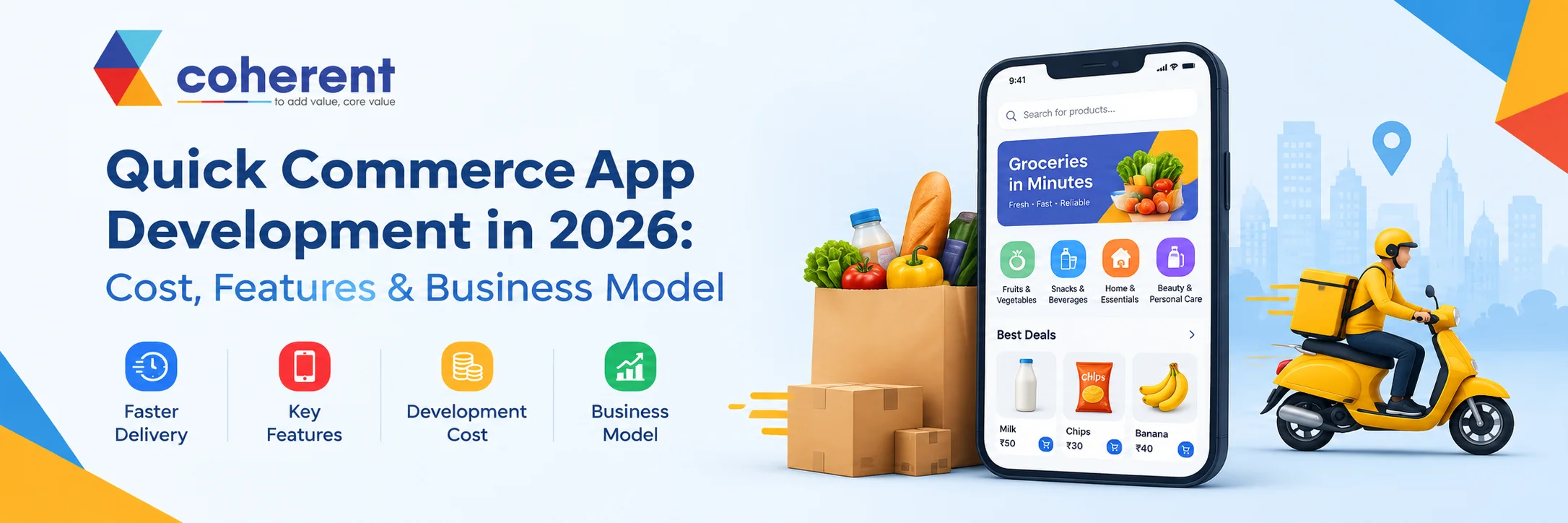
Quick commerce is changing how customers purchase groceries, household essentials, personal care products, and everyday items. People increasingly expect convenient ordering, real-time tracking, and deliveries within minutes rather than hours. For businesses, this shift creates opportunities to build scalable digital platforms that connect customers, local stores, inventory systems, and delivery partners. However, launching a successful platform requires more than developing a mobile application.
Companies must consider development costs, technology infrastructure, inventory management, delivery operations, and long-term profitability. Quick commerce app development in 2026 involves combining customer-friendly features with efficient fulfilment and a sustainable business model. Whether you are a startup planning a grocery delivery app or an established retailer expanding into hyperlocal commerce, understanding these elements can help you make informed investment decisions and build a competitive quick commerce business.
What Is Quick Commerce App Development?
Quick commerce app development requires a well-planned approach to connect customer apps, inventory management, order processing, and delivery operations. Businesses can follow the E-Commerce App Development Process to understand essential development stages, from planning and feature selection to testing and deployment. However, quick commerce also demands real-time inventory updates, nearby fulfilment centres, and efficient delivery coordination to ensure faster order fulfilment and a reliable customer experience.
Key Components of a Quick Commerce Platform
- Customer application: Enables product discovery, cart management, payments, offers, and order tracking.
- Inventory management: Displays stock availability and updates quantities as orders are processed.
- Delivery management: Assigns orders to delivery partners and supports navigation, status updates, and proof of delivery.
- Admin dashboard: Helps businesses manage products, customers, pricing, orders, refunds, and performance reports.
How Much Does Quick Commerce App Development Cost in 2026?
The cost of quick commerce app development depends on complexity, integrations, platforms, and business needs. Understanding the overall Mobile App Development Cost helps businesses plan budgets realistically. A basic MVP costs less than a complete solution with multiple stores, automated inventory, advanced analytics, and delivery management. Founders should also account for operational expenses, including warehouse rentals, stock purchases, and delivery partner payments, before planning future expansion.
|
Development Level |
Estimated Cost (USD) |
Typical Features |
Estimated Timeline |
|---|---|---|---|
|
Basic MVP |
$15,000–$35,000 |
Product listings, cart, payments, basic order tracking |
2–4 months |
|
Mid-Level Platform |
$35,000–$80,000 |
Multiple integrations, delivery management, inventory controls |
4–7 months |
|
Advanced Platform |
$80,000–$180,000+ |
Advanced analytics, automation, multi-store operations, AI features |
6–12+ months |
What Are the Essential Features of a Quick Commerce App?
A successful quick commerce application must make shopping convenient while helping businesses process orders accurately. Customers expect simple navigation, transparent pricing, secure payments, and reliable delivery updates. Partnering with an experienced Android App Development Company can help businesses build user-friendly applications with seamless integrations and scalable features. Behind the interface, inventory synchronization and order management remain essential for improving operational efficiency and customer retention.
Must-Have Quick Commerce App Features
- Customer features: Registration, product search, category filters, shopping carts, saved addresses, multiple payment methods, and order history.
- Delivery partner features: Order acceptance, GPS navigation, delivery instructions, status updates, and earnings tracking.
- Store management features: Product catalogues, stock monitoring, order preparation, pricing controls, and low-stock alerts.
- Business intelligence features: Sales reports, customer behaviour insights, promotional performance, and demand forecasting.
Also Read :- 10 Best Ecommerce App Development Companies in India
Which Business Model Is Best for a Quick Commerce Startup?
The quick commerce business model determines how a company manages inventory, fulfils orders, earns revenue, and distributes operational responsibilities. Some businesses purchase and store products themselves, while others connect customers with independent retailers. A hybrid model combines elements of both approaches. Selecting the right structure depends on available capital, supplier relationships, target locations, product margins, and delivery capabilities. A sustainable model must balance convenience with fulfilment costs and customer demand.
Popular Quick Commerce Business Models
- Inventory-led model: The company purchases products, controls stock, and manages fulfilment. It offers greater control but requires working capital and inventory planning.
- Marketplace model: Third-party retailers list products and fulfil orders. This reduces inventory ownership but requires reliable partner coordination.
- Hybrid model: The business manages selected high-demand products while partnering with local stores for additional selection.
- Subscription and membership model: Customers pay recurring fees for eligible delivery benefits, exclusive offers, or other membership advantages.
Which Technology Stack Is Used for Quick Commerce App Development?
A scalable technology stack helps quick commerce platforms manage orders, synchronize inventory, protect customer data, and handle growing transaction volumes. Choosing the right stack depends on performance, budget, team expertise, and integration needs. Partnering with a reliable Mobile App Development Company can help businesses select suitable technologies, build seamless mobile experiences, and develop a flexible architecture that supports reliable operations and future growth.
Recommended Technologies and Integrations
- Mobile development: Flutter, React Native, Swift, or Kotlin, depending on platform requirements and available expertise.
- Backend and databases: Node.js, Java, Python, PostgreSQL, or suitable document databases for business logic and operational data.
- Cloud and integrations: AWS, Microsoft Azure, or Google Cloud, alongside payment gateways, mapping services, notifications, and analytics tools.
- Automation and security: Role-based access, encryption, monitoring, inventory alerts, demand forecasting, and carefully tested AI-powered recommendations.
Also Read :- Top Ecommerce Website Development Companies
How Can Quick Commerce Apps Make Money and Improve Profitability?
A quick commerce platform can generate revenue through multiple channels, but profitability depends on efficient operations and controlled fulfilment costs. Businesses must monitor order values, product margins, delivery expenses, discounts, and repeat purchases. With its expertise in digital solutions, Coherent Lab LLP can help businesses develop scalable quick commerce platforms that improve inventory management, streamline operations, enhance customer experiences, and support sustainable growth through data-driven decisions.
Strategies to Build a Profitable Quick Commerce Business
- Increase average order value: Use relevant product bundles, complementary recommendations, and minimum-order thresholds where appropriate.
- Improve delivery efficiency: Optimize delivery zones, order batching where practical, and rider allocation without compromising promised delivery times.
- Encourage repeat purchases: Introduce useful loyalty benefits, personalized offers, dependable service, and convenient reorder options.
- Control inventory expenses: Forecast demand, monitor expiry dates, reduce stockouts, and adjust product assortment to local buying patterns.
What Is the Quick Commerce App Development Process?
A structured development process helps businesses turn an idea into a reliable application while managing scope, cost, and technical risk. Before development begins, teams should validate customer demand, identify competitors, select a target service area, and define operational requirements. Building a minimum viable product allows businesses to test assumptions before investing in advanced functionality. After launch, customer feedback and performance data should guide improvements and expansion.
Steps to Launch a Quick Commerce Application
- Research and planning: Define customer segments, product categories, delivery promises, revenue streams, and launch locations.
- Design and development: Create user journeys, prototypes, application interfaces, backend services, and administrative tools.
- Testing and deployment: Test checkout, payments, inventory updates, security, order assignment, and real-world delivery workflows.
- Launch and optimization: Monitor customer feedback, technical errors, fulfilment speed, retention, and operating costs before scaling.
Also Read :- 10 Best Ecommerce App Development Companies
Conclusion
Quick commerce app development in 2026 offers businesses an opportunity to meet growing customer expectations for speed, convenience, and reliable local delivery. However, long-term success depends on choosing the right business model, maintaining accurate inventory, controlling delivery costs, and investing in scalable technology. Starting with a minimum viable product (MVP) helps businesses test demand and improve their services before expanding.
A customer-friendly interface, efficient logistics, and clear unit economics can support sustainable growth. If you are planning to launch your own quick commerce platform, Connect With Us to discuss your requirements and explore the right development approach for your business goals.
Frequently Asked Questions
Q1. How much does quick commerce app development cost in 2026?
Ans. Quick commerce app development may cost approximately 15,000–35,000 for a basic MVP, 35,000–80,000 for a mid-level platform, or 80,000–180,000 or more for advanced solutions. These are illustrative estimates, not guaranteed quotations. Features, integrations, location, team expertise, and scalability requirements affect the final budget. Warehouse setup, inventory, delivery operations, and marketing generally require separate financial planning.
Q2. How long does it take to develop a quick commerce app?
Ans. A basic quick commerce MVP may take two to four months, while a mid-level platform could require four to seven months. Advanced applications may take six to twelve months or longer. Timelines depend on design complexity, integrations, testing, team size, and operational requirements. Clear specifications and phased development can help businesses launch essential features earlier and expand according to customer feedback.
Q3. What features should a quick commerce app include?
Ans. Essential features include customer registration, product search, shopping carts, secure checkout, order tracking, delivery partner management, and inventory synchronization. An admin dashboard should support product management, pricing, refunds, and reporting. Businesses can add loyalty programmes, personalized recommendations, demand forecasting, and automated alerts later. Feature priorities should reflect customer needs, business objectives, and the operational capabilities of the launch market.
Q4. How do quick commerce apps generate revenue?
Ans. Quick commerce applications can earn revenue through product margins, retailer commissions, delivery charges, subscriptions, and sponsored listings. The appropriate mix depends on whether the business owns inventory, operates a marketplace, or combines both models. Revenue alone does not establish profitability. Businesses must account for discounts, delivery expenses, payment processing, customer acquisition, inventory losses, and support costs when evaluating financial performance.
Q5. What is the difference between quick commerce and traditional e-commerce?
Ans. Traditional e-commerce typically serves broader geographic areas and may deliver products over several days. Quick commerce focuses on nearby fulfilment locations, limited delivery zones, real-time inventory, and faster order delivery. It often requires more localized stock management and coordination with delivery partners. The best approach depends on product type, customer expectations, fulfilment infrastructure, and whether speed justifies the additional operating expenses.
Q6. Which technology is best for quick commerce app development?
Ans. There is no single best technology stack for every quick commerce business. Flutter and React Native can support cross-platform mobile development, while native technologies may suit specific performance or platform needs. Backend frameworks, databases, cloud services, mapping APIs, and payment gateways should be selected according to requirements. Scalability, security, maintainability, developer expertise, and integration reliability matter more than choosing technologies solely for popularity.
Q7. Can a startup launch a quick commerce app with a limited budget?
Ans. Yes. A startup can begin with a focused MVP serving a small geographic area and a carefully selected product range. Essential features should include product discovery, checkout, inventory management, and order tracking. Using established payment and mapping services may reduce initial development effort. Before expanding, the business should validate demand, measure fulfilment costs, monitor repeat orders, and confirm that its operational model is financially sustainable.
Q8. How can businesses choose a quick commerce app development company?
Ans. Businesses should evaluate a development company's relevant portfolio, technical expertise, integration experience, security practices, communication, and post-launch support. Request a detailed proposal covering scope, milestones, deliverables, maintenance, and potential additional charges. Discuss how the team will handle inventory synchronization, payment failures, delivery workflows, and scaling. Compare proposals on overall value and technical suitability rather than selecting a provider based only on the lowest price.

 +91 774-202-1725
 +1 (945) 3387904
 business@coherentlab.com
 +49 15223341304
 UK

