Table of Contents
Why Businesses Are Rebuilding Legacy Apps with AI
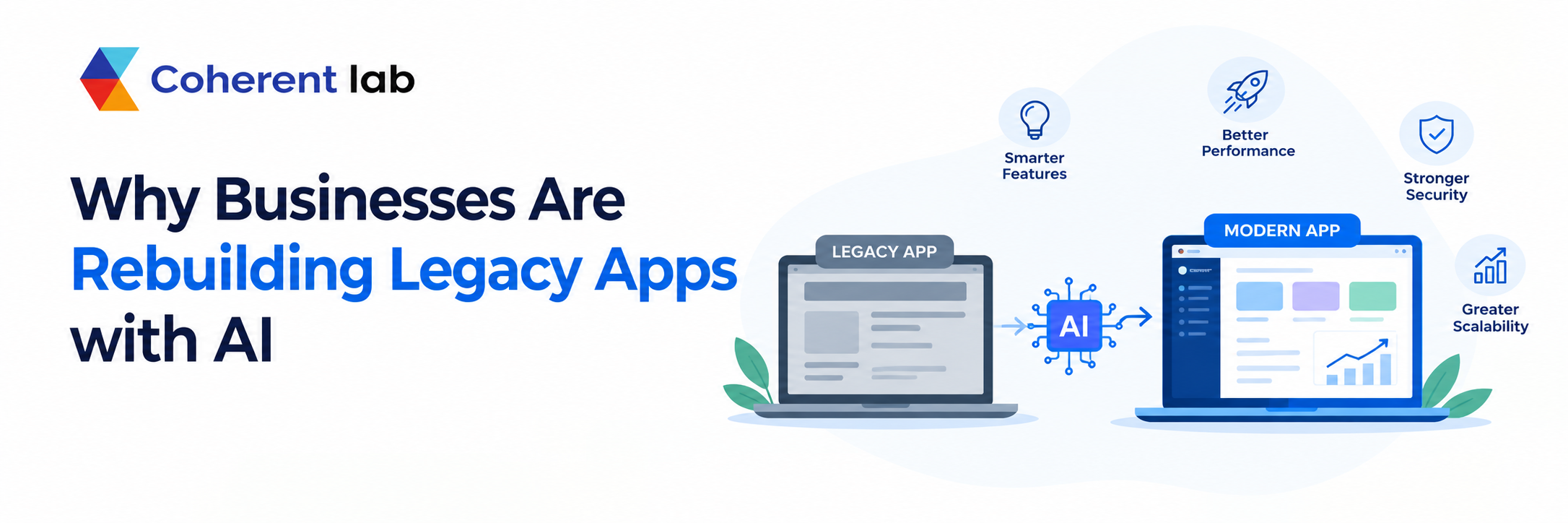
In today’s rapidly evolving digital landscape, businesses are under constant pressure to innovate, scale, and deliver exceptional customer experiences. However, many organizations are still dependent on legacy applications that were built years ago.
While these systems once worked efficiently, they now act as roadblocks to growth. Rebuilding legacy apps with Artificial Intelligence (AI) helps businesses become faster, smarter, and more competitive.
What Are Legacy Applications?
Legacy applications are outdated software systems that still support business operations but lack modern capabilities, which is why businesses increasingly rely on AI app development companies to modernize these systems with advanced technologies, improved performance, and better user experiences.
Key Characteristics of Legacy Systems
- Built on outdated technologies
- Difficult to scale
- High maintenance cost
- Limited integration options
- Security vulnerabilities
Why Businesses Are Modernizing Legacy Apps with AI
Businesses are increasingly modernizing legacy applications with AI to stay competitive, improve efficiency, and reduce operational costs. AI App Development Company enables smarter automation, better data insights, and enhanced user experiences. By rebuilding outdated systems, companies can boost scalability, strengthen security, and accelerate innovation while meeting evolving customer expectations in a fast-changing digital landscape.
Improved Performance and Automation
AI helps automate repetitive tasks and improves system efficiency.
Benefits:
- Faster operations
- Reduced manual errors
- Increased productivity
Enhanced Customer Experience
AI allows businesses to deliver personalized and real-time experiences.
Examples:
- AI chatbots
- Recommendation systems
- Customer behavior prediction
Cost Reduction and Better ROI
Legacy systems are expensive to maintain.
AI helps by:
- Reducing maintenance costs
- Minimizing downtime
- Optimizing resources
Data-Driven Decision Making
AI converts data into valuable insights.
- Real-time analytics
- Predictive forecasting
- Better business strategies
Stronger Security
AI improves cybersecurity in modern systems.
- Threat detection
- Fraud prevention
- Automated monitoring
AI Technologies Powering Modernization
Mobile App Development AI technologies like machine learning, natural language processing, and computer vision are driving legacy app modernization in mobile app development. These tools help automate workflows, extract valuable insights from data, and enhance user interactions. Cloud computing and APIs further enable seamless integration, making mobile systems more scalable, agile, and capable of adapting to evolving business needs efficiently.
Machine Learning (ML)
- Improves system intelligence over time
Natural Language Processing (NLP)
- Enables chatbots and voice assistants
Robotic Process Automation (RPA)
- Automates repetitive workflows
Predictive Analytics
- Forecasts future trends
Challenges in Rebuilding Legacy Applications
Rebuilding legacy applications comes with several challenges, including high migration costs, data compatibility issues, and potential system downtime. Integrating AI into outdated architectures can be complex and time-consuming. Businesses must also address security risks, skill gaps, and resistance to change while ensuring minimal disruption to ongoing operations and maintaining data integrity throughout the transition.For organizations managing these complexities, legacy software modernization services can help structure the transition around existing systems and business requirements.
Common Issues
- Complex data migration
- Integration problems
- High initial cost
- Resistance to change
Best Practices for AI-Based Modernization
- Create a clear strategy
- Focus on important applications first
- Use cloud-based AI solutions
- Ensure data security
- Train employees
Future of AI in Legacy Modernization
The future of AI in legacy modernization looks highly promising as businesses adopt smarter, more adaptive technologies. AI will enable faster migrations, predictive maintenance, and real-time optimization of systems. With advancements in automation and cloud integration, organizations can expect improved scalability, reduced costs, and continuous innovation, helping them stay competitive in an increasingly digital-first world.
Conclusion
Rebuilding legacy applications with AI is not just a technical upgrade—it is a business transformation strategy. Outdated systems slow down growth, increase costs, and limit innovation. By adopting AI, businesses can automate operations, improve customer experience, and make smarter decisions using real-time data.Although modernization requires investment and careful planning, the long-term benefits far outweigh the costs.
Companies that embrace AI-driven transformation today position themselves to handle future challenges and seize new opportunities. In contrast, businesses that continue relying on outdated legacy systems risk falling behind in an increasingly competitive market.Contact us today to start your AI-powered modernization journey and future-proof your business.
Frequently Asked Questions
Q1. What is legacy application modernization?
Ans. Legacy application modernization is the process of upgrading or transforming outdated software systems into modern, scalable, and efficient solutions. This often involves integrating advanced technologies such as artificial intelligence, cloud computing, and microservices architecture. The goal is to improve performance, security, and user experience while ensuring the system remains relevant to current business needs and technological advancements in a rapidly evolving digital landscape.
Q2. Why are businesses rebuilding legacy apps with AI?
Ans. Businesses are rebuilding legacy applications with AI to stay competitive and improve operational efficiency. AI helps automate repetitive tasks, reduce human errors, and provide deeper insights through data analysis. It also enhances customer experience with personalization and faster responses. By adopting AI-driven solutions, companies can lower long-term costs, increase productivity, and adapt more quickly to changing market demands and customer expectations.
Q3. How does AI help in modernization?
Ans. AI plays a crucial role in modernization by automating complex processes, improving decision-making, and enhancing system performance. It can analyze large volumes of data to identify patterns, predict outcomes, and optimize workflows. AI also strengthens cybersecurity by detecting threats in real time. Additionally, it enables smarter applications that can learn and evolve, helping businesses become more agile, efficient, and responsive to user needs.
Q4. What are the challenges in modernization?
Ans. Modernizing legacy systems comes with several challenges, including data migration complexities, integration with existing systems, and high initial costs. Organizations may also face resistance to change from employees and stakeholders. Ensuring data security during the transition is another major concern. Additionally, lack of skilled professionals and unclear modernization strategies can delay progress, making proper planning and execution essential for success.
Q5. Is AI modernization expensive?
Ans. AI-driven modernization can require a significant initial investment, including costs for technology, infrastructure, and skilled talent. However, it often leads to substantial long-term savings by improving efficiency, reducing manual work, and minimizing errors. Over time, businesses benefit from increased productivity, better decision-making, and reduced maintenance costs, making AI modernization a cost-effective strategy in the long run despite the upfront expenses.
Q6. Which industries benefit most?
Ans. Several industries benefit greatly from AI-powered legacy modernization, including healthcare, finance, retail, and manufacturing. In healthcare, it improves patient care and data management. In finance, it enhances fraud detection and risk analysis. Retail businesses use AI for personalized customer experiences, while manufacturing benefits from automation and predictive maintenance. Overall, any industry relying on data and efficiency can gain significant advantages.
Q7. How long does it take?
Ans. The time required for legacy application modernization varies depending on the system’s complexity, size, and business requirements. Small-scale upgrades may take a few months, while large, enterprise-level transformations can take a year or more. Factors such as data migration, integration challenges, and testing processes also influence the timeline. Proper planning, clear goals, and expert execution can help speed up the modernization process.
Q8. What is the future of AI in legacy systems?
Ans. The future of AI in legacy systems is highly promising, with increasing adoption of automation, scalability, and intelligent decision-making. AI will continue to transform outdated systems into smart, adaptive platforms that can learn and evolve over time. Businesses will benefit from real-time insights, improved efficiency, and enhanced customer experiences. As technology advances, AI will become a key driver of innovation and long-term digital transformation.

 +91 774-202-1725
 +1 (945) 3387904
 business@coherentlab.com
 +49 15223341304
 UK
UK