Table of Contents
Route Planning App Development Guide: Features, Cost & Technology Stack
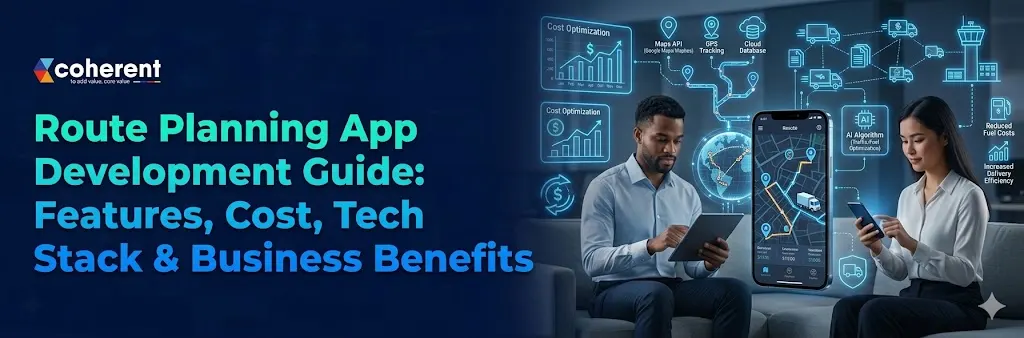
Route planning apps are transforming industries like logistics, transportation, food delivery, e-commerce, taxi booking, and fleet management. Businesses today rely on smart route optimization software to reduce fuel costs, improve delivery speed, and enhance customer satisfaction. A modern route planning application uses GPS tracking, AI-powered navigation, real-time traffic updates, and predictive analytics to create the fastest and most efficient routes. From startups to enterprises, companies are investing in route optimization app development to streamline operations and boost productivity. In this complete guide, we will explore route planning app features, development process, technology stack, development cost, monetization models, and future trends.
What is a Route Planning App?
A Route Planning App is a smart navigation solution that helps users find the fastest, safest, and most efficient routes for travel or deliveries. It uses real-time GPS, traffic updates, and optimization technology to reduce travel time, fuel costs, and delays. Businesses, delivery services, and everyday commuters rely on route planning apps to improve productivity, navigation accuracy, and overall travel convenience.
- Traffic conditions
- Distance
- Road closures
- Fuel consumption
- Delivery priorities
- Weather conditions
Popular industries using route planner apps include:
- Logistics & transportation
- Food delivery services
- Taxi booking businesses
- Fleet management companies
- Field service management
- e-commerce delivery platforms
Key Features of Route Planning Apps
Key features of route planning apps include real-time GPS tracking, traffic updates, multi-stop route optimization, voice navigation, fuel-efficient route suggestions, and live ETAs. These apps help businesses and travelers save time, reduce transportation costs, and improve delivery accuracy. Advanced route planning solutions also offer fleet management, driver tracking, offline maps, and seamless integration with logistics and delivery systems.
Real-Time GPS Tracking
Real-time GPS tracking allows businesses and users to monitor vehicle locations instantly.
- Live driver tracking
- Improved delivery accuracy
- Better customer communication
- Reduced operational delays
AI-Based Route Optimization
AI-Based Route Optimization uses artificial intelligence and real-time data to identify the fastest, most cost-effective travel routes. It analyzes traffic patterns, weather conditions, delivery schedules, and road restrictions to improve route efficiency. Businesses use AI-powered route optimization to reduce fuel consumption, shorten delivery times, enhance fleet productivity, and provide better customer experiences through accurate and intelligent route planning solutions.
Important Functionalities:
- Multi-stop route optimization
- Dynamic rerouting
- Traffic prediction
- Smart ETA calculation
Voice Navigation Integration
Voice Navigation Integration allows users to receive hands-free, turn-by-turn directions while driving, cycling, or walking. It enhances safety, convenience, and navigation accuracy by providing real-time voice guidance and traffic alerts. Modern route planning apps use voice navigation to improve user experience, reduce distractions, and support seamless travel with multilingual assistance, smart rerouting, and GPS-enabled location tracking features.
Common Integrations:
- Google Maps API
- Mapbox Navigation SDK
- Apple Maps
- HERE Maps
Multi-Stop Route Management
Multi-Stop Route Management helps businesses and drivers efficiently plan routes with multiple destinations in a single trip. It optimizes stop sequences to reduce travel time, fuel costs, and delivery delays. Advanced route planning apps use real-time traffic data, GPS tracking, and AI-powered optimization to improve delivery efficiency, fleet productivity, and customer satisfaction for logistics, transportation, and delivery services.
Advantages:
- Lower fuel costs
- Faster deliveries
- Better route efficiency
- Reduced idle time
Delivery Scheduling System
A Delivery Scheduling System helps businesses organize, manage, and automate deliveries with accurate time slots and route coordination. It improves operational efficiency by reducing delays, optimizing driver schedules, and enhancing customer communication. Modern delivery scheduling solutions integrate real-time tracking, automated notifications, and AI-based route planning to streamline logistics, increase on-time deliveries, and improve overall customer satisfaction.
Features Include:
- Time-slot management
- Automated dispatch
- Driver assignment
- Route prioritization
Push Notifications & Alerts
Push Notifications & Alerts keep users informed with real-time updates about deliveries, route changes, traffic conditions, and order statuses. These instant notifications improve communication, customer engagement, and operational efficiency. Route planning and delivery apps use smart alerts to reduce missed deliveries, provide accurate ETAs, enhance driver coordination, and deliver a seamless user experience through timely and personalized updates.
Examples:
- Delivery updates
- Route changes
- Delayed shipment alerts
- Driver arrival notifications
Advanced Features for Modern Route Planning Apps
Advanced features for modern route planning apps include AI-powered route optimization, real-time GPS tracking, voice navigation, predictive traffic analysis, multi-stop route management, and automated delivery scheduling. These smart capabilities help businesses reduce fuel costs, improve fleet efficiency, enhance customer satisfaction, and streamline logistics operations. Modern route planning solutions also support cloud integration, live analytics, and instant push notifications for better performance.
| Feature | Short Description |
|---|---|
| Real-Time GPS Tracking | Live vehicle and user location updates |
| AI Route Optimization | Finds the fastest and most efficient routes |
| Traffic Prediction | Avoids congestion using live traffic data |
| Multi-Stop Routing | Optimizes routes with multiple destinations |
| Geofencing | Creates virtual location boundaries |
| Voice Navigation | Hands-free turn-by-turn guidance |
| Offline Maps | Access routes without internet connection |
| Fleet Management | Monitor and manage multiple vehicles |
| Fuel Optimization | Reduces fuel consumption and travel costs |
| ETA Notifications | Provides accurate arrival time updates |
| Driver Behavior Monitoring | Tracks speed, braking, and driving habits |
| IoT Integration | Connects with smart devices and sensors |
| Weather Alerts | Adjusts routes based on weather conditions |
| Analytics Dashboard | Shows route performance and insights |
| EV Route Planning | Finds charging stations for electric vehicles |
AI & Machine Learning Integration
AI & Machine Learning Integration enhances route planning apps by analyzing real-time traffic, driver behavior, weather conditions, and delivery patterns to optimize routes automatically. These advanced technologies improve accuracy, reduce fuel costs, and increase operational efficiency. Businesses use AI-driven insights and predictive analytics to automate logistics, improve delivery performance, enhance customer experiences, and make smarter transportation decisions with greater efficiency.
Smart Capabilities:
- Predictive traffic analysis
- Intelligent route recommendations
- Fuel optimization
- Automated scheduling
IoT Integration
IoT Integration connects route planning apps with smart devices, GPS trackers, sensors, and connected vehicles to enable real-time data sharing and monitoring. It improves fleet visibility, driver tracking, fuel management, and delivery accuracy. Businesses use IoT-powered route planning solutions to enhance operational efficiency, reduce downtime, optimize logistics performance, and provide faster, smarter, and more reliable transportation and delivery services.s
Use Cases:
- Vehicle diagnostics
- Temperature tracking
- Fuel monitoring
- Driver behavior analytics
Blockchain for Secure Logistics
Blockchain for Secure Logistics improves transparency, security, and traceability across supply chain and transportation operations. It enables secure data sharing, tamper-proof transaction records, and real-time shipment tracking between logistics partners. Businesses use blockchain technology to reduce fraud, improve delivery verification, streamline documentation, and enhance trust in route planning and logistics management systems with secure and decentralized digital records.
Benefits:
- Secure transactions
- Delivery verification
- Fraud prevention
- Smart contracts
Route Planning App Development Process
The Route Planning App Development Process involves planning, UI/UX design, GPS integration, route optimization, app development, testing, and deployment. Developers use advanced technologies like AI, real-time tracking, and cloud integration to create efficient navigation solutions. A well-structured development process ensures better performance, accurate route management, seamless user experience, and scalable logistics operations for businesses and transportation services.
Market Research & Business Analysis
- Target audience
- Industry requirements
- Competitor analysis
- Revenue opportunities
UI/UX Design
UI/UX Design plays a vital role in creating intuitive, visually appealing, and user-friendly route planning apps. A well-designed interface improves navigation, accessibility, and user engagement by simplifying route management and real-time tracking. Effective UI/UX design enhances customer satisfaction through responsive layouts, easy interactions, clear map visualization, and seamless mobile experiences, helping businesses deliver efficiency
Best Practices:
- Simple navigation
- Interactive maps
- Minimal clicks
- Responsive design
Backend Development
Backend Development powers the core functionality of a route planning app by managing servers, databases, APIs, and real-time data processing. It ensures smooth communication between users, GPS systems, and cloud platforms. A strong backend improves app performance, security, scalability, and route accuracy while supporting features like live tracking, delivery scheduling, push notifications, and AI-based route optimization for seamless operations.
Essential Components:
- Cloud server setup
- Database management
- API integration
- Real-time synchronization
API & Map Integration
API & Map Integration enables route planning apps to deliver accurate navigation, real-time traffic updates, GPS tracking, and location-based services. By integrating mapping APIs like Google Maps and geolocation technologies, businesses can improve route accuracy and user experience. These integrations support live directions, multi-stop routing, delivery tracking, and seamless communication between mobile apps, cloud systems, and logistics platforms.
Popular APIs:
- Google Maps API
- Mapbox API
- OpenStreetMap
- HERE Location Services
App Testing & Quality Assurance
App Testing & Quality Assurance ensure a route planning app performs smoothly, securely, and efficiently across all devices and platforms. This process identifies bugs, improves performance, and verifies features like GPS tracking, map integration, and real-time navigation. Thorough testing enhances user experience, app reliability, and data security while ensuring seamless functionality, faster loading speeds, and high-quality performance for logistics and transportation applications.
Testing Types:
- Functional testing
- GPS accuracy testing
- Security testing
- Load testing
- Performance optimization
Best Tech Stack for Route Planning App Development
The best tech stack for route planning app development includes React Native or Flutter for mobile apps, Node.js or Python for backend development, and Google Maps API for navigation and GPS services. Cloud platforms like AWS and databases such as MongoDB improve scalability and performance. This modern tech stack supports real-time tracking, AI-based route optimization, and secure logistics management solutions.
Frontend Technologies
- React Native
- Flutter
- Swift (iOS)
- Kotlin (Android)
Backend Technologies
- Node.js
- Python
- Laravel
- Django
Database Solutions
- PostgreSQL
- MongoDB
- Firebase
Cloud & DevOps
- AWS
- Google Cloud
- Microsoft Azure
- Docker
Route Planning App Development Cost
Route Planning App Development Cost depends on features, app complexity, platform selection, and technology integration. Basic apps with GPS and map integration cost less, while advanced solutions with AI, real-time tracking, IoT, and delivery management require higher investment. Development costs also vary based on UI/UX design, backend infrastructure, third-party APIs, testing, and ongoing maintenance for scalable route planning applications.
| App Type | Estimated Cost |
|---|---|
| Basic Route Planner App | $10,000 – $25,000 |
| Medium Complexity App | $25,000 – $60,000 |
| Advanced AI Route Optimization App | $60,000 – $150,000+ |
Cost Influencing Factors:
- GPS integration
- AI implementation
- Real-time tracking
- Multi-platform support
- Cloud infrastructure
Monetization Models for Route Planning Apps
Monetization models for route planning apps include subscription plans, in-app advertisements, premium features, commission-based delivery services, and enterprise licensing. Businesses generate revenue by offering advanced navigation tools, fleet management solutions, real-time tracking, and AI-powered route optimization. Freemium models with paid upgrades also help attract users while creating long-term revenue opportunities through scalable logistics and transportation management services.
Subscription Model
Businesses pay monthly or yearly subscription fees.
Freemium Model
Basic features remain free while premium tools require payment.
In-App Advertising
Apps can generate revenue through location-based advertisements.
SaaS Licensing
Route planning software can be sold to enterprises as a SaaS platform.
Benefits of Route Planning App Development
Route planning app development helps businesses improve delivery efficiency, reduce fuel costs, and optimize transportation operations. These apps provide real-time GPS tracking, AI-powered route optimization, and accurate delivery scheduling for better customer satisfaction. Businesses benefit from improved fleet management, faster deliveries, reduced operational expenses, and enhanced productivity while offering seamless navigation and smarter logistics solutions for modern transportation needs.
For Businesses
- Reduced operational costs
- Better fleet management
- Increased delivery efficiency
- Improved customer satisfaction
For Customers
- Accurate delivery tracking
- Faster services
- Real-time notifications
- Better user experience
Challenges in Route Planning App Development
Challenges in route planning app development include real-time traffic management, accurate GPS tracking, map API integration, data security, and scalability. Developers must ensure smooth performance across devices while handling complex route optimization and live location updates. Additional challenges include maintaining app accuracy, reducing battery consumption, integrating AI technologies, and delivering seamless user experiences for logistics and transportation operations.
Real-Time Traffic Data Management
Handling live traffic updates requires robust infrastructure.
GPS Accuracy Issues
Poor GPS accuracy can impact navigation performance.
High API Costs
Third-party map APIs may become expensive at scale.
Data Security & Privacy
Apps must comply with data protection regulations.
Future Trends in Route Planning Apps
Future trends in route planning apps include AI-powered predictive navigation, autonomous vehicle integration, IoT-enabled fleet management, and blockchain-based logistics security. Advanced technologies like real-time analytics, voice assistants, and smart traffic forecasting will improve route accuracy and delivery efficiency. Businesses will increasingly adopt cloud-based and sustainable transportation solutions to enhance customer experiences, reduce costs, and streamline modern logistics operations.
AI-Powered Predictive Navigation
Future apps will use AI to predict traffic before congestion occurs.
Autonomous Vehicle Integration
Self-driving vehicle support will redefine route optimization.
AR-Based Navigation
Augmented Reality navigation will enhance driver experiences.
Green Route Optimization
Eco-friendly routing will reduce carbon emissions and fuel usage.
Why Businesses Should Invest in Route Planning Apps
Route planning app development is becoming essential for businesses aiming to improve operational efficiency, reduce transportation costs, and deliver better customer experiences. Companies investing in AI-powered route optimization solutions gain a strong competitive advantage in the logistics and transportation industry. With technologies like AI, IoT, cloud computing, and real-time analytics, modern route planning applications are shaping the future of smart mobility and logistics automation. Contact us today.
Frequently Asked Questions
Q1. How long does it take to develop a route planning app?
Ans. Developing a route planning app usually takes between 3 and 9 months, depending on the app’s complexity, features, and technology stack. A basic app with GPS tracking, route mapping, and navigation can be completed faster, while advanced apps with AI-powered optimization, real-time traffic updates, fleet management, and multi-platform support require more development time. Integration with APIs like Google Maps or HERE Maps also affects the timeline. The process includes planning, UI/UX design, backend development, testing, and deployment. Businesses that want scalable and feature-rich route optimization solutions should expect additional time for customization, security implementation, and performance optimization.
Q2. Which API is best for route planning apps?
Ans. Several powerful APIs are available for route planning app development, but the best choice depends on your business requirements and budget. Google Maps API is widely used for its accurate maps, traffic data, and navigation features. Mapbox is popular for customization, advanced visualizations, and cost-effective scalability. HERE Maps offers excellent route optimization, offline navigation, and logistics-focused solutions. Some businesses also use OpenStreetMap for open-source flexibility. The ideal API should provide real-time traffic updates, geolocation accuracy, ETA calculation, and smooth navigation performance. Choosing the right API helps businesses deliver a reliable user experience while improving route efficiency and operational productivity.
Q3. What industries benefit most from route planning apps?
Ans. Route planning apps provide major benefits to industries that depend on transportation, delivery, and field operations. Logistics and fleet management companies use these apps to reduce fuel costs, improve delivery speed, and optimize driver routes. Food delivery services rely on real-time navigation for faster customer deliveries. eCommerce businesses improve last-mile delivery efficiency and customer satisfaction. Taxi and ride-sharing companies use route optimization for better trip management and shorter wait times. Healthcare, construction, and field service industries also benefit from improving staff movement and scheduling. Overall, route planning apps help businesses save time, reduce operational expenses, and enhance service quality.
Q4. Can AI improve route optimization?
Ans. Yes, Artificial Intelligence significantly improves route optimization by analyzing large amounts of real-time and historical data. AI-powered route planning apps can predict traffic conditions, suggest faster routes, reduce fuel consumption, and improve delivery accuracy. Machine learning algorithms continuously learn from driver behavior, weather patterns, and road conditions to provide smarter navigation recommendations. AI also helps businesses optimize fleet management, reduce idle time, and improve Estimated Time of Arrival (ETA) calculations. For industries like logistics, delivery, and transportation, AI-driven route optimization increases operational efficiency and customer satisfaction. As technology evolves, AI continues to make route planning systems more intelligent and adaptive.
Q5. Is route planning app development profitable?
Ans. Yes, route planning app development is highly profitable because businesses increasingly depend on smart logistics and efficient transportation systems. Industries such as delivery services, e-commerce, ride-sharing, and fleet management require advanced route optimization solutions to reduce costs and improve operational performance. These apps generate revenue through subscription plans, licensing, advertisements, premium features, and enterprise integrations. The growing demand for real-time tracking, AI-powered navigation, and automated fleet management creates strong market opportunities for startups and software companies. Businesses investing in route planning technology can improve productivity, reduce fuel expenses, and enhance customer experience, making this app category both scalable and profitable.

 +91 774-202-1725
 +1 (945) 3387904
 business@coherentlab.com
 +49 15223341304
 UK
UK