Table of Contents
Sports Event App Development Guide: Features, Cost & Process (2026)
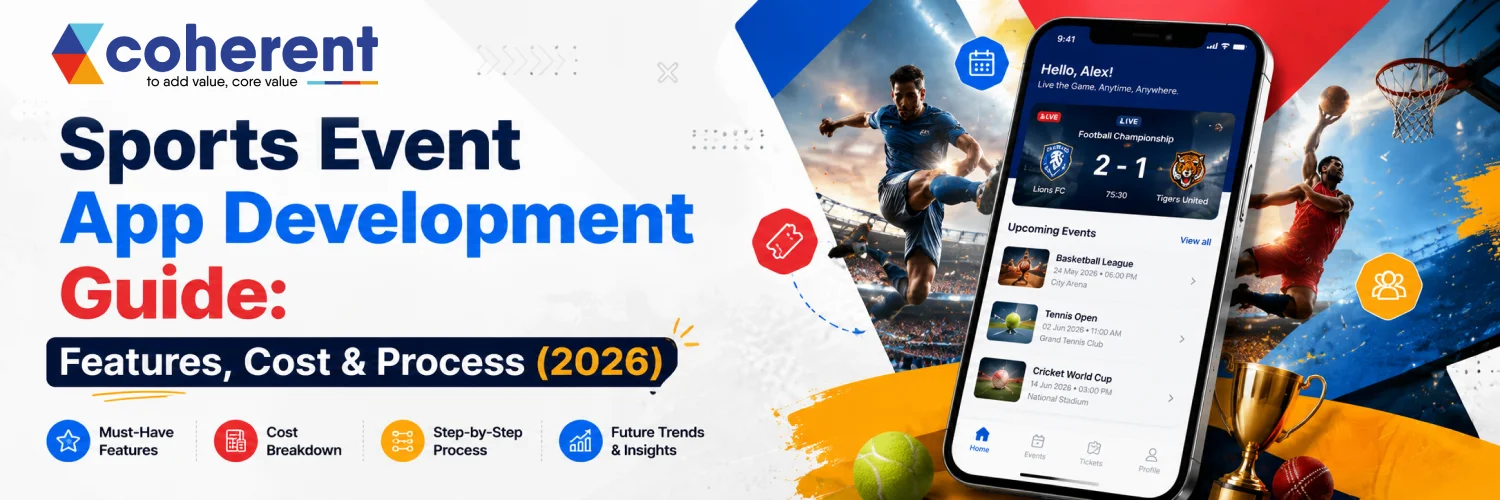
The sports industry is rapidly moving towards digital transformation and sports event apps are proving to be an indispensable tool for sports event organizers, sports teams, leagues, sports clubs and sports fans. From ticket booking and live match updates to interactive schedules and real-time notifications, these apps enhance the overall event experience while streamlining event management. From hosting a local tournament to organizing an international championship or a professional league, a custom sports event app can ensure that your events are more engaging, efficient, and profitable. In 2026,
New technologies such as Artificial Intelligence (AI), cloud computing, real-time analytics, and cross-platform development are changing the landscape of sports events management and experience. This guide covers all the key components, development processes, technologies, costs, ways to monetize your sports event app, and future trends to help you build a scalable, secure, and user-friendly sports event app.
What is a Sports Event App?
Coherent lab llp A sports event app is a mobile application that is developed to make the event management easier and at the same time provide an engaging experience for the sports enthusiasts. The applications will enable users to find events, tickets, live updates, timetables, team and organiser interaction. In addition, companies can enjoy a more optimized event management experience, audience insights and the ability to communicate with a single mobile device.
Types of Sports Event Applications
Different sports require different app functionalities, but most applications fall into these common categories:
- Tournament Management Apps for organizing leagues, fixtures, and player registrations.
- Live Sports Event Apps that provide real-time scores, streaming, and match statistics.
- Marathon and Running Event Apps with participant tracking and route navigation.
- Multi-Sport Event Platforms supporting cricket, football, basketball, tennis, and other competitions.
Key Features of a Sports Event App
To make any sports event application successful, it is essential that it has valuable features that make it easier and more convenient for people who attend the event, and makes it easier for the event organizers to manage. By fostering user engagement, streamlining their workflows, and introducing digital services and premium experiences, this feature-rich application translates into new revenue streams and operational efficiency.
User Features
Modern sports fans expect a smooth, interactive, and personalized mobile experience throughout the event journey.
- Secure registration with social login and profile management.
- Live match scores, schedules, player statistics, and event notifications.
- Digital ticket booking with QR code-based entry.
- Personalized event recommendations, favorites, and venue navigation.
Advanced Features That Increase User Engagement
As competition grows in the sports industry, advanced technologies help applications stand out by delivering personalized, immersive, and intelligent experiences. AI, AR, blockchain, and cloud-based services enable sports event apps to offer better engagement while improving operational efficiency and security.
AI-Powered Features
Artificial Intelligence improves user satisfaction by delivering smarter recommendations and automated assistance.
- AI-based event recommendations using user preferences.
- Intelligent chatbots providing instant customer support.
- Predictive analytics for attendance and ticket demand forecasting.
- Personalized notifications based on browsing and booking history.
Sports Event App Development Process
Building a sports event app requires careful planning, user-focused design, robust development, and continuous optimization. Following a structured development process ensures the application is scalable, secure, and capable of delivering exceptional performance during high-traffic sporting events.
Step-by-Step Development Lifecycle
Each development phase contributes to building a reliable and feature-rich sports event platform.
- Conduct market research and gather detailed business requirements.
- Design wireframes, UI/UX layouts, and interactive prototypes.
- Develop frontend, backend, and integrate third-party APIs.
- Perform testing, deploy the application, and provide ongoing maintenance.
Sports Event App Tech Stack
Choosing the appropriate tech stack is among the most significant choices to make when developing a sports event app. AI app development. The modern tech stack guarantees high performance, real-time data synchronization, data security, and scalability. The selection of trusted and proven front-end, back-end, cloud and third party technologies enhances the user experience and facilitates ease of maintenance and future upgrades.
Frontend Technologies
The frontend is responsible for delivering a fast, responsive, and visually engaging user experience across different devices.
- Flutter for cross-platform Android and iOS development from a single codebase.
- React Native for faster development and reusable components.
- Swift for building high-performance native iOS applications.
- Kotlin for creating secure and feature-rich native Android apps.
Sports Event App Development Cost
There are a variety of factors that influence the price of a sports occasion app, such as the variety of functions, the program it is going to run on, the complexity of the consumer interface and user experience, third-party integrations, and the location of the app developer. The idea should be tested with an MVP to ensure that it has market potential before investing in costly features and overall deployment.
Cost Based on App Complexity
Development costs vary according to project scope and business requirements.
|
|
|
|
|
|
|
|
|
|
|
|
|
|
|
|
|
|
|
|
Monetization Strategies
Many sports event applications can be sustainable in terms of revenue generation by many methods. When multiple revenue streams are combined, businesses can optimize their profits while also providing value to their users. The decision on which strategy to choose should be made based on the event size and scope, the audience, and the business goals.
Revenue Models
Successful sports event platforms often use multiple income sources instead of relying on a single revenue channel.
- Ticket booking commissions and convenience fees.
- Premium subscriptions offering exclusive content and live streaming.
- In-app advertising and sponsored promotional campaigns.
- Merchandise sales, affiliate partnerships, and digital event passes.
Essential APIs for Sports Event Apps
Third-party APIs enable sports event applications to provide real-time data, secure transactions, location services, and user notifications without building every feature from scratch. Integrating reliable APIs improves app performance, reduces development time, and enhances the overall user experience.
Sports Data APIs
Sports APIs provide live information that keeps fans engaged before, during, and after events.
- Live match scores and real-time scoreboards.
- Player statistics, rankings, and team performance data.
- Tournament schedules, fixtures, and event calendars.
- Match highlights, historical records, and game analytics.
Security Features Every Sports Event App Needs
Security is a critical component of sports event app development because users share sensitive information such as personal details, payment credentials, and ticket data. A secure application builds trust, prevents fraud, protects business reputation, and ensures compliance with international data protection regulations. Implementing multiple layers of security helps safeguard both organizers and attendees from cyber threats.
User Data Protection
Protecting user information should be a top priority throughout the application lifecycle.
- Implement end-to-end encryption and SSL certificates for secure data transmission.
- Enable two-factor authentication (2FA) for stronger account security.
- Store passwords using secure hashing and encryption techniques.
- Follow GDPR and other data privacy regulations to ensure compliance.
Challenges in Sports Event App Development
Developing a successful sports event app involves overcoming several technical and operational challenges. Mobile app development. From handling thousands of concurrent users during live matches to maintaining uninterrupted streaming and real-time updates, businesses need scalable architecture and efficient planning to deliver an exceptional user experience.
Technical Challenges
Modern sports applications require high availability, fast performance, and seamless scalability.
- Manage sudden traffic spikes during live sporting events.
- Reduce live streaming latency for real-time viewing experiences.
- Ensure smooth API integration with minimal downtime.
- Optimize app performance across multiple devices and operating systems.
Benefits of Sports Event App Development
A sports event application delivers significant advantages for organizers, sponsors, athletes, and fans. It simplifies event management, enhances audience engagement, increases revenue opportunities, and provides valuable insights through analytics. As digital sports experiences continue to grow, investing in a feature-rich mobile app has become a strategic necessity.
Benefits for Businesses
Sports organizations can improve operations while creating new digital revenue streams.
- Generate income through ticket sales, subscriptions, and sponsorships.
- Improve brand visibility and audience reach worldwide.
- Analyze user behavior with real-time business analytics.
- Automate event management and communication processes.
How to Choose the Right Sports Event App Development Company
Choosing the right development partner directly impacts the quality, performance, and long-term success of your sports event application. An experienced company can recommend the best technologies, deliver scalable solutions, and provide ongoing support that ensures continuous improvement after launch.
Evaluation Checklist
Before hiring a development company, evaluate its expertise and proven track record.
- Review sports app development experience and completed projects.
- Analyze client testimonials and verified case studies.
- Confirm expertise in AI, cloud, and cross-platform technologies.
- Check post-launch maintenance and technical support services.
Future Trends in Sports Event Apps (2026–2030)
The future of sports event applications will be driven by Artificial Intelligence, immersive technologies, automation, and smart stadium innovations. Businesses that adopt these trends early will deliver superior fan experiences, improve operational efficiency, and stay ahead in the rapidly evolving sports technology market.
AI & Automation
Artificial Intelligence will continue transforming sports event management and fan engagement.
- AI-powered personalized event and ticket recommendations.
- Predictive analytics for attendance forecasting and resource planning.
- Intelligent chatbots offering 24/7 customer support.
- Automated marketing campaigns based on user behavior.
Why Invest in Sports Event App Development in 2026?
The global sports industry continues to experience rapid digital growth, making sports event apps a valuable investment for businesses of all sizes. Mobile-first audiences expect seamless digital experiences, while organizers seek efficient event management and new revenue opportunities. A custom sports event app enables both goals by combining technology, convenience, and innovation.
Business Growth Opportunities
Investing in sports technology opens new possibilities for expansion and profitability.
- Reach a larger audience through mobile-first digital platforms.
- Increase revenue using ticketing, subscriptions, and sponsorships.
- Strengthen customer loyalty with personalized user experiences.
- Expand into national and international sports markets.
Conclusion
The development of sports event apps has emerged as a smart investment for organisations looking to provide a smooth digital journey, boost efficiency and boost revenue. These applications boast a variety of features, including live score updates, ticket booking, AI-powered recommendations, secure payments, and real-time notifications, which not only improve fan engagement but also streamline event management. Choosing the right technology stack, deploying robust security systems, and working with a skilled developer firm can help companies develop their solutions on a scalable, future-proof framework. In 2026, contact us today the global sports industry will be defined by ongoing advancements in technology, including AI, blockchain, AR, and cloud solutions, making investing in a custom sports event app a smart move for sustained growth, enhanced customer loyalty, and a competitive edge.
Frequently Asked Questions
Q.1. What is a Sports Event App?
Ans. Sports Event App is a mobile or web application designed to facilitate the discovery, ticket buying, viewing of sports schedules, and interaction with teams or organizers of sporting events, while providing up-to-date information on matches. It also provides administrators with tools for managing registrations, ticketing, promotions, analytics and event operations from a single dashboard. These applications enhance fans' involvement and make event planning and management easier.
Q.2. How much does Sports Event App Development cost?
Ans. The development budget of the Sports Event App is dependent on the complexity, feature set, technology stack and development team location of the app. A basic app typically costs between $10,000 and $20,000, while a medium-complexity app ranges from $20,000 to $45,000. The cost of advanced applications that incorporate AI, live streaming, and analytics can be in excess of $100,000, depending on customization requirements and maintenance needs.
Q.3. How long does it take to develop a Sports Event App?
Ans. There is a range of development times, depending on the nature of the project and the features. Sport events typically take 2-3 months to develop, whereas medium sized projects are 3-5 months. AI, live streaming, multiple integrations, enhanced security are usually the features of enterprise level applications and these usually take 6–9 months to come to fruition or even longer. Delays and quality are minimized with proper planning, Agile development and frequent testing.
Q.4. Which technologies are best for Sports Event App Development?
Ans. Common technologies are: Flutter and React Native (Cross-platform), Swift (iOS), Kotlin (Android apps). Commonly, backend solutions employ either Node.js, Laravel, or Python, while cloud-based platforms such as AWS, Google Cloud, or Firebase offer robust infrastructure, scalable options, secure hosting, authentication, and real-time databases, making them ideal for high-traffic sports events.
Q.5. What features should a Sports Event App include?
Ans. A successful Sports Event App should have user registration, event discovery, ticket booking, QR code verification, live scores, schedules, push notifications, player profiles, venue navigation, secure payment integration and personalized recommendations. The event management, analytics, ticket administration, content management, marketing tools, and reporting dashboard are all features that should be included in organizer tools to enhance the efficiency of operations and the engagement of the audience.
Q.6. How do Sports Event Apps generate revenue?
Ans. Sports Event Apps can be monetized in various ways such as ticket sales fees, premium subscription, in-app ads, sponsorship fees, merchandise sales, affiliate fees, and access to paid live-streaming. Numerous businesses employ a hybrid strategy of a subscription, advertisements, and a digital service to maximize revenue and to provide a valuable and engaging user experience.
Q.7. Can Artificial Intelligence improve Sports Event Apps?
Ans. Yes. The applications of sports events are greatly benefitted by Artificial Intelligence with its personalized recommendations, predictive analytics, automated customer support via chatbots, intelligent notifications, attendance prediction, and user behavior analysis. AI also aids in optimizing ticket pricing, marketing strategies, and operational planning, and improves user engagement by personalizing experiences based on individual preferences and actions.
Q.8. How do I choose the best Sports Event App Development Company?
Ans. Look for a company with a track record in sports app development, a robust portfolio, and positive client reviews—with a special emphasis on experience with cutting-edge technologies such as AI, cloud computing, and cross-platform development. Make sure they provide clear pricing, strong security measures, API integration capabilities, post-launch support, and scalable options. A trustworthy development partner can assist you in realizing your business idea into a successful, future-proof sports event application.

 +91 774-202-1725
 +1 (945) 3387904
 business@coherentlab.com
 +49 15223341304
 UK
UK