Table of Contents
Sports Streaming App Development Cost in UAE: Complete 2026 Pricing Guide
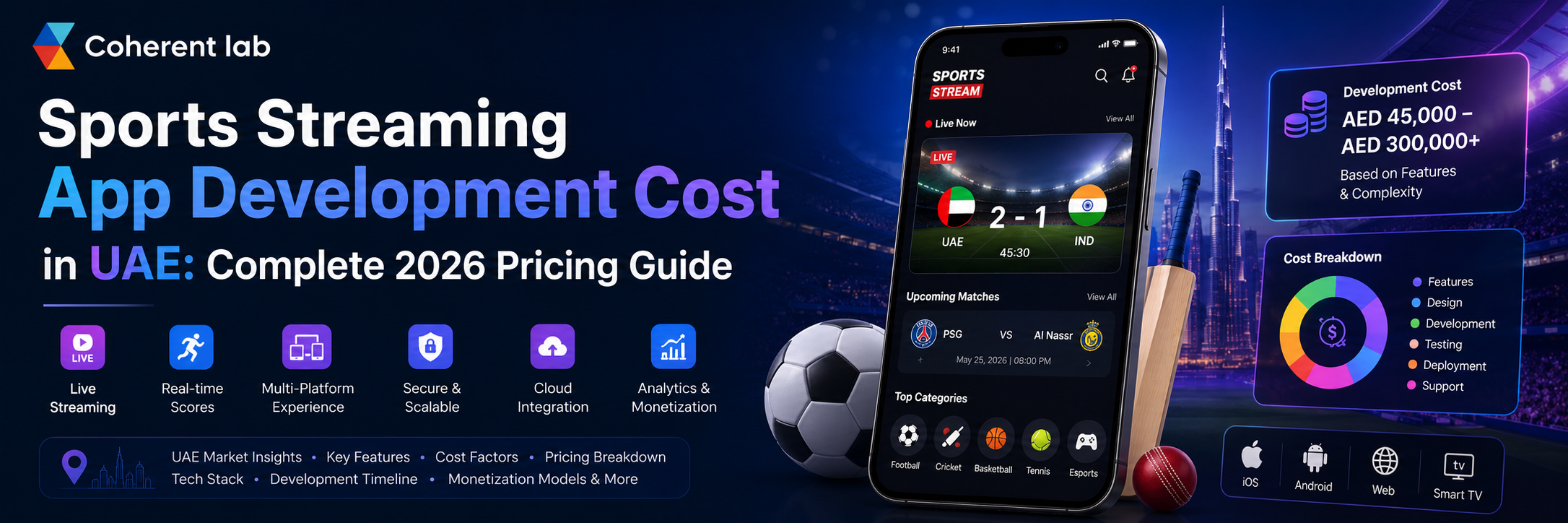
The sports industry is no longer limited to stadiums and television broadcasts. Today, millions of fans prefer watching live matches on their smartphones, tablets, Smart TVs, and laptops. Whether it's football, cricket, basketball, Formula 1, tennis, or esports, audiences expect instant access to high-quality live streams from anywhere.
The UAE has become one of the fastest-growing digital entertainment markets in the Middle East. With high smartphone penetration, widespread 5G connectivity, and increasing demand for OTT (Over-the-Top) streaming services, businesses are investing heavily in sports streaming platforms that deliver seamless viewing experiences.
Quick Answer
The average sports streaming app development cost in the UAE ranges from AED 75,000 to AED 900,000+ (USD 20,000–250,000+). A basic MVP with essential live-streaming capabilities costs significantly less than a fully featured OTT sports platform that supports 4K streaming, AI recommendations, Smart TV compatibility, multi-camera viewing, and subscription management.
Key Takeaways
- Sports streaming app development typically costs AED 75K–900K+.
- Live video infrastructure is one of the largest cost factors.
- Cross-platform development reduces overall development expenses.
- AI-powered recommendations improve user engagement and retention.
- Subscription-based monetization provides recurring revenue.
- Cloud scalability is essential for handling live sporting events.
- Security and content protection are critical for premium broadcasts.
- Building an MVP first helps validate the business idea before scaling.
Also Read: How to Choose the Best Mobile App Development Company in Dubai (2026 Guide)
Why Sports Streaming Apps Are Booming in the UAE
Sports consumption has changed dramatically over the past decade. Instead of waiting for television broadcasts, users now expect instant access to live games, highlights, statistics, and exclusive sports content from their preferred devices.
The UAE is uniquely positioned for this shift due to its advanced digital infrastructure and tech-savvy population.
Several factors are driving the rapid growth of sports streaming apps:
- High smartphone and internet penetration
- Nationwide 5G connectivity
- Growing demand for OTT entertainment
- Popular international sports leagues and tournaments
- Increasing adoption of subscription-based digital services
- Rising investments in sports technology and digital media
Sports Streaming App Development Cost in UAE (2026 Breakdown)
The overall development cost depends on your business goals and feature requirements. A startup launching an MVP requires a much smaller investment than a broadcaster building a full-scale streaming ecosystem.
Estimated Cost by App Type
| App Type | Estimated Development Cost (AED) | Best For |
|---|---|---|
| Basic MVP Sports Streaming App | AED 75,000 – 150,000 | Startups validating a streaming app idea with essential features |
| Standard Sports Streaming App | AED 150,000 – 350,000 | Growing businesses requiring live streaming, user accounts, and subscriptions |
| Advanced OTT Sports Platform | AED 350,000 – 700,000 | Businesses offering HD streaming, multi-device support, analytics, and premium features |
| Enterprise Sports Streaming Platform | AED 700,000 – 900,000+ | Large enterprises needing AI recommendations, global scalability, DRM security, and high-concurrency streaming |
Basic MVP (AED 75K–150K)
Suitable for startups testing their business idea.
Features include:
- User registration
- Login
- Live streaming
- Video playback
- Match schedules
- Push notifications
- Admin dashboard
- Basic analytics
Standard Sports Streaming App (AED 150K–350K)
Ideal for businesses launching a commercial streaming platform.
Additional features include:
- HD streaming
- Subscription management
- Multiple payment gateways
- Watch history
- Personalized recommendations
- Search functionality
- Social login
- User profiles
Advanced OTT Sports Platform (AED 350K–700K)
Designed for broadcasters and sports organizations.
Includes advanced capabilities such as:
- 4K streaming
- AI recommendations
- Multi-language support
- DVR functionality
- Live chat
- Match statistics
- Cloud recording
- Multiple camera angles
- Smart TV applications
Enterprise-Level Platform (AED 700K–900K+)
Large media companies often require enterprise-grade solutions capable of handling millions of concurrent viewers.
These platforms include:
- Global CDN integration
- AI analytics
- Personalized advertising
- DRM protection
- Real-time data synchronization
- Scalable cloud architecture
- Advanced monitoring systems
- Enterprise security compliance
Also Read: Top Game App Development Companies in India (July 2026 Updated List)
Cost Breakdown by Development Stage
Understanding where your budget is allocated helps you prioritize features and avoid unnecessary expenses.
| Development Stage | Estimated Share of Total Budget |
|---|---|
| Business Analysis & Planning | 5% |
| UI/UX Design | 10% |
| Frontend Development | 20% |
| Backend Development | 25% |
| Live Streaming Integration | 20% |
| Testing & Quality Assurance | 10% |
| Deployment & Launch | 5% |
| Maintenance & Updates | 5% annually |
Factors That Affect Sports Streaming App Development Cost
Every sports streaming platform has unique business requirements. Several technical and business decisions directly influence the final development budget.
1. Platform Selection
The number of supported platforms significantly impacts development costs.
Options include:
- Android
- iOS
- Web
- Android TV
- Apple TV
- Smart TVs
2. Streaming Quality
Video quality directly affects infrastructure costs.
Streaming options include:
- SD
- HD
- Full HD
- 4K Ultra HD
Higher resolutions require:
- More powerful servers
- Larger storage capacity
- Higher bandwidth
- Better CDN services
- Advanced encoding technology
3. Number of Users
An app designed for 5,000 users requires a vastly different infrastructure than one expected to support millions of concurrent viewers.
Scalable cloud architecture helps businesses:
- Handle traffic spikes
- Maintain streaming quality
- Reduce downtime
- Optimize operational costs
4. Third-Party Integrations
Modern sports streaming apps rely on numerous external services, such as:
- Payment gateways
- Live score APIs
- Sports statistics providers
- Push notification services
- Video hosting platforms
- Cloud storage
- CRM systems
- Marketing automation tools
5. Security Requirements
Sports streaming platforms often distribute premium content, making security a top priority.
Essential security features include:
- DRM (Digital Rights Management)
- End-to-end encryption
- Secure payment processing
- Multi-factor authentication
- Anti-piracy protection
- Secure cloud storage
- GDPR and regional compliance
Also Read: Top Android App Development Companies in India
Must-Have Features of a Sports Streaming App
A successful sports streaming app offers more than just live video. Coherent Lab LLP users expect an engaging, personalized, and seamless experience across multiple devices. Investing in the right features not only improves user satisfaction but also increases retention and subscription revenue.
User Features
Every sports streaming application should include these core functionalities:
- Secure user registration and login
- Social media authentication
- Personalized user profiles
- Live match streaming
- Match schedules and reminders
- Search and filter options
- Favorite teams and leagues
- Watch history
- Continue watching
- Push notifications
- Multi-language support
- High-quality video playback
- Chromecast and AirPlay support
Premium Features
To stand out in a competitive market, businesses often include advanced capabilities such as:
- AI-powered content recommendations
- Multi-camera viewing angles
- Picture-in-Picture (PiP) mode
- Instant replay and DVR functionality
- Live commentary
- Interactive live chat
- Fantasy sports integration
- Real-time match statistics
- Personalized notifications
- Offline downloads for highlights
- Live polls and fan engagement
Admin Panel Features
A powerful backend dashboard allows administrators to manage content efficiently.
Important admin capabilities include:
- User management
- Subscription management
- Match scheduling
- Content upload and management
- Video analytics
- Revenue reports
- Advertisement management
- Push notification management
- Customer support dashboard
- Content moderation
Also Read: Top Apps Like Uber for Ride Sharing & Taxi Booking (July 2026 Updated List)
Technology Stack for Sports Streaming App Development
Choosing the right technology stack directly impacts performance, scalability, and long-term maintenance costs.
Frontend
- Flutter
- React Native
- Swift (iOS)
- Kotlin (Android)
- React.js (Web)
Backend
- Node.js
- Python
- Java
- .NET
- Go
Streaming Technologies
- HLS (HTTP Live Streaming)
- MPEG-DASH
- WebRTC (for ultra-low latency)
- FFmpeg
- Wowza Streaming Engine
Database
- PostgreSQL
- MySQL
- MongoDB
- Redis
Cloud Infrastructure
- AWS
- Microsoft Azure
- Google Cloud Platform
CDN Providers
- CloudFront
- Cloudflare
- Akamai
Payment Gateways
- Stripe
- PayPal
- Apple Pay
- Google Pay
- Local UAE payment gateways
Sports Streaming App Development Process
Developing a sports streaming platform involves multiple stages, each contributing to the overall quality and success of the product.
Step 1: Market Research
Begin by identifying:
- Target audience
- Competitors
- Popular sports
- Revenue model
- User expectations
Step 2: Feature Planning
Prioritize essential features before adding advanced functionality.
Create an MVP with:
- Live streaming
- User accounts
- Subscription plans
- Notifications
- Match schedules
Step 3: UI/UX Design
An intuitive interface enhances user engagement.
Design should focus on:
- Simple navigation
- Fast content discovery
- Responsive layouts
- Dark mode support
- Accessibility
Step 4: Development
Developers build:
- Mobile applications
- Web platform
- Backend APIs
- Admin dashboard
- Streaming infrastructure
Step 5: Live Streaming Integration
This stage includes:
- Video encoding
- CDN integration
- Adaptive bitrate streaming
- Low-latency streaming
- DRM implementation
Step 6: Testing
Before launch, QA engineers test:
- Streaming performance
- Device compatibility
- Security
- Load handling
- Payment systems
- Bug fixes
Step 7: Deployment
After approval, the app is published on:
- Google Play Store
- Apple App Store
- Smart TV stores
- Web servers
Step 8: Maintenance & Updates
Post-launch maintenance includes:
- Performance optimization
- Feature enhancements
- Security patches
- OS compatibility updates
- Bug fixes
Revenue Models for Sports Streaming Apps
Selecting the right monetization strategy is crucial for long-term profitability.
1. Subscription (SVOD)
Users pay monthly or yearly fees for unlimited access.
Best for:
- Premium sports channels
- Exclusive leagues
- OTT platforms
2. Pay-Per-View (PPV)
Users purchase access to individual matches or tournaments.
Ideal for:
- Championship fights
- Football finals
- Formula 1 races
- Special sporting events
3. Advertising (AVOD)
Revenue comes from:
- Video advertisements
- Banner ads
- Sponsored content
4. Freemium
Users receive basic access for free while premium content requires a subscription.
This approach attracts more users and increases conversion opportunities.
5. Sponsorships
Sports brands can sponsor:
- Tournaments
- Live broadcasts
- Highlight sections
- Team pages
6. Affiliate Partnerships
Businesses can generate commissions through:
- Merchandise sales
- Sports equipment
- Event tickets
- Fantasy sports platforms
Challenges in Sports Streaming App Development
Despite the opportunities, developers must address several challenges:
- Broadcasting rights and licensing
- High server costs during live events
- Low-latency streaming requirements
- Cybersecurity threats
- Video piracy
- Cross-device compatibility
- Scalability during peak traffic
- Continuous feature updates
Best Practices to Reduce Development Costs
Businesses can optimize budgets without compromising quality by following these practices:
- Start with a Minimum Viable Product (MVP)
- Use cross-platform development frameworks
- Adopt scalable cloud infrastructure
- Integrate reliable streaming APIs
- Optimize CDN usage
- Prioritize essential features first
- Plan for future scalability
Conclusion
The UAE's digital entertainment market presents significant opportunities for businesses looking to invest in sports streaming platforms. While development costs can range from AED 75,000 to AED 900,000+, the final investment depends on your feature set, streaming quality, supported devices, and long-term scalability goals.
By starting with a well-planned MVP, choosing the right technology stack, and partnering with an experienced development company, you can build a secure, high-performance sports streaming app that delivers exceptional user experiences and sustainable business growth.
If you're ready to launch a sports streaming platform in the UAE, Coherent Lab can help you transform your idea into a scalable, feature-rich solution designed for the future of digital sports entertainment. Contact us today
Frequently Asked Questions
Q1. How much does sports streaming app development cost in the UAE?
Ans: The cost of developing a sports streaming app in the UAE generally ranges from AED 75,000 to AED 900,000+. Pricing depends on factors such as app complexity, live streaming capabilities, supported platforms, UI/UX design, cloud infrastructure, third-party integrations, and scalability. Enterprise-grade platforms with advanced features require a higher investment.
Q2. How long does it take to build a sports streaming app?
Ans: Development timelines vary based on project scope. A basic MVP usually takes 3–5 months, while a feature-rich sports streaming platform with live broadcasting, user management, AI recommendations, and Smart TV support may require 8–12 months or longer for design, development, testing, and deployment.
Q3. Which monetization model is best?
Ans: Subscription-based (SVOD) is the most popular monetization model for sports streaming apps. However, many successful platforms maximize revenue by combining subscriptions, advertising (AVOD), pay-per-view (PPV), sponsorships, and premium memberships, creating multiple income streams while serving different audience preferences.
Q4. Can I launch an MVP first?
Ans: Yes. Launching a Minimum Viable Product (MVP) is a smart strategy. It enables businesses to validate market demand, collect real user feedback, reduce upfront development costs, and improve the platform gradually by introducing advanced features based on customer needs and business growth.
Q5. Which technologies are commonly used?
Ans: Modern sports streaming apps commonly use Flutter, React Native, Swift, Kotlin, Node.js, HLS, WebRTC, AWS, Microsoft Azure, Google Cloud Platform, CloudFront, Cloudflare CDN, Firebase, and AI-powered analytics to deliver secure, scalable, and high-performance streaming experiences across multiple devices.
Q6. Can sports streaming apps support Smart TVs?
Ans: Absolutely. Sports streaming applications can be developed for Android TV, Apple TV, Samsung Smart TVs, LG WebOS, Amazon Fire TV, Roku, and other connected devices, allowing users to enjoy live sports on larger screens while maintaining a seamless cross-platform experience.
Q7. What security features are essential?
Ans: Essential security features include Digital Rights Management (DRM), end-to-end encryption, secure payment gateways, multi-factor authentication (MFA), token-based access, anti-piracy protection, content watermarking, DDoS mitigation, and regular security monitoring to protect both user data and premium streaming content.
Q8. Why hire an experienced UAE app development company?
Ans: An experienced UAE app development company understands local regulations, user expectations, multilingual requirements, and scalable cloud infrastructure. Their expertise helps deliver secure, high-performance sports streaming platforms with reliable live broadcasting, optimized user experience, and ongoing technical support for long-term business success.

 +91 774-202-1725
 +1 (945) 3387904
 business@coherentlab.com
 +49 15223341304
 UK
UK