
Table of Contents
Types of Mini-Games: A Complete Guide to Different Game Genres
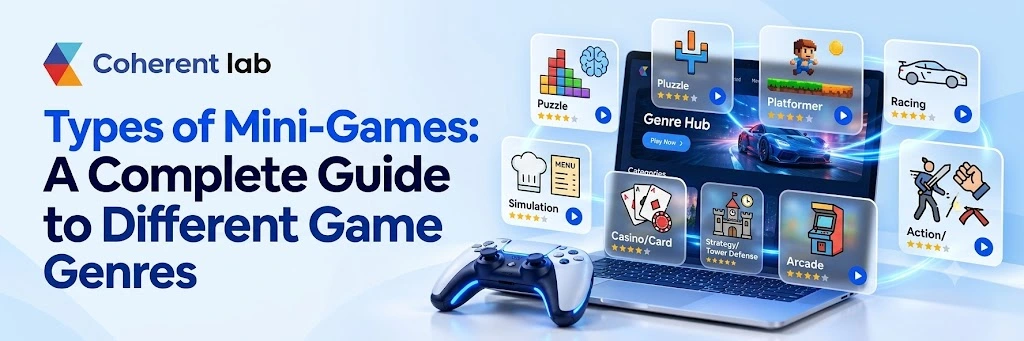
Mini-games have become an important part of modern gaming because they offer quick entertainment, simple challenges, and rewarding experiences without requiring players to invest hours in a single session. From solving puzzles and racing against the clock to answering trivia questions and competing with friends, mini-games appeal to a wide range of players across different age groups and skill levels. Today, mini-games are found in mobile applications, browser-based platforms, multiplayer games, educational software, and even large-scale video games. Their short gameplay sessions and easy-to-understand mechanics make them an effective way to attract players, improve engagement, and encourage repeat participation.
For businesses and developers, mini-games also create opportunities to build interactive digital experiences, introduce gamification, and explore new ways to connect with audiences. In this guide, we will explore the different types of mini-games, popular mini-game genres, examples of engaging gameplay, and the essential factors involved in developing a successful mini-game.
Quick Answer
Mini-games are short, self-contained gaming experiences built around a specific objective, challenge, or gameplay mechanic. Unlike full-length video games, which may involve extensive storylines, large environments, and complex progression systems, mini-games focus on delivering an enjoyable experience in a relatively short amount of time. A mini-game can be a standalone experience or a smaller activity within a larger game. For example, a racing game might include a quick time-trial challenge, while an adventure game could feature a puzzle that players must solve to unlock the next level. Developing a mini game app development starts with validating your idea, understanding your target audience, and selecting the right game genre.
Most mini-games share a few common characteristics:
- Simple objectives: Players can quickly understand what they need to achieve.
- Short sessions: Gameplay can often be completed in seconds or minutes.
- Accessible controls: Simple interactions make the experience easy to learn.
- Replayability: Players can return to improve their scores, beat previous records, or explore different outcomes.
- Focused gameplay: Each mini-game typically emphasizes one main skill, challenge, or mechanic.
Key Takeaways
The popularity of mini-games comes from their ability to deliver quick, satisfying experiences. Players do not always have time for long gaming sessions, and a well-designed mini-game allows them to enjoy a challenge during a short break, while travelling, or between other activities. Another reason mini-games attract attention is their simplicity. Players can understand the rules quickly and start playing without spending too much time learning complicated controls or systems. Several factors contribute to their popularity.
Quick Entertainment and Easy Accessibility
Mini-games offer instant entertainment with minimal preparation. A player can open a mobile game, complete a short puzzle, and return to everyday activities within minutes. Browser-based mini-games also allow users to play without necessarily downloading a full application.
Short-Term Goals and Rewards
Clear objectives give players something immediate to work toward. Completing a level, beating a high score, or finishing a challenge creates a sense of progress that encourages further participation.
Competition and Social Interaction
Leaderboards, multiplayer modes, score sharing, and friendly competitions make mini-games more engaging. These features can turn a simple activity into a shared experience among friends or online communities.
Variety and Replay Value
Different challenges help prevent gameplay from becoming repetitive. Developers can introduce new levels, difficulty settings, achievements, or time-based events to maintain interest without making the core game unnecessarily complicated.
Different Types of Mini-Games Across Popular Game Genres
Mini-games come in many genres, each offering a different type of challenge. Some test logical thinking, while others focus on speed, coordination, knowledge, creativity, or teamwork. Choosing the right genre depends on the intended audience, platform, gameplay objectives, and overall experience a developer wants to create. The following are some of the most popular types of mini-games used in modern game development. The Coherent Lab global mobile gaming market continues to experience significant growth, creating favorable conditions for mini game development.
|
|
|
|
|---|---|---|
|
|
|
|
|
|
|
|
|
|
|
|
|
|
|
|
|
|
|
|
|
|
|
|
|
|
|
|
|
|
|
|
1. Puzzle Mini-Games
Puzzle mini-games challenge players to solve problems using logic, pattern recognition, observation, or creative thinking. They are popular across mobile games, casual gaming platforms, educational applications, and larger video games. Common puzzle mini-games include match-three challenges, tile puzzles, number games, word puzzles, and object-matching activities. The rules are usually straightforward, but the difficulty can increase as players progress.
Why they work: Puzzle games provide a satisfying sense of achievement when players discover the correct solution. They are particularly suitable for audiences who enjoy thoughtful gameplay rather than fast-paced action.
2. Arcade Mini-Games
Arcade mini-games focus on fast reactions, simple controls, high scores, and continuous challenges. They often feature short rounds in which players must avoid obstacles, collect items, survive for as long as possible, or reach a target score. Examples include endless runners, bouncing-ball games, obstacle-dodging challenges, and classic score-based arcade experiences.
Why they work: Their immediate feedback and easy-to-understand mechanics encourage repeated attempts. Players can quickly restart after failure and try to improve their previous performance.
3. Racing Mini-Games
Racing mini-games revolve around speed, timing, navigation, and competition. Instead of building an extensive racing simulation, developers can create short experiences such as completing a lap, avoiding traffic, passing checkpoints, or reaching the finish line before time runs out. Popular formats include kart racing challenges, drag-racing rounds, obstacle courses, and time trials.
Why they work: Racing mini-games combine clear goals with excitement and a sense of urgency. They can also support scoreboards, personal bests, and head-to-head competition.
4. Trivia and Quiz Mini-Games
Trivia and quiz mini-games test players' knowledge across subjects such as general knowledge, sports, science, entertainment, history, and geography. Players may need to select the correct answer, identify an image, complete a word, or respond before a countdown ends. Developers can also introduce difficulty levels, question categories, streaks, and multiplayer quiz modes.
Why they work: Quiz games combine entertainment with learning. They are useful for educational applications, training platforms, social games, and branded engagement campaigns.
5. Strategy and Logic Mini-Games
Strategy mini-games require players to make decisions, anticipate outcomes, manage limited resources, or solve challenges in a particular order. Unlike reaction-based games, these experiences reward planning and careful thinking. Examples include simplified chess challenges, tactical battles, resource-allocation puzzles, tower-defense rounds, and turn-based decision games.
Why they work: These mini-games create meaningful challenges without necessarily requiring large maps or lengthy campaigns. They are suitable for players who enjoy making decisions and finding efficient solutions.
6. Action and Adventure Mini-Games
Action and adventure mini-games emphasize movement, timing, exploration, combat, or completing a specific mission. They may appear as independent games or as optional challenges within larger adventure titles. Examples include short platforming levels, boss-fight challenges, item-collection missions, target practice, and timed obstacle courses.
Why they work: They provide excitement and variety while allowing developers to introduce different gameplay mechanics. A short challenge can make a larger game feel more dynamic without requiring a separate lengthy storyline.
7. Sports Mini-Games
Sports mini-games bring familiar sporting activities into compact, accessible formats. Rather than recreating an entire sporting event, they focus on one action or skill. Examples include penalty kicks, basketball shooting, golf putting, bowling challenges, table-tennis rallies, and free-throw competitions.
Why they work: Familiar rules make sports mini-games easy to understand. They can also encourage competition through score comparisons, multiplayer matches, and timed challenges.
8. Simulation and Management Mini-Games
Simulation and management mini-games allow players to operate simplified systems, manage resources, or perform everyday tasks in an interactive environment. Examples include running a virtual restaurant, managing a small shop, arranging products, serving customers, building structures, or completing farming activities.
Why they work: These games combine creativity, planning, and progression. They are especially useful when developers want players to experience a simplified version of a real-world activity.
9. Casual and Hyper-Casual Mini-Games
Casual mini-games are designed to be approachable for a broad audience, including people who do not regularly play video games. Hyper-casual games take simplicity further by emphasizing immediately understandable mechanics and minimal learning requirements. Examples include stacking objects, tapping targets, sorting colours, bouncing balls, and guiding characters through obstacles.
Why they work: The low learning curve allows players to start quickly. However, long-term success still depends on responsive controls, balanced difficulty, visual clarity, and enough variety to keep the experience interesting.
10. Multiplayer and Social Mini-Games
Multiplayer mini-games bring players together for quick competitions or cooperative challenges. They may support two players on the same device, online matches, private rooms, or larger groups.Developers building online multiplayer mini-games must also consider network performance, matchmaking, fair gameplay, and player safety. Examples include party games, quick duels, cooperative puzzles, guessing games, and short team challenges.
Why they work: Social interaction adds unpredictability and replay value. Friends can compete, collaborate, or compare results, making the experience more engaging than playing alone.
11. Rhythm and Music Mini-Games
Rhythm mini-games challenge players to tap, press, or move in time with music or visual cues. The gameplay usually revolves around timing, coordination, and recognizing repeating patterns. Examples include rhythm tapping, virtual drumming, dance challenges, and music-based reaction games.
Why they work: Music adds energy and personality to the experience. Increasing difficulty and accurate feedback can help players improve their timing while making each round feel rewarding.
12. Survival and Reflex-Based Mini-Games
Survival and reflex-based mini-games test how quickly players react to changing situations. Players may need to avoid hazards, escape a closing area, survive waves of obstacles, or respond to visual prompts. Examples include dodging falling objects, surviving timed rounds, avoiding moving barriers, and completing rapid reaction tests.
Why they work: The pressure of limited time creates excitement, while short rounds encourage players to attempt the challenge again. Developers should balance difficulty carefully so the experience remains challenging without becoming frustrating.
Mini-Games in Mobile, PC, Console, and Browser Gaming
Mini-games can be adapted to different platforms, but the development approach should reflect how players interact with each device. Screen size, control methods, performance limitations, and expected session length all influence the final experience. Mini game app development offer numerous advantages for startups, entrepreneurs, and gaming companies.
Mobile Mini-Games
Mobile mini-games are often designed around touch controls, portrait or landscape layouts, and short play sessions. Developers should prioritize responsive interactions, readable interfaces, efficient performance, and compatibility across different screen sizes.
PC Mini-Games
PC mini-games can take advantage of keyboards, mice, and game controllers. They may offer more detailed interfaces, precise controls, or deeper mechanics depending on the target audience and game genre.
Console Mini-Games
Console mini-games commonly use controller-based interactions and are often integrated into larger games or party experiences. Clear feedback, accessible controls, and comfortable gameplay are particularly important when several people are playing together.
Browser-Based Mini-Games
Browser mini-games provide convenient access through websites and web applications. HTML5 and JavaScript can be used to create lightweight gaming experiences that run in compatible browsers without requiring a traditional installation. Browser-based games are particularly useful for casual entertainment, educational activities, promotional campaigns, and web-based gamification.
The Role of Mini-Games in Modern Game Development
Mini-games are more than small entertainment products. They can serve as gameplay features, engagement tools, learning experiences, and interactive elements within larger digital products. Also NFT game development focuses on integrating blockchain technology with gaming ecosystems to enable true ownership of in-game assets, secure transactions, and play-to-earn models.
Improving Player Engagement
Short challenges give players opportunities to participate even when they do not have time for a full gaming session. Daily tasks, optional challenges, and score-based activities can encourage repeat visits when they offer genuine value.
Adding Variety to Larger Games
Developers can use mini-games to introduce variety into role-playing games, adventure titles, simulation experiences, and open-world environments. Activities such as crafting, fishing, lockpicking, or racing can make a larger game feel more interactive.
Supporting Education and Training
Educational mini-games can help players practise vocabulary, mathematics, problem-solving, or decision-making through interactive challenges. In professional training, they can also simulate situations that require learners to apply specific knowledge.
Enabling Gamification for Businesses
Businesses can use mini-games in marketing campaigns, loyalty programmes, product demonstrations, and customer engagement initiatives. For example, a branded spin-free prize-selection challenge, product-matching activity, or interactive quiz can introduce an audience to a service in an entertaining way.
The success of such experiences depends on a clear purpose, an appropriate audience, and a rewarding user journey rather than simply adding game mechanics to an existing product.
Essential Features of a Successful Mini-Game
A successful mini-game combines a simple idea with careful execution. Even a short experience requires thoughtful game design, reliable programming, and testing to ensure players understand the objective and enjoy the challenge.
Simple and Clear Objectives
Players should understand what they need to do within the first few moments. Instructions should be brief, and the interface should make important actions easy to identify.
Intuitive Controls
Controls should feel natural for the target platform. Touch gestures may work well for mobile puzzles, while keyboard inputs or controllers may be better suited to action-oriented challenges.
Balanced Difficulty
The game should provide a manageable introduction and gradually increase the challenge. Sudden difficulty spikes can frustrate players, while overly simple gameplay may lose their interest.
Responsive Feedback and Rewards
Animations, sound effects, score updates, progress indicators, and visual responses help players understand the results of their actions. Feedback should feel immediate and consistent.
Replayability and Progression
High scores, unlockable content, new levels, achievements, and varied challenges can give players reasons to return. These features should complement the core gameplay instead of making the experience unnecessarily complicated.
Performance and Accessibility
A mini-game should load quickly and run smoothly on its intended devices. Readable text, suitable contrast, adjustable audio, and alternative control options can also make the experience more accessible to different players.
Technologies and Tools Used to Develop Mini-Games
The technology stack affects how a mini-game is built, optimized, maintained, and distributed. Developers should select tools based on the gameplay requirements rather than choosing a technology simply because it is popular.
|
|
|
|
|---|---|---|
|
|
|
|
|
|
|
|
|
|
|
|
|
|
|
|
|
|
|
|
|
|
|
|
Conclusion
Mini-games demonstrate that enjoyable gameplay does not always require extensive storylines, complex controls, or long playing sessions. A well-designed puzzle, racing challenge, quiz, sports activity, or multiplayer round can provide meaningful entertainment through a clear objective and satisfying interactions. The best types of mini-games depend on the target audience, platform, development resources, and intended outcome. Puzzle and casual games may suit accessible entertainment, while strategy, racing, and multiplayer genres can offer more specialized challenges.
For developers and businesses, the most effective approach is to start with a focused concept, validate the core mechanic through prototyping, and refine the experience through testing. Thoughtful game design, reliable technology, and an understanding of player needs can turn a small gaming idea into a memorable interactive product. As gaming expands into mobile applications, browser experiences, education, and business engagement, mini-games offer flexible opportunities to create entertaining and purposeful digital experiences. Contact us here to get help to turn your ideas into powerful digital solutions.
Frequently Asked Questions
Q1. What are the most popular types of mini-games?
Ans. Popular types of mini-games include puzzle games, arcade challenges, racing games, trivia quizzes, sports challenges, strategy games, rhythm games, and multiplayer party games. Each genre offers a different experience, from solving problems to competing with friends. The most suitable option depends on the intended audience, platform, and gameplay objectives.
Q2. What is the difference between a mini-game and a full-length game?
Ans. A mini-game focuses on a specific activity or challenge and is usually designed for short play sessions. A full-length game often includes more extensive progression, multiple gameplay systems, larger environments, or a detailed storyline. However, mini-games can also exist independently and provide complete experiences within a smaller scope.
Q3. Which mini-game genres are best for mobile gaming?
Ans. Puzzle, casual, hyper-casual, trivia, arcade, and simple sports mini-games are well suited to mobile devices because they can use touch controls and support short sessions. The best choice depends on the target audience, interface design, and gameplay requirements. Mobile games should also be optimized for different screen sizes and device capabilities.
Q4. How long does it take to develop a mini-game?
Ans. Mini-game development time depends on the gameplay mechanics, graphics, platform, team size, and testing requirements. A basic prototype may take considerably less time than a polished commercial game with custom assets, multiple levels, analytics, and multiplayer features. Developers should establish the scope and technical requirements before estimating a realistic timeline.
Q5. Which game engines are commonly used to build mini-games?
Ans. Unity, Unreal Engine, and Godot are commonly used game engines for different types of mini-games. HTML5 and JavaScript are also useful for browser-based gaming experiences. The appropriate technology depends on the desired platform, graphics, performance requirements, development team's expertise, and future maintenance needs.
Q6. Can mini-games include multiplayer features?
Ans. Yes, mini-games can include local or online multiplayer features. Examples include competitive racing, trivia battles, cooperative puzzles, and party games. Online multiplayer development may require networking systems, matchmaking, player synchronization, security measures, and reliable server infrastructure, depending on the design.
Q7. How do mini-games improve player engagement?
Ans. Mini-games can encourage engagement through short challenges, clear objectives, responsive feedback, progression, and opportunities to improve performance. Features such as leaderboards, achievements, and multiplayer modes can add further motivation when used appropriately. The strongest results come from enjoyable core gameplay rather than rewards alone.
Q8. What should businesses consider before developing a mini-game?
Ans. Businesses should define the target audience, primary objective, gameplay genre, platform, budget, and expected development scope. They should also consider branding, accessibility, performance, data privacy, testing, and future maintenance. If the mini-game supports marketing or customer engagement, its mechanics should align with the business goal and provide a meaningful experience for users.

 +91 774-202-1725
 +1 (945) 3387904
 business@coherentlab.com
 +49 15223341304
 UK

