Table of Contents
How to Build an Uber Clone App: Complete Development Guide for 2026
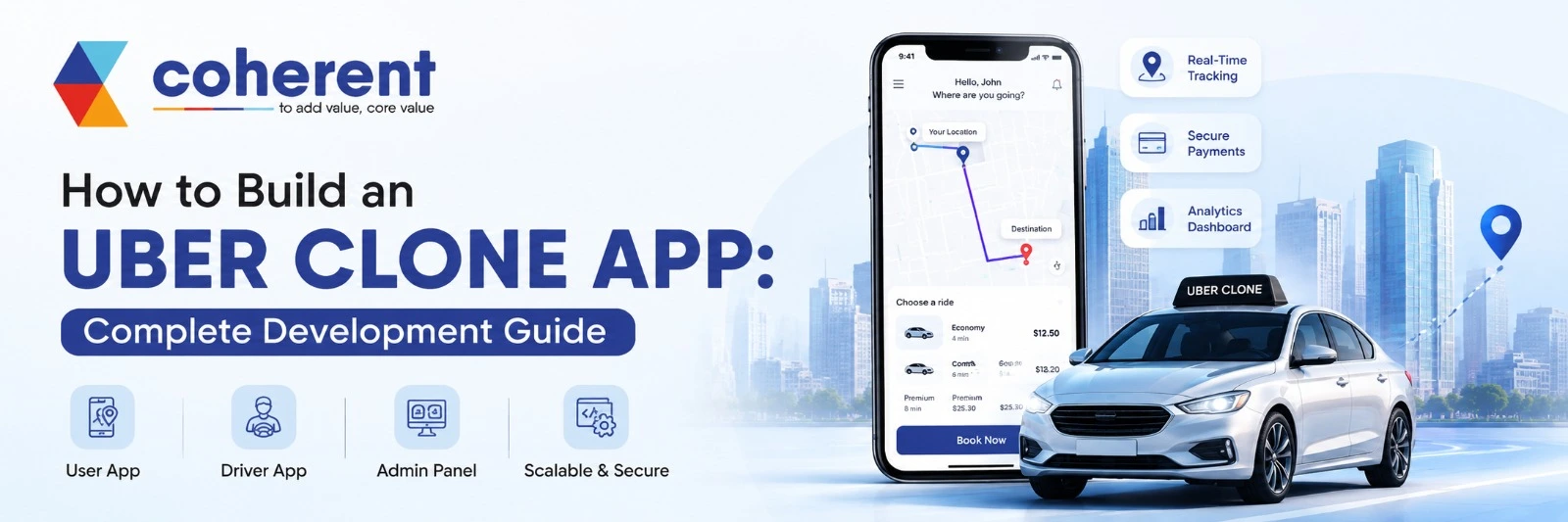
Building an app like Uber is no longer limited to large transportation companies. Startups, local taxi businesses, fleet operators, and entrepreneurs can launch their own ride-hailing platforms with the right technology, development strategy, and business model.This guide explains how to build an Uber clone app and how much Uber clone app development may cost in 2026.
However, an Uber-like application is much more than a booking screen and a map. A successful Uber clone app needs real-time GPS tracking, intelligent ride matching, secure payments, driver management, push notifications, ratings, location services, and a reliable backend capable of handling thousands of users simultaneously.
What Is an Uber Clone App?
An Uber clone app is a ride-hailing application inspired by the core functionality of Uber. It allows passengers to book rides, drivers to accept requests, and administrators to manage the entire transportation ecosystem from a centralized dashboard.The goal isn't to copy Uber's branding or interface. Instead, businesses use an Uber clone app development approach to build a customized ride-hailing solution around their own market, customers, and business model.
- Manage fleets digitally
- Improve customer engagement
- Expand into new cities
- Build multiple revenue streams
Why Build an Uber Clone App in 2026?
The ride-hailing industry continues to evolve as customers increasingly expect convenient, cashless, and location-aware transportation services. For startups, launching a focused ride-hailing platform can be more practical than trying to compete directly with global companies. For example, a business could build an app specifically for airport transfers, corporate transportation, women-only rides, luxury transportation, bike taxis, or intercity travel. Partnering with an experienced mobile app development company can help turn these ideas into a scalable, user-friendly, and feature-rich ride-hailing platform.
- Launch a digital taxi booking service
- Connect passengers with drivers
- Automate ride bookings
- Track vehicles in real time
How Does an Uber Clone App Work?
An Uber clone app connects passengers with nearby drivers through a real-time digital platform. The complete ride-hailing workflow starts when a passenger enters a pickup and destination location and ends with payment and ratings. Behind the scenes, GPS tracking, ride-matching algorithms, payment gateways, notifications, and backend APIs work together to provide a smooth and reliable ride-booking experience. Businesses can work with an experienced mobile app development company like Coherent Lab to build a scalable and customized ride-hailing solution.
Step 1: Passenger Requests a Ride
The passenger opens the app, selects the pickup and destination locations, and chooses a preferred vehicle category. The app uses GPS and mapping services to estimate the route, travel time, and approximate fare before the passenger confirms the booking.
- Enter pickup location
- Add destination
- Select vehicle type
- View estimated fare
- Confirm ride
Step 2: Ride Request Goes to Nearby Drivers
Once the passenger confirms the booking, the backend searches for available drivers within a suitable radius. The system considers location, driver availability, vehicle category, and other business rules before sending the ride request to eligible drivers.
- Detect nearby drivers
- Check driver availability
- Match suitable vehicles
- Send ride requests
- Calculate estimated arrival time
Step 3: Driver Accepts the Request
The driver receives the ride request with important trip details. After reviewing the pickup location, destination, estimated fare, and passenger information, the driver can accept the request and start navigation toward the pickup point.
- Receive ride request
- View passenger details
- Check pickup location
- Review estimated fare
- Accept or reject the ride
Step 4: Real-Time Ride Tracking
After the driver accepts the booking, both users can track the trip in real time. GPS technology continuously updates the driver's location, while mapping and navigation services help provide accurate routes and estimated arrival times.
- Track driver location
- Display live route
- Show estimated arrival time
- Provide navigation
- Update ride status
Step 5: Ride Completion
When the driver reaches the destination, the ride is marked as completed. The system calculates the final fare using factors such as distance, duration, vehicle type, base fare, applicable taxes, and any additional charges configured by the platform.
- Confirm destination arrival
- Calculate final fare
- Update trip status
- Generate ride receipt
- Save trip history
Step 6: Payment and Rating
After completing the ride, the passenger pays using the selected payment method. The platform processes the transaction and generates a digital receipt. Both passengers and drivers can then provide ratings or feedback, helping maintain service quality and trust.
- Process online or cash payment
- Generate digital receipt
- Update payment status
- Rate the driver
- Submit feedback
Also read :Courier Apps: Revolutionizing the Delivery Industry
Essential Features of an Uber Clone App
A successful Uber clone app development project needs more than basic ride booking. It should provide passengers and drivers with a smooth, secure, and real-time experience. From registration and GPS tracking to fare calculation, payments, ratings, and notifications, every feature should support convenience and reliability. The right combination of ride-hailing app features also helps businesses deliver better customer experiences and scale efficiently.
Passenger App Features
The passenger app is the primary interface for customers using your Uber-like app. It should make finding a ride, booking a vehicle, tracking the driver, completing payments, and providing feedback simple. A clean interface with essential features can reduce booking friction and encourage customers to use the platform regularly.
- Quick registration and login
- Easy ride booking
- Real-time driver tracking
- Fare estimation
- Multiple payment options
User Registration and Login
A simple registration process helps passengers quickly access the taxi booking app. Users should be able to sign up using commonly preferred authentication methods. Secure login and verification also help protect accounts and provide a trustworthy experience from the beginning.
- Email registration
- Mobile number
- OTP verification
- Google login
Location Detection
Accurate location detection is essential for any ride-hailing app development project. The application should automatically identify the passenger's current position while allowing them to adjust the pickup location manually. Reliable GPS integration ensures drivers can find passengers efficiently and helps improve estimated arrival times.
- Automatic current-location detection
- Manual pickup adjustment
- GPS integration
- Accurate pickup coordinates
Ride Booking
The ride-booking feature allows passengers to request transportation within a few simple steps. Users can enter their destination, select a suitable vehicle category, check the estimated fare, choose a payment method, and confirm the booking. A straightforward booking flow improves usability and reduces unnecessary steps.
- Select pickup location
- Enter destination
- Choose vehicle category
- View estimated fare
Real-Time GPS Tracking
Real-time GPS tracking is one of the most important features of an Uber clone app. It allows passengers to monitor their driver's location and estimated arrival time. Continuous location updates also help the platform track trip progress and provide accurate information throughout the journey.
- Live driver location
- Estimated arrival time
- Vehicle information
- Route visualization
Fare Estimation
Fare estimation gives passengers transparency before confirming a ride. The system can calculate an estimated price using distance, travel time, vehicle category, base fare, demand-based pricing, taxes, and additional charges. Accurate estimates help customers make informed decisions and reduce confusion about the final ride cost.
- Distance-based pricing
- Time-based pricing
- Vehicle category
- Base fare
Multiple Payment Options
Offering multiple payment methods makes a taxi booking app more convenient for different customer groups and markets. Depending on the target geography, businesses can integrate cards, digital wallets, UPI, net banking, cash, and an in-app wallet to provide flexible and secure payment experiences.
- Credit and debit cards
- Digital wallets
- UPI
- Net banking
Ride History
Ride history allows passengers to access important information about their previous bookings. Users can review completed trips, payment details, receipts, driver information, and ratings from one place. This feature is also useful for expense tracking, customer support, and resolving disputes related to previous rides.
- Previous trips
- Digital receipts
- Payment records
- Driver information
Ratings and Reviews
Ratings and reviews help maintain service quality across the ride-hailing platform. After completing a trip, passengers can rate their drivers and share feedback about their experience. This information can help administrators identify service issues, recognize high-performing drivers, and improve overall customer satisfaction.
- Driver ratings
- Written feedback
- Service quality reviews
- Driver performance monitoring
Push Notifications
Push notifications keep passengers informed about important booking and trip updates without requiring them to constantly open the application. Notifications can be triggered throughout the ride lifecycle, from driver acceptance to arrival, payment confirmation, and cancellation.
- Driver acceptance alerts
- Driver arrival notifications
- Ride status updates
- Payment confirmation
Backend Services Behind the Ride
Although the user experience looks simple, multiple backend services operate simultaneously to keep an Uber-like app running smoothly. These services manage location updates, ride matching, payments, notifications, authentication, pricing, and trip data.
- GPS and location services
- Real-time ride matching
- Payment processing
- Push notifications
Also Read :- Top Ride-Sharing Apps in India: Best Apps to Book Rides
Technology Stack for Uber Clone App Development
Choosing the right technology stack for Uber clone app development is essential for performance, security, real-time tracking, and scalability. Developers can use Flutter or React Native for cross-platform apps, Node.js or Python for backend development, PostgreSQL or MongoDB for databases, and AWS or Google Cloud for infrastructure. Maps, payment, notification, and GPS APIs complete the core ecosystem.
| Technology Layer | Recommended Technologies |
|---|---|
| Mobile App | Flutter, React Native, Swift, Kotlin |
| Frontend | React.js, Next.js |
| Backend | Node.js, Python, Java |
| Database | PostgreSQL, MySQL, MongoDB |
| Real-Time Communication | WebSockets, Socket.IO |
| Cloud | AWS, Google Cloud, Microsoft Azure |
| Maps | Google Maps Platform, Mapbox |
| Authentication | OAuth, OTP, Firebase Authentication |
| Notifications | Firebase Cloud Messaging, Apple Push Notification service |
| Payments | Stripe, Razorpay, PayPal |
| Analytics | Firebase Analytics, Custom Dashboards |
How to Build an Uber Clone App: Step-by-Step Process
Building an Uber clone app requires more than developing a passenger booking interface. You need a clear business model, market research, scalable technology, intuitive UI/UX, real-time GPS, secure payments, and thorough testing. Following a structured Uber clone app development process helps reduce development risks, control costs, and create a reliable ride-hailing platform that can scale from a local MVP to multiple cities.
1. Define Your Business Model
Before starting development, clearly define how your ride-hailing business will operate. Identify your target audience, service area, vehicle categories, pricing model, driver commission, and revenue strategy. A well-defined business model gives the development team clear direction and helps avoid costly changes during later stages.
- Target customers
- Target city or country
- Vehicle categories
- Pricing strategy
2. Conduct Market Research
Market research helps you understand what passengers and drivers actually expect from a taxi booking app. Analyze competitors in your target location, identify service gaps, and study local transportation preferences. This information can help you develop features and pricing strategies that provide a meaningful advantage over existing ride-hailing platforms.
- Customer expectations
- Competitor pricing
- Popular vehicle categories
- Payment preferences
3. Define MVP Features
An MVP allows you to launch essential ride-hailing app features without spending heavily on advanced functionality from the beginning. Focus on the features required to connect passengers and drivers, process rides, and manage operations. After launch, real user feedback can guide investment in more advanced features and integrations.
- User registration and profiles
- Driver registration and profiles
- Ride booking
- GPS tracking
4. Design UI/UX
A successful Uber clone app should make ride booking simple, fast, and intuitive. The passenger should quickly understand their current location, destination, estimated fare, and available ride options. The driver interface should focus on ride requests, navigation, availability, and earnings without unnecessary complexity or distracting screens.
- Simple passenger onboarding
- Easy ride booking flow
- Clear fare information
- Interactive maps
5. Develop the Applications
The development stage brings the passenger experience, driver operations, and administration system together. A typical Uber clone app development project includes separate interfaces for passengers and drivers, supported by a centralized backend. The backend manages authentication, bookings, driver matching, payments, GPS data, notifications, and other core platform operations.
- Passenger mobile app
- Driver mobile app
- Backend APIs
- Admin dashboard
6. Integrate Third-Party APIs
Third-party integrations provide essential capabilities without requiring every service to be developed from scratch. For a ride-hailing application, reliable APIs are particularly important for maps, payments, communication, notifications, and identity verification. Selecting stable providers can improve application reliability while reducing development complexity and maintenance requirements.
- Maps and navigation APIs
- Geolocation services
- Payment gateways
- SMS and OTP services
7. Implement Real-Time Features
Real-time functionality is at the heart of an Uber-like app. Passengers need accurate driver locations, while drivers need immediate ride requests and status updates. The backend should synchronize important information with minimal delay so that both sides receive consistent trip information throughout the booking and transportation process.
- Live driver location
- Ride status updates
- Booking acceptance
- Estimated arrival time
8. Test the Application
Testing is essential because ride-hailing apps operate in unpredictable real-world conditions. Developers should test different devices, network environments, GPS conditions, payment scenarios, and high-traffic situations. Strong testing helps identify crashes, incorrect fare calculations, location problems, security vulnerabilities, and communication failures before the application reaches customers.
- Functional testing
- UI/UX testing
- API testing
- Payment testing
9. Launch the MVP
Instead of immediately launching across an entire country, consider starting with a specific city or service area. A controlled launch makes it easier to monitor ride demand, driver availability, customer acquisition, cancellations, and operational performance. The insights collected during this stage can help improve the product before expanding into additional locations.
- Ride demand
- Driver availability
- Customer acquisition
- Cancellation rates
10. Improve Based on User Feedback
Launching the first version is only the beginning of the Uber clone app development journey. Collect feedback from both passengers and drivers to identify usability problems, missing features, pricing concerns, and operational issues. Use this feedback to prioritize product improvements instead of adding features simply because competitors already offer them.
- Review passenger feedback
- Analyze driver feedback
- Monitor app analytics
- Identify recurring problems
How Much Does It Cost to Build an Uber Clone App?
The Uber clone app development cost can range from $20,000 to $150,000+, depending on app complexity, features, platforms, design, integrations, and development location. A basic MVP requires a smaller budget, while an advanced ride-hailing platform with AI, real-time tracking, multiple payment gateways, analytics, and scalable backend infrastructure requires a significantly higher investment. These are broad estimates rather than fixed quotes. A platform with advanced AI, multiple services, and enterprise-level infrastructure can cost considerably more. For a detailed understanding of the factors involved, explore our guide on mobile app development costs.
| App Complexity | Estimated Cost | Approx. Development Time |
|---|---|---|
| Basic MVP | $20,000–$40,000 | 3–5 months |
| Medium Complexity | $40,000–$80,000 | 5–8 months |
| Advanced Platform | $80,000–$150,000+ | 8–12+ months |
| Enterprise-Level Platform | $150,000–$250,000+ | 12–18+ months |
| AI-Powered Platform | $100,000–$200,000+ | 10–16+ months |
| Multi-Service Platform | $120,000–$250,000+ | 12–18+ months |
How to Make Your Uber Clone App Different
To stand out in the competitive ride-hailing app market, your Uber clone app should offer more than basic booking and GPS tracking. Focus on a specific audience, location, or transportation problem and build unique value around it. Features such as AI-powered recommendations, loyalty programs, eco-friendly rides, corporate bookings, personalized experiences, and faster customer support can help differentiate your platform. If you plan to expand into food delivery, exploring Food Delivery App Development can help you understand how to build an on-demand delivery platform.
- Women-focused transportation
- Corporate employees
- Airport transportation
- Luxury rides
- Electric vehicle transportation
Final Thoughts
Building an Uber clone app can be a strong opportunity for businesses that identify the right market and solve a specific transportation problem.The most important part isn't copying Uber's features. It's understanding your customers, designing an efficient driver-passenger marketplace, selecting the right technology, and building a platform that can scale as demand grows.
Start with a focused MVP, validate the business model, collect feedback from passengers and drivers, and then invest in advanced features such as AI-powered ride matching, predictive analytics, and personalized recommendations. With the right strategy and an experienced Uber clone app development company, an idea can evolve from a simple taxi booking application into a scalable transportation platform. Get in Touch with our team to discuss your ride-hailing app development requirements.
Frequently Asked Questions
Q1: How much does it cost to build an Uber clone app?
Ans.The cost to build an Uber clone app can range from $20,000 to $150,000+, depending on the project's complexity. Features, Android and iOS platforms, UI/UX design, third-party integrations, backend architecture, security, and development team location all affect the final cost. A basic MVP requires less investment, while an advanced ride-hailing platform needs more resources.
Q2: How long does it take to develop an Uber clone app?
Ans.The development timeline for an Uber clone app depends on its features and technical complexity. A basic ride-hailing app MVP can take around 3–5 months, while a feature-rich platform may require 8–12 months or longer. Development time also depends on UI/UX design, API integrations, testing, backend development, platform selection, and customization requirements.
Q3: Can I build an Uber clone app for Android and iOS?
Ans. Yes, you can build an Uber clone app for both Android and iOS. Businesses can choose native development with Kotlin and Swift or use cross-platform frameworks such as Flutter or React Native. Cross-platform development can reduce development time and maintenance requirements, while native development may be preferred when the application requires platform-specific functionality and performance optimization.
Q4: What are the most important features of an Uber-like app?
Ans.The essential features of an Uber-like app include user registration, ride booking, GPS tracking, driver matching, fare estimation, online payments, push notifications, ratings, ride history, and driver management. A complete platform should also include an admin dashboard for managing passengers, drivers, rides, pricing, payments, promotions, reports, and overall ride-hailing operations efficiently.
Q5: Can AI be integrated into an Uber clone app?
Ans. Yes, AI can make an Uber clone app more intelligent and efficient. Businesses can integrate AI for driver-passenger matching, demand forecasting, route optimization, fraud detection, customer support, personalized recommendations, and driver performance analysis. Machine learning can analyze historical ride data to identify demand patterns, improve operational decisions, reduce waiting times, and create a better passenger experience.
Q6: Can I launch an Uber clone app in a single city?
Ans.Yes, launching an Uber clone app in a single city is a practical strategy for startups and local transportation businesses. A city-focused MVP allows companies to validate demand, attract drivers, test pricing, understand customer behavior, and optimize operations before expanding. Once the platform achieves stable user adoption and ride volume, the business can gradually enter additional cities.
Q7: Is it legal to build an Uber clone app?
Ans.Yes, you can develop a ride-hailing application with functionality similar to Uber, but you should not copy its trademarks, branding, copyrighted content, proprietary designs, or protected intellectual property. Your app should have its own brand identity and user experience. You must also follow applicable transportation, licensing, insurance, tax, privacy, and data protection regulations in your target market.
Q8: How can I monetize an Uber clone app?
Ans. An Uber clone app can generate revenue through multiple business models, including ride commissions, booking fees, dynamic pricing, driver subscriptions, corporate transportation accounts, and advertising. Businesses can combine different revenue streams based on their target audience and market. A well-planned monetization strategy should maintain competitive fares for passengers while providing sustainable revenue for the platform and drivers.

 +91 774-202-1725
 +1 (945) 3387904
 business@coherentlab.com
 +49 15223341304
 UK
UK