
Table of Contents
Can an AI Answering Service Book Jobs Instead of Taking Messages?
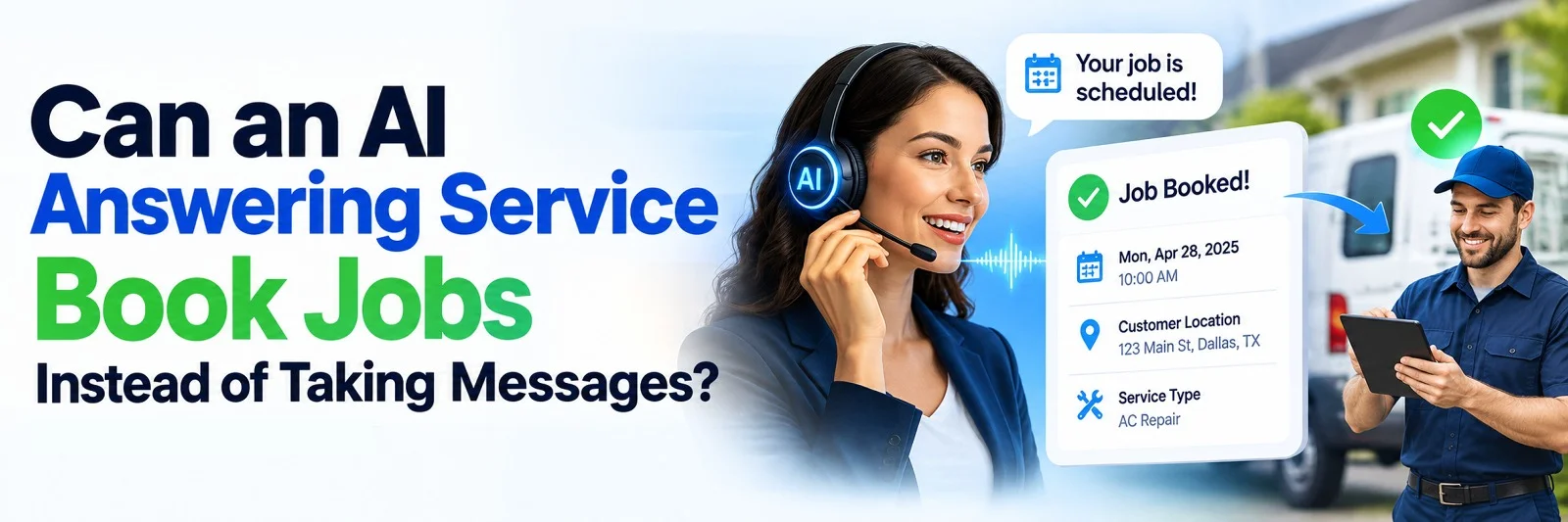
It's 9 p.m. on a cold Tuesday. A property manager calls about a heating failure that has left three floors of tenants without heat. The call reaches an answering service, and the agent takes a name, a number and a short note. Then the request sits untouched until someone reads it the next morning.
That gap between a message and a booking costs field teams real work. For mid-market and enterprise field operations, the same gap repeats across every site and crew. Callers don't want a promise. They want a confirmed visit. This article follows that call twice, then covers emergencies and what to check before switching.
The short answer: Yes, if it's connected to the schedule. It captures the details, books the job and routes emergencies to the on-call technician, with no callback needed.
The Same Call, Handled the Old Way
Traditional answering services were built to capture messages. Completing work was never part of the design. They protect the phone line, but they rarely touch the schedule, and that matters most after hours. So here's how the 9 p.m. call actually plays out.
A Message, Not a Booking
The agent is polite. They thank the property manager and promise a callback first thing tomorrow, but nobody assigns a technician. No time slot gets held. The caller hangs up with no idea when help will arrive.
Meanwhile, the tenants keep calling the property manager for updates throughout the evening. There's nothing new to tell them. By morning, frustration has built on both sides of the relationship. A simple message has quietly become a customer experience problem.
Missing Details Slow Everything Down
The note usually holds a name, a number and one line of free text. That's it. No site address, no equipment type and no access instructions. So the dispatcher calls back just to gather the basics. Each extra call pushes the repair further into the day.
Across multiple sites and crews, these small delays stack up fast. Grand View Research links conversational AI growth to rising expectations for round-the-clock support. Customers expect answers at any hour now. Teams that rely on message-taking struggle to keep up, especially when call volume spikes overnight.
By the time the office calls back, the property manager may have phoned another provider. Nobody made a mistake. Yet the business still lost the work, and no one at the company even knew it existed. That's exactly the outcome an AI answering service is built to prevent.
The Same Call, Handled by an AI Answering Service
Now replay the same call. Same night, same building, same broken heating system. This time, the AI answering service is connected to the schedule, and that changes everything that follows. The difference isn't the voice on the line; it's what happens to the request afterward.
Every Call Is Answered and Captured, 24/7
The AI picks up on the first ring, whether it's 9 p.m. or 3 a.m. No hold music. No voicemail prompt. The conversation starts right away, in plain language, so no request slips through because the office has closed.
Instead of free text, the AI asks for the facts a technician actually needs. It confirms the site, the problem, the equipment and how to get into the building. Every answer lands in a structured field. The dispatcher gets a complete request, not a puzzle.
The Job Is Booked and Created Directly
This is where AI pulls away from a message pad. Operations running multiple sites and crews need more than a polite note taker. They need every call to end with real work on the schedule. That’s the thinking behind FieldCamp’s field service answering service, which books and creates the job directly. Nothing waits for a callback.
The property manager hangs up with a confirmed booking. The tenants get a real update before bedtime. And when the dispatcher arrives in the morning, the work is already on the schedule, ready to go. Everyone knows what happens next.
That's the practical answer to the question in the title. An AI answering service can book jobs, but only when it's wired into the schedule. The caller gets certainty, and the company keeps the work. A message pad can't deliver either one after hours.
Message-Taking vs. AI Booking at a Glance
Side by side, the gap between the two approaches is hard to miss. One records a request. The other turns it into scheduled work. Here's how they compare on the points that matter most to a dispatch team.
|
Feature |
Message-Taking Service |
AI Answering Service with Booking |
|---|---|---|
|
Response to the Caller |
A callback, often the next business day |
Answered on the first ring, 24/7 |
|
Details Captured |
Name, phone number, and a free-text note |
Site, issue, equipment, and access details in structured fields |
|
Job Created |
No, someone enters it later |
Yes, the job is booked and created directly |
|
Emergency Handling |
Depends on someone reading the message |
Routed to the on-call technician |
|
What the Caller Leaves With |
A promise to call back |
A confirmed booking |
The table makes one point clear. Speed matters, but completeness matters more. A fast message is still just a message, and the caller still waits. Only a booked job moves the work forward.
What Happens When the Call Is an Emergency
Not every request can wait for the next open slot. A building with no heat in January is different from a routine filter change. A capable system needs to spot that difference instantly. Then it needs to act on it.
Telling Urgent Calls From Routine Requests
The AI listens for the signals your organization defines as urgent. No heat in winter. An active leak. A safety risk. Routine work, like seasonal maintenance, simply follows the normal booking path.
Every organization draws that line a little differently, so the rules need to be adjustable. A commercial portfolio might treat certain sites as priority, whatever the issue. The rules should reflect how your team actually works, not a vendor's default script. Test them before launch with a realistic emergency call.
Routing Emergencies to the On-Call Technician
When a call meets the emergency criteria, the AI routes it to the on-call technician. The technician gets the details right away. No waiting for the office to open. Meanwhile, the caller hears that help is on the way. That one step can protect a contract worth far more than a single visit.
Routine callers benefit too. Their requests get booked into a normal slot instead of being escalated. The on-call technician only hears about genuine emergencies, which keeps the rotation manageable. Each call lands in the right place, and nobody in the office has to lift a finger.
The result is a clean split. Emergencies reach a person quickly, while everyday requests still become booked jobs. Neither caller is left waiting on a message. That balance is hard to strike when a service can only take notes.
What Operations Teams Should Check Before Switching
Here's the catch. Not every AI answering service actually books jobs, and plenty still just collect messages with a smoother voice. Before you commit, ask a few direct questions. These checks separate genuine booking tools from upgraded voicemail.
Does It Book, or Only Take Messages?
Ask for a live test call instead of a recorded demo. Describe a real request from your own operation, then watch what the system produces. A booked job with a time and a technician is the right result. A neatly typed message isn't.
Next, look at how the tool connects to dispatch, CRM and the rest of your stack. A standalone service just creates another data silo. The booking should land where dispatchers and account managers already work. Integration matters as much as conversation quality.
Can You Measure the Results?
Define success before rollout, not after. Clear metrics keep the evaluation honest and focused on outcomes rather than impressions. Without them, it's hard to tell whether the investment is paying off. Track these four numbers weekly for the first few months:
- Calls answered after business hours.
- Jobs booked without a callback.
- Emergencies routed to the on-call technician.
- Requests created with complete job details.
Together, these figures show whether the system completes work or just records it. A rising share of booked jobs is the clearest sign of success. Callback volume should fall soon after. If neither number moves, the tool is probably still just taking messages.
Run every check with your own scenarios, including at least one emergency. The answers come quickly. Skip the polished pitch and judge what the system actually produces. The right provider becomes obvious once you see real results.
Conclusion
So, can an AI answering service book jobs instead of taking messages? Yes, as long as it connects to the schedule rather than sitting beside it. The 9 p.m. heating call shows the contrast clearly. One version ends with a note; the other ends with a booked job.
Across every site and crew, that difference compounds. Emergencies reach the on-call technician, and routine requests become scheduled work. Every after-hours call turns into an opportunity instead of a risk. Place your own test call, and judge the outcome rather than the pitch.
Frequently Asked Questions
Q.1 Can an AI answering service handle emergency calls?
Ans. Yes, if the escalation rules are set up properly. The AI checks each call against the criteria your team defines as urgent. Calls that qualify are routed to the on-call technician right away. Routine requests are booked into a normal slot instead.
Q.2 Does an AI answering service replace the dispatcher?
Ans. No. It handles intake, booking and after-hours routing, so dispatchers start each day with complete requests. They spend less time chasing details and more time managing the schedule. Human judgment still matters for complex jobs and customer relationships.
Q.3 What’s the difference between an answering service and an AI receptionist?
Ans. A traditional answering service takes messages for someone to act on later. An AI receptionist or booking-enabled answering service completes the request during the call. It captures structured details and creates the job directly. The terms overlap, so always ask whether the tool actually books.
Q.4 How should you test an AI answering service before buying?
Ans. Use your own phone line and real scenarios, not the vendor’s demo script. Include a routine booking, an incomplete request and a genuine emergency. Then check what the system produced after each call. A booked job is a pass, and a typed message is a fail. These answers cover the basics. Your own test calls will cover the rest. Treat any claim you can’t verify on a live call with caution. The results should speak for themselves.

 +91 774-202-1725
 +1 (945) 3387904
 business@coherentlab.com
 +49 15223341304
 UK

