
Table of Contents
How Retailers Can Integrate AI into Existing Ecommerce Platforms or Tools without Rebuilding Everything
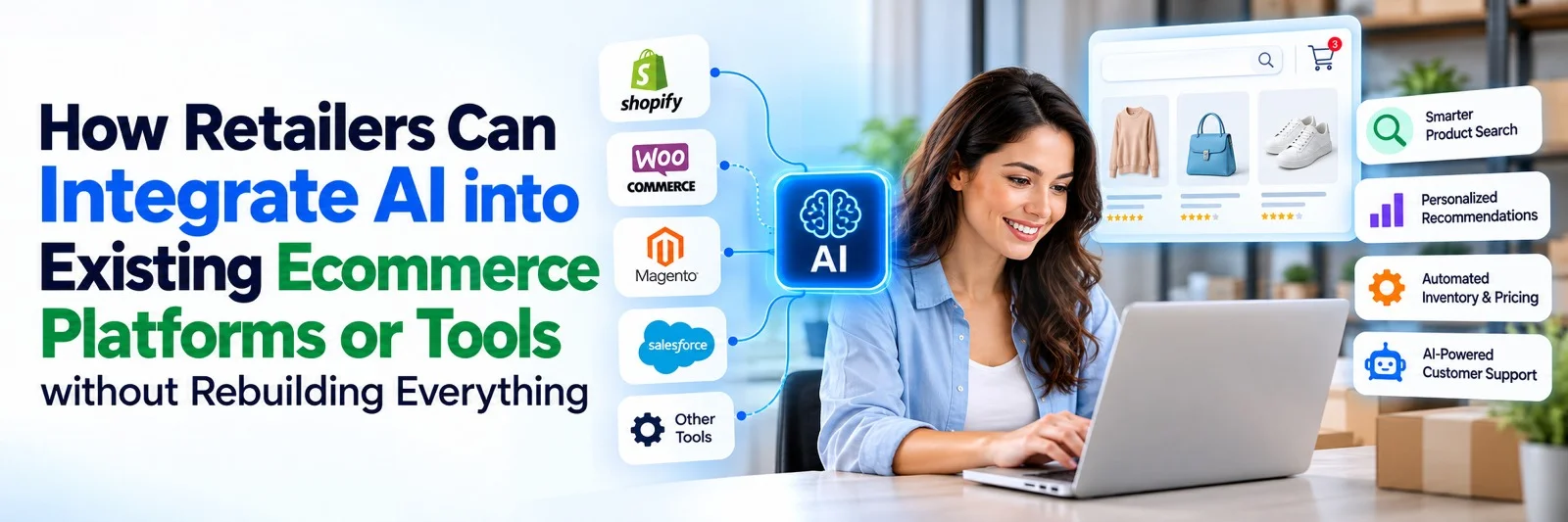
Say you run an online store that has been live for eight or nine years. It started on one platform, picked up a couple of plugins along the way, got connected to an ERP by a contractor, and now holds a pile of custom rules that only two people in the company fully understand. Then someone in a meeting says the store needs AI. The room goes quiet, because everyone is thinking the same thing. Does this mean starting over? Usually, no. And that's the point of this blog.
Why Most Retailers Don't Need to Rebuild
A rebuild is a big undertaking. Months of development, a migration, new training for the team, and a decent chance that something breaks on the way. Checkout, payments, tax, shipping rules. All of that took years to get right, and it works today. Replacing it just to add a smarter search bar is hard to justify.
Timing matters too. AI tools move fast. A rebuild planned around today's tools could finish after those tools have already been replaced by better ones. Keeping the existing platform and adding AI alongside it means a retailer can change its mind later without much pain.
Then there's the stuff nobody wrote down. Odd discount logic for one region. A shipping exception for a single supplier. A workaround from three years ago that quietly keeps orders flowing. A new build forgets these things. An integration doesn't touch them.
Identify the Right Problem to Solve
Plenty of AI projects start with a tool. Someone sees a good demo, gets excited, and the team spends weeks hunting for somewhere to use it. That's backwards.
A better starting point is a conversation with the people who run the store every day. Ask the support team what they answer fifty times a week. Ask the merchandisers what they're tired of fixing by hand. Ask the buyers how they decide how much to reorder. You'll hear specific, slightly annoyed answers, and those are the useful ones.
Choose one. A small, clear problem beats a grand vision every time, mostly because you can tell whether you actually fixed it.
How AI Integrates with an Existing Ecommerce Platform
This is the bit that surprises people. Most platforms already have ways to talk to outside software. Even older ones.
The most common route is the API. Products, orders, customers and stock levels can usually be read and updated through it. An AI service pulls in what it needs, does its job, and sends the result back. The store itself carries on exactly as before.
Then there are webhooks, which are basically alerts. A customer places an order, abandons a cart or opens a support ticket, and the platform sends a signal. Something on the AI side picks it up. A fraud check runs. A follow-up message gets written. It happens in the background and the customer never sees the machinery.
Many teams also put a small layer of middleware between the store and the AI service. It sounds like extra work, but it earns its place. It handles logins, tidies the data into the right format, keeps a log, and gives the team a single switch to turn things off. If the AI provider changes in a year or two, you swap one piece instead of untangling everything.
For simpler jobs, an extension from the platform's own marketplace might be enough. Just read what it does with customer data before installing it.
The important thing is that none of this reaches into the core of the store. If an AI feature misbehaves on a Friday evening during a sale, someone can flip it off and the shop keeps taking orders.
Top Use Cases for AI in Ecommerce
Not every Ai in an ecommerce use case is equally easy to add. A few of them slot in without much fuss. Site search is a good example. Default search on many stores is poor. A shopper types "waterproof jacket for hiking in the rain" and sees a page of random items, or nothing at all. An AI search layer can read what the person means, cope with typos and push the products people actually buy to the top. It usually feeds off the product data already in place.
Customer support is another. An assistant connected to order records and store policies can take the repetitive questions. Where's my parcel? How do I send this back? Does it come in green? Real agents then spend their time on cases that need a human brain. One warning here: the moment a conversation passes from the assistant to a person needs testing, and then testing again. That handoff is where customers lose patience if it's clumsy.
Product data is less exciting but very useful. Big catalogs get messy. Attributes go missing, names are inconsistent, descriptions are thin. AI can clean and fill in a lot of that in bulk, as long as someone reviews it before it goes live. Better data quietly improves search, filtering and sales across the whole store.
Inventory forecasting can also be added on the side. It looks at past sales and outside patterns like seasons, then sends suggestions into whatever tool the buying team already uses. No need to replace the ERP.
And personalization, meaning recommendations, emails and banners that change by shopper, can run as a separate service that simply reads behavior and returns suggestions. It's a well-trodden area, which makes it a sensible first step for a team that's new to all this.
Prepare Your Data for AI Integration
Nobody likes hearing this part. AI can only work with what it can see. If product records contradict each other, customer details sit in three different systems and order history has holes, the output will be disappointing. AI isn't the problem there. It's just working from a blurry picture.
So before choosing any tool, do a quick audit. Where is the product data kept? Customer records? Order history? Find out, and find out who looks after each one. Then take an honest look at the quality. Duplicates, blank fields, old entries nobody cleared out. It's usually worse than people expect. Privacy rules need a look as well, since what a store can do with shopper data depends on where those shoppers live.
Quite often this turns out to be the bigger job. The AI is the easy bit. Far better to learn that in week one than in month three.
Start with a Pilot Project
Keep the first attempt contained. One use case. One product category or one region. A start date and an end date. And two or three numbers agreed before anyone begins, such as how often search leads to a purchase, how many support tickets get resolved without a person, or how long product copy takes to write.
Afterwards, compare against the old way and be honest. Some pilots work. Some half work. Some should be quietly dropped. Any of those outcomes teaches the team something, and none of them cost what a rebuild would.
If it does work, grow it slowly. Next category, next channel, next idea. The platform underneath hardly changes during any of this.
Common Challenges and Mistakes to Avoid
A handful of problems show up again and again. People skip the human review. Content written by AI and decisions made by AI need a person checking them, at least early on. One wrong price or a badly worded product claim can hurt trust faster than you'd expect.
Speed gets ignored. If an AI call adds two seconds to a page, the lost sales can outweigh whatever the feature earns. Test it, and use caching where it makes sense.
Teams get locked into one vendor. When everything depends on a single provider's special setup, leaving gets expensive. Middleware helps here as well.
Staff aren't brought along. If the people using a tool don't understand it or trust it, they'll find ways around it. A short, honest explanation of what's changing and what isn't makes a big difference. And nobody owns it after launch. Models drift, catalogs change, shoppers behave differently from one season to the next. Without an owner, quality slides.
Working with an AI Integration Partner
Plenty of retail teams are skilled, but they're also busy just keeping the store running. Connecting AI to a live platform properly needs a mix of things: API work, data engineering, security, model selection, and a real understanding of how ecommerce operations behave under pressure.
That's where AI integration services come in. A good provider starts by studying what's already there, works out what can stay as it is, and recommends the lightest connection that solves the problem. If a provider opens with "you'll need to migrate platforms," it's worth pausing and asking why.
A few direct questions help when comparing options. Has the team worked with your platform before? How will they handle your customer data? What happens if you want to leave in twelve months? Specific answers are a good sign. Fuzzy ones tend to stay fuzzy.
Conclusion
Retailers don't have to start over to get value from AI. The store they already have, quirks and all, is a perfectly workable base. What matters is picking a real problem, cleaning up the data, connecting through the doors that already exist and testing before spreading it further.
Handled that way, AI is just another addition to the business rather than a disruption. For any team considering AI integration services, the most useful question isn't how much has to be replaced. It's what the smallest change is that would make a visible difference.

 +91 774-202-1725
 +1 (945) 3387904
 business@coherentlab.com
 +49 15223341304
 UK

