Table of Contents
Top 10 AI App Ideas Startups Are Building: Future Guide
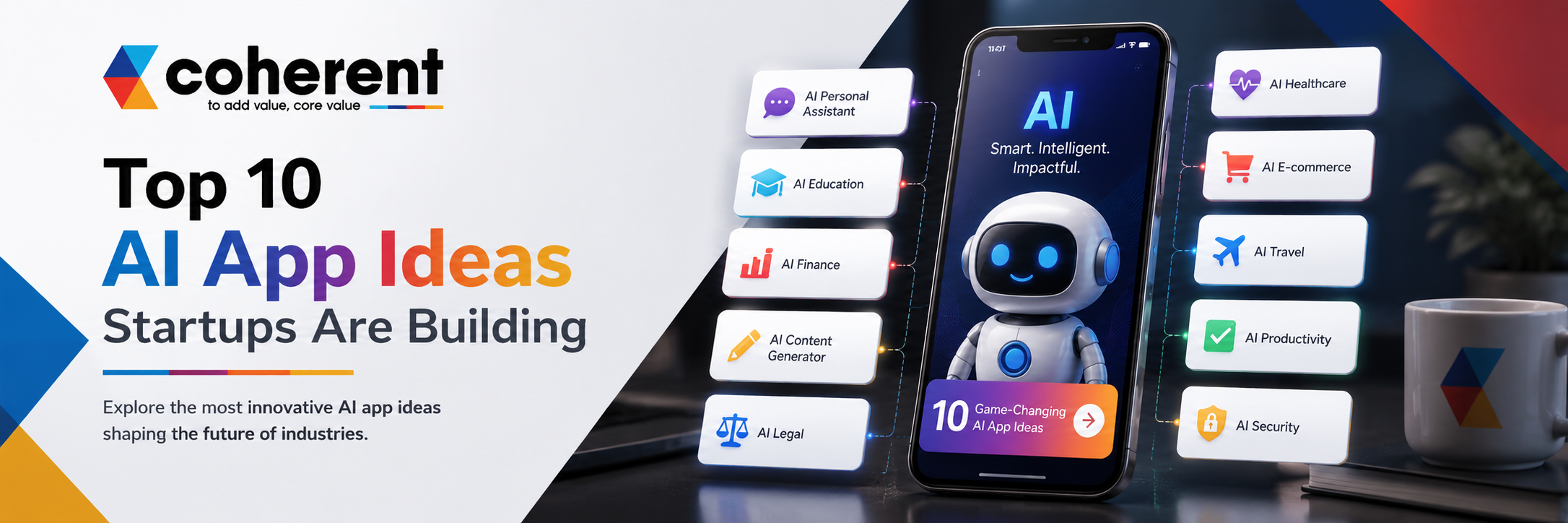
Artificial Intelligence is transforming the startup ecosystem, creating new opportunities for innovation across every industry. From healthcare and finance to education, retail, and logistics, AI-powered applications are helping startups solve real-world problems faster and more efficiently. Modern AI technologies such as machine learning, generative AI, computer vision, and natural language processing enable businesses to automate workflows, personalize customer experiences, and make data-driven decisions. As demand for intelligent digital solutions continues to grow, entrepreneurs are investing in AI app ideas that offer scalability, competitive advantage, and long-term business value. Whether you're launching your first startup or expanding an existing business, choosing the right AI app concept is the foundation of success. In this guide, we'll explore the top 10 AI app ideas startups are building and why these innovative solutions are shaping the future of technology.
Why AI App Ideas Are the Future of Startup Growth
AI app ideas are driving the next wave of startup innovation because they solve real-world problems faster and more efficiently than traditional software. With generative AI, machine learning, and automation tools, startups like Coherentlab can build scalable products with lower costs, higher accuracy, and better user engagement. Investors also prefer AI-first businesses due to strong long-term growth potential and global demand. These advancements are reshaping industries and enabling startups to innovate rapidly, improve efficiency, and deliver smarter digital solutions worldwide.
Top 10 AI App Ideas Startups Are Building in 2026
Artificial Intelligence is driving the next wave of innovation, helping startups create smarter, faster, and more personalized digital products. From AI-powered virtual assistants and healthcare solutions to intelligent finance, education, and productivity apps, entrepreneurs are leveraging AI to solve real-world challenges and unlock new business opportunities. In this guide, we explore the top 10 AI app ideas startups are building in 2026, their market potential, key features, and why these AI-driven solutions are attracting investors, users, and rapid growth across industries.
1. AI Personal Productivity Assistant Apps
AI productivity assistants help users manage tasks, emails, schedules, and workflows intelligently. These apps reduce manual effort by automating reminders, summarizing meetings, and offering smart suggestions, improving daily efficiency for professionals, students, and businesses.
2. AI Healthcare Diagnosis & Symptom Checker Apps
These apps analyze symptoms, medical history, and health data to provide early diagnosis suggestions. AI-powered healthcare tools support remote monitoring, telemedicine, and personalized treatment recommendations, making healthcare more accessible and efficient.
3. AI Finance & Investment Advisory Apps
AI finance apps provide automated budgeting, expense tracking, and investment insights. Using predictive analytics, they help users make smarter financial decisions, reduce risks, and optimize portfolio performance based on market trends.
4. AI Content Creation & Copywriting Apps
These apps generate blogs, ads, emails, and social media posts instantly using generative AI. They also optimize content for SEO, tone, and audience engagement, helping businesses scale content marketing effortlessly.
5. AI Customer Support Chatbot Apps
AI chatbots deliver 24/7 customer support using natural language processing. They handle queries, complaints, and service requests instantly, improving response time, customer satisfaction, and reducing operational costs.
6. AI Education & Smart Learning Apps
AI learning apps personalize education based on student performance. They offer adaptive learning paths, AI tutors, and exam preparation tools, making learning more interactive, efficient, and result-oriented.
7. AI E-Commerce Personalization Apps
These apps analyze user behavior to recommend products, optimize pricing, and improve shopping experiences. AI-driven personalization increases conversions, customer retention, and average order value for online stores.
8. AI Cybersecurity & Fraud Detection Apps
AI cybersecurity apps detect threats, prevent data breaches, and monitor suspicious activities in real time. They protect businesses from cyberattacks using advanced anomaly detection and behavioral analysis.
9. AI Video & Image Generation Apps
These tools create images, videos, and marketing creatives using text prompts. They help designers, marketers, and creators produce AI animations quickly without expensive production tools.
10. AI Real Estate Smart Listing Apps
AI real estate apps match buyers with properties using smart filters, pricing prediction, and virtual tours. They improve property discovery and streamline buying and selling processes.
Key Technologies Powering AI App Development in 2026
AI app development in 2026 is powered by advanced technologies that enable intelligent, scalable, and highly personalized user experiences. Innovations such as generative AI, large language models (LLMs), machine learning, natural language processing (NLP), computer vision, cloud computing, edge AI, and predictive analytics are transforming how applications are built and used. These technologies help businesses automate processes, improve decision-making, enhance customer engagement, and deliver smarter digital solutions across industries, making AI-powered applications more accessible and effective than ever before.
Business Benefits of AI App Startups
AI startups gain advantages such as faster automation, reduced operational costs, and improved decision-making. These apps enhance customer experience through personalization and scalability. Businesses adopting AI-first models achieve stronger market positioning, higher revenue growth, and long-term digital transformation success.
Challenges in Building AI Startup Apps
Despite opportunities, AI app development faces challenges like data privacy concerns, high computational costs, model bias, and integration complexity. Startups must also ensure ethical AI usage and compliance with global regulations to build trustworthy and scalable products.
Future Trends of AI App Development Beyond 2026
The future of AI apps includes autonomous AI agents, multimodal systems, and hyper-personalized digital ecosystems. Voice-first interfaces and fully automated SaaS platforms will redefine how users interact with technology, making AI an essential part of everyday life. Top AI App Development Trends in 2026 are clearly driven by these innovations.
Conclusion
AI-powered applications are shaping the future of startups by solving real-world problems across healthcare, finance, education, retail, logistics, and customer service. Choosing the right AI app idea can help businesses innovate faster, improve user experiences, and gain a competitive edge. As AI technology continues to evolve, startups that invest in practical, scalable, and customer-focused solutions will be well-positioned for long-term success. Ready to turn your AI app idea into reality? Contact us today to discuss your project and build an intelligent, future-ready AI solution tailored to your business goals.
Frequently Asked Questions (FAQs)
Q1. What are AI app ideas in 2026?
Ans. AI app ideas in 2026 are advanced digital solutions powered by machine learning, generative AI, and automation. These apps solve real-world problems like healthcare, finance, education, and business operations by offering faster decision-making, personalization, and intelligent user experiences across industries.
Q2. Why are startups focusing on AI apps?
Ans. Startups focus on AI apps because they reduce operational costs, improve efficiency, and scale quickly. AI-driven products also attract investors due to high demand, global adoption, and their ability to solve complex problems with minimal human intervention and maximum accuracy.
Q3. Which industries benefit most from AI apps?
Ans. Industries like healthcare, fintech, education, e-commerce, logistics, and marketing benefit the most. AI apps help with automation, predictive analytics, customer support, fraud detection, and personalized recommendations, making these sectors more efficient and competitive in the digital economy.
Q4. What technologies power AI apps in 2026?
Ans. AI apps in 2026 use technologies like machine learning, deep learning, natural language processing, computer vision, and generative AI models. Cloud computing and edge AI also play a major role in improving performance, scalability, and real-time decision-making capabilities.
Q5. Are AI apps expensive to build?
Ans. AI app development cost depends on complexity, features, and data requirements. Simple AI apps are affordable for startups, while advanced solutions with deep learning models and integrations can be expensive. However, no-code AI tools are reducing development costs significantly.
Q6. Can small startups compete in AI app development?
Ans. Yes, small startups can compete by focusing on niche problems and using ready-made AI APIs and frameworks. Instead of building large systems, they can create specialized AI solutions that solve specific user needs and scale gradually with market demand.
Q7. What is the future of AI app startups?
Ans. The future of AI app startups is highly promising. With increasing adoption of automation and intelligent systems, AI startups will dominate industries. They will continue to innovate in personalization, predictive systems, and autonomous applications across global markets

 +91 774-202-1725
 +1 (945) 3387904
 business@coherentlab.com
 +49 15223341304
 UK
UK