
Table of Contents
How AI Can Improve Booking, Dispatch, and Support in On-Demand Apps
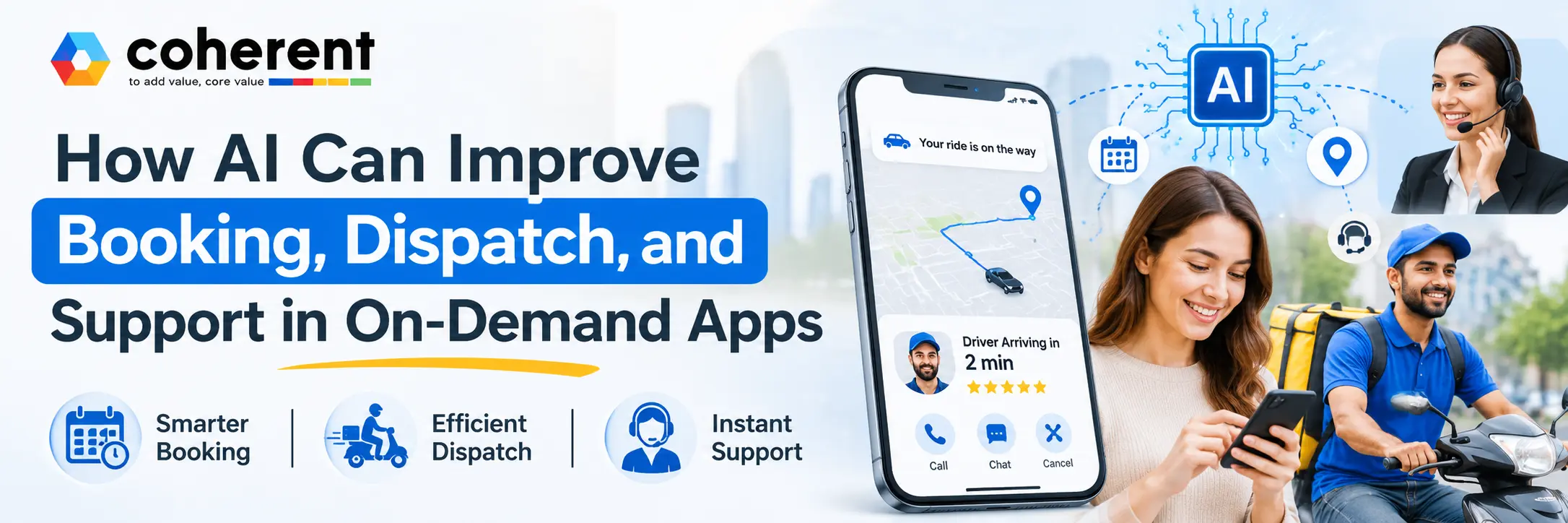
Customers using on-demand applications expect quick bookings, reliable service providers, accurate arrival times, and immediate assistance when something goes wrong. Managing these expectations becomes challenging as an application grows and handles more orders, service requests, and customer interactions.Artificial Intelligence (AI) helps businesses simplify these operations by automating bookings, intelligently assigning service providers, optimizing delivery routes, and improving customer support. I
nstead of relying entirely on manual processes, businesses can use AI-powered on-demand applications to make faster decisions, reduce operational delays, and deliver more personalized customer experiences.For example, a food delivery application can predict order demand, recommend available delivery partners, and provide automated order updates. Similarly, a home-service platform can match customers with suitable professionals based on location, availability, skills, and service requirements.Let's explore how AI can improve booking, dispatch, and support in on-demand apps and what businesses should consider when implementing these capabilities.
What Is the Role of AI in On-Demand Apps?
AI in on-demand apps refers to using technologies such as machine learning, predictive analytics, Natural Language Processing (NLP), and intelligent automation to improve how applications operate. These technologies help applications process information, identify patterns, make recommendations, and automate repetitive tasks. Businesses can leverage these capabilities through professional Mobile App Development Services to build smarter applications, streamline service operations, and deliver better customer experiences.
- Recommend providers based on location, skills, and availability.
- Estimate the expected service arrival time.
- Send booking confirmations and reminders.
- Answer customer questions through an AI chatbot.
How Can AI Improve Booking in On-Demand Apps?
AI improves the booking process by reducing manual steps, checking availability, recommending suitable time slots, and helping customers complete reservations more easily. Traditional booking systems generally depend on predefined schedules and manual availability updates. AI-powered booking systems can use historical booking information, current availability, customer preferences, and demand patterns to make more informed recommendations. Businesses can partner with an experienced AI App Development Company to integrate intelligent booking features, automate scheduling, and create more convenient customer experiences.
1. Smart Appointment Scheduling
AI can analyze provider availability, service duration, customer preferences, and existing appointments to recommend suitable booking slots.For example, a customer using a salon booking application may want an appointment on Saturday afternoon. Instead of browsing multiple service providers manually, the application can recommend salons with suitable availability and preferred services.
- Manage overlapping service requests.
- Send automatic booking reminders.
- Handle rescheduling requests.
- Improve provider utilization.
2. Personalized Service Recommendations
AI-powered recommendation systems can analyze previous bookings, frequently selected services, customer preferences, and browsing activity to suggest relevant options.For instance, a customer who regularly books home maintenance services may receive recommendations for related services when they open the application.
- Make booking decisions easier.
- Encourage repeat bookings.
- Promote relevant additional services.
- Create more engaging customer experiences.
3. Predictive Booking and Demand Forecasting
Predictive analytics helps businesses forecast when customers may request specific services. For example, an on-demand taxi application can analyze historical bookings, time of day, location, and external factors to predict peak ride demand. This helps businesses plan driver availability, allocate resources, and reduce customer waiting times.
- Identify high-demand locations.
- Plan staffing requirements.
- Manage appointment capacity.
- Prepare for seasonal demand changes.
4. AI-Powered Booking Assistance
Conversational AI allows customers to book services through natural language instead of navigating multiple screens.An AI assistant can identify the requested service, collect the location and preferred time, check available professionals, and guide the customer through booking confirmation.This makes the booking journey more convenient, especially for customers who prefer conversational interactions.
How Does AI Improve Dispatch Management in On-Demand Apps?
AI improves dispatch management by helping businesses assign service requests, coordinate providers, optimize routes, and manage resources more efficiently. Instead of depending entirely on manual allocation or fixed dispatch rules, AI-powered systems analyze real-time information such as provider availability, location, traffic conditions, workload, and customer requirements. This helps on-demand businesses make faster and more informed dispatch decisions. From matching customers with suitable professionals to predicting delays, AI can improve operational coordination, reduce unnecessary waiting time, and support a more reliable service experience.
1. Intelligent Service Provider Matching
AI-powered dispatch systems can evaluate several factors before assigning a booking to a driver or service professional. Rather than selecting a provider based only on proximity, the system can consider qualifications, availability, workload, and estimated travel time. For example, an on-demand plumbing application can match customers with plumbers based on their service requirements and appointment schedules. This helps businesses improve assignment accuracy while ensuring that customers receive suitable services.
- Current provider location.
- Distance from the pickup or service location.
- Provider availability and current workload.
- Skills, qualifications, and service requirements.
2. Real-Time Dispatch Optimization
Traditional dispatch systems may require administrators to assign orders manually or follow fixed allocation rules. AI-powered dispatch can continuously evaluate new requests and changing operational conditions to recommend suitable assignments. For example, a delivery application receiving several orders simultaneously can analyze available riders, delivery locations, existing assignments, and estimated travel times. This helps businesses coordinate multiple service requests while reducing unnecessary manual intervention and improving overall dispatch efficiency.
- Faster order assignment.
- Better workload distribution.
- Reduced manual intervention.
- More efficient resource utilization.
3. AI-Based Route Optimization
AI-based route optimization helps delivery partners and field-service professionals travel more efficiently between multiple locations. An intelligent routing system can analyze traffic conditions, delivery deadlines, pickup locations, vehicle capacity, and customer time windows to recommend suitable routes. For example, a grocery delivery application handling several orders in the same neighborhood can organize delivery stops more efficiently. This helps businesses reduce unnecessary travel and improve delivery coordination.
- Traffic conditions and estimated travel time.
- Distance between multiple destinations.
- Delivery deadlines and customer time windows.
- Driver working hours and vehicle capacity.
4. Predictive Delay Detection
AI can analyze operational information to identify situations that may cause service delays. For example, traffic congestion, provider location, or an unexpected increase in order volume may indicate that a delivery or appointment could be delayed. The system can flag affected bookings and recommend appropriate actions. This allows businesses to communicate potential delays earlier, manage customer expectations, and make operational adjustments before minor disruptions become larger service problems.
- Update estimated arrival times.
- Notify customers about potential delays.
- Suggest alternative available providers.
- Alert dispatch managers about operational issues.
5. Dynamic Resource Allocation
AI can help businesses distribute available resources according to changing customer demand. For example, an on-demand transportation platform may experience higher ride requests in specific locations during morning and evening commuting periods. Predictive demand analysis can identify these patterns and help operations teams determine where additional drivers or service professionals may be needed. This supports better resource planning, reduces uneven workloads, and helps businesses respond to changing demand without depending entirely on manual monitoring.
- Identify locations with increasing service demand.
- Predict peak booking periods.
- Allocate drivers and professionals more effectively.
- Balance provider availability with customer requests.
How Can AI Improve Customer Support in On-Demand Apps?
AI improves customer support in on-demand apps by automating common inquiries, providing real-time booking updates, managing complaints, and helping customers find solutions faster. Instead of depending entirely on support representatives, businesses can use AI-powered chatbots, Natural Language Processing (NLP), and sentiment analysis to handle repetitive customer interactions. These technologies can improve response times and make support more accessible. However, human assistance remains important for sensitive complaints, payment disputes, complicated refunds, and situations requiring personal judgment.
1. AI Chatbots for Instant Customer Assistance
AI chatbots can respond to frequently asked questions and guide customers through common application activities. For example, a customer using a food delivery application may ask, "Where is my order?" The chatbot can retrieve the relevant order status from the application backend and provide an updated response. This reduces the need for customers to contact support representatives for routine information and makes assistance available beyond standard business hours.
- Provide real-time order tracking information.
- Confirm bookings and service requests.
- Assist with cancellation and refund inquiries.
- Answer payment, account, and service availability questions.
2. Natural Language Processing for Better Conversations
Natural Language Processing (NLP) helps AI systems understand the meaning and intent behind customer messages. Customers may describe the same problem using different words. For example, one person might say, "My driver hasn't arrived," while another may write, "The pickup is taking too long." NLP can recognize that both messages relate to a delayed pickup. This helps support systems understand customer concerns and provide more relevant responses.
- Understand different expressions of the same problem.
- Identify customer intent and relevant keywords.
- Categorize incoming support requests.
- Direct complicated inquiries to the appropriate support team.
3. Automated Complaint and Ticket Management
AI can classify customer complaints and direct them to the appropriate support department. For example, an on-demand application may receive complaints about late deliveries, incorrect orders, payment failures, or provider behavior. AI can identify the general issue, collect relevant details, and create or update a support ticket. This helps businesses organize incoming complaints, prioritize urgent cases, and reduce the administrative workload of customer support teams.
- Identify and categorize customer complaints.
- Collect relevant booking and transaction details.
- Create or update support tickets automatically.
- Prioritize urgent complaints and payment disputes.
4. Sentiment Analysis and Customer Feedback
Sentiment analysis helps businesses understand the general tone of customer feedback across reviews, surveys, and support conversations. For example, AI can identify recurring concerns about late arrivals, poor communication, or service quality. These insights help businesses understand customer expectations and identify areas that need improvement. However, sentiment analysis should be treated as a supporting indicator rather than a definitive judgment about an individual customer or service provider.
- Identify recurring customer complaints.
- Monitor feedback and satisfaction trends.
- Recognize common service-related concerns.
- Identify opportunities to improve provider performance.
5. Smooth Human Agent Handoff
AI should not replace human support in every situation. Some problems require empathy, investigation, judgment, or special authorization, particularly payment disputes, safety incidents, complicated refunds, and serious service complaints. An effective customer support system should recognize when automation is insufficient and transfer the conversation to a human representative. Sharing relevant booking information and previous messages helps the agent understand the issue without making customers explain everything again.
- Recognize issues that require human intervention.
- Transfer conversations to available support representatives.
- Share conversation history and relevant booking details.
- Allow customers to request human assistance.
Also Read:- On-Demand Milk Delivery App Development: Working, Features, Cost
AI Dispatch vs Manual Dispatch: What Is the Difference?
The main difference is how service assignments are evaluated and managed. Traditional dispatch systems generally rely on predefined rules, manual decisions, and basic availability checks to allocate service requests. In contrast, AI-powered dispatch systems analyze real-time data, provider locations, traffic conditions, workloads, and customer requirements to recommend suitable assignments. This helps businesses improve coordination, reduce delays, and use available resources more efficiently.
|
Factor |
Manual Dispatch |
AI-Powered Dispatch |
|---|---|---|
|
Provider Assignment |
Managed by an operator |
Recommended through data-driven matching |
|
Route Planning |
Manual or basic navigation |
Can optimize multiple routes and stops |
|
Workload Distribution |
Depends on operator decisions |
Can consider workload and capacity |
|
Delay Management |
Often reactive |
Can identify potential delays |
|
Scalability |
Requires additional coordination |
Can automate repetitive decisions |
|
Decision Making |
Human-led |
AI-assisted with business-defined rules |
What Are the Main Benefits of AI in On-Demand App Development?
Artificial intelligence helps on-demand applications improve operational efficiency, automate repetitive tasks, and deliver more personalized customer experiences. By integrating AI into booking, dispatch, customer support, and demand forecasting, businesses can manage daily operations more effectively. These capabilities also help service providers make informed decisions, allocate resources, and respond to changing customer requirements. Whether you operate a food delivery platform, taxi booking application, healthcare service, or home service marketplace, AI can support business growth while improving service quality and operational performance.
1. Better Operational Efficiency
AI improves operational efficiency by automating repetitive activities such as booking management, provider matching, order assignments, and customer notifications. Instead of relying entirely on manual coordination, businesses can use intelligent systems to process routine requests and support faster decisions. This allows employees to focus on complex operational tasks while reducing administrative workload and improving service management.
- Automate booking and reservation management.
- Match customers with suitable service providers.
- Send automated booking confirmations and notifications.
- Reduce repetitive administrative tasks.
2. Improved Customer Experience
Customer experience plays an important role in the success of on-demand applications. AI can make applications more convenient by providing personalized recommendations, faster booking confirmations, intelligent assistance, and timely service updates. Understanding customer preferences and previous interactions also helps businesses deliver more relevant experiences and improve customer engagement.
- Provide personalized service recommendations.
- Offer faster booking confirmations and updates.
- Enable AI-powered customer assistance.
- Deliver relevant suggestions based on customer preferences.
3. Reduced Operational Waste
AI-powered optimization can help businesses reduce unnecessary travel, inefficient resource allocation, and scheduling conflicts. By analyzing location information, traffic conditions, service availability, and booking demand, intelligent systems can recommend more efficient operational decisions. This is particularly useful for delivery platforms, transportation applications, and businesses managing multiple service providers.
- Optimize delivery and service routes.
- Reduce unnecessary travel and waiting time.
- Improve provider and vehicle allocation.
- Minimize scheduling conflicts and operational delays.
4. Better Business Decisions
AI-powered analytics helps business owners understand customer behavior, operational performance, and changing market demand. By analyzing booking patterns and historical information, businesses can identify opportunities for improvement and make more informed decisions. These insights also help managers recognize operational problems before they significantly affect customer satisfaction or service delivery.
- Identify popular services and booking trends.
- Analyze customer cancellations and complaints.
- Understand peak demand periods and locations.
- Identify operational delays and improvement opportunities.
5. Improved Business Scalability
As an on-demand application grows, manually managing bookings, service providers, customer requests, and operational activities becomes increasingly challenging. AI automation can help businesses handle larger workloads while reducing dependence on repetitive manual coordination. Combined with scalable infrastructure and effective operational management, AI supports business expansion without requiring administrative resources to increase at the same rate.
- Automate high-volume booking and assignment activities.
- Manage increasing customer service requests.
- Improve resource allocation across multiple locations.
- Support business expansion with intelligent automation.
How to Implement AI in an On-Demand Application
Implementing AI in an on-demand application requires a structured approach that connects business requirements with suitable technologies. Businesses should first identify operational challenges, select relevant AI capabilities, and prepare reliable data before starting integration. The implementation process should also consider backend architecture, security, testing, and ongoing performance monitoring. Instead of introducing multiple AI features simultaneously, prioritize solutions that deliver measurable business value. The following steps explain how to integrate AI into an on-demand application effectively.
Step 1: Identify Operational Challenges
Start by understanding the operational problems affecting your existing application or business model. Identify areas where manual processes create delays, increase administrative workload, or negatively affect customer satisfaction. This evaluation helps determine where AI can deliver practical improvements instead of introducing unnecessary functionality.
Ask questions such as:
- Are customers facing difficulties finding available services?
- Do administrators spend excessive time assigning orders?
- Are delivery partners following inefficient routes?
- Do customers frequently contact support for booking updates?
Step 2: Choose the Right AI Features
AI systems depend on accurate, relevant, and properly organized information to generate useful results. Businesses should review their existing databases and identify the information required for each AI feature. Data quality, consistency, privacy, and security should be considered before training or integrating AI models.
- Customer booking history and preferences.
- Service provider availability and locations.
- Order, payment, and delivery information.
- Customer support tickets and cancellation records.
Step 3: Integrate AI With the Application Backend
AI features must communicate effectively with the application's backend, databases, and external services. Proper integration allows intelligent systems to access authorized information and provide recommendations or automate specific workflows. Businesses should also establish backend validation and permission controls to ensure that important transactions and operational decisions remain secure.
- Connect AI services through backend APIs.
- Integrate databases and cloud infrastructure.
- Connect mapping, location, and notification services.
- Establish secure authorization and transaction validation.
Step 4: Test AI Features Before Launch
Testing helps identify inaccurate recommendations, incorrect responses, scheduling conflicts, and integration problems before customers start using AI-powered functionality. Businesses should evaluate AI performance under different operational conditions and verify that automated workflows behave as expected. Human intervention should remain available when AI cannot handle a request reliably.
- Verify booking and provider assignment accuracy.
- Evaluate route recommendations and chatbot responses.
- Test human escalation and exception handling.
- Assess data security and high-traffic performance.
Step 5: Monitor and Improve Performance
AI implementation requires continuous evaluation after deployment. Businesses should monitor operational metrics, analyze customer feedback, and identify areas where automated processes need improvement. Regular performance reviews help ensure that AI features continue delivering measurable value as booking volumes, customer expectations, and business requirements change.
- Track average booking completion time.
- Monitor provider assignment and arrival rates.
- Measure cancellation and customer satisfaction rates.
- Evaluate chatbot resolution and escalation rates.
Also Read:- On-Demand Logistics App Development: A Useful Guide
Which Types of On-Demand Businesses Can Benefit From AI?
AI-powered features can support several on-demand business models by improving service coordination, customer experiences, and operational efficiency. Whether a business manages food deliveries, transportation, home services, healthcare appointments, or product rentals, AI can help automate repetitive tasks and make informed decisions. From intelligent booking and provider matching to predictive demand analysis and automated customer support, these capabilities help businesses manage growing service requirements and deliver more reliable experiences.
|
Industry |
AI Application |
Business Advantage |
|---|---|---|
|
Food Delivery |
Order prediction and rider dispatch |
Better delivery coordination |
|
Ride-Hailing |
Driver matching and route optimization |
More efficient ride allocation |
|
Home Services |
Professional matching and scheduling |
Better appointment management |
|
Healthcare |
Appointment scheduling and reminders |
Convenient patient booking |
|
Grocery Delivery |
Demand forecasting and delivery routing |
Improved order coordination |
|
Beauty and Salon |
Personalized service recommendations |
Easier appointment discovery |
|
Logistics |
Fleet and shipment optimization |
Better delivery planning |
|
Laundry Services |
Pickup scheduling and order tracking |
Improved service coordination |
Conclusion
AI is changing how on-demand applications manage bookings, dispatch operations, and customer support. From recommending suitable appointment slots to matching delivery partners and answering customer questions, intelligent automation can make everyday business operations more organized and responsive.However, successful AI integration is not about adding as many features as possible. It is about identifying operational challenges and selecting technologies that solve real problems.
Businesses planning to build or upgrade an on-demand application should start with practical capabilities, maintain reliable data, and introduce automation gradually.If you are planning to develop an intelligent, scalable, and customer-focused application, Coherent Lab LLP can help you explore the right technology approach.Ready to build a smarter on-demand application? Connect with our experts to discuss your AI-powered application development requirements.
Frequently Asked Questions (FAQs)
Q1. How Does AI Improve On-Demand Applications?
Ans.AI improves on-demand applications by automating repetitive operations, analyzing customer behavior, optimizing provider assignments, and improving customer support. It can recommend suitable booking slots, predict service demand, and help businesses coordinate deliveries more efficiently. AI-powered chatbots can also handle common customer questions, while predictive analytics helps administrators understand operational trends. The overall benefit depends on the quality of available data, the selected AI technologies, and how effectively these features are integrated into the application.
Q2. How Does AI Help With Booking Management?
Ans.AI helps with booking management by analyzing provider availability, customer preferences, appointment duration, and historical booking patterns. It can recommend suitable time slots, automate reminders, assist with rescheduling, and provide conversational booking support. For example, a home-service application can identify available professionals based on service requirements and location. This reduces the amount of manual coordination required and makes the booking experience more convenient for customers. However, confirmed appointments should always be validated against the application's actual scheduling system.
Q3. Can AI Automatically Assign Orders to Delivery Partners?
Ans.Yes. AI-powered dispatch systems can recommend or automatically assign orders to delivery partners based on factors such as location, availability, workload, vehicle capacity, and estimated travel time. Businesses can configure assignment rules to match their operational requirements. For example, a grocery delivery application can identify eligible riders and recommend the most suitable assignment for a new order. However, businesses should include exception handling and administrator controls for unusual situations, incorrect data, and provider unavailability.
Q4. How Do AI Chatbots Improve Customer Support in On-Demand Apps?
Ans.AI chatbots improve customer support by answering common questions and assisting customers with routine activities. They can provide order updates, explain cancellation policies, help customers check booking status, and collect information about complaints. Natural Language Processing helps these systems understand different ways customers describe their problems. When an issue requires human judgment, the chatbot should transfer the conversation to a support representative with the relevant context. This combination of automation and human assistance creates a more useful support experience.
Q5. Is AI Useful for Small On-Demand Businesses?
Ans.Yes. Small on-demand businesses can benefit from selected AI features without building a complex AI ecosystem. For example, a local salon platform may start with an AI booking assistant, while a small delivery company may prioritize route optimization. Businesses should identify their most time-consuming operational tasks and choose features that address those challenges. Starting with limited integrations also makes it easier to evaluate performance, manage costs, and expand the application when business demand increases.
Q6. What Technologies Are Required to Build AI-Powered On-Demand Apps?
Ans.AI-powered on-demand applications may use machine learning frameworks, natural language processing, predictive analytics, cloud infrastructure, backend APIs, databases, and mapping services. Technologies such as Python and machine learning libraries can support customized AI development, while conversational AI platforms can help build chatbots. Mapping APIs can support location tracking and route optimization. The final technology stack depends on the application's requirements, expected user volume, data availability, and integration needs.
Q7. Can AI Reduce Operational Costs in On-Demand Applications?
Ans.AI can help reduce certain operational costs by improving resource allocation, automating repetitive activities, and supporting more efficient route planning. For example, better dispatch decisions may reduce unnecessary travel, while automated customer support can handle routine inquiries without requiring manual intervention for every request. However, AI also introduces expenses related to development, infrastructure, model usage, and maintenance. Businesses should compare these costs with measurable operational improvements before deciding which features to implement.
Q8. Should Businesses Build Custom AI Features or Use Existing AI APIs?
Ans.The decision depends on business requirements, technical complexity, available data, and long-term product goals. Existing AI APIs can be useful when businesses need standard capabilities such as conversational support or language understanding. Custom AI development may be more suitable when a company needs specialized dispatch logic, proprietary recommendation systems, or business-specific predictive models. A hybrid approach is also possible, combining third-party AI services with custom application logic. Businesses should evaluate integration flexibility, data privacy, performance, and ongoing costs before selecting an approach.

 +91 774-202-1725
 +1 (945) 3387904
 business@coherentlab.com
 +49 15223341304
 UK

