
Table of Contents
AI Game Testing Trends: Automated Playtesting and Simulated Players
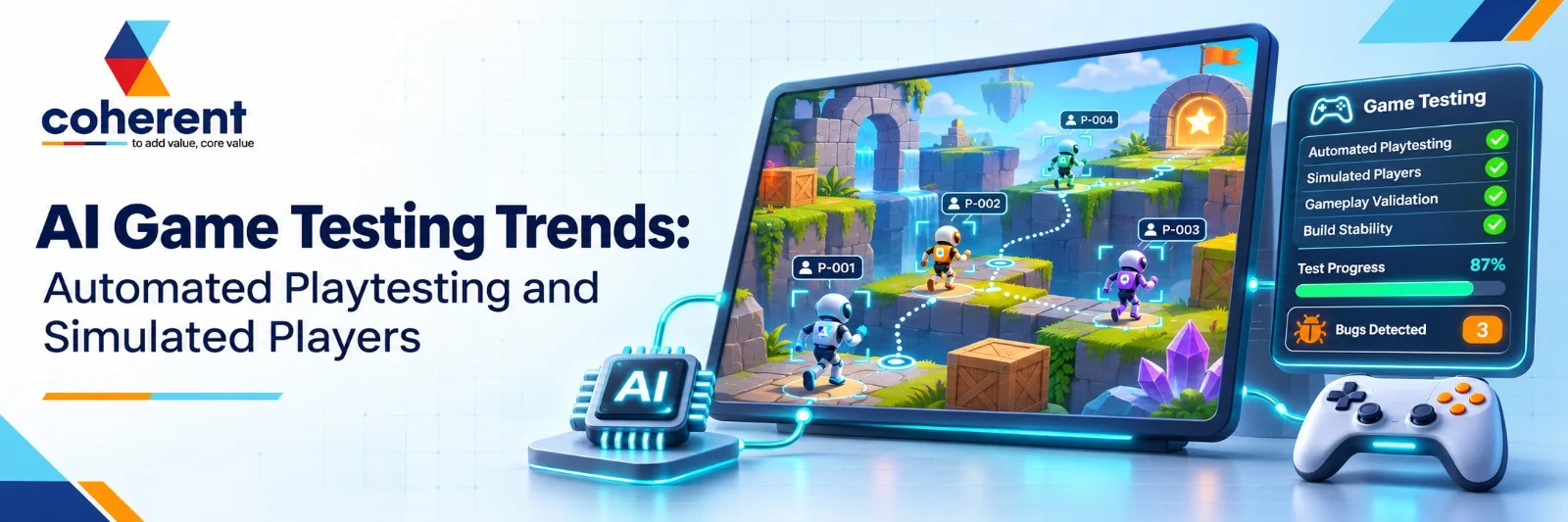
The gaming industry is evolving rapidly as developers introduce more complex gameplay, realistic environments, multiplayer experiences, and AI-powered characters. Traditional game testing methods often require significant time and manual effort to identify bugs, evaluate player interactions, and maintain gameplay quality. As games become more sophisticated, development teams need smarter testing approaches that can evaluate different gameplay scenarios efficiently. AI game testing is emerging as an important solution, helping developers automate repetitive testing activities and improve the overall gaming experience.
Automated playtesting and simulated players are changing how game development companies test their products before release. AI-powered testing systems can simulate player behaviour, explore different game environments, identify unexpected gameplay issues, and evaluate how players interact with game mechanics. These technologies help development teams discover potential problems earlier and make data-driven improvements. Companies such as Coherent Lab can leverage these emerging approaches to support modern game development, improve testing workflows, and build more reliable gaming experiences.
Quick Answer
AI game testing trends involve using artificial intelligence, machine learning, automated playtesting, and simulated players to evaluate video games. These technologies help developers identify bugs, analyse gameplay behaviour, test different scenarios, and improve game performance. AI-driven testing reduces repetitive manual work and supports faster, more comprehensive quality assurance throughout the game development lifecycle.
Key Takeaways
- AI game testing automates repetitive quality assurance activities.
- Automated playtesting helps identify gameplay issues earlier.
- Simulated players reproduce different player behaviours and skill levels.
- Machine learning supports adaptive testing and intelligent bug detection.
- AI-powered NPCs help developers evaluate complex interactions.
- Behaviour analytics provides insights into player engagement and difficulty.
- Future AI testing systems will support more realistic game simulations.
Understanding AI Game Testing and Its Growing Importance
AI game testing uses artificial intelligence technologies to evaluate gameplay, identify technical issues, and analyse player interactions. Unlike traditional testing, which depends heavily on human testers following predefined instructions, AI-driven systems can explore multiple scenarios and adapt their testing behaviour. This approach is becoming increasingly valuable as modern games introduce open-world environments, advanced physics, multiplayer functionality, and complex decision-making systems. AI helps development teams evaluate these elements more systematically while reducing repetitive testing activities. Businesses planning such projects should also consider AI Game Development Cost in 2027, including development complexity, AI integration, testing tools, and infrastructure requirements.
How AI Is Transforming Traditional Game Testing
Artificial intelligence is transforming traditional game testing by automating repetitive testing activities, identifying gameplay issues, and improving quality assurance processes. Unlike manual testing, AI-powered systems can evaluate multiple gameplay scenarios, analyse player interactions, and detect unexpected behaviour.
Key Points:
- Automated Bug Detection: Identifies gameplay errors, glitches, and unexpected behaviour.
- Intelligent Test Execution: Automatically performs repetitive gameplay testing scenarios.
- Player Behaviour Analysis: Evaluates different player actions and interaction patterns.
- Performance Monitoring: Detects frame rate drops, crashes, and performance issues.
- Improved Test Coverage: Tests multiple gameplay conditions and scenarios.
- Faster Quality Assurance: Reduces manual effort and supports quicker development cycles.
Step-by-Step Process for Implementing AI Game Testing
Implementing AI game testing requires a clear strategy that connects testing objectives with suitable AI technologies. Development teams should begin with specific requirements and gradually introduce automation into their quality assurance workflows.Coherent Lab highlights the importance of adopting a structured approach to make AI-powered game testing more effective and reliable.
|
|
|
|
|
|
|
|
|
|
|
|
|
|
|
|
|
|
|
|
|
|
|
|
|
|
|
|
|
|
|
|
|
|
|
Step 1: Identify Game Testing Requirements
Identify the key areas that need testing to ensure smooth gameplay. Focus on important game functions, player interactions, and performance.
- Gameplay mechanics
- Character movements
- Multiplayer interactions
Step 2: Select Suitable AI Testing Technologies
Choose AI technologies that match your game's testing requirements. These tools help automate testing and improve issue detection.
- Machine learning tools
- Computer vision systems
- Reinforcement learning
Step 3: Develop AI Testing Agents
Create AI-powered agents that can perform gameplay actions automatically. Configure them to test different scenarios and identify potential issues.
- Define agent objectives
- Configure testing actions
- Set decision-making rules
Step 4: Create Simulated Player Profiles
Develop virtual player profiles to represent different gaming styles and skill levels. This helps evaluate how different users experience the game.
- Beginner player models
- Experienced player models
- Competitive player models
Step 5: Execute Automated Playtesting
Run automated gameplay sessions using AI agents and simulated players. Monitor their actions to detect bugs and performance issues.
- Run gameplay scenarios
- Detect bugs and glitches
- Record testing results
Step 6: Analyse Results and Improve Gameplay
Evaluate testing reports to understand gameplay problems and technical errors. Use the findings to improve game quality and repeat testing.
- Review testing reports
- Fix identified issues
- Repeat regression testing
Automated Playtesting: The Future of Game Quality Assurance
Automated playtesting uses AI-powered agents, scripts, and testing frameworks to play through different sections of a video game without requiring continuous human involvement. These systems can complete objectives, explore environments, interact with objects, and evaluate gameplay mechanics. By automating repetitive testing activities, development teams can identify issues before they affect the final gaming experience. AI Game Development Services can also help businesses integrate intelligent testing solutions into their game development workflows.
How Automated Playtesting Works
Automated playtesting follows a structured process in which AI agents interact with the game and collect performance information.
- Game Environment Analysis: The testing system identifies available gameplay elements.
- Action Execution: AI agents perform movements, interactions, and objectives.
- Scenario Repetition: Different gameplay conditions are tested.
- Issue Identification: Unexpected results and technical problems are recorded.
- Testing Reports: Results are shared with developers for further investigation.
Conclusion
AI game testing is transforming how developers evaluate gameplay, identify bugs, and improve gaming experiences. Automated playtesting, simulated players, reinforcement learning, and computer vision are helping development teams explore more scenarios and reduce repetitive quality assurance activities.
As gaming environments become more interactive and complex, AI-driven testing will become an increasingly valuable part of modern development workflows. However, automation should complement rather than completely replace human testers. Combining intelligent testing agents with human feedback can help developers build more balanced, reliable, and engaging games. Businesses exploring advanced gaming solutions can work with technology partners such as Coherent Lab to evaluate suitable development approaches and emerging AI capabilities. Connect with our experts
Frequently Asked Questions
Q1. What is AI game testing, and how does it work?
Ans.AI game testing is the process of using artificial intelligence, machine learning, and automated testing systems to evaluate video games. It works by deploying intelligent agents that interact with game environments, perform different actions, complete objectives, and identify unexpected behaviour. These systems can analyse gameplay mechanics, detect bugs, monitor performance, and generate testing reports. Developers use the collected information to identify problems and improve game quality. AI game testing can also support regression testing, multiplayer scenario evaluation, and gameplay balancing. It helps reduce repetitive manual testing while allowing human testers to concentrate on creativity, usability, and overall player experience.
Q2. How does automated playtesting improve video game development?
Ans.Automated playtesting improves video game development by allowing AI-powered agents to perform repetitive gameplay activities without requiring continuous human involvement. These agents can explore different environments, test character movements, interact with objects, and complete specific game objectives. Developers can use automated playtesting to identify bugs, evaluate gameplay mechanics, and check whether updates introduce new problems. It also supports repeated testing under different conditions, improving consistency and scenario coverage. By reducing repetitive work, automated playtesting allows quality assurance teams to spend more time evaluating complex gameplay situations and improving the overall gaming experience.
Q3. What are simulated players in AI game testing?
Ans.Simulated players are artificial intelligence agents designed to imitate different types of human gaming behaviour. They can represent beginners, experienced players, aggressive competitors, strategic decision-makers, and exploration-focused users. Developers use these agents to understand how different playing styles affect game mechanics, difficulty, progression, and multiplayer interactions. For example, simulated players can test whether a particular weapon provides an unfair advantage or whether a game level is too difficult for inexperienced users. They can also explore unusual gameplay strategies that developers may not discover through predefined manual test cases. This makes simulated players valuable for balancing and evaluating complex games.
Q4. Which AI technologies are used for automated game testing?
Ans.Several AI technologies support automated game testing, including machine learning, reinforcement learning, computer vision, natural language processing, and behavioural simulation. Machine learning helps identify patterns in gameplay data and recognise unusual behaviour. Reinforcement learning trains agents to make decisions through rewards and feedback. Computer vision analyses screenshots, animations, and graphical elements to detect visual defects. Natural language processing helps evaluate dialogue systems, text interactions, and conversational NPCs. Behavioural simulation allows developers to reproduce different player strategies. These technologies can be combined to create testing systems that evaluate technical performance, gameplay mechanics, and interactive experiences.
Q5. Can AI replace human game testers completely?
Ans.No, AI cannot completely replace human game testers because both approaches evaluate different aspects of gaming quality. AI systems are effective at repetitive testing, identifying technical errors, executing predefined scenarios, and analysing large amounts of gameplay data. However, human testers are better equipped to evaluate enjoyment, storytelling, emotional engagement, accessibility, creativity, and subjective gameplay experiences. Human players can also discover unexpected problems through spontaneous interactions. The most effective approach combines automated testing with human evaluation. AI handles repetitive and measurable activities, while professional testers assess whether the game feels enjoyable, intuitive, balanced, and engaging.
Q6. What are the major benefits of using simulated players in multiplayer games?
Ans.Simulated players help multiplayer developers evaluate different competitive situations without depending entirely on large groups of human participants. They can represent different skill levels, strategies, reaction patterns, and playing styles. Developers can use these agents to examine matchmaking balance, weapon effectiveness, character abilities, team coordination, and competitive progression. Simulated players can also help reproduce unusual multiplayer situations that may be difficult to arrange through manual testing. By running multiple scenarios, development teams can identify gameplay imbalances and improve competitive fairness. However, simulated results should be validated with real-player testing to ensure that they accurately reflect actual multiplayer experiences.
Q7. How much does AI game testing cost for a gaming company?
Ans.The cost of AI game testing varies according to the game's complexity, testing requirements, development environment, automation level, and infrastructure. Basic automated testing for a small mobile game may require fewer resources than developing advanced simulated players for a large multiplayer or open-world game. Custom AI agent development, model training, cloud infrastructure, data preparation, and integration with existing development pipelines can also influence the overall investment. Businesses should first identify their most important testing requirements and automate high-priority activities. A phased implementation can help control costs while allowing development teams to measure improvements in testing coverage, defect detection, and execution time.
Q8. What are the future trends in AI game testing for 2026–2027?
Ans.The future of AI game testing will likely involve autonomous testing agents, more realistic simulated players, generative AI test-case creation, predictive analytics, and cloud-based testing infrastructure. Reinforcement learning will help AI agents improve their gameplay strategies, while behavioural models will support more diverse player simulations. Generative AI may also help create test scenarios and analyse testing reports. Another important development will be the integration of automated quality assurance with continuous integration and deployment pipelines. These advancements can help developers evaluate frequent game updates more efficiently. Nevertheless, human testing will remain important for assessing creativity, emotional engagement, accessibility, and player satisfaction.

 +91 774-202-1725
 +1 (945) 3387904
 business@coherentlab.com
 +49 15223341304
 UK

