
Table of Contents
TinyML and On-Device Intelligence Trends for Connected Products
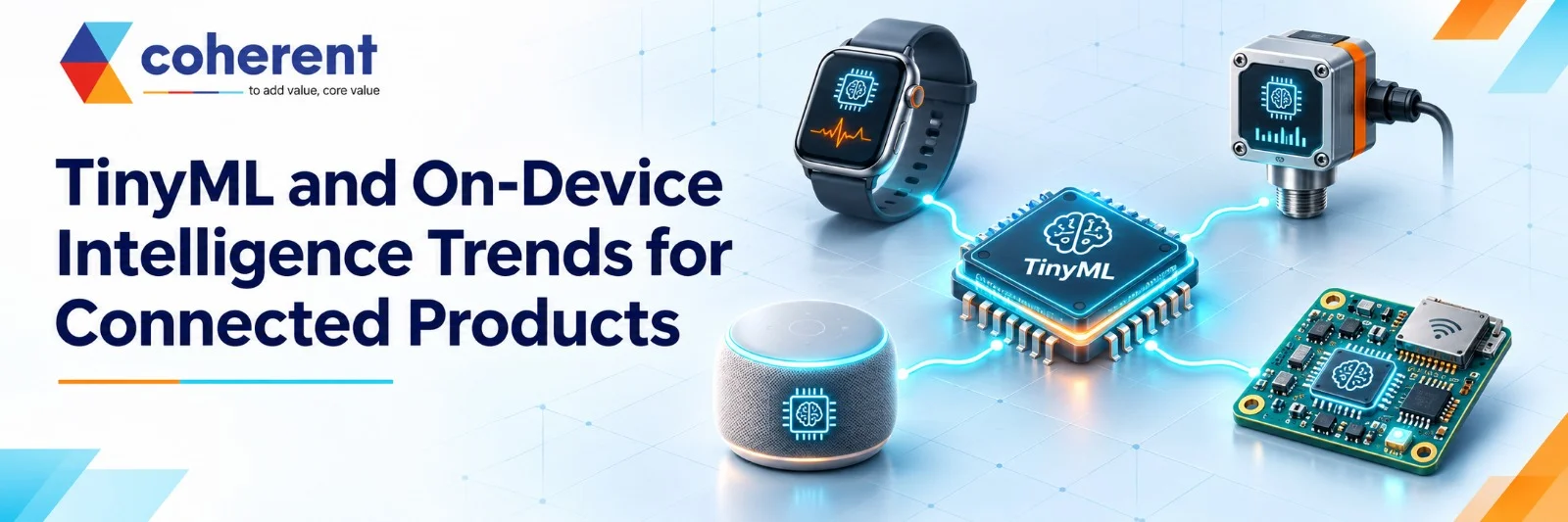
TinyML and on-device intelligence are transforming how connected products collect, process, and respond to data. Traditional IoT devices often depend on cloud computing to analyze information and make decisions. However, TinyML allows machine learning models to run directly on resource-constrained devices such as sensors, wearables, smart appliances, and industrial equipment. This approach enables faster processing, lower latency, reduced bandwidth consumption, and improved data privacy.
As businesses increasingly adopt intelligent connected products, on-device AI is becoming an important part of modern product development. From predictive maintenance and voice recognition to smart home automation and real-time monitoring, TinyML makes connected devices more responsive and efficient. This blog explores the latest TinyML trends, practical applications, benefits, challenges, implementation processes, and future developments shaping connected products in 2026–2027.
Quick Answer
TinyML is a technology that enables machine learning models to operate directly on small, low-power devices with limited memory and processing capabilities. On-device intelligence allows connected products to analyze data locally, make real-time decisions, and perform intelligent tasks without continuously depending on cloud servers. Together, these technologies improve responsiveness, privacy, energy efficiency, and reliability across IoT ecosystems.
Key Takeaways
- TinyML enables machine learning directly on resource-constrained devices.
- On-device intelligence reduces dependence on cloud-based processing.
- Connected products benefit from faster responses and lower latency.
- Edge AI improves data privacy by processing information locally.
- TinyML supports predictive maintenance and intelligent automation.
- Model optimization helps reduce memory and power consumption.
What Is TinyML and How Does It Work?
TinyML (Tiny Machine Learning) is a technology that enables machine learning models to run directly on small, low-power devices such as microcontrollers, sensors, and embedded systems. Instead of sending all collected data to cloud servers, TinyML processes information locally and generates real-time insights. It helps connected products perform intelligent tasks while reducing latency, bandwidth usage, and power consumption. Understanding How to Build an IoT App also involves exploring how TinyML can make connected devices smarter, faster, and more efficient.
Key Components and Working Process:
- Data Collection: Sensors collect information such as temperature, movement, sound, and vibration.
- Data Processing: The device prepares and processes collected information locally.
- Machine Learning Models: Lightweight AI models analyze data and identify patterns.
- Local Inference: The device generates predictions or decisions without continuous cloud communication.
- Automated Actions: Connected products respond to detected conditions through alerts, adjustments, or automated operations.
- Low-Power Computing: Optimized models operate within limited memory, processing, and battery resources.
Latest TinyML and On-Device Intelligence Trends in 2026–2027
TinyML innovation is expanding beyond basic sensor monitoring into advanced connected product intelligence. Businesses are adopting smaller AI models, energy-efficient processors, federated learning, and intelligent edge computing to improve device performance. These developments are creating opportunities for smarter wearables, industrial IoT equipment, connected healthcare products, and smart home systems that deliver faster and more personalized experiences. Coherent Lab recognizes the growing importance of these innovations in shaping the future of intelligent connected products.
|
|
|
|
|
|
|
|
|
|
|
|
|
|
|
|
|
|
|
|
|
|
|
|
|
|
|
|
|
|
1. AI Models Becoming Smaller and More Efficient
Lightweight AI models help connected devices perform machine learning tasks using limited memory, processing power, and energy. Model optimization makes TinyML more practical for embedded applications.
- Model Quantization: Reduces model size.
- Model Pruning: Removes unnecessary parameters.
- Knowledge Distillation: Creates smaller AI models.
2. Growth of Edge AI and Local Processing
Edge AI enables connected products to process information near the data source. It reduces cloud dependency and supports faster decisions across IoT devices and embedded systems.
- Real-Time Inference: Enables instant decisions.
- Reduced Cloud Dependency: Minimizes data transfers.
- Distributed Intelligence: Shares processing across devices.
3. Federated Learning for Connected Products
Federated learning allows multiple connected devices to contribute to model training without directly sharing their raw data. It supports collaborative learning while helping protect sensitive information.
- Decentralized Training: Trains across devices.
- Data Privacy: Keeps raw data local.
- Collaborative Learning: Shares model updates.
4. Low-Power AI Hardware and Microcontrollers
Advanced microcontrollers and energy-efficient processors make it easier to run machine learning models on compact connected products. These hardware improvements support intelligent features in battery-powered devices.
- AI Microcontrollers: Support embedded ML.
- Energy Efficiency: Reduces power usage.
- Hardware Acceleration: Speeds up inference.
5. Generative AI at the Edge
Compact generative AI models are bringing intelligent communication and content generation closer to connected devices. This trend supports responsive voice assistants and context-aware interactions with reduced cloud dependency.
- Compact Language Models: Run lightweight AI locally.
- Local Voice Assistants: Enable faster responses.
- Context Awareness: Understands device surroundings.
Statistics and Market Insights: TinyML and Edge AI
Market research helps businesses understand the growing role of edge computing, artificial intelligence, and connected devices. TinyML is part of this broader technology ecosystem, where demand for low-latency processing, privacy-focused computing, and intelligent automation is increasing. These developments are also influencing IoT & Smart-Connected Apps, enabling businesses to explore new opportunities in intelligent and connected solutions. When evaluating market opportunities, businesses should distinguish between the overall edge AI market and the smaller, specialized TinyML segment.
Suggested research points:
- Global edge AI market growth and forecasts.
- Increasing adoption of connected IoT devices.
- Demand for low-power machine learning hardware.
- Enterprise investment in edge computing infrastructure.
- Growth of embedded AI across industrial applications.
Real-World Applications of TinyML in Connected Products
TinyML is creating practical opportunities across consumer electronics, healthcare, manufacturing, automotive systems, and smart infrastructure. By processing sensor information locally, connected products can recognize patterns, detect unusual activities, and respond automatically. These applications help businesses improve operational efficiency, reduce response times, enhance product functionality, and deliver intelligent experiences without requiring constant cloud connectivity. When planning such solutions, businesses should also consider IoT App Development Cost, including device integration, AI model development, and ongoing maintenance.
1. TinyML in Smart Home Devices
TinyML makes smart home products more intelligent by processing sensor data locally. It enables connected appliances to recognize activities, automate operations, and respond quickly to user requirements.
- Smart Lighting: Detects room occupancy.
- Smart Thermostats: Adjusts room temperature.
- Voice Recognition: Processes basic voice commands.
2. TinyML in Wearable Technology
Wearable devices use TinyML to analyze movement, activity, and sensor data directly on the device. This supports real-time monitoring while reducing cloud communication and battery consumption.
- Activity Recognition: Tracks physical movements.
- Sleep Monitoring: Analyzes sleep patterns.
- Gesture Detection: Recognizes hand movements.
3. TinyML in Industrial IoT
TinyML helps industrial equipment monitor operating conditions and identify unusual patterns. It supports predictive maintenance, improves operational efficiency, and enables faster responses to potential equipment problems.
- Predictive Maintenance: Detects equipment abnormalities.
- Vibration Analysis: Identifies unusual machine movements.
- Fault Detection: Recognizes operational issues.
4. TinyML in Healthcare Devices
TinyML enables healthcare-related connected devices to process sensor information locally. It supports continuous monitoring, activity recognition, and faster analysis while helping minimize unnecessary transmission of sensitive data.
- Health Monitoring: Analyzes sensor readings.
- Movement Tracking: Detects physical activities.
- Remote Monitoring: Supports connected health devices.
Conclusion
TinyML and on-device intelligence are changing how businesses design and develop connected products. By bringing machine learning directly to embedded devices, organizations can improve processing speed, reduce cloud dependency, strengthen data privacy, and support real-time automation. From industrial IoT and wearable technology to smart home appliances, these capabilities are creating new opportunities for intelligent product development.
As hardware becomes more efficient and machine learning models become smaller, TinyML adoption is expected to expand further in 2026–2027. Businesses that invest in optimized models, secure architectures, and reliable embedded systems can build smarter connected products that deliver better performance and long-term value. Connect with our experts
Frequently Asked Questions
Q1. What is TinyML in connected products?
Ans.TinyML is the implementation of machine learning models on small, low-power devices such as microcontrollers, sensors, and embedded systems. It allows connected products to analyze information and make predictions locally without sending every data request to cloud servers. For example, a smart home device can recognize voice commands, while an industrial sensor can detect unusual machine vibrations. TinyML helps improve response times, reduce network usage, and support intelligent functionality in products with limited memory, processing power, and battery capacity.
Q2. How does on-device intelligence improve IoT performance?
Ans.On-device intelligence improves IoT performance by allowing connected devices to process information and make decisions locally. Instead of transferring all collected data to cloud servers, devices can analyze sensor readings directly on their hardware. This reduces communication delays, lowers bandwidth consumption, and supports faster responses. It also allows certain device functions to continue when internet connectivity is unavailable. Businesses can use on-device intelligence for predictive maintenance, smart automation, anomaly detection, and real-time monitoring across connected product ecosystems.
Q3. What is the difference between TinyML and Edge AI?
Ans.TinyML focuses on running lightweight machine learning models on resource-constrained devices, particularly microcontrollers and low-power embedded hardware. Edge AI is a broader concept that involves processing artificial intelligence workloads closer to where data is generated. Edge AI can operate on powerful gateways, industrial computers, smartphones, and embedded devices. TinyML can be considered part of the wider edge AI ecosystem, with a particular emphasis on small models, limited memory, low processing requirements, and energy-efficient operation.
Q4. Which industries benefit most from TinyML technology?
Ans.TinyML offers significant opportunities in manufacturing, healthcare, automotive, consumer electronics, agriculture, and smart home technology. Manufacturing companies can use it to detect equipment abnormalities and support predictive maintenance. Healthcare devices can process sensor information locally for activity monitoring and other supported functions. Automotive applications can use embedded intelligence for vehicle monitoring and safety-related detection. Agriculture systems can analyze environmental sensor readings to support irrigation decisions. Its usefulness depends on the application's processing requirements, hardware limitations, accuracy needs, and operating environment.
Q5. What hardware is required to run TinyML models?
Ans.TinyML models typically operate on microcontrollers, embedded processors, and low-power development boards. Common development platforms include Arduino-compatible boards, ESP32 devices, and supported microcontroller platforms from semiconductor manufacturers. Hardware selection depends on available RAM, flash storage, processing speed, power consumption, sensor compatibility, and model complexity. Some applications may also require dedicated accelerators for efficient inference. Developers should evaluate hardware specifications alongside model requirements before selecting a platform for a connected product.
Q6. How much does TinyML development cost for connected products?
Ans.TinyML development costs depend on product complexity, hardware requirements, machine learning model development, sensor integration, software engineering, and testing. A basic sensor-based prototype generally requires fewer development resources than an industrial monitoring solution involving multiple sensors, advanced anomaly detection, and extensive deployment requirements. Additional expenses may include hardware procurement, firmware development, security implementation, and ongoing maintenance. Businesses should define product requirements, estimate development stages, and prepare a project-specific budget instead of relying on a single standard TinyML development price.
Q7. Is TinyML better than cloud-based machine learning?
Ans.TinyML is not necessarily better than cloud-based machine learning because both approaches address different requirements. TinyML is useful when applications need low latency, local processing, reduced bandwidth consumption, or offline functionality. Cloud-based machine learning is more suitable for computationally intensive workloads, centralized data analysis, and large-scale model training. Many connected products benefit from a hybrid architecture that combines local inference with cloud-based analytics and model management. The right approach depends on product functionality, hardware capabilities, connectivity, privacy, and scalability requirements.
Q8. What are the future trends of TinyML and on-device intelligence?
Ans.Future TinyML developments will likely focus on smaller machine learning models, more efficient AI-enabled microcontrollers, federated learning, and improved hardware acceleration. Connected products are also expected to adopt more advanced local intelligence for predictive maintenance, voice recognition, environmental monitoring, and automated decision-making. Integration with edge computing and 5G networks can further improve connected product ecosystems. During 2026–2027, businesses should pay attention to model optimization, privacy-preserving AI, energy-efficient hardware, and secure device management as important areas of development

 +91 774-202-1725
 +1 (945) 3387904
 business@coherentlab.com
 +49 15223341304
 UK

