
Table of Contents
B2B eCommerce Platform Development in 2026: Key Features, Benefits, Costs, and Challenges
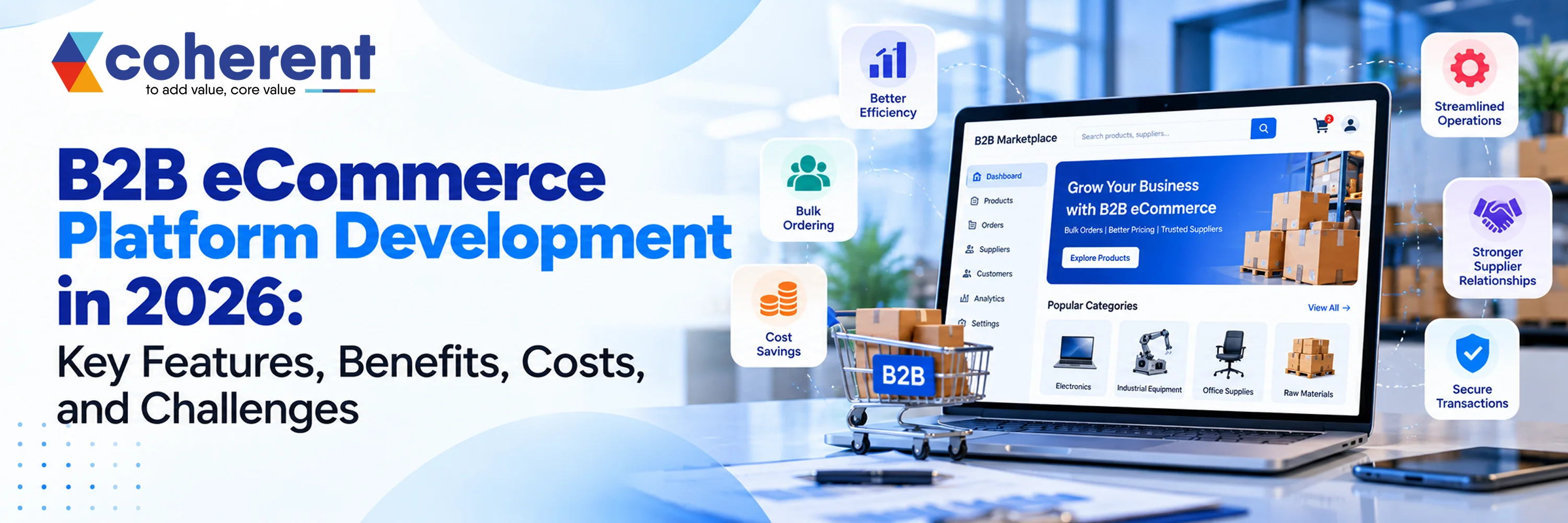
B2B eCommerce platform development has become an important investment for businesses that want to modernize sales, simplify purchasing, and serve customers more efficiently. Manufacturers, wholesalers, distributors, and technology providers are moving beyond traditional ordering methods toward digital platforms that support bulk purchases, negotiated pricing, customer accounts, and automated order processing.
In 2026, business buyers expect the same convenience they experience when shopping online as consumers. They want accurate product information, transparent order status, personalized pricing, and reliable self-service options. Meeting these expectations requires more than a basic online store. Businesses need connected systems that integrate sales, inventory, payments, and customer management.
Quick Answer
B2B eCommerce platform development is the process of creating an online system through which businesses sell products or services to other businesses. Technology partners such as Coherent Lab can help businesses explore custom software solutions tailored to their operational needs. These platforms support features such as bulk ordering, negotiated pricing, company accounts, quotations, business payments, and software integrations, helping organizations streamline transactions, improve buyer experiences, and scale digital sales operations.
Key Takeaways
- Business-specific functionality: Support negotiated pricing, bulk orders, purchase orders, and approval workflows.
- Connected business systems: Integrate ERP, CRM, inventory, accounting, and payment solutions.
- Improved customer experience: Offer self-service purchasing, accurate product information, and convenient reordering.
- Flexible development investment: Costs depend on customization, platform selection, integrations, and complexity.
- Security and scalability: Plan for data protection, system reliability, and increasing order volumes.
- AI-driven commerce: Explore intelligent search, recommendations, and workflow automation where they deliver measurable value.
- Continuous improvement: Use analytics and customer feedback to refine the platform after launch.
Statistics and Market Insights Shaping B2B eCommerce in 2026
B2B digital commerce is becoming a central part of business sales strategies as organizations invest in online ordering, connected operations, and personalized buyer experiences. Market research helps businesses understand these changes, while top B2B platforms for developers & tech partners enable organizations to discover, evaluate, and compare technology providers. Statistics should be interpreted carefully because reports may measure different markets, company sizes, and sales channels. For decision-makers, the priority is translating market trends into practical technology investments and measurable business outcomes.
B2B eCommerce Adoption and Digital Sales
The 2024 B2B Pulse Survey from McKinsey & Company reported that e-commerce had become a leading revenue-generating channel among surveyed B2B organizations. Its findings highlighted the importance of providing buyers with effective digital purchasing options alongside sales representatives and other channels. Source: McKinsey, B2B Pulse Survey.
AI Adoption and Product Data Quality
AI is creating opportunities for intelligent product discovery, customer support, demand forecasting, and sales automation. However, useful AI features depend on accurate product specifications, current inventory information, and reliable customer records. Businesses should improve data quality before deploying AI features that influence purchasing decisions.
What These Market Trends Mean for Businesses
- Review how customers currently place and manage orders.
- Identify repetitive tasks suitable for automation.
- Improve product information and system integration.
- Measure digital revenue, customer retention, and ordering efficiency.
- Validate market statistics against current industry reports before using them in business decisions.
What Is B2B eCommerce Platform Development, and Why Does It Matter in 2026?
B2B eCommerce platform development involves designing, building, and maintaining digital commerce systems for transactions between businesses. Unlike consumer-focused online stores, these platforms must accommodate larger orders, negotiated contracts, multiple purchasing users, and complex approval processes. A manufacturer, for example, can provide distributors with customer-specific catalogs, agreed prices, inventory information, and online ordering through one centralized portal
How B2B eCommerce Differs From B2C
B2C platforms generally serve individual consumers, while B2B platforms support organizational purchasing and longer commercial relationships. Business buyers may require quotations, credit terms, purchase approvals, and repeat ordering rather than a simple checkout.
Key differences include:
- Pricing: Contract rates, customer-specific discounts, and volume-based pricing.
- Ordering: Bulk purchases, minimum quantities, and recurring orders.
- Payments: Purchase orders, invoicing, and approved credit terms.
- Account management: Multiple users with different permissions.
- Sales workflows: Quotations, negotiations, and approval processes.
Why Businesses Are Investing in Digital Commerce
Digital purchasing gives customers convenient access to products and ordering tools while reducing dependence on manual sales administration. It also connects sales, operations, and customer service through shared information, making it easier to manage orders and identify opportunities for growth.
Essential Features of a Modern B2B eCommerce Platform
A successful B2B eCommerce platform must support the commercial processes that make business purchasing different from consumer shopping. Account-based pricing, bulk ordering, quotations, flexible payments, and accurate inventory information are essential for many organizations. Businesses exploring digital commerce solutions can also evaluate ecommerce app development companies in India to identify suitable technology partners based on their industry, customer requirements, and operational complexity rather than adding features without a clear purpose.
Account Management and Customer-Specific Pricing
B2B platforms support company accounts, role-based access, personalized product catalogs, and customer-specific pricing. These features ensure buyers access the correct products, negotiated rates, and purchasing permissions. They are especially valuable for manufacturers and distributors managing multiple business customers.
Bulk Ordering and Quotation Management
Bulk ordering and quotation tools simplify large purchases and negotiated transactions. Buyers can quickly add multiple products, request pricing, and repeat previous orders. These capabilities reduce manual work, improve purchasing efficiency, and help sales teams manage wholesale orders.
Payment, Checkout, and Order Management
B2B checkout systems support purchase orders, credit terms, invoices, and online payments. Buyers can review order histories, track shipments, download invoices, and manage returns. These features improve transaction transparency, simplify purchasing, and reduce routine customer service requests.
ERP, CRM, Inventory, and AI Integrations
Integrating ERP, CRM, and inventory systems synchronizes product prices, stock levels, customer records, and orders. AI-powered search and recommendations help buyers discover relevant products faster. Accurate, regularly updated data ensures consistent information across connected business systems.
Benefits of B2B eCommerce Platform Development
B2B eCommerce development can transform how businesses manage sales, serve customers, and coordinate daily operations. By moving repetitive tasks into connected digital workflows, organizations can reduce manual administration and make purchasing more convenient. Following a business website cost guide can also help decision-makers estimate development expenses, plan budgets, and prioritize essential features. The value extends beyond online transactions: a well-integrated platform can improve visibility across departments, support customer retention, and create a foundation for sustainable digital growth.
Improved Sales and Operational Efficiency
Automating routine order entry, invoice generation, and quotation processes can reduce administrative workload and help limit manual errors. Sales representatives gain more time to develop customer relationships, discuss complex requirements, and pursue new business opportunities rather than repeatedly handling routine transactions.
Better Customer Experience and Self-Service
Customers can access relevant catalogs, review their prices, place orders, and track shipments without waiting for assistance. A well-designed self-service portal makes repeat purchases easier and gives business buyers greater control over their purchasing activities.
Scalability and Wider Market Reach
A scalable platform can accommodate growing product catalogs, additional customer accounts, and increasing order volumes. Businesses may also expand into new regions or introduce additional sales channels without rebuilding every part of their commerce operation.
Data-Driven Business Decisions
Commerce analytics reveal purchasing patterns, popular products, abandoned carts, and repeat-order behavior. Businesses can use these insights to improve inventory planning, identify cross-selling opportunities, prioritize sales activities, and make more informed commercial decisions.
Challenges in B2B eCommerce Platform Development
Building a B2B eCommerce platform requires careful planning beyond website design and software development. Businesses must manage complex pricing structures, legacy system integrations, data security, and changing customer expectations. Integrating B2B Mobile App Development into the digital commerce strategy can help businesses provide convenient ordering, real-time updates, and improved accessibility for business buyers. Identifying these challenges early helps reduce implementation risks, control development costs, and ensure the platform supports existing workflows while delivering a reliable, scalable purchasing experience.
Common Challenges in B2B eCommerce Platform Development
- Complex pricing structures and customer-specific purchasing workflows.
- Legacy system integration with ERP, CRM, and inventory software.
- Data migration errors and inconsistent product information.
- Cybersecurity risks and sensitive business data protection.
- Platform performance issues and scalability limitations.
- User adoption challenges and employee training requirements.
- Ongoing maintenance, technical support, and system updates.
How Much Does B2B eCommerce Platform Development Cost in 2026?
B2B eCommerce development costs depend on the selected platform, required functionality, integrations, and complexity of business workflows. Understanding how manufacturing website development works can also help manufacturers plan their digital investment, from product catalogs and custom pricing to inventory management and ERP integration. A basic wholesale storefront requires less investment than an enterprise solution supporting multiple warehouses, contract pricing, and real-time ERP synchronization. Businesses should evaluate the full project cost, including discovery, development, testing, deployment, and maintenance, instead of choosing a provider based only on the lowest initial quotation.
Estimated B2B eCommerce Development Costs
The following ranges are illustrative planning estimates in US dollars, not fixed industry prices. Actual quotations depend on project scope, development location, technology choices, and vendor expertise.
|
Platform Type |
Estimated Development Cost (USD) |
|---|---|
|
Basic B2B Storefront |
$15,000–$40,000 |
|
Customized B2B Platform |
$40,000–$100,000 |
|
Advanced Enterprise Solution |
$100,000–$250,000+ |
Factors That Influence Development Costs
B2B eCommerce development costs depend on customization, integrations, platform selection, and data migration requirements. Complex pricing rules, ERP connections, and large product catalogs increase implementation effort. Understanding these factors helps businesses estimate expenses, allocate resources, and select suitable solutions.
How to Manage the Development Budget
Managing a B2B eCommerce budget requires clear priorities, realistic cost estimates, and phased implementation. Start with essential features, document requirements, and introduce advanced capabilities gradually. Account for hosting, subscriptions, security, maintenance, and support to evaluate the total cost of ownership accurately.
Step-by-Step B2B eCommerce Platform Development Process
A structured development process connects business objectives with technology decisions and customer requirements. Studying what makes the best ecommerce site effective can help teams identify useful features, improve navigation, and simplify the purchasing journey. Starting with discovery rather than coding helps teams identify operational problems, prioritize essential features, and establish realistic budgets. Each stage should have clear deliverables and measurable outcomes. This approach improves coordination, reduces avoidable changes, and creates a stronger foundation for a reliable and scalable B2B commerce platform.
|
Development Step |
Description |
Key Activities |
|---|---|---|
|
Step 1: Define Business Goals and Requirements |
Identify business objectives, target customers, and purchasing workflows before development. |
Identify target customers; define ordering workflows; establish business goals and KPIs; document functional and technical requirements. |
|
Step 2: Choose the Right eCommerce Platform |
Evaluate SaaS, open-source, and custom development options based on business needs and future growth. |
Compare platform capabilities and pricing; evaluate customization and scalability; check security and maintenance; assess long-term costs. |
|
Step 3: Design the User Experience and Architecture |
Create an intuitive interface and reliable technical architecture for smooth purchasing and efficient operations. |
Create wireframes and responsive layouts; simplify navigation; plan databases, APIs, and hosting; design scalable architecture. |
|
Step 4: Develop Core Features and Integrations |
Build essential B2B eCommerce features and connect business systems to streamline operations. |
Develop customer accounts and catalogs; implement custom pricing and bulk ordering; integrate ERP, CRM, and inventory; connect payments, shipping, and invoicing. |
|
Step 5: Test, Launch, and Optimize Performance |
Test functionality, security, and performance before launch to ensure a reliable buyer experience. |
Test checkout and payments; verify pricing and permissions; conduct security and performance testing; monitor launch issues and feedback. |
|
Step 6: Monitor Results and Improve Continuously |
Track performance and customer feedback to improve usability, retention, and operational efficiency. |
Monitor conversion rates and repeat purchases; analyze customer behavior; update features; optimize performance, security, and usability. |
Step 1: Define Business Goals and Requirements
Identify business objectives, target customers, and purchasing workflows before starting development. Clear requirements help teams select suitable features, control project costs, and build a platform that supports business growth and improves the overall B2B purchasing experience.
- Identify target customers and buyer needs.
- Define ordering workflows and approval processes.
- Establish measurable business goals and KPIs.
- Document functional and technical requirements.
Step 2: Choose the Right eCommerce Platform
Evaluate SaaS, open-source, and custom development options based on business requirements. Consider scalability, integrations, security, customization, and maintenance costs to select a platform that supports current operations and future expansion.
- Compare platform capabilities and pricing models.
- Evaluate customization and scalability options.
- Check security, support, and maintenance requirements.
- Assess long-term ownership and operating costs.
Step 3: Design the User Experience and Architecture
Develop an intuitive user interface and reliable technical architecture for business buyers. Plan navigation, responsive layouts, databases, APIs, and hosting infrastructure to ensure smooth purchasing experiences, efficient operations, and dependable platform performance.
- Create wireframes and responsive page layouts.
- Simplify product discovery and navigation.
- Plan databases, APIs, and hosting infrastructure.
- Design architecture for expected transaction volumes.
Step 4: Develop Core Features and Integrations
Build essential B2B eCommerce features that support product discovery, account management, ordering, and checkout. Integrate business systems to synchronize operational data, reduce manual work, and maintain accurate information across departments.
- Develop customer accounts and product catalogs.
- Implement custom pricing and bulk ordering.
- Integrate ERP, CRM, and inventory systems.
- Connect payment, shipping, and invoicing services.
Step 5: Test, Launch, and Optimize Performance
Conduct comprehensive testing before launching the platform to identify functional, security, and performance issues. Validate purchasing workflows, pricing accuracy, permissions, and mobile usability to provide a reliable experience for business customers.
- Test checkout and payment workflows.
- Verify pricing, discounts, and user permissions.
- Conduct security and performance testing.
- Monitor launch issues and customer feedback.
Step 6: Monitor Results and Improve Continuously
Track platform performance after launch using analytics, customer feedback, and operational metrics. Regular improvements help businesses optimize purchasing workflows, improve customer retention, address technical issues, and adapt the platform to changing market demands.
- Monitor conversion rates and repeat purchases.
- Analyze customer behavior and feedback.
- Update features and resolve technical issues.
- Optimize performance, security, and usability.
Conclusion
B2B eCommerce platform development in 2026 is helping businesses simplify purchasing, streamline sales operations, and deliver better digital experiences to their customers. With features such as custom pricing, bulk ordering, account management, secure payments, and seamless business system integrations, companies can make transactions more efficient and build stronger customer relationships. Choosing the right platform and designing it around actual business needs can also improve scalability and support long-term growth.
Before investing in development, businesses should clearly define their requirements, compare available platforms, and consider both initial development and ongoing maintenance costs. Testing essential features, monitoring performance, and collecting customer feedback are equally important for long-term success. By adopting AI-powered tools and predictive analytics where they provide practical value, businesses can improve decision-making, personalize purchasing experiences, and keep their B2B eCommerce platforms aligned with changing customer expectations. Talk to Our Experts
Frequently Asked Questions
Q1. What is Business-to-Business (B2B) eCommerce Platform Development, and How Does It Work?
Ans. Business-to-Business (B2B) eCommerce platform development involves building a digital platform that enables businesses to sell products or services to other businesses online. It supports company accounts, negotiated pricing, bulk ordering, Request for Quotation (RFQ), and business payments. Integration with Enterprise Resource Planning (ERP), Customer Relationship Management (CRM), and inventory systems helps synchronize data and simplify purchasing operations.
Q2. How Much Does It Cost to Build a B2B eCommerce Platform in 2026?
Ans. The cost of developing a B2B eCommerce platform in 2026 depends on features, integrations, customization, and security requirements. A basic storefront may cost 15,000–40,000, while customized platforms may range from 40,000–100,000. Advanced enterprise solutions can exceed $250,000. These estimates are indicative, and businesses should also consider licensing, maintenance, hosting, and future upgrades.
Q3. How Long Does Business-to-Business eCommerce Website Development Take?
Ans. Business-to-Business eCommerce website development can take two to four months for a basic platform and four to eight months for a customized solution. Complex enterprise implementations may require nine to twelve months or longer. The timeline depends on project requirements, third-party integrations, data migration, design approvals, testing, and the availability of business stakeholders throughout development.
Q4. What Features Should a B2B eCommerce Platform Include?
Ans. A B2B eCommerce platform should include customer-specific pricing, company accounts, bulk ordering, Request for Quotation (RFQ), purchase orders, inventory visibility, order tracking, and flexible payment options. Enterprise Resource Planning (ERP) and Customer Relationship Management (CRM) integrations connect commerce with business operations. Artificial Intelligence (AI)-powered search and product recommendations can also improve product discovery and purchasing efficiency.
Q5. Which Is the Best Electronic Commerce (eCommerce) Platform for B2B Businesses?
Ans. The right electronic commerce (eCommerce) platform depends on business size, budget, customization requirements, and existing technology. Businesses can compare Shopify, Adobe Commerce, BigCommerce, and custom-built solutions based on B2B features, scalability, security, integrations, and total cost of ownership. Evaluating these factors helps companies select a platform that supports current purchasing workflows and future business growth.
Q6. How Does Enterprise Resource Planning (ERP) Integration Improve B2B eCommerce Operations?
Ans. Enterprise Resource Planning (ERP) integration connects a B2B eCommerce platform with inventory, accounting, pricing, order processing, and fulfillment systems. It reduces manual data entry, improves information accuracy, and helps buyers access updated product availability and order details. Effective integration requires consistent data synchronization, secure connections, error monitoring, and regular maintenance to support reliable business operations.
Q7. What Is the Difference Between Business-to-Business (B2B) and Business-to-Consumer (B2C) eCommerce Platforms?
Ans. Business-to-Business (B2B) eCommerce platforms serve business buyers and support negotiated pricing, bulk orders, company accounts, purchase orders, and approval workflows. Business-to-Consumer (B2C) platforms primarily serve individual customers and focus on convenient shopping and straightforward checkout. B2B transactions often involve multiple decision-makers, larger order quantities, customized payment terms, and longer purchasing cycles.
Q8. How Can Artificial Intelligence (AI) Improve B2B eCommerce Platforms in 2026–2027?
Ans. Artificial Intelligence (AI) can improve B2B eCommerce through personalized recommendations, intelligent product search, automated customer support, demand forecasting, and sales workflow automation. Conversational assistants can help buyers identify suitable products and understand specifications. Businesses should maintain accurate product data, implement appropriate access controls, and ensure human oversight when AI affects pricing, purchasing decisions, or sensitive commercial information.

 +91 774-202-1725
 +1 (945) 3387904
 business@coherentlab.com
 +49 15223341304
 UK

