
Table of Contents
The Illusion of Free Value: How Casino Bonus Design Influences Risk Perception and Decision-Making
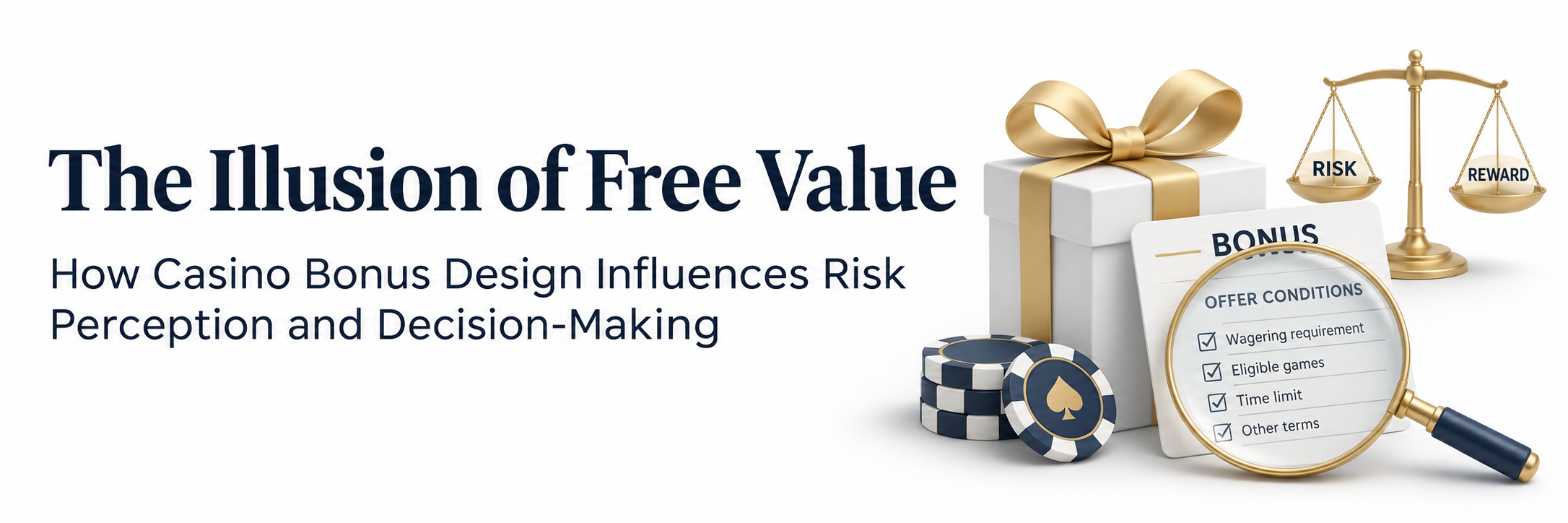
A promotional reward can feel valuable long before someone understands what it actually provides. Digital gaming platforms frequently present bonuses through colorful graphics, large numbers, and messages emphasizing immediate availability. These elements attract attention, but they can also influence how people evaluate risk, especially when virtual currencies and potential prizes appear within the same interface.
The distinction becomes particularly important in the American sweepstakes casino market, where promotional coins may serve different purposes depending on their classification. Resources explaining offers such as the crown coins casino bonus illustrate why understanding promotional structures requires looking beyond the numbers displayed on a screen. A large virtual balance does not necessarily represent an equivalent amount of redeemable value.
Understanding this difference involves more than reading promotional terms. Behavioral psychology offers useful explanations for why people respond positively to rewards, how presentation influences perceived value, and why apparently free benefits can affect subsequent decisions.
Why Does the Brain Respond So Strongly to Free Rewards?
The appeal of free rewards is closely connected to how people evaluate gains and potential losses. Behavioral economics suggests that individuals do not always assess opportunities through purely mathematical comparisons. Instead, emotional reactions, expectations, and contextual information can influence their judgments.
One relevant concept is the zero-price effect, which describes how an item's perceived attractiveness can increase disproportionately when its price reaches zero. Removing an immediate financial cost may reduce hesitation, even when the offer includes restrictions or limited practical utility.
In digital gaming, this creates an interesting psychological distinction. Receiving virtual coins can produce a sense of immediate gain, while the conditions governing their use may receive less attention. The reward is visible and immediate, whereas its limitations often require additional reading.
The important distinction is that receiving something for free does not automatically make it financially valuable. Its usefulness depends on what the reward permits, whether it carries restrictions, and what actions are required afterward.
How Virtual Currency Changes the Perception of Value
Digital currencies introduce an additional layer between a player's decisions and their financial consequences. Instead of displaying conventional dollar amounts, platforms may use coins, credits, points, or other internal units.
These systems are not inherently misleading. Virtual currencies are common across mobile games, loyalty programs, and entertainment applications. However, their presentation can make comparisons with ordinary money less intuitive.
The Difference Between Entertainment Coins and Redeemable Rewards
Some sweepstakes gaming platforms use separate virtual currencies for recreational gameplay and promotional sweepstakes participation. Their functions can differ substantially.
For example, one currency may be intended exclusively for entertainment, while another may be associated with eligibility for prize redemption under specific conditions.
This distinction matters because a balance containing thousands of entertainment coins may have no direct monetary redemption value.
Consider a hypothetical platform offering 50,000 entertainment coins alongside five promotional sweepstakes coins. Although the first figure is much larger, comparing the two numerically would be misleading because they serve different purposes.
Consumers should therefore examine three questions:
- Currency classification: Is the balance intended for entertainment, sweepstakes participation, or another purpose?
- Redemption conditions: Are prizes available, and what eligibility requirements apply?
- Practical limitations: Do expiration rules, location restrictions, or other conditions affect how rewards can be used?
Understanding these differences helps separate promotional presentation from actual utility.
The Psychological Role of Framing and Reward Presentation
Framing describes how the presentation of information can influence decisions, even when the underlying facts remain unchanged.
Imagine two promotional messages describing an identical offer.
The first emphasizes receiving thousands of complimentary virtual coins. The second explains that those coins are restricted to entertainment gameplay and cannot be exchanged for cash.
Both descriptions could be factually accurate, yet they direct attention toward different aspects of the same reward.
The first highlights abundance and immediate gratification. The second emphasizes practical limitations.
This illustrates why promotional language matters. Consumers may initially respond to the most prominent information rather than evaluating every condition simultaneously.
Why Large Numbers Can Create Misleading Impressions
Large numerical rewards can also encourage anchoring, a cognitive bias in which an initial number influences subsequent judgments.
When someone encounters an unusually large promotional balance, that figure may become a reference point for evaluating the offer.
However, virtual currency quantities are not meaningful without understanding their units, purchasing power within the platform, and redemption restrictions.
A million nonredeemable entertainment coins cannot reasonably be compared with a smaller number of coins associated with potential prize eligibility.
The practical lesson is straightforward: numerical size and economic value are separate concepts.
How Reward Anticipation Can Influence Risk Perception
Rewards do not need to produce immediate financial benefits to influence behavior. Anticipation itself can motivate continued engagement, particularly when outcomes are uncertain.
Research into gambling-related decision-making has examined how reward expectations, perceived control, and near-miss experiences affect motivation.
A near miss occurs when an unsuccessful outcome appears close to a winning result. Experimental research has found that certain near-miss experiences can increase motivation to continue gambling, despite producing no monetary reward.
These findings do not establish that every digital gaming promotion produces the same psychological response. They do, however, demonstrate why reward presentation and uncertainty deserve attention.
When Engagement Becomes a Behavioral Pattern
Promotional systems may encourage repeated interactions through recurring rewards, progress indicators, or limited-time opportunities.
For example, a hypothetical daily reward program might provide virtual coins whenever a user returns to an application. Over time, checking for rewards could become part of an established routine.
The potential concern is not necessarily the reward itself. Rather, it is whether repeated engagement begins to influence decisions that users would otherwise approach differently.
A person might spend more time playing than intended because they want to maintain a reward streak or avoid missing a promotional opportunity.
Recognizing these patterns can help users distinguish deliberate entertainment choices from automatic responses to incentives.
Why Sweepstakes Rules Matter for American Consumers
Psychological awareness is useful, but it cannot replace an understanding of consumer protections and applicable rules.
In the United States, sweepstakes promotions operate within a legal framework that differs from conventional gambling regulation. The Federal Trade Commission explains that legitimate sweepstakes cannot require purchases as a condition of entry or winning.
However, the legal treatment of particular gaming models can depend on their structure and the jurisdiction involved. State-level requirements and restrictions may differ, making broad claims about nationwide availability unreliable.
For consumers evaluating promotional gaming offers, several considerations deserve attention:
- Confirm whether a free method of participation is available.
- Read the official rules rather than relying exclusively on promotional banners.
- Check eligibility requirements, including age and geographic restrictions.
- Understand how virtual currencies differ and whether either can be associated with prize redemption.
- Examine any applicable redemption thresholds and verification procedures.
- Avoid assuming that promotional availability establishes regulatory approval.
These checks provide a more reliable foundation for decision-making than the advertised size of a reward.
How to Evaluate Casino Bonuses Without Cognitive Bias
Completely eliminating cognitive bias is unrealistic. However, a structured evaluation process can reduce reliance on first impressions.
The first step is to separate the emotional appeal of a promotion from its actual conditions.
Instead of asking how much a bonus appears to offer, consider what it permits and what limitations accompany it.
A useful approach involves comparing three dimensions: accessibility, practical value, and potential consequences.
Accessibility concerns whether participation is available without payment and whether eligibility restrictions apply.
Practical value concerns the function of promotional currencies, including whether they can be used only for entertainment or may qualify for redemption under specified conditions.
Potential consequences include the time spent engaging with the platform, possible purchases, and whether participation affects personal spending habits.
For instance, a reward that requires no purchase may still encourage someone to return repeatedly or consider optional spending. The absence of an initial cost does not eliminate the importance of setting boundaries.
Consumers can make more informed decisions by reviewing these factors before participating rather than after becoming emotionally invested in a promotional balance.
Understanding Value Beyond the Promotional Screen
Digital casino bonuses sit at the intersection of entertainment design, behavioral psychology, and consumer decision-making. Their appeal often comes from visible rewards, simplified presentation, and the anticipation of future possibilities.
Yet perceived value and practical value are not interchangeable.
A promotional balance may look substantial while offering limited utility, and a reward presented as free may still influence how someone allocates time and attention.
For American consumers, understanding virtual currency classifications, reviewing sweepstakes conditions, and recognizing common cognitive biases provides a stronger basis for evaluating promotional offers.
Ultimately, the most useful question is not how impressive a reward looks, but what it actually means within the rules governing its use.

 +91 774-202-1725
 +1 (945) 3387904
 business@coherentlab.com
 +49 15223341304
 UK

