
Table of Contents
Pros and Cons of Cross-Platform Game App Development
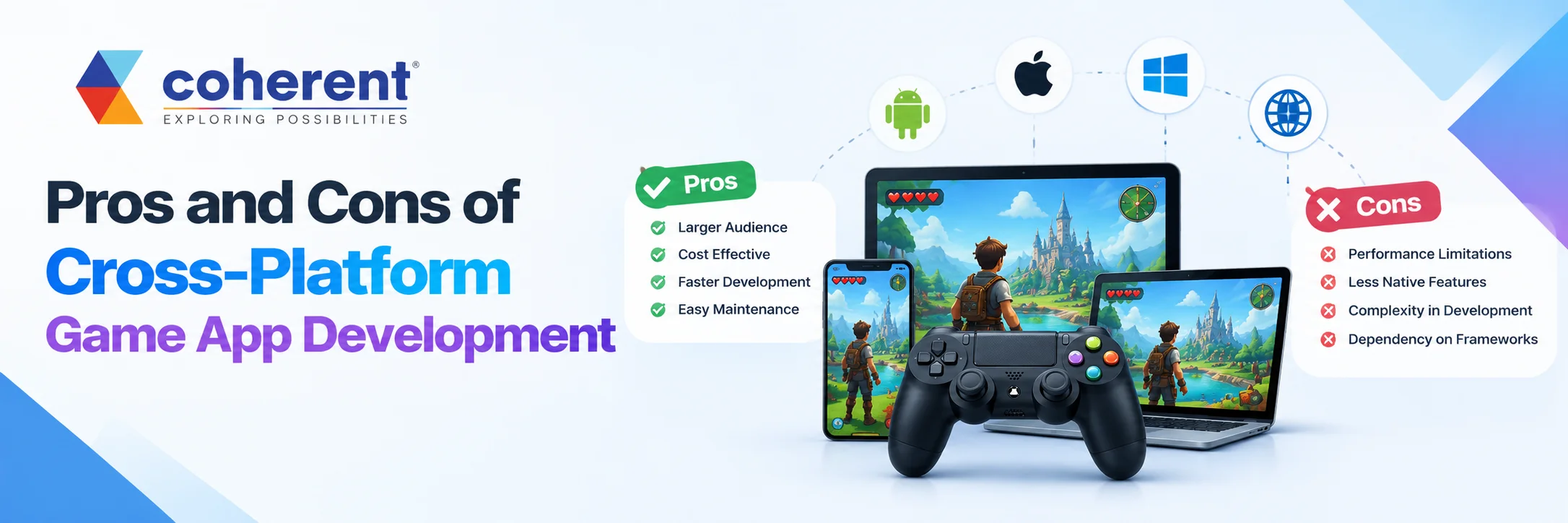
Cross-platform game app development has become a practical approach for businesses and game creators that want to launch games across multiple devices without building completely separate applications for every platform. Instead of maintaining different codebases, developers can use cross-platform game development frameworks and engines to create applications that work across Android, iOS, and other supported platforms. This approach can reduce development time, simplify maintenance, and help businesses reach a wider gaming audience.
However, cross-platform development also comes with limitations related to performance, platform-specific features, optimization, and user experience. Understanding the advantages and disadvantages is important before selecting a development strategy. This guide explains how cross-platform game app development works, its major benefits and challenges, costs, technologies, and when businesses should choose it over native game development.
What Is Cross-Platform Game App Development?
Cross-platform game app development creates games that work across multiple operating systems and devices through a shared development approach. Instead of building separate Android and iOS versions, developers can reuse much of the code, assets, game logic, and core components. This approach, often supported by cross-platform app development technologies, can improve development efficiency, reduce duplication, and help businesses reach a wider gaming audience.
How Cross-Platform Game Development Works
- Shared codebase: Developers can reuse game logic, mechanics, assets, and other components across supported platforms, reducing duplicate development work.
- Game engines: Technologies such as Unity and Unreal Engine provide tools for building and deploying games across multiple platforms from a common development environment.
- Platform deployment: After development, the game can be configured and optimized for different operating systems, devices, screen sizes, and hardware environments.
- Testing and optimization: Developers test the game across different devices and platforms to identify performance issues, compatibility problems, crashes, and user-interface differences.
How Does Cross-Platform Game App Development Work?
The cross-platform game development process combines reusable programming with platform-specific configuration and testing. Developers generally design the game architecture, gameplay mechanics, graphics, backend integration, and user interface so that most components can operate across multiple platforms. The development team then adapts the game for individual operating systems where necessary. This approach provides flexibility while still allowing developers to address platform-specific requirements.
| Factor | Cross-Platform Game Development | Native Game Development |
|---|---|---|
| Codebase | Shared codebase | Separate platform-specific code |
| Development Speed | Generally faster for multiple platforms | Can require more development time |
| Development Cost | Often lower for multi-platform projects | Can be higher when building separately |
| Performance | Strong, but may require optimization | High platform-specific control |
| Maintenance | Easier to manage shared functionality | Separate maintenance may be required |
| Platform Access | Good, with some limitations | Extensive native access |
| Android and iOS Support | Strong option | Requires separate implementations |
| Best Suited For | Multi-platform and mobile games | Highly specialized games |
Pros of Cross-Platform Game App Development
A cross-platform game app development company helps businesses reach Android and iOS players through a unified development strategy. It allows developers to reuse resources across platforms, reducing repetitive work and supporting faster launches. This approach also simplifies maintenance by managing core functionality through a shared codebase. With a well-planned development process, businesses can deliver engaging game experiences while maintaining consistent performance across different devices and operating systems.
Major Advantages of Cross-Platform Game Development
- Faster development: Reusing code and development components can shorten the overall development cycle and help businesses bring games to market sooner.
- Lower development costs: Maintaining one primary codebase can reduce duplicate development efforts, particularly for projects targeting several mobile platforms.
- Wider market reach: A single game can be prepared for Android, iOS, and other supported platforms, allowing businesses to reach more potential players.
- Simpler maintenance: Bug fixes, gameplay improvements, and feature updates can often be implemented across platforms more efficiently than maintaining completely separate applications.
Also Read :- How Much Does Game Development Cost in 2026
Cons of Cross-Platform Game App Development
Although cross-platform game development provides significant advantages, it is not the ideal solution for every gaming project. Performance-sensitive games may require extensive optimization to deliver a smooth experience across different hardware environments. Developers may also encounter challenges when a game depends heavily on platform-specific APIs or advanced device capabilities. Therefore, businesses should evaluate technical requirements before selecting a cross-platform strategy.
Major Disadvantages of Cross-Platform Game Development
- Performance limitations: Highly demanding games may require additional optimization because performance can vary between operating systems, devices, processors, and graphics hardware.
- Limited native access: Some platform-specific features may not be immediately available through cross-platform tools and may require native development or additional integrations.
- Optimization complexity: Developers need to account for different screen resolutions, hardware specifications, operating-system versions, input methods, and device capabilities.
- User-experience differences: Android and iOS users may expect different interface behaviors, navigation patterns, permissions, and interactions, requiring platform-specific adjustments.
Cross-Platform vs Native Game App Development: Which Is Better?
There is no universal answer to whether cross-platform or native game development is better. The right choice depends on the game’s complexity, performance needs, target audience, budget, timeline, and platform-specific features. Cross-platform development can help businesses achieve faster deployment and wider reach, while native development may suit highly optimized games requiring advanced device capabilities, similar to how mobile app development balances performance, flexibility, and platform requirements.
Key Differences Between Cross-Platform and Native Game Development
- Development approach: Cross-platform development uses shared code and tools, while native development generally creates platform-specific implementations.
- Performance: Native solutions can provide greater control over platform-specific optimization, while modern cross-platform engines can still deliver strong performance for many game types.
- Cost and time: Cross-platform development can reduce duplicated work when targeting multiple platforms, whereas separate native development can require more resources.
- Platform control: Native development generally offers deeper access to operating-system features, while cross-platform solutions prioritize code reuse and multi-platform efficiency.
Cross-Platform Game Development: Cost and Timeline Factors
The cost of cross-platform game development depends on several technical and creative factors rather than simply the number of supported platforms. A basic 2D game may require significantly fewer resources than a multiplayer 3D game with advanced graphics, real-time communication, artificial intelligence, and complex backend infrastructure. Businesses should also consider testing, maintenance, updates, security, and post-launch support when estimating the overall project investment.
What Influences Cross-Platform Game Development Cost?
- Game complexity: Advanced gameplay mechanics, artificial intelligence, physics, multiplayer functionality, and complex game worlds can increase development requirements.
- Graphics and animation: High-quality 2D or 3D assets, character animation, visual effects, and realistic environments can require additional design and development resources.
- Backend requirements: User accounts, leaderboards, cloud saves, multiplayer servers, analytics, notifications, and payment systems can increase technical complexity.
- Testing and maintenance: Cross-device testing, performance optimization, bug fixing, updates, security improvements, and ongoing support contribute to the total development cost.
Also Read :- How Much Does It Cost to Develop a Cross-Platform App
Best Cross-Platform Game Development Frameworks
Choosing the right technology is one of the most important decisions in cross-platform game development. The framework or game engine should match the game's visual requirements, gameplay complexity, target devices, development skills, and long-term objectives. Popular game engines provide development tools, rendering systems, physics capabilities, animation support, debugging features, and platform deployment options that can simplify the development process.
Popular Technologies for Cross-Platform Game Development
- Unity: Unity is a flexible choice for 2D, 3D, mobile, casual, simulation, and many other types of games, with broad platform support and a large development ecosystem.
- Unreal Engine: Unreal Engine is well suited to high-quality 3D experiences where advanced graphics, visual effects, physics, and immersive environments are important.
- C# and C++: These programming languages support game logic, gameplay systems, performance optimization, and integration with major game development engines.
- Supporting technologies: APIs, cloud platforms, databases, analytics systems, authentication services, advertising platforms, and payment gateways can extend game functionality.
When Should You Choose Cross-Platform Game App Development?
Cross-platform game development can be an effective choice when the primary goal is to launch on multiple platforms efficiently. It is particularly useful for businesses that want to validate a game idea, reach a broad mobile audience, or control development resources. The approach can also work well when the game's technical requirements do not depend heavily on unique platform-specific capabilities.
Cross-Platform Development Is Best For
- Startups and smaller businesses: Shared development can make it easier to manage resources while targeting multiple mobile platforms.
- Games targeting Android and iOS: Businesses can develop a common foundation for both major mobile ecosystems instead of creating entirely separate games.
- MVP development: A cross-platform approach can help teams launch an initial version, collect player feedback, and validate the concept.
- Frequent updates: A shared codebase can simplify the implementation of gameplay improvements, bug fixes, and new features across supported platforms.
When Should You Avoid Cross-Platform Game Development?
Cross-platform development is not automatically the best option for every gaming project. Games that depend on extremely high graphics performance, specialized hardware, or deep operating-system integration may benefit from native or highly customized development. Businesses should evaluate technical requirements before selecting a framework because changing the development approach later can increase project complexity and costs.
Native Development May Be Better For
- AAA-quality games: Extremely complex graphics and performance requirements may benefit from deeper platform-specific optimization.
- Hardware-intensive gaming: Games that depend heavily on specialized hardware capabilities may need direct native access.
- Advanced AR and VR: Immersive experiences can require detailed control over platform-specific sensors, cameras, graphics, and device capabilities.
- Platform-specific experiences: Games designed around unique Android or iOS features may benefit from a native development approach.
How to Choose the Right Game Development Approach?
Selecting between cross-platform and native game development requires businesses to consider target players, gameplay requirements, platform strategy, performance, budget, and long-term goals. With guidance from an experienced game development company like Coherent Lab LLP, businesses can choose an approach that supports future expansion while maintaining scalability, performance, easier maintenance, and a smooth player experience across their selected platforms.
Factors to Consider Before Development
- Target audience: Identify which platforms your players use and whether Android, iOS, PC, consoles, or multiple platforms are required.
- Game complexity: Consider whether the project is a simple 2D game, multiplayer title, 3D game, simulation, action game, or graphics-intensive experience.
- Performance requirements: Determine the expected frame rate, graphics quality, device range, loading speed, memory usage, and responsiveness.
- Budget and timeline: Compare available development resources with the desired launch date, features, testing requirements, and long-term maintenance plans.
Also Read :- How Much Does Game Development Cost? Complete
How to Improve Cross-Platform Game Performance?
Performance optimization is essential for delivering a consistent gaming experience across different devices. Android devices can vary considerably in hardware capabilities, while iOS devices also have different generations and specifications. Developers should therefore test the game on real devices instead of relying exclusively on development environments. Efficient assets, optimized code, memory management, loading strategies, and platform-specific improvements can significantly improve gameplay performance.
Best Practices for Cross-Platform Game Development
- Optimize graphics and assets: Compress textures, optimize models, manage visual effects carefully, and use appropriate asset quality for different devices.
- Reduce unnecessary processing: Optimize game logic, background processes, physics calculations, and other operations that can consume CPU or GPU resources.
- Test on real devices: Test different screen sizes, operating-system versions, hardware configurations, and performance levels before launch.
- Monitor post-launch performance: Use crash reporting, analytics, player feedback, and performance monitoring to identify problems after release.
Conclusion
Cross-platform game app development offers businesses an efficient way to create games for multiple platforms while reducing duplicated development work. Faster development, broader market reach, simplified maintenance, and potentially lower costs make it suitable for many Android and iOS game projects. However, performance limitations, platform-specific requirements, optimization challenges, and native feature access should be evaluated before development begins.
The right approach depends on game complexity, target audience, budget, performance expectations, and future goals. Businesses can assess these factors carefully and, when needed, Connect With Our Team to choose a reliable strategy for long-term gaming success.
Frequently Asked Questions
Q1. What is cross-platform game app development?
Ans. Cross-platform game app development involves creating a game that can operate across multiple platforms using a shared development approach. Developers can reuse code, gameplay logic, assets, and other components instead of creating completely separate applications. This can reduce development duplication and help businesses launch games on Android, iOS, and other supported platforms more efficiently while maintaining a consistent overall gaming experience.
Q2. What are the main advantages of cross-platform game development?
Ans. The main advantages include faster development, reduced duplication, broader platform reach, easier maintenance, and potentially lower development costs. A shared codebase allows developers to implement many features once and adapt them for supported platforms. This can be especially useful for businesses that want to launch an Android and iOS game simultaneously while managing limited development resources and maintaining a consistent product.
Q3. What are the disadvantages of cross-platform game development?
Ans. The main disadvantages include possible performance limitations, platform-specific compatibility challenges, additional optimization requirements, and restricted access to certain native features. These issues become more important for complex games requiring advanced graphics, specialized hardware, or deep operating-system integration. Developers may need native code or platform-specific solutions to overcome certain limitations and deliver the expected gaming experience.
Q4. Is cross-platform game development cheaper than native development?
Ans. Cross-platform game development can be more cost-effective when a business wants to launch on multiple platforms because developers can reuse significant portions of the codebase. However, the actual cost depends on game complexity, graphics, multiplayer functionality, backend systems, testing, optimization, and maintenance. A simple cross-platform game may cost considerably less than a complex native project, but requirements ultimately determine the investment.
Q5. Is cross-platform game development good for Android and iOS?
Ans. Yes, cross-platform game development can be a strong option for games targeting both Android and iOS. It allows developers to maintain a shared foundation while adapting the application to platform-specific requirements. This approach can help businesses reduce duplicated development work and reach players on both major mobile ecosystems. However, developers should still conduct platform-specific testing and optimization before release.
Q6. Which framework is best for cross-platform game development?
Ans. There is no single best framework for every game because the appropriate technology depends on gameplay, graphics, performance, target devices, and development requirements. Unity is commonly suitable for many 2D and 3D games, while Unreal Engine is often considered for highly detailed and graphics-intensive experiences. Businesses should evaluate technology based on project requirements rather than choosing a framework solely because it is popular.
Q7. Is cross-platform game development suitable for 3D games?
Ans. Yes, cross-platform development can support many types of 3D games, including mobile action, simulation, strategy, adventure, and multiplayer experiences. Modern game engines provide rendering, physics, animation, lighting, asset management, and deployment capabilities for 3D development. However, demanding 3D games require careful optimization, device testing, memory management, and graphics configuration to maintain stable performance across different hardware environments.
Q8. How much does cross-platform game development cost?
Ans. There is no fixed price for cross-platform game development because costs depend on the game's scope and technical requirements. Important factors include game type, 2D or 3D graphics, gameplay complexity, multiplayer features, backend infrastructure, integrations, testing, and post-launch support. A detailed project specification and technical assessment are usually required to estimate development costs and timelines accurately.

 +91 774-202-1725
 +1 (945) 3387904
 business@coherentlab.com
 +49 15223341304
 UK

