Table of Contents
A Detailed Guide on Codeless Testing
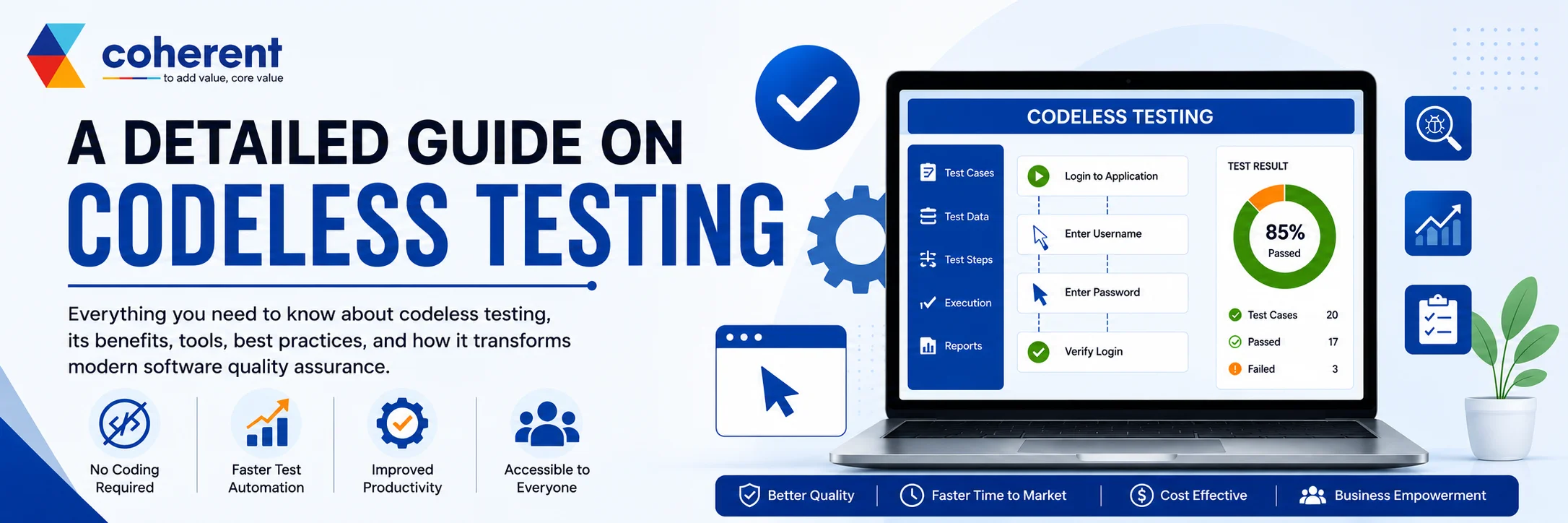
Codeless testing is now changing the way software testing is being done by eliminating the need for coding. FMI had estimated that the global codeless testing market would experience phenomenal growth in its revenue from $2 billion in 2023 to $8.6 billion in 2033.
The same trend is expected to continue, where this approach will make it easier and more efficient for teams to come up with and execute tests.
This change is because of the increasing awareness of the advantages of codeless testing that can speed up the rate of testing cycles, improve the cooperation between technical and non-technical teams, and reduce operation costs. It has features such as NLP and easy-to-use interfaces which offer solutions that are relevant and cost-effective for current testing requirements. Whether you aim to test Android apps, do web app testing, or test enterprise systems, codeless testing is the future of effective software testing.
This blog provides a comprehensive overview of codeless testing, why it is relevant and how it can be applied. Scroll down to learn.
What Is Codeless Testing?
Codeless Automation Testing is a new-generation testing approach where the testers are able to develop, run and manage the automated tests without coding. The main difference between this method and other similar methods is that it is based on interactions and test automation for less technical people.
The idea of intuitive UI, NLP, and visual workflows make the codeless automation testing tools easy to use, and the test creation and maintenance are much easier than with the barriers of coding.
At first, codeless testing was only applicable in the record and playback tools sense, but with the help of technology it has transformed into other techniques like Keyword-Driven Testing, Model-Based Testing and NLP solutions.
These tools take user inputs and convert them into executable test scripts, enabling users to automate testing without writing code. CoTester AI Agent uses AI to automatically generate executable test scripts while ensuring the effectiveness and accuracy of the testing process. TestGrid is another platform that provides AI-powered test automation capabilities.
Why Is Codeless Testing Important?
Automated testing has always been a game-changer, but codeless testing is even better because it fills gaps and makes processes easier. Here’s why it’s essential:
- Manual testers can easily automate test cases without having to write a single line of code.
- The main advantage of codeless testing is that there is no need for coding skills, and therefore, automation is faster and more accessible.
- Codeless testing tools are built to be scalable and can manage large applications as they expand.
- Since there is no coding language used in test cases, it is easier for team members who are not so technical to comprehend, thus improving team-work.
- Lower dependence on specialized coding skills decreases operational costs.
How Codeless Testing Works
Codeless testing automates the creation of test cases using intuitive features such as:
- NLP - Natural Language Processing: Testers document steps in simple English, which the tool translates into scripts.
- Model-Based Testing: Separates test logic, technical details, and data to create reusable and efficient tests
- Recording and Playback: Records the users’ actions as test steps and can be easily modified and improved.
- Keyword-Driven Testing: It has predefined keywords for performing specific actions without the need to script.
Read more: 7 Best Testing Frameworks in 2024 for Java Developers
What to Consider When Selecting a Codeless Automation Testing Tool?
It is important to choose the right codeless automation tool to facilitate the testing processes. Here are key factors to consider:
1. Multi-Platform Support:
Ensure that the tool you are selecting for the testing allows you to perform the testing on different platforms, like; desktop, mobile, and web-based applications.
2. Security Measures:
Data is the most valuable asset in this world that is dominated by technology. Always ensure that the tool you decide to use addresses matters concerning security by having data encryption and access control and complying with standard security requirements.
3. User-Friendliness:
Choose a tool with a simple and clear interface and operations based on drag-and-drop features to enable anyone with or without testing knowledge to use these tools.
4. Integration Capabilities:
The tool should seamlessly integrate into your existing CI/CD set, and your software developers’ environment as well as the current test management applications.
5. Cost Efficiency:
It is viable to check the overall cost of the software, the licensing cost, as well as any other extra elements, which have to fit your budget and bring value to your money.
6. Scalability:
Select a tool that can easily manage tests in different locations or environments which will be suitable for big projects.
7. Customer Support:
Select a provider that offers assistance from the initial stage to the time they have embraced codeless automation testing.
How to Incorporate Codeless Testing into Your Processes?
Now let’s see how you can get started with codeless testing:
- Choose the Right Tool: First, you should know what the requirements of your project are. Then, choose a tool that contains all the necessary testing features and possibilities, such as cross-platform testing, scalability, and integration.
- Set Up Test Scenarios: Ideally, you should define your test objective and scenarios before creating tests using the codeless testing tool.
- Run and Monitor Tests: Execute tests and evaluate the results with the assistance of the tool’s detailed reporting option.
- Incorporate Test Maintenance: Ensure that the testing tool that you are using has AI-powered features so that every time the application changes, the tests are modified as well.
Read more:Mobile App Development Process: Step-by-Step Guide for Businesses
What are Some Myths About Codeless Testing?
Codeless testing is now preferred because it is simple to implement, but misunderstandings about this type of testing make people reluctant to use it. Let’s debunk some of the most common myths about codeless testing:
1- It’s Just Record and Playback:
A lot of people have a perception that codeless testing is a record-and-playback kind of tool. This might have been true in the past, but the current codeless tools are far from these methods; they include NLP, model-based testing, and keyword-driven approaches.
2. Codeless Tests Are Hard to Maintain:
It is necessary to mention that some of the first codeless solutions were not very effective when it was a question of modifying or editing test cases. However, the modern tools are easy to edit, reusable and adaptable, which makes test maintenance easier.
3. It’s Not Truly Codeless:
Some people still believe that codeless tools are not truly free from coding. Although it is true that coding is done in the background and the tool interprets the actions of the user into code, the testers do not need to code.
Conclusion
Automated codeless testing is not a buzzword anymore; it is the future of testing. It accelerates the test creation process, is highly scalable, and is compatible with agile processes, whereby organizations can always address changing test requirements while enhancing quality and speed.
Embrace codeless testing today and usher in a new era of affordable, fast and high-quality automation in your projects. To explore how codeless testing can improve your automation strategy and deliver better results, get in touch with our team today.

 +91 774-202-1725
 +1 (945) 3387904
 business@coherentlab.com
 +49 15223341304
 UK
UK