Table of Contents
When Your AI-Assisted MVP Works but Won't Grow
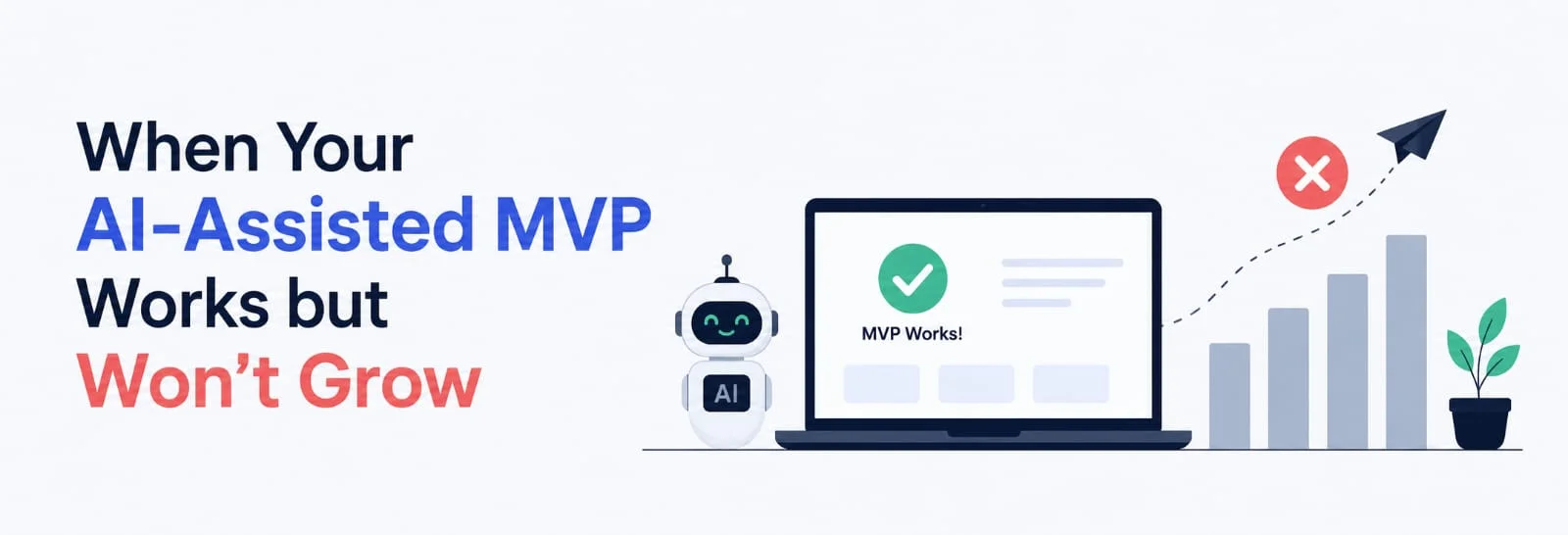
Something strange tends to happen a few months after a founder releases a first version built principally with AI coding tools. The demo had run without complaint, the early users had signed up and clicked around, and by every visible measure, the product had looked finished. Then the growing pains arrive. A feature that took an afternoon to generate now needs a careful week to change, and a small adjustment in one corner has a habit of breaking something unrelated two screens away. Every push toward more users seems to cost more effort than the last one did, and nobody can quite explain why.
This is one of the defining patterns of the current building era. AI has made the first ten percent of a software product almost free, which is a real gift to anyone who wants to test an idea quickly. The remaining ninety percent, the part where a prototype becomes something a business can depend on, still answers to the older rules of engineering. A tool that writes code in seconds does not, on its own, understand the system that code is meant to become.
Why the first version feels finished
The convincing demo is assuredly the problem. Modern coding assistants are apparently distinguished at producing something that runs, which is why a person with no engineering background can now assemble a working prototype over a weekend. What these tools are built to reward is a believable answer to the request in front of them, not a coherent structure underneath. When GitClear examined 211 million lines of code written between 2020 and 2024, it found that duplicated blocks rose approximately eightfold during 2024, while the share of edits that involved refactoring (the ordinary discipline of reshaping existing code into something cleaner) had fallen below ten percent, down from about a quarter three years earlier. More code is being pasted in, and less of it is being tidied up, which is precisely how a codebase ends up looking fine on the surface and tangled beneath it.
What the quick build quietly skipped
Speed always comes from somewhere. When a prototype appears in a matter of days, the parts that normally take weeks have usually been skipped rather than solved, and two of them tend to cause the most serious trouble later. The first is the data model. An AI will readily invent a structure that stores whatever the current screen needs, with no sense of how that information will be searched once the dataset scales from a mere dozen records to a hundred thousand. The second is security, which is the more dangerous omission of the two. Veracode tested code produced by more than a hundred large language models across eighty realistic tasks and found that around 45 percent of it carried a known security flaw, a proportion that barely improved even as the models grew better at writing syntactically correct code. Its researchers linked the risk to a simple habit, which is asking a model for working code without ever stating a security requirement, and that is very close to a description of how most prototypes get made.
The bill comes due when you try to scale
The inescapable caveat, however, is this. The weaknesses in an AI-assisted build hardly never reveal themselves while the product is small, and they surface at the worst imaginable moment, which is when the idea starts working and the founder decides to grow it. That timing is not a mishap. After studying more than three thousand high-growth startups, the Startup Genome Project concluded that roughly 74 percent of them failed because they scaled prematurely, spending on growth before the product beneath could carry the weight. The aforementioned research noted that the startups most prone to this had written far more code in their early days than their steadier counterparts, a finding that reads differently now that producing code is the cheapest part of the whole endeavor. A shaky foundation is perfectly survivable at ten users, yet at ten thousand it quietly determines whether the company can deliver on the promises it has started making.
How to tell a fixable foundation from a lost cause
Not every stalled prototype needs to be scrapped. This truth demands unambiguous expression, because the panic that sets in when a product stops scaling tends to push founders toward one of two costly errors. Some keep patching a structure that was never going to hold, spending good money to make a fragile thing marginally less fragile. Others discard work that could have been saved, paying a second time for functionality they already owned. The definitive litmus test of a system’s integrity lies in how it behaves when you change it. A codebase where one small edit reliably breaks three unrelated things is telling you something structural about itself, and no quantity of further prompting will coax it out of that behavior. A codebase that is solely unkempt, where changes stay where you put them, typically merits continued investment. That difference is seldomly visible from the outside, which is why an experienced engineer who reads the actual code will learn more in an afternoon than a founder will from weeks of anxious guessing.
What a serious engineering pass changes
Rebuilding well is not the same as starting from scratch. A capable team rarely throws everything away because the product's behavior and the hard-won understanding of what makes users respond are worth preserving. What gets replaced is the structure underneath all of it. The data model is redesigned around the way the information will really be queried once the record count grows serious, instead of around whatever a single screen happened to require on the day it was generated. Permissions and account security are rebuilt by engineers who assumed from the first line that strangers would try to force their way in, which is a very different starting point from adding protection after an incident has already happened. This is the work that specialist firms offering AI Development Services usually describe as taking a proof of concept the rest of the way to a dependable product, and the distinction counts for more than it first sounds, as the goal is not to deliver a cleverer demo but to architect a fault-tolerant, resilient system capable of steadfastly sustaining business growth.
Questions worth asking before you commit
A few probing questions dismantle operational uncertainty significantly faster than speculative anxiety.
- What happens when you change one thing? If a single small edit tends to ripple into places nobody anticipated, the foundation is the issue rather than the feature you were trying to add.
- Who designed the way your data is stored, and were they thinking past launch day? A structure built to satisfy a demo rarely survives its first encounter with real volume.
- Has anyone with security experience ever read the code that handles accounts and sensitive information? Given that close to half of AI-written code carries a known vulnerability, this is not a question to leave for later.
- If your user numbers multiplied by fifty next quarter, do you know what would break first? A founder who cannot answer that is usually one incident away from finding out in public
Building the second version on purpose
None of this invalidates AI-assisted creation. The speed is real, and when the objective is to validate baseline market viability, putting a crude functional artifact into user hands within a week remains unmatched. The mistake is treating that rough version as a finished product simply because the code executes. A prototype serves a singular diagnostic mandate: validating whether genuine demand exists. A product has the harder job of holding up once that demand materializes. Recognizing this distinction, and possessing the discipline to re-architect core infrastructure before scaling, is what separates a promising demo from a company. Founders who navigate this inflection point early are usually the ones still standing when the users finally arrive in numbers.

 +91 774-202-1725
 +1 (945) 3387904
 business@coherentlab.com
 +49 15223341304
 UK
UK