Table of Contents
Custom Software Development vs Off-the-Shelf Software: Which Is Better?
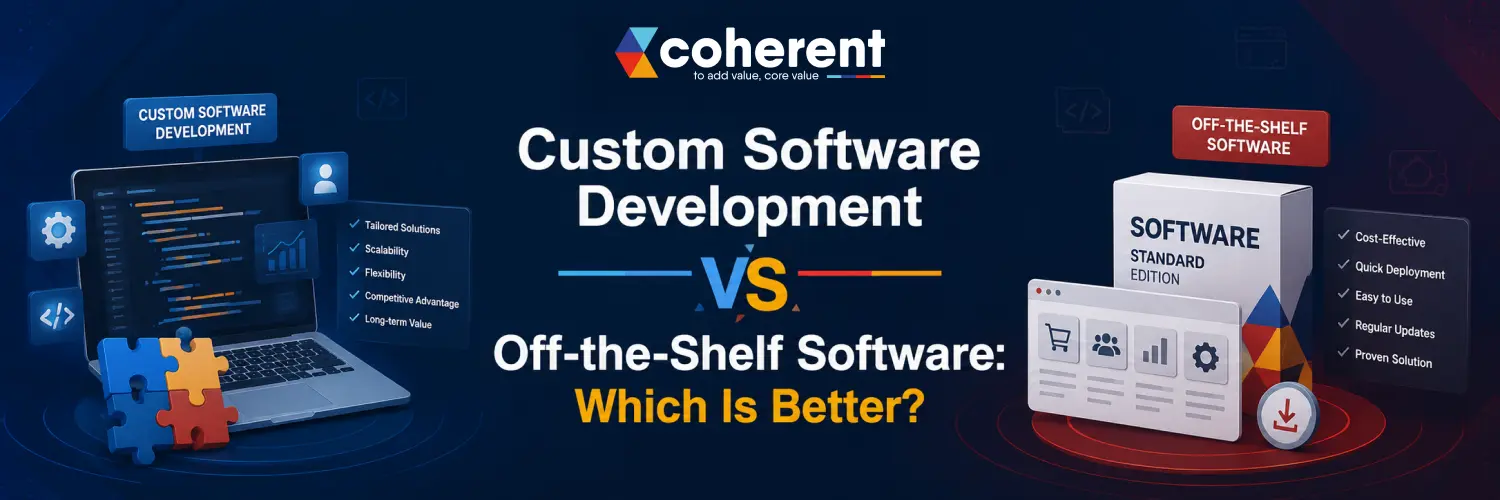
Every business depends on software to manage operations, improve customer experiences, and increase productivity. The answer depends on your business goals, budget, growth plans, and operational requirements.
While off-the-shelf software provides quick implementation and lower upfront costs, custom software is built specifically around your business processes, making it more scalable, secure, and efficient over time.This guide compares custom software development vs off-the-shelf software in detail, helping you choose the right solution for your organization.
What Is Custom Software Development?
Custom software development is the process of designing, developing, testing, and deploying software tailored specifically to the unique needs of a business.Unlike ready-made applications, custom software is built around your workflows, customers, and business objectives.
Examples of Custom Software
- CRM systems
- ERP platforms
- Inventory management software
- Healthcare applications
- FinTech platforms
- Logistics management systems
- Marketplace applications
- Learning Management Systems (LMS)
- HR management platforms
- Manufacturing software
Key Features
- Personalized functionality
- High scalability
- Custom integrations
- Enhanced security
- Flexible architecture
- Ownership of source code
What Is Off-the-Shelf Software?
Off-the-shelf software is a pre-built solution designed for general business needs. It offers standard features, quick installation, and affordable pricing, making implementation faster with minimal development effort.
Businesses commonly use off-the-shelf software for accounting, CRM, HR, and project management. While cost-effective and reliable, it offers limited customization compared to software built specifically for unique business requirements.
Popular Examples
- Microsoft 365
- Slack
- Zoom
- Shopify
- QuickBooks
- Trello
- Asana
- Salesforce
- Canva
- Dropbox
Also Read: Leading Custom Software Development Company In India.
Custom Software vs Off-the-Shelf Software: Quick Comparison
Custom software is built specifically for your business needs, offering greater flexibility, scalability, and seamless integration. Off-the-shelf software is pre-built, cost-effective, and quick to deploy but provides limited customization. The right choice depends on your budget, long-term goals, operational complexity, and growth plans.
| Feature | Custom Software | Off-the-Shelf Software |
|---|---|---|
| Development | Built specifically for your business | Built for a wide range of users |
| Cost | Higher upfront investment | Lower initial cost |
| Scalability | Excellent and grows with your business | Limited by vendor capabilities |
| Customization | Fully customizable to your needs | Limited customization options |
| Security | Tailored security features and controls | Standard vendor-provided security |
| Integrations | Seamless integration with existing systems | Depends on vendor-supported integrations |
| Ownership | Full ownership and control | Owned and managed by the vendor |
| Deployment Time | Weeks to months, depending on complexity | Ready for immediate deployment |
| Maintenance | Managed by your development team or technology partner | Managed by the software vendor |
| Updates | Implemented based on your business needs | Released according to the vendor's schedule |
| Flexibility | Easily adapts to changing business requirements | Limited flexibility for unique workflows |
| Long-Term Cost | Higher initial cost but better long-term ROI | Lower upfront cost but recurring licensing fees |
| Support | Dedicated, personalized support | Standard vendor support for all customers |
| Best For | Businesses with unique processes and growth plans | Businesses with standard requirements and limited budgets |
| Competitive Advantage | High—software is built to support your unique business strategy | Low—competitors may use the same software |
Benefits of Custom Software Development
Custom software development provides solutions tailored to your business processes, improving efficiency, scalability, and security. It integrates seamlessly with existing systems, supports future growth, enhances user experience, and gives businesses greater control over features, updates, and long-term maintenance compared to generic software solutions.
Partnering with Coherent Lab ensures you receive scalable, high-performance custom software designed to meet your unique business goals and drive long-term digital success.
Designed Around Your Business
Every workflow, department, and customer journey is different.Custom software fits your operations instead of forcing your team to adapt to generic software.
Better Scalability
As your business grows, custom software grows with you.
- New modules
- New users
- AI features
- Analytics dashboards
- Payment gateways
- APIs
- Mobile applications
Stronger Security
Custom applications typically have fewer common vulnerabilities because they are not widely used by thousands of organizations.
- Multi-factor authentication
- Role-based access
- Custom encryption
- Secure APIs
- Compliance support
- Audit logs
Seamless Integration
Custom software can connect with:
- ERP
- CRM
- Accounting software
- Payment systems
- IoT devices
- Marketing platforms
- Inventory software
Higher Productivity
Employees spend less time switching between systems because everything works together in one platform.
- Faster workflows
- Reduced errors
- Better reporting
- Automated processes
Long-Term Cost Savings
Although development costs are higher initially, businesses often save money by eliminating:
- Multiple subscriptions
- Manual processes
- Third-party integrations
- Licensing fees
- Productivity losses
Benefits of Off-the-Shelf Software
Off-the-shelf software offers fast deployment, lower upfront costs, and proven functionality for common business needs. It includes regular updates, vendor support, and minimal development time, making it an ideal choice for startups and businesses seeking a reliable, ready-to-use solution with a quick return on investment.
Quick Implementation
Most software can be set up within minutes or hours.
- Startups
- Small businesses
- Freelancers
- Teams needing immediate solutions
Lower Initial Investment
Subscription pricing makes it affordable.
- Development costs
- Infrastructure setup
- Large upfront investments
Proven Reliability
Popular software has already been tested by millions of users.
- Stable performance
- Regular updates
- Large user communities
- Extensive documentation
Vendor Support
Most providers offer:
- Technical support
- User training
- Documentation
- Security updates
- Cloud backups
Drawbacks of Custom Software
Custom software typically requires a higher initial investment and longer development time than ready-made solutions. It also demands ongoing maintenance, updates, testing, and technical support.
Without proper planning and an experienced development team, projects may face delays, budget overruns, or changing business requirements.
Higher Initial Cost
Custom software requires planning, development, testing, and deployment.
Longer Development Time
Projects can take:
- 2 months
- 6 months
- 12 months
Requires Expert Development Team
Finding experienced developers is critical for long-term success.
Drawbacks of Off-the-Shelf Software
Off-the-shelf software often provides limited customization, making it difficult to match unique business workflows. Businesses may also face ongoing subscription fees, vendor dependency, integration challenges, and unnecessary features.
As organizations grow, these limitations can reduce flexibility, scalability, and overall operational efficiency, potentially requiring a switch to custom software later.
Limited Customization
Businesses often have to adjust their workflows instead of the software adapting to them.
Recurring Subscription Costs
Monthly licensing costs increase as teams grow.
Vendor Dependency
You rely on the provider for:
- Updates
- Features
- Pricing
- Support
- Availability
Unnecessary Features
Many businesses pay for features they never use.
Maintenance and Support
Regular maintenance and reliable support are essential for keeping software secure, stable, and up to date. Custom software provides dedicated maintenance tailored to your business needs, while off-the-shelf software depends on vendor-managed updates and support, which may offer less flexibility for unique requirements or urgent changes. Partnering with an experienced mobile development company ensures your applications receive timely updates, proactive monitoring, performance optimization, and ongoing technical support for long-term success.
Custom Software
Support generally includes:
- Bug fixes
- Feature updates
- Performance improvements
- Security patches
- System optimization
Off-the-Shelf Software
Maintenance is handled by the vendor.
- Automatic updates
- Cloud hosting
- Technical support
- New feature releases
Which Businesses Should Choose Custom Software?
Custom software is the ideal choice for businesses with unique workflows, complex operations, strict security requirements, or long-term growth plans. While it requires a higher upfront investment, it delivers greater flexibility, scalability, competitive advantage, and a higher return on investment over time.
| Business Type | Why Custom Software Is the Right Choice |
|---|---|
| Startups with Unique Ideas | Build innovative products with unique features that help you stand out in the market and support future growth. |
| Small & Medium Businesses (SMBs) | Automate business processes, improve productivity, and scale operations without the limitations of generic software. |
| Large Enterprises | Integrate multiple systems, manage complex workflows, and implement enterprise-grade security and compliance. |
| Healthcare Organizations | Ensure regulatory compliance, protect sensitive patient data, and streamline clinical and administrative workflows. |
| Financial Services | Enhance security, reduce fraud risks, support regulatory requirements, and deliver customized banking or fintech solutions. |
| E-commerce Businesses | Create personalized shopping experiences, integrate payment gateways, manage inventory, and support business expansion. |
| Manufacturing Companies | Optimize production planning, inventory management, supply chain operations, and real-time performance monitoring. |
| Logistics & Transportation | Improve fleet management, route optimization, shipment tracking, warehouse management, and delivery efficiency. |
| Educational Institutions | Develop custom learning management systems (LMS), student portals, online examinations, and administrative tools. |
| Real Estate Companies | Build property listing platforms, CRM systems, virtual property tours, and lead management solutions. |
| Travel & Hospitality Businesses | Create customized booking systems, travel portals, customer loyalty programs, and reservation management platforms. |
| Businesses with Rapid Growth | Develop scalable software that evolves with increasing users, business processes, data volume, and future technology requirements. |
- Have unique workflows
- Need enterprise-level security
- Require custom integrations
- Expect rapid growth
- Want full ownership of their software
- Need industry-specific functionality
- Operate in regulated industries
- Aim to gain a competitive advantage through technology
Final Verdict
Choosing between custom software development and off-the-shelf software is not about finding a universally better option—it is about selecting the solution that best aligns with your business goals.If your organization values speed, affordability, and standard functionality, off-the-shelf software is often the practical choice.
However, if you need software tailored to your workflows, require advanced security, plan to scale, or want a long-term competitive advantage, custom software development is typically the stronger investment.As businesses continue to embrace AI, automation, and digital transformation, flexible and scalable software solutions are becoming increasingly important. Contact us today.
Frequently Asked Questions
Q1. Is custom software better than off-the-shelf software?
Ans. Custom software is ideal for businesses with unique workflows, specific operational requirements, or long-term growth goals. It offers greater flexibility, scalability, and customization. Off-the-shelf software is better suited for standard business processes, providing faster deployment and lower upfront costs for organizations that don't require extensive customization.
Q2. Is custom software more expensive?
Ans. Custom software generally requires a higher initial investment because it is designed specifically for your business. However, it can reduce long-term costs by eliminating recurring licensing fees, improving productivity, minimizing manual work, and providing a solution that grows with your business instead of requiring frequent replacements.
Q3. Which option is more secure?
Ans. Custom software allows businesses to implement security features tailored to their specific risks and compliance requirements. While reputable off-the-shelf software also includes strong security measures, organizations depend on the vendor's update schedule and shared architecture. Custom solutions offer greater control over security policies and data protection.
Q4. Can custom software integrate with existing systems?
Ans. Yes. Custom software is designed to integrate seamlessly with existing business systems, including CRM platforms, ERP software, accounting applications, payment gateways, cloud services, and third-party APIs. These integrations improve workflow efficiency, reduce manual data entry, and create a unified digital ecosystem.
Q5. How long does custom software development take?
Ans. Development timelines depend on project scope, features, integrations, and complexity. A basic application may take two to four months, while enterprise-grade software with advanced functionality, security requirements, and multiple integrations can take six months or longer to complete successfully.
Q6. Who should choose off-the-shelf software?
Ans. Off-the-shelf software is a great option for startups, small businesses, and organizations with standard operational needs. It offers quick deployment, lower upfront costs, regular updates, and vendor support, making it suitable for businesses that need proven functionality without extensive customization.
Q7. Can custom software scale as my business grows?
Ans. Yes. One of the biggest advantages of custom software is scalability. It can be enhanced with new features, support more users, integrate additional systems, and adapt to changing business requirements, helping organizations avoid the limitations commonly associated with generic software solutions.
Q8. How do I choose between custom and off-the-shelf software?
Ans. Consider your budget, business goals, required features, scalability needs, integration requirements, and long-term growth plans. If your business relies on unique processes or expects rapid expansion, custom software is often the better investment. For standard needs and faster implementation, off-the-shelf software may be the right choice.

 +91 774-202-1725
 +1 (945) 3387904
 business@coherentlab.com
 +49 15223341304
 UK
UK