Table of Contents
Software Development Predictions for the Next 5 Years
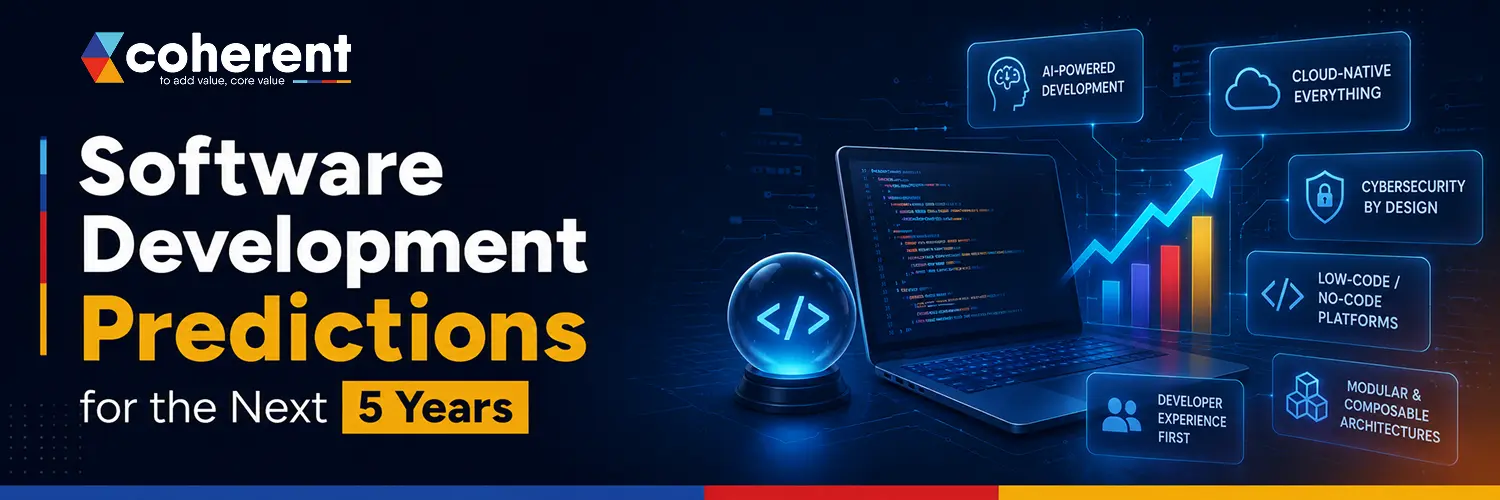
Software development is evolving faster than ever. Artificial intelligence is transforming how developers write code, businesses are embracing automation, and cloud-native applications have become the standard. Over the next five years, software development will move beyond faster coding—it will focus on building smarter, more secure, scalable, and user-centric digital products.
Whether you're a startup founder, CTO, software engineer, or business owner planning your next digital product, understanding where the industry is heading can help you make better technology decisions.In this guide, we'll explore the biggest software development predictions for the next five years, explain what they mean for businesses, and share practical insights to help you stay ahead of the competition.
Why Software Development Is Changing Rapidly
Several technologies are accelerating software innovation simultaneously. AI, cloud computing, automation, cybersecurity, and data analytics are no longer optional—they're becoming the foundation of modern applications.
- Faster to build
- Easy to scale
- Highly secure
- Cost-efficient
- AI-powered
- Personalized
- Available across multiple platforms
Top Software Development Predictions for the Next 5 Years
Discover the top software development predictions for the next five years, from AI-driven coding and cloud-native applications to low-code platforms, cybersecurity, automation, and emerging technologies. Learn how these trends will transform software engineering, accelerate digital innovation, improve user experiences, and help businesses and developers stay competitive in a rapidly evolving technology landscape. Partner with Coherent Lab LLP to build future-ready, scalable software solutions that drive long-term business growth.
1. AI Will Become Every Developer's Coding Partner
Artificial Intelligence is no longer replacing developers—it's helping them become significantly more productive.
- Generate boilerplate code
- Detect bugs
- Suggest improvements
- Write documentation
- Create test cases
- Review pull requests
- Optimize performance
How This Benefits Businesses
- Faster product launches
- Reduced development costs
- Higher software quality
- More innovation with smaller teams
2. Custom Software Will Continue to Replace Off-the-Shelf Solutions
Businesses increasingly want software tailored to their workflows rather than adapting their operations to generic platforms.
- Better scalability
- Stronger security
- Easier integrations
- Personalized customer experiences
- Long-term flexibility
Industries Driving Demand
- Healthcare
- Finance
- Retail
- Manufacturing
- Logistics
- Education
- Real Estate
3. Cybersecurity Will Be Built Into Every Stage of Development
Cyber threats continue to grow in sophistication, making security a core requirement rather than an afterthought.
Future Development Practices
- Secure coding standards
- Automated vulnerability scanning
- Zero Trust architecture
- API security
- Continuous security testing
- Multi-factor authentication
- Secure DevOps (DevSecOps)
Business Benefits
- Lower security risks
- Better compliance
- Stronger customer trust
- Reduced downtime
4. Cloud-Native Development Will Become the Standard
Cloud-first development enables applications to scale quickly, recover from failures, and support global users.
Cloud-Native Technologies
- Containers
- Kubernetes
- Serverless computing
- Microservices
- Cloud databases
- Managed infrastructure
Why Businesses Prefer Cloud-Native Apps
- Lower infrastructure costs
- Better reliability
- Faster deployment
- Improved scalability
- Automatic updates
5. Low-Code and No-Code Platforms Will Expand
Business teams increasingly want to build simple applications without relying entirely on software developers.
Common Use Cases
- Internal dashboards
- Workflow automation
- Approval systems
- CRM customization
- Employee portals
- Data collection apps
6. DevOps and Platform Engineering Will Continue to Mature
Development teams are focusing on improving software delivery speed without compromising quality.
Key Trends
- Continuous Integration (CI)
- Continuous Delivery (CD)
- Infrastructure as Code
- Automated deployments
- Self-service developer platforms
- Intelligent monitoring
Benefits
- Faster releases
- Reduced downtime
- Better collaboration
- Improved software quality
7. Edge Computing Will Power Real-Time Applications
Applications increasingly require instant responses, making edge computing more valuable.
Industries Using Edge Computing
- Healthcare
- Manufacturing
- Smart cities
- Autonomous vehicles
- IoT
- Retail
Advantages
- Lower latency
- Faster processing
- Better reliability
- Reduced bandwidth costs
8. Blockchain Will Expand Beyond Cryptocurrency
Blockchain technology is finding practical applications in industries that require secure, transparent, and tamper-resistant records.
Future Applications
- Digital identity
- Supply chain tracking
- Smart contracts
- Healthcare records
- Financial services
- Asset management
9. AR, VR, and Spatial Computing Will Enter Mainstream Business
Immersive technologies are moving beyond gaming into enterprise applications.
Business Use Cases
- Employee training
- Virtual product demonstrations
- Remote collaboration
- Healthcare simulations
- Architecture visualization
- Retail experiences
10. Green Software Development Will Become a Business Priority
Organizations are paying greater attention to the environmental impact of software.
Sustainable Development Practices
- Efficient coding
- Reduced server usage
- Optimized cloud resources
- Energy-efficient infrastructure
- Sustainable hosting
11. Data Privacy Will Shape Application Development
Privacy regulations are becoming stricter around the world, influencing how software is designed.
Future Priorities
- Privacy by design
- Data encryption
- Consent management
- Secure APIs
- Compliance automation
- Transparent data practices
12. Industry-Specific AI Solutions Will Rise
Instead of relying solely on general-purpose AI, businesses will increasingly adopt AI App development tailored to their industry.
Examples
- AI for healthcare diagnostics
- AI-powered fraud detection
- Retail recommendation engines
- Manufacturing quality control
- Legal document analysis
- Financial forecasting
Developer Skills That Will Matter Most
Developers will need expertise in AI integration, cloud computing, cybersecurity, DevOps, full-stack development, API design, data engineering, and automation. Strong problem-solving, adaptability, communication, and continuous learning will be just as important as technical skills.Teams handling complex data pipelines may also rely on data engineering services to support scalable data processing and integration.
Professionals who combine engineering expertise with business insight and emerging technologies will be better equipped to build innovative, scalable, and future-ready software solutions. Whether developing enterprise applications or specialized platforms like dating portal development , staying current with evolving technologies will be key to long-term success.
Technical Skills
- Artificial Intelligence
- Machine Learning
- Cloud Computing
- Kubernetes
- DevOps
- Cybersecurity
- API Development
- Data Engineering
- Mobile Development
- Full Stack Development
Soft Skills
- Problem-solving
- Communication
- Adaptability
- Product thinking
- Collaboration
- Critical thinking
Final Thoughts
The next five years will redefine software development. AI-assisted coding, cloud-native architectures, stronger cybersecurity, edge computing, low-code platforms, and industry-specific AI will become integral to how applications are built and maintained.
While technologies will continue to evolve, one principle will remain constant: successful software solves real business problems. Companies that invest in scalable architecture, user-focused design, and continuous innovation will be well-equipped to thrive in an increasingly digital world.Contact us Today.
Frequently Asked Questions (FAQs)
Q1. What is the biggest software development trend over the next five years?
Ans. Artificial intelligence will likely be the most influential software development trend over the next five years. AI-powered coding assistants, automated testing, intelligent debugging, and predictive analytics will significantly improve developer productivity. Businesses will use AI to accelerate software delivery, reduce development costs, enhance user experiences, and allow development teams to focus on innovation, architecture, and solving complex business challenges.
Q2. Will AI replace software developers?
Ans. No. AI is designed to assist developers rather than replace them. While it can automate repetitive coding, testing, and documentation tasks, developers remain responsible for software architecture, creative problem-solving, business logic, security decisions, and user experience. Human expertise, collaboration, and critical thinking will continue to play a vital role in successful software development projects.
Q3. Why is cloud-native development becoming so popular?
Ans. Cloud-native development enables businesses to build scalable, resilient, and highly available applications using containers, microservices, and cloud infrastructure. It supports faster deployments, automatic scaling, lower operational costs, and improved reliability. Organizations adopting cloud-native technologies can respond quickly to changing customer demands while simplifying application maintenance and continuous software delivery.
Q4. What skills should developers learn for the future?
Ans. Future-ready developers should build expertise in artificial intelligence, cloud computing, cybersecurity, DevOps, API development, automation, data engineering, and modern programming frameworks. Strong communication, collaboration, adaptability, and problem-solving skills are equally important. Continuous learning helps developers stay competitive as technologies evolve and industry requirements continue changing across different software domains.
Q5. Will low-code platforms replace traditional development?
Ans. No. Low-code platforms simplify application development for routine business processes and internal tools, but they cannot replace traditional software development for complex enterprise applications. Experienced developers are still needed to create customized features, ensure application security, optimize performance, integrate multiple systems, and build scalable solutions that meet unique business requirements.
Q6. Why is cybersecurity becoming more important in software development?
Ans. Cybersecurity has become essential because organizations face increasing cyber threats, ransomware attacks, and stricter data privacy regulations. Integrating security throughout the software development lifecycle helps identify vulnerabilities early, protect sensitive information, maintain customer trust, reduce financial risks, and ensure applications remain secure, reliable, and compliant with industry standards.
Q7. How will edge computing impact future applications?
Ans. Edge computing processes data closer to users, devices, or sensors instead of relying entirely on centralized cloud servers. This reduces latency, improves response times, saves bandwidth, and supports real-time applications. Industries including healthcare, manufacturing, autonomous vehicles, smart cities, and IoT will benefit from faster, more efficient, and reliable software performance.
Q8. How can businesses prepare for the future of software development?
Ans. Businesses should modernize legacy systems, adopt cloud-native architectures, invest in AI-powered tools, strengthen cybersecurity practices, and provide continuous employee training. Staying informed about emerging technologies, embracing agile development, and prioritizing scalable software solutions will help organizations remain competitive, improve operational efficiency, and meet evolving customer expectations in the digital economy.

 +91 774-202-1725
 +1 (945) 3387904
 business@coherentlab.com
 +49 15223341304
 UK
UK