Table of Contents
How to Develop an App Like Porter in 2026
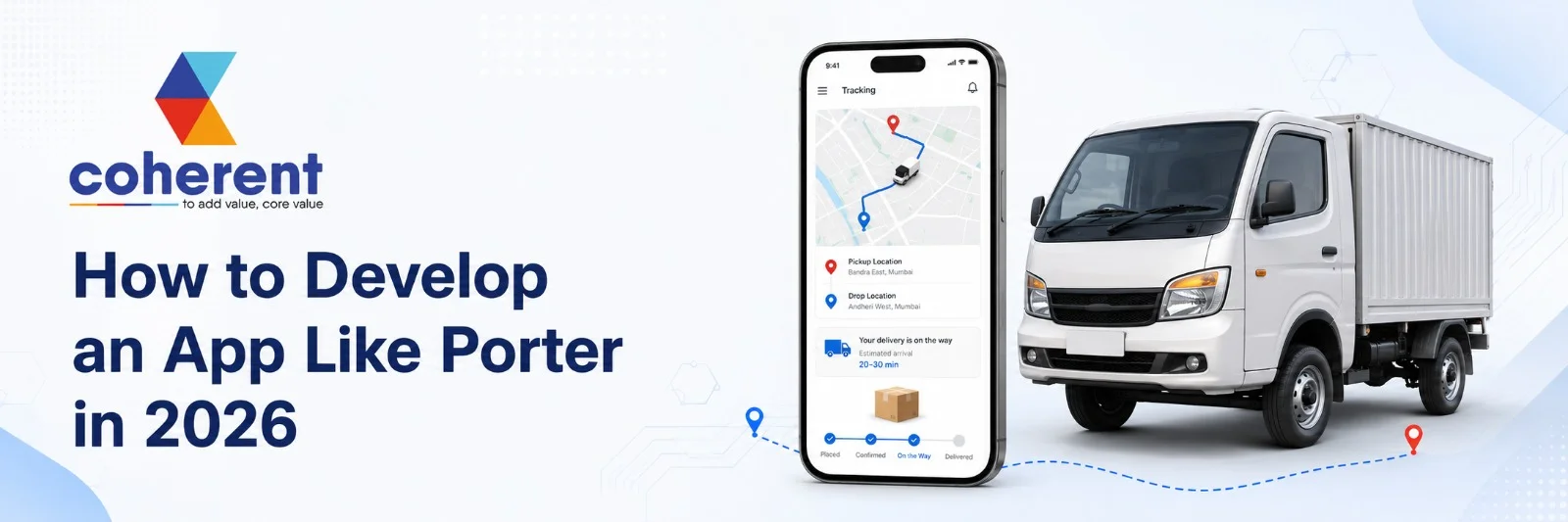
The rise of on-demand logistics has changed how individuals and businesses move goods across cities. Apps like Porter simplify transportation by connecting customers with suitable vehicles and driver-partners through a digital booking platform. Porter currently offers multiple vehicle categories and app-based goods transportation services, making it a useful reference for entrepreneurs planning a logistics marketplace.
If you want to develop an app like Porter in 2026, you need more than a booking interface. Your platform should combine real-time GPS tracking, automated driver allocation, transparent pricing, secure payments, route optimization, customer support, and scalable backend infrastructure. This guide explains the features, development process, technology stack, business model, estimated cost, monetization strategies, challenges, and future opportunities involved in building a Porter-like logistics app.
What Is a Porter-Like Logistics App?
A Porter-like logistics app is an on-demand transportation marketplace that connects customers who need to move goods with available drivers and vehicles. The platform can support two-wheelers, three-wheelers, mini trucks, tempos, and larger commercial vehicles depending on its target market. Customers can enter locations, choose a vehicle, receive an estimated fare, book transportation, and track the trip.
Core Working Model
- Customer side: Users create a booking by entering pickup and destination details, selecting goods information, and choosing an appropriate vehicle.
- Driver side: Verified driver-partners receive nearby requests, accept suitable orders, navigate to the pickup point, and complete deliveries.
- Admin side: Administrators manage users, drivers, vehicles, bookings, pricing, payments, disputes, promotions, and analytics.
- Marketplace model: The platform earns revenue by connecting transportation demand with available supply while automating booking, dispatch, tracking, and payment operations.
Also Read :- Travel App Development 2026: Features, Cost & Trends
Why Develop an App Like Porter in 2026?
The logistics industry is increasingly moving toward digital-first transportation services because customers want faster booking, transparent pricing, real-time visibility, and convenient payment options. Porter itself describes its services around on-demand goods transportation, vehicle selection, online booking, and fare estimation. A new logistics startup can target underserved cities, specialized cargo categories, B2B transportation, or niche delivery requirements.
Key Market Opportunities
- On-demand transportation: Customers can request vehicles whenever transportation is required instead of depending entirely on traditional offline operators.
- B2B logistics: Retailers, wholesalers, manufacturers, restaurants, and small businesses can use the platform for recurring transportation requirements.
- Local delivery: Same-day intra-city movement can serve businesses that need fast transportation between stores, warehouses, offices, and customers.
- Specialized services: Entrepreneurs can create niche offerings for furniture movement, commercial supplies, EV logistics, scheduled distribution, or other permitted goods categories.
Essential Features to Develop an App Like Porter
A successful logistics platform needs three connected products: a customer app, driver-partner app, and admin dashboard. The customer experience should simplify booking, while the driver app supports efficient order management, tracking, and navigation. The admin system connects everything through centralized controls. Combining these components through professional Android App Development creates a complete on-demand logistics ecosystem rather than a basic transportation booking app.
Customer, Driver, and Admin Features
- Customer app: Registration, pickup and drop locations, vehicle selection, fare estimates, multiple stops, booking confirmation, live tracking, digital payments, booking history, ratings, notifications, coupons, invoices, and customer support.
- Driver app: Registration, KYC/document verification, vehicle details, availability status, booking requests, navigation, trip acceptance, delivery updates, earnings, wallet, incentives, ratings, and support.
- Admin dashboard: User management, driver management, vehicle management, booking monitoring, pricing controls, commission management, payment tracking, promotions, complaints, reports, and analytics.
- Real-time operations: GPS tracking, automated driver matching, ETA updates, push notifications, trip-status changes, route monitoring, and automated alerts should work together to provide reliable logistics visibility.
How Does a Porter-Like App Work?
A Porter-like logistics app can follow a seamless marketplace workflow, from submitting a transportation request to successful delivery. The process may include selecting a service, entering pickup and drop locations, adding stops, choosing a vehicle, providing goods details, selecting payment, and confirming the booking. Coherent Lab LLP can help transform this workflow into a user-friendly, scalable logistics solution tailored to specific business requirements and customer needs.
Step-by-Step Booking Workflow
- Step 1 – Request: The customer enters pickup, destination, contact, goods, and vehicle requirements.
- Step 2 – Pricing: The system calculates an estimated fare using distance, vehicle category, demand, pricing rules, and applicable fees.
- Step 3 – Matching: The dispatch engine identifies suitable available drivers based on location, vehicle type, capacity, availability, and operational rules.
- Step 4 – Delivery: The driver accepts the request, reaches the pickup point, transports the goods, updates trip status, and completes delivery while the customer receives tracking updates.
Also Read :- Top Ride-Sharing Apps in India: Best Apps to Book Rides
Technology Stack for Porter-Like App Development
The technology stack directly affects performance, scalability, security, development speed, and long-term maintenance. For a modern logistics application, developers should select technologies that support real-time communication, location services, payment processing, analytics, and high-volume booking operations. Cross-platform frameworks can reduce development time for an MVP, while native development may be considered when highly specialized platform capabilities or performance requirements justify it.
Recommended Technology Stack
- Mobile development: Flutter or React Native can support cross-platform development, while Kotlin and Swift can be selected for native Android and iOS applications.
- Backend: Node.js, Python, Java, or Go can power APIs, booking systems, authentication, pricing engines, driver matching, and business logic.
- Database and infrastructure: PostgreSQL or MySQL can manage transactional data, MongoDB can support flexible data structures, and Redis can improve caching and real-time performance.
- Cloud and APIs: AWS, Google Cloud, or Azure can provide infrastructure, while mapping, payment, SMS, OTP, push notification, analytics, and communication APIs extend platform functionality.
How to Develop an App Like Porter Step by Step
Successful logistics app development should begin with business validation instead of immediately writing code. Define your target customers, launch geography, vehicle categories, pricing model, driver acquisition strategy, and minimum viable features first. Once the business model is validated, the development team can design the product architecture, build the MVP, test real-world workflows, launch in a controlled market, and continuously improve the platform using operational data.
Development Process
- Research and planning: Analyze competitors, customers, transportation requirements, pricing, regulations, launch cities, vehicle categories, and potential revenue opportunities before development begins.
- UI/UX and MVP: Design simple customer and driver journeys, then develop the essential booking, driver matching, GPS tracking, payment, notification, and administration features.
- Testing and deployment: Conduct functional, usability, security, API, GPS, payment, performance, and load testing before publishing the applications and opening the service to customers.
- Optimization and scaling: Monitor bookings, cancellations, driver utilization, delivery times, customer feedback, and revenue metrics, then use these insights to improve algorithms and expand operations.
How Much Does It Cost to Develop an App Like Porter in 2026?
The cost of developing a Porter-like logistics application depends on product complexity, platforms, features, integrations, development location, team expertise, security, and ongoing support. A basic MVP may require a modest budget, while a multi-city platform with AI, analytics, automated dispatch, enterprise integrations, and scalable cloud infrastructure can cost more. Therefore, mobile app development costs should be estimated according to specific business and technical requirements.
Estimated Development Budget
| App Type | Typical Scope | Estimated Cost | Development Time |
|---|---|---|---|
| Basic MVP | Booking, driver app, GPS, payments, admin | $20,000–$40,000 | 3–5 months |
| Mid-Level Platform | Advanced tracking, pricing, notifications, analytics | $40,000–$80,000 | 5–8 months |
| Advanced Platform | AI, automation, enterprise tools, scalable architecture | $80,000–$150,000+ | 8–12+ months |
These figures are planning ranges rather than fixed quotations. Your final budget should be calculated after defining the feature list, platform requirements, UI/UX scope, integrations, testing requirements, and team location.
How Does a Porter-Like App Make Money?
A logistics marketplace can generate revenue from multiple sources instead of depending on a single commission model. The strongest monetization strategy depends on customer type, city economics, transportation category, driver supply, and booking frequency. A platform can combine transaction commissions with service fees, business subscriptions, premium logistics products, and value-added services while maintaining transparent pricing for customers and attractive earning opportunities for drivers.
Revenue Models
- Commission: Charge a percentage or fixed amount from completed transportation bookings handled through the marketplace.
- Service fees: Add clearly disclosed platform, convenience, delivery, or operational fees based on the service structure.
- Business plans: Offer recurring accounts, dashboards, consolidated billing, APIs, and logistics management tools to business customers.
- Premium services: Generate additional revenue from specialized transportation, priority fulfillment, advanced tracking, enterprise integrations, or other value-added logistics services.
Also Read :- Top Apps Like Uber Eats for Food Delivery & Alternatives
AI and Advanced Features for a Porter-Like App
AI can make a logistics marketplace more efficient by solving practical challenges through AI app development. Startups can use AI for demand forecasting, driver allocation, route optimization, fraud detection, customer support, and accurate delivery-time estimates. These capabilities help reduce operational effort, improve decision-making, and create a more scalable logistics platform as the business expands across multiple cities and manages larger transportation networks.
AI-Powered Logistics Capabilities
- Demand forecasting: Predict booking demand by location, time, day, season, and customer segment to improve driver availability.
- Intelligent dispatch: Recommend or automatically assign suitable drivers based on distance, vehicle category, availability, historical performance, and operational constraints.
- Route optimization: Analyze traffic, distance, stops, and delivery priorities to recommend efficient routes and improve estimated arrival times.
- AI support and analytics: Use conversational AI for common customer questions and machine learning models to identify unusual cancellations, fraud patterns, and operational bottlenecks.
How to Make a Porter-Like App Scalable and Secure?
Scalability should be considered before the application receives thousands or millions of bookings. A logistics platform continuously handles location updates, booking requests, driver availability, payments, notifications, and status changes. Poor architecture can cause delays or outages during demand spikes. Security is equally important because the application processes personal information, location data, payment information, driver documents, and business transaction records.
Scalability and Security Practices
- Cloud architecture: Use scalable cloud infrastructure, load balancing, caching, monitoring, and automated deployment to handle changing demand.
- Real-time infrastructure: WebSockets or similar technologies can support live driver locations, booking updates, delivery status, and ETA notifications.
- Data protection: Apply encryption, secure authentication, role-based permissions, token protection, API security, logging, and regular vulnerability testing.
- Performance optimization: Use database indexing, caching, asynchronous processing, optimized APIs, and background jobs to maintain responsiveness as bookings increase.
Also Read :- Courier Apps: Revolutionizing the Delivery Industry
How to Launch a Porter-Like App Successfully
Launching a logistics app in every major city from day one can create unnecessary operational complexity. A better approach is to validate the business model in one carefully selected market, measure performance, improve the product, and then expand. Start with a focused customer segment and a manageable vehicle network. Once the marketplace achieves healthy booking volume and driver utilization, the company can introduce additional services and locations.
Launch Strategy
- Choose one market: Select a city or service area where transportation demand, driver availability, and competitive conditions create a strong opportunity.
- Launch the MVP: Start with essential customer, driver, admin, GPS, payment, and booking features instead of building every advanced capability immediately.
- Build both sides: Run customer acquisition and driver-partner acquisition together so that demand does not exceed supply and drivers have sufficient booking opportunities.
- Measure performance: Track completed trips, cancellation rate, customer acquisition cost, driver utilization, average order value, repeat bookings, delivery time, and customer satisfaction.
Future Trends in On-Demand Logistics App Development
The next generation of logistics applications will focus on intelligent automation, real-time visibility, connected vehicles, predictive analytics, and more personalized transportation services. AI can help platforms anticipate demand and improve dispatch decisions, while IoT devices can provide additional fleet information. Businesses will also increasingly expect APIs, centralized dashboards, automated billing, and multi-location logistics management rather than simple transportation booking.
Emerging Opportunities
- AI logistics automation: Predictive demand, intelligent dispatch, route optimization, automated support, and operational forecasting can reduce manual intervention.
- Electric vehicle integration: EV fleets can become part of urban logistics strategies where charging infrastructure and operating economics support adoption.
- Enterprise logistics: Businesses can receive centralized booking, multi-user access, reporting, invoicing, APIs, and transportation management capabilities.
- Connected fleet management: IoT sensors, telematics, vehicle diagnostics, and real-time data can provide deeper visibility into fleet utilization and performance.
Also Read :- Mobile App Development Process: Step-by-Step Guide
Conclusion
Developing an app like Porter in 2026 requires marketplace strategy, mobile app development, real-time logistics, driver management, secure payments, and scalable infrastructure. Start with an MVP featuring booking, vehicle selection, GPS tracking, driver management, payments, and administration. As demand grows, introduce AI dispatch, route optimization, analytics, enterprise integrations, and automation. A successful Porter-like platform should solve transportation challenges better, build reliable driver supply, offer transparent pricing, and create a scalable logistics ecosystem. Get in touch with our team to turn your logistics app idea into a reliable, growth-ready digital platform.
Frequently Asked Questions
Q1. How much does it cost to develop an app like Porter?
Ans. The cost can range from approximately $20,000 for a basic MVP to $150,000 or more for an advanced logistics platform. The actual price depends on features, platforms, UI/UX complexity, GPS tracking, payment integrations, backend architecture, AI capabilities, testing, security, development-team location, and maintenance. A detailed requirement document should be prepared before requesting a final development estimate.
Q2. How long does it take to build a Porter-like app?
Ans. A basic Porter-like MVP can take around three to five months, while a mid-level application may require five to eight months. Advanced platforms with AI, enterprise integrations, sophisticated dispatch systems, analytics, and scalable infrastructure can take eight to twelve months or longer. The timeline also depends on the number of platforms, integrations, testing requirements, development team size, and feature complexity.
Q3. What features should a Porter-like app have?
Ans. Essential features include customer registration, pickup and destination selection, vehicle selection, fare estimation, booking, driver matching, real-time GPS tracking, digital payments, notifications, booking history, ratings, and support. The driver application should include verification, availability, booking requests, navigation, earnings, and trip management. An admin panel should manage customers, drivers, vehicles, pricing, bookings, payments, complaints, and analytics.
Q4. How does a Porter-like logistics app make money?
Ans. A Porter-like application can generate revenue through booking commissions, platform or service fees, business subscriptions, premium transportation services, enterprise solutions, and specialized logistics offerings. The platform can use different monetization models for individual customers and businesses. Before launching, founders should evaluate local transportation costs, driver earnings, customer willingness to pay, competition, booking frequency, and operational expenses.
Q5. Which technology stack is best for a logistics app?
Ans. Flutter or React Native can be suitable for cross-platform mobile development, while Kotlin and Swift are options for native applications. Node.js, Python, Java, or Go can power the backend. PostgreSQL, MySQL, MongoDB, and Redis can handle different data requirements. AWS, Google Cloud, or Azure can provide scalable infrastructure. Mapping, payment, notification, authentication, analytics, and communication APIs complete the technology ecosystem.
Q6. Can I build a Porter-like app using Flutter?
Ans. Yes, Flutter can be a practical choice for developing a cross-platform logistics application because it allows teams to build Android and iOS applications from a shared codebase. It can support booking interfaces, driver dashboards, location features, notifications, payment flows, and other common functionality. However, the final technology decision should consider performance requirements, native integrations, development expertise, scalability, and long-term maintenance.
Q7. How does real-time tracking work in a logistics app?
Ans. Real-time tracking generally combines GPS location data from the driver’s smartphone with a backend system that processes and distributes location updates. The customer application receives updated coordinates and displays the driver’s approximate position on a digital map. Technologies such as location APIs, WebSockets, geofencing, mapping services, caching, and optimized backend communication can help provide responsive tracking without unnecessarily consuming device resources.
Q8. How can AI improve a Porter-like logistics app?
Ans. AI can improve a logistics marketplace by predicting transportation demand, recommending suitable drivers, optimizing routes, estimating delivery times, detecting unusual booking behavior, and automating customer support. Machine learning models can analyze historical bookings, locations, traffic patterns, cancellations, and driver performance to improve operational decisions. AI should be introduced around measurable business problems so that automation improves efficiency, customer experience, driver utilization, or profitability.

 +91 774-202-1725
 +1 (945) 3387904
 business@coherentlab.com
 +49 15223341304
 UK
UK