Ready to launch your travel app? Contact us today and hire expert Flutter app developers to build your dream app fast!

Table of Contents
Mobile App Development
Travel App Development Guide 2026: Features, Cost, Trends & Step-by-Step Process
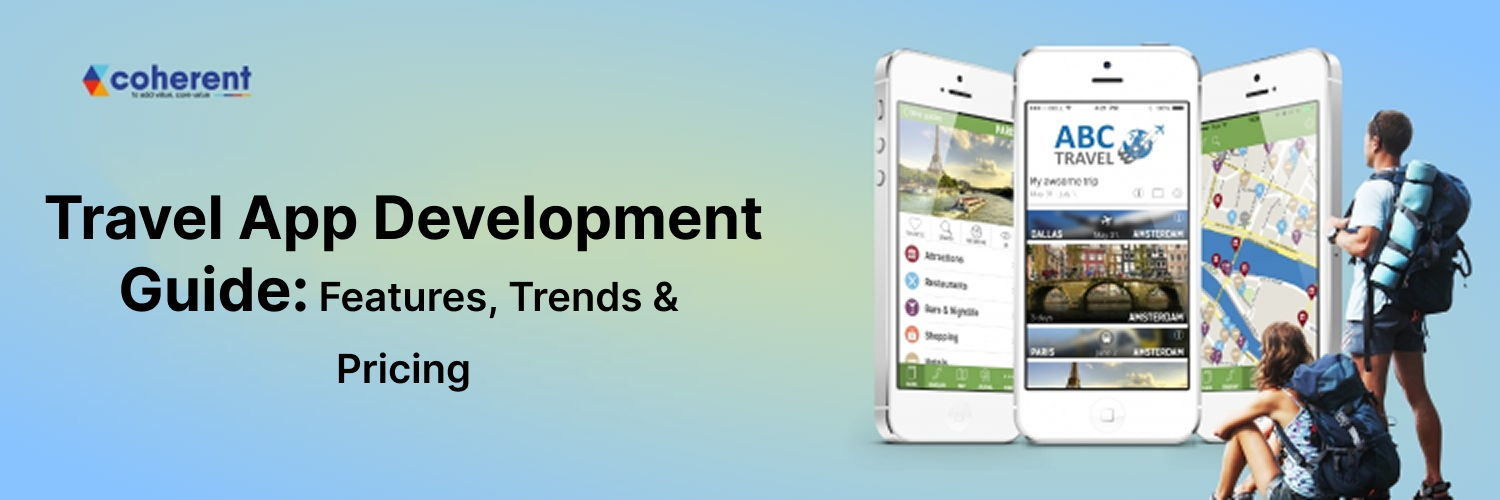
Planning a travel app in 2026? The travel industry is transforming faster than ever with AI-powered personalisation, AR-based navigation, and secure blockchain payments. Travellers now expect seamless booking, real-time updates, and smart recommendations — all in one place. If your business wants to stay competitive, investing in travel app development is no longer optional; it’s essential.
Modern travel apps are helping companies boost customer engagement, increase direct bookings, and build long-term loyalty. From flight and hotel reservations to itinerary management and in-app support, users want convenience, speed, and personalisation. Businesses that deliver this experience are seeing higher retention and stronger brand trust.
In this complete guide, you’ll discover key features, development costs, latest trends, monetisation strategies, and expert tips to build a successful travel app in 2026. Let’s turn your travel app idea into a scalable digital product.
What is a Travel App?
A travel app is a mobile or web application that helps users plan, book, and manage trips in one place. It allows travellers to search flights, reserve hotels, book transport, explore destinations, and access real-time travel updates.
Modern travel apps also offer AI-based recommendations, digital payments, itinerary tracking, and customer support, making travel planning faster, smarter, and more convenient.
Read More: Discover the Best Rideshare Apps: Your Ultimate Travel Companion!
Key Features of a Travel App

Better travel operations offer a better user experience through travel mobile app development. From booking systems to real-time updates, these features improve user satisfaction when implemented properly. The features are as follows:
Seamless Booking System
The booking system of travel applications requires simple accessibility. The application needs to provide a simple booking mechanism for flights together with hotels, car rentals, and travel activities. An international travel app development solution requires multiple payment options because this ensures a frictionless experience for its worldwide user base.
Real-Time Updates & Notifications
Users need instant alert systems for any flight delay or nearby event notifications as well as weather conditions. The strong notification system present in top-rated travel apps keeps users well-informed to deliver an improved experience.
AI-Based Personalised Recommendations
Travel app development improves from AI because it tells user behaviour patterns to deliver personalised suggestions. Through AI functionalities, the app selects hotels together with activities and destinations to enrich the user journey. The best travel app development delivers excellence depending on its ability to provide personalised solutions.
Offline Accessibility
Travellers often experience inadequate internet signals so they need products that operate offline. The essential features that a mobile app development company should offer are to provide offline capabilities for maps, along with itineraries and guides. The system enables users to move through the software without any interruptions.
Benefits of a Travel App

Technology progress in digital solutions has transformed how people manage travel through new software development for travel applications. Travel app development enhances the convenience of users and simultaneously generates substantial growth prospects for businesses. These benefits are as follows:
Improved User Experience
A carefully designed travel mobile application solution creates a unified platform for all required travel services. Users now find all their travel needs to be consolidated in one single app instead of using numerous separate applications. With this, the best travel app for android makes an impact in the travel world due to their interface as well.
Increased Business Revenue
A best travel app development project generates various revenue channels for businesses to succeed. Companies apply commission-based booking methods alongside in-app advertising for premium membership programs to multiply their profits. Travel app development enables businesses to reach more customers which results in increased total revenue.
Stronger Customer Engagement
Business success in travel depends heavily on maintaining active customer participation. AI recommendations along with chatbots and loyalty programs, serve as active user participation. Travel apps for iPhone or Android users become more satisfactory through interactive features that drive user loyalty to the brand.
Improved Travel Safety
Security features that enable safety form an essential component in a well-constructed app for travellers. The safety of users improves through these features, which enable emergency contact insurance options. So, businesses that collaborate with an Android app development company obtain a reliable implementation of these safety features as well.
Costs of Travel App Development

The total costs of travel app development mainly depend on three key aspects: the number of features required, the selected platform alongside the app's complexity. Essential app functionality will cost between $20,000 and $50,000, yet advanced apps that integrate AI and real-time tracking, along with AR and multilingual options, cost more than $100,000.
The total expense hinges on three principal elements, which include using skilled developers alongside Android or iOS choices, together with built-in special features. An iOS app development company should have the professional expertise to build user-specific, high-performance, scalable applications when you choose them.
| Feature / Module | Estimated Cost (USD) | Description |
|---|---|---|
| Basic Travel Booking Features | $5,000 – $10,000 | Flight, hotel, transport search, booking, and basic itinerary management. |
| On-Demand Travel App Features | $10,000 – $20,000 | Taxi booking, real-time tracking, notifications, and chat support. |
| AI & Personalisation Integration | $3,000 – $7,000 | AI recommendations, smart suggestions, and personalized travel experiences. |
| UI/UX Design | $2,000 – $5,000 | User-friendly design, smooth navigation, and responsive interface. |
| API & Third-Party Integrations | $3,000 – $6,000 | Payment gateways, maps, hotels, airlines, and taxi booking APIs. |
| Security & Testing | $2,000 – $5,000 | Encryption, secure authentication, functional and performance testing. |
| Launch & Marketing | $1,000 – $3,000 | App store submission, ASO, and initial digital marketing campaigns. |
| Total Travel App Development Cost | $26,000 – $56,000 | Cost varies depending on app type, features, and custom travel app development company. |
Also Read: Top Mobile App Development Ideas for the Travel Industry
How to Build a Travel App (Step-by-Step Process)
Building a successful travel app in 2026 requires strategic planning, smart technology choices, and a clear understanding of user behaviour. Whether you're targeting travel booking app development, an on-demand travel app, or even taxi booking app development, following a structured process ensures better ROI. Below is a practical step-by-step guide explaining how to build a travel app, control travel app development cost in 2026, and choose the right custom travel app development company.
1. Market Research & Competitor Analysis
Start by analysing market trends, user pain points, and top competitors. Study leading travel and taxi booking app development models to understand features, pricing, and monetisation strategies. Strong research reduces risk and helps position your travel booking app development project effectively.
-
Identify Target Audience & Trends: Analyse customer needs, behaviour, and current market trends to create data-driven strategies that improve positioning and growth opportunities.
-
Evaluate Competitor Strengths & Gaps: Study competitor products, pricing, marketing strategies, and customer feedback to identify opportunities for differentiation and competitive advantage.
2. Choose Travel App Type (Booking, Rideshare, Itinerary Planner)
Define whether you’re building a flight/hotel booking platform, an on-demand travel app, or a taxi booking app development solution. Each type requires different features, APIs, and investment levels. Choosing the right model directly impacts your travel app development cost in 2026.
-
Booking App: Allow users to book flights, hotels, and holiday packages seamlessly, similar to platforms like Booking.com, with secure payments and real-time availability.
-
Rideshare App: Provide on-demand transportation services like Uber, featuring live tracking, fare estimation, and driver ratings.
-
Itinerary Planner App: Help travelers organize trips, manage schedules, and discover attractions, inspired by tools like TripIt for smarter travel planning.
3. Define Core Features
List must-have features like search filters, real-time booking, secure payments, GPS tracking, AI recommendations, chat support, and itinerary management. Clear feature planning helps your custom travel app development company estimate budget, timeline, and technology requirements accurately.
-
User Registration & Profiles: Enable secure sign-up/login with email, mobile, or social accounts, along with personalised user dashboards.
-
Advanced Search & Filters: Allow users to search flights, hotels, rides, or destinations with smart filters for price, ratings, location, and availability.
-
Real-Time Notifications: Send instant updates for booking confirmations, ride status, price drops, and travel reminders.
4. Select Tech Stack (Flutter, React Native, AI APIs)
Choose scalable technologies such as Flutter or React Native for cross-platform development. Integrate AI APIs for personalisation, maps for navigation, and secure payment gateways. The right tech stack improves performance while optimising overall travel booking app development costs.
-
Flutter for Cross-Platform Development: Hire a skilled Flutter app developer to build high-performance, visually rich apps for both Android and iOS using a single codebase, ensuring faster development and cost efficiency.
-
React Native for Flexible UI: Use React Native to create scalable mobile applications with reusable components and strong community support.
5. UI/UX Design
Design a clean, user-friendly interface with intuitive navigation and fast booking flow. Travellers prefer minimal steps and quick confirmations. A well-designed UI/UX increases engagement, reduces bounce rates, and strengthens your on-demand travel app’s market competitiveness.
-
User-Centric Design Approach: Create a clean, intuitive interface that makes booking, searching, and trip planning simple and stress-free for users.
-
Easy Navigation & Clear Layouts: Use structured menus, bottom navigation bars, and minimal design elements to improve usability and reduce confusion.
6. Development & API Integration
Begin frontend and backend development while integrating third-party APIs for flights, hotels, payments, maps, and taxi booking app development systems. Ensure seamless data synchronization and real-time updates to deliver a smooth, reliable booking experience.
-
Backend & Server Setup: Develop a secure and scalable backend to manage user accounts, bookings, and app logic efficiently.
-
API Integration: Integrate essential APIs such as flight and hotel booking, rideshare services, maps, payment gateways, and AI-powered recommendations for real-time functionality.
7. Launch & Marketing
Deploy your app on Google Play and the App Store with ASO-optimised descriptions. Use digital marketing, SEO, influencer campaigns, and paid ads to attract users. Partnering with a reliable custom travel app development company ensures smooth post-launch support and scaling.
-
App Store Submission: Publish your travel app on Google Play Store and Apple App Store with optimised descriptions, screenshots, and keywords for maximum visibility.
-
Pre-Launch Marketing: Create buzz through social media teasers, email campaigns, influencer collaborations, and landing pages to attract early users.
Future Trends of Travel App Development

Technology advances in the travel industry continue to remodel both user travel procedures and tourist experiences. Travel app development for modern times aims to provide better user convenience as well as safety measures alongside customisation features. These are as follows:
AI & Chatbots for Virtual Assistance
Travel app development gets transformed through AI-powered chatbots that automatically deal with reservations as well as manage itineraries and customise suggestions. Virtual assistants working through automation decrease the requirement for human handling, which results in higher operational performance. Users enjoy better satisfaction and remain more engaged with the best travel apps on Android.
Augmented Reality (AR) for Interactive Experiences
Travellers benefit from online virtual tours together with interactive maps and real-time translation features, which simplify their navigation. AR technology brings the most advanced Android and iOS travel application, which provides passengers with engaging information throughout their journey.
Blockchain for Secure Transactions
The primary security priority in creating the best travel apps gets support from blockchain technology which brings secure financial transactions alongside transparency. Through blockchain technology, users can prevent booking fraud in the hotel industry as well as authenticate identities in a decentralised manner. The implementation of advanced security measures in iOS apps could be ensured through collaboration with a trustworthy USA-based iOS app development company.
Voice Search & Command Integration
Travel mobile app development introduces voice search functionality because users increasingly use voice assistants in their devices for hands-free interactions. Users benefit from voice commands which give them the ability to search hotels as well as book flights. The inclusion of this feature supplies essential travel convenience that drives top-rated travel application success.
Conclusion
Travel app development through modern technology methods transforms the way people both plan and undertake their trips in our present digital age. Modern travel apps redefine the future of the travel industry by using AI recommendations together with blockchain security features. Business establishments and startup companies should invest in modern travel applications to enhance customer retention and grow their market presence. The first essential step to developing the next large travel industry breakthrough involves working with a trustworthy travel app development company. Those who are ready to shape the travel industry through mobile apps should consider embracing it now.
Frequently Asked Questions (FAQs)
Q1. What are the essential features of a travel app?
The travel app needs to provide users with features such as booking functionality along with up-to-date information and artificial intelligence-based suggestions. The app also should work offline and feature the safe payment protocols as well. Travel apps contain multiple services like interactive map tools and itinerary organizers together with automated chatbots, which strengthen both user engagement and experience.
Q2. How long does it take to develop a travel app?
The application development duration depends significantly on the application's design complexity, together with its feature set. Straightforward travel apps require approximately 3 to 6 months to develop whereas comprehensive versions with AI, AR, and blockchain security usually need between 9 and 12 months or additional time. Customisation choices, along with third-party integration implementations, push forward or delay the development period.
Q3. What is the cost of developing a travel app?
Travel app development costs depend on the number of built-in features, together with the selected platforms for deployment. An app with basic features falls between $20,000 - $50,000 yet an advanced travel app incorporating AI, AR, and multilingual attributes costs more than $100,000. Professional development teams influence the final expense of the project.
Q4. What are the advantages of hiring an experienced travel app development company?
Experienced developers provide faster delivery, scalable architecture, reliable API integration, advanced security, and a polished UI—ensuring long-term business success.
Q5.What is the most affordable platform to build a travel app for startups?
Using a cross-platform framework like Flutter or React Native is the most cost-effective option for startups because it allows building both iOS and Android apps using one codebase, reducing overall development time and cost.
Q6. What technologies are essential for modern travel app development?
AI, AR, blockchain security, cloud integration, GPS tracking, voice search, and secure payment systems are essential for building advanced travel applications.
Q7. What are the advantages of integrating chatbot support in a travel booking app?
Chatbots provide 24/7 assistance for flight bookings, cancellations, refunds, itinerary support, and frequently asked questions—reducing customer support load.

 +91 774-202-1725
 +1 (945) 3387904
 business@coherentlab.com
 +49 15223341304
 UK
UK