Table of Contents
Building an Ecommerce Video Stack With a Marketing Video Maker
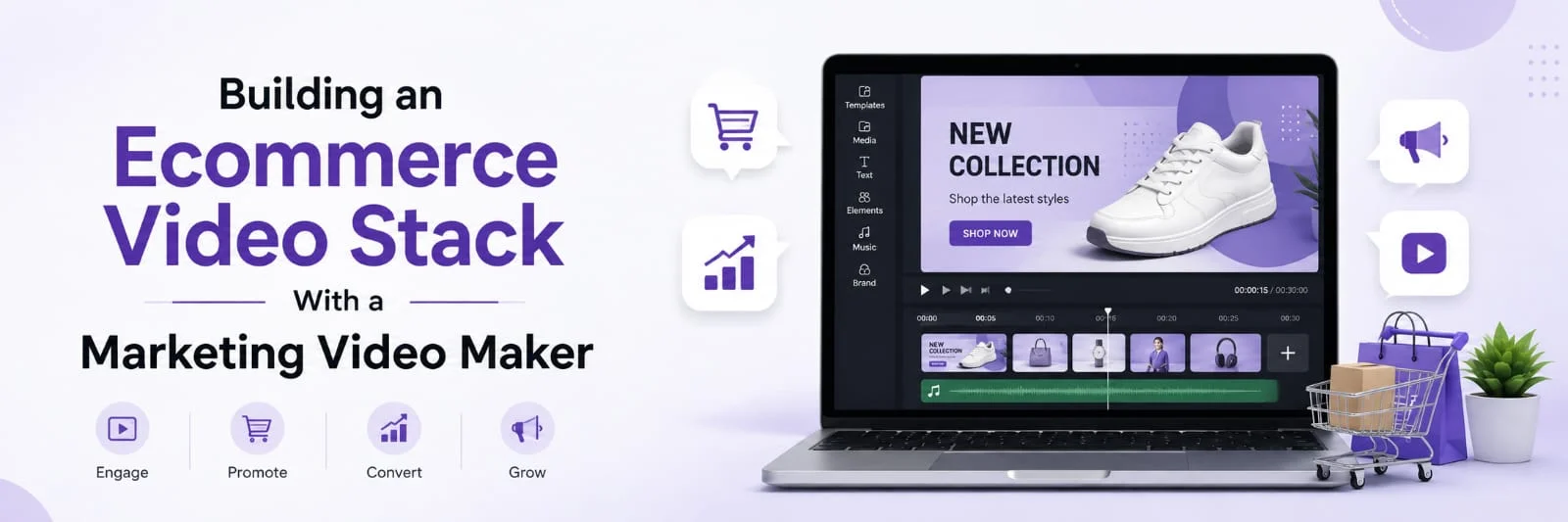
Most ecommerce tool stacks have a visible gap. There's a platform holding the catalogue, an email system, an ad manager, an analytics layer and usually a product information tool keeping specifications consistent. Everything is connected, everything syncs, and then video sits entirely outside it produced in a separate application by a separate person, delivered as files, uploaded manually, and disconnected from any of the data that describes what's actually in the catalogue. It's the last major asset type still handled as a craft process rather than an operational one, and that's beginning to change.
Video Is the Only Asset Not Wired Into the Stack
Consider how a product description works in a well-run operation. It lives in a central system, syncs to the storefront, feeds the shopping feed, populates the marketplace listing and updates everywhere when edited once.
Now consider a product video. It exists as a file. Nobody knows which version is current. The one on the marketplace listing is from last year, the storefront has a different cut, and the ad account has three variants a freelancer produced whose source files are gone. Nothing about this is connected to the catalogue.That disconnection produces real operational cost not just in production, but in the ongoing drift between what the catalogue says and what the video shows.

Tools built around catalogue input rather than timeline editing are what close this gap. Pollo AI's Marketing Video Maker functions at that layer: it draws from structured sources a store already maintains, including live listing URLs, image libraries, existing clips and written product copy, then assembles them into finished promotional videos with sales-oriented structure applied automatically. Because the input is the catalogue record rather than a manually assembled brief, the output stays tethered to the source of truth in a way that traditional editing workflows never have.
Where Video Belongs in an Operational Stack
If you map an ecommerce stack by function, video should sit alongside content generation rather than in the creative department. Its inputs are product data. Its outputs are distributed to channels. That's the same shape as a feed management tool.
Framing it this way changes how teams evaluate options. The relevant questions stop being about editing capability and become operational ones: what does it ingest, can it batch, does it export to every placement specification, and how much manual handling sits between input and published asset. Teams that evaluate video tools on creative sophistication alone typically end up with something powerful that produces four assets a quarter, which solves nothing.
The Compounding Cost of Manual Handling

The hidden expense in most ecommerce video operations isn't production. It's the handling around it. Downloading exports, renaming files, resizing for placements, re-uploading to four destinations, updating spreadsheets so somebody knows which version is live. For a store running video across thirty products and five channels, that administrative layer routinely exceeds the actual production time.
Reducing it is unglamorous work with an immediate return. Every step removed between generation and publication is time recovered permanently, and it's usually the difference between a video programme that survives a busy quarter and one quietly abandoned in November.
A Complementary Option for Multi-Scene Production
Operational tooling doesn't cover everything. Some work brand films, campaign narratives, anything requiring continuity across several scenes needs a more deliberate production environment, and a well-built stack often includes both.

DeeVid AI fills that role for many teams. Its producer-guided process structures planning, generation and editing across a large template library while preserving stylistic and character consistency between separate segments. It assigns the most suitable model to each shot automatically, supports defining opening and closing frames so the motion between them is generated coherently, and integrates advanced speech synthesis with AI-generated scoring. It also handles structured variant production for split testing and localisation across a wide language range with precise lip and emotion matching.
Sensible stack design uses the operational tool for catalogue-driven volume and the production tool for the handful of pieces that genuinely warrant creative direction.
Wiring Video Into an Existing Ecommerce Stack
Start From the Product Feed, Not the Asset Library
Export your product feed and use it as the production queue rather than working from a folder of images. The feed already contains the accurate title, current price, live specifications and the canonical URL for each item. Working from it eliminates the most common error in ecommerce video, which is publishing an asset describing a configuration you no longer sell.
Establish Naming and Versioning Before Producing Anything
Agree a file convention that encodes SKU, aspect ratio, message variant and date, and enforce it from the first asset. This sounds like bureaucratic overhead until the third quarter, when there are two hundred files and nobody can determine which version is currently running on the marketplace listing. Version control is the difference between a video library and a video archaeology problem.
Batch by Campaign, Then Fan Out to Channels
Group production by campaign or category rather than producing per channel. Building each concept once through Pollo AI's Marketing Video Maker and then exporting into the formats each destination requires means one approved message reaches social placements, the product page, email and paid channels without separate builds or reinterpretation. Fanning out from a single master is also what keeps messaging consistent across surfaces, which fragmented per-channel production reliably destroys.
Close the Loop With Performance Data
Tag every asset, so performance can be attributed back to the specific message and format, then review monthly. Most stores never do this, which means they produce video indefinitely without ever learning which type earns its place. The teams treating video as an operational asset rather than a creative deliverable are precisely the ones measuring it like one.
Operational Maturity Is the Real Upgrade
The interesting change here isn't that video production got cheaper. It's that video became something a stack can handle systematically rather than something outsourced and hoped for.
That's the same transition product copy went through a decade ago, when it moved from a marketing task to a managed data field synced across every channel. Nobody would run a catalogue without central copy management today. Video is following the same path, several years behind.
Whether a store layers DeeVid AI over its stack for campaign work or standardises on feed-driven generation for catalogue coverage, the durable advantage comes from treating video as infrastructure. Tools change constantly. Operational discipline is what persists.

 +91 774-202-1725
 +1 (945) 3387904
 business@coherentlab.com
 +49 15223341304
 UK
UK