Table of Contents
How to Build an Online Furniture Shopping App in 2026: Features, Cost & Development Guide
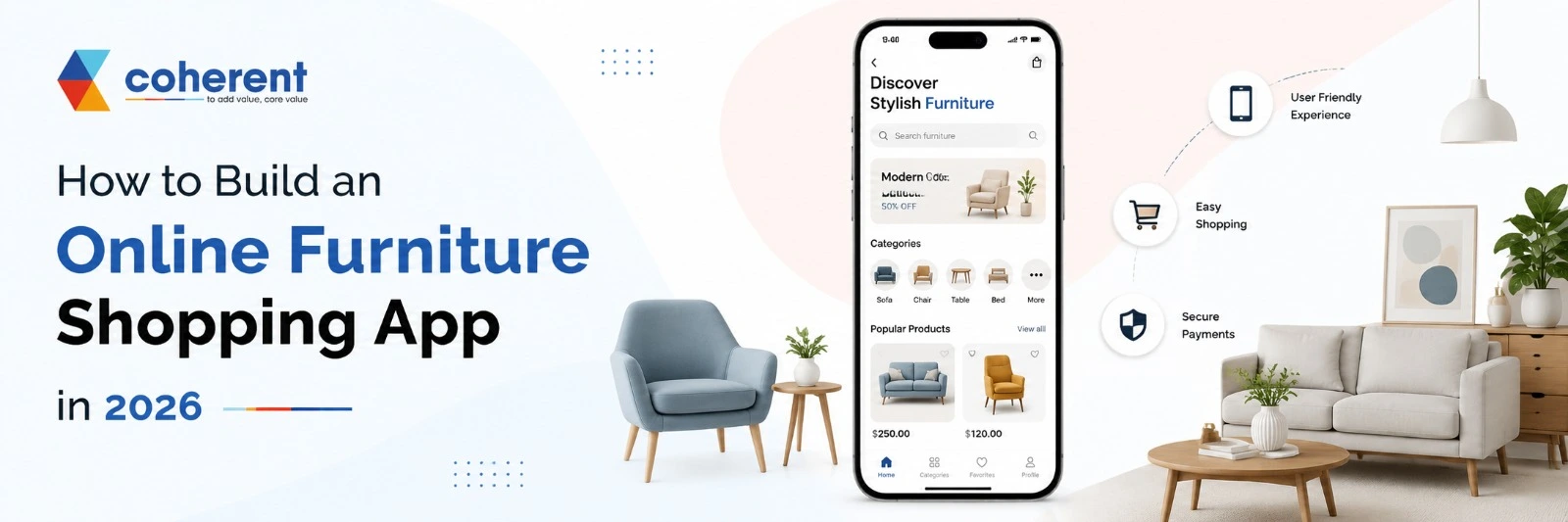
The way people buy furniture is changing. Customers no longer want to spend an entire weekend visiting furniture stores, comparing prices, and imagining whether a sofa will fit in their living room. In 2026, they expect a fast, personalized, mobile-first furniture shopping experience where they can discover products, visualize furniture in their homes, compare options, pay securely, and track delivery from one app.
If you are a furniture retailer, startup, marketplace, or home décor brand planning to enter the digital market, building an online furniture shopping app can open the door to a much larger customer base.This guide explains how to build a furniture shopping app in 2026, including essential features, AI technologies, development steps, technology stack, integrations, estimated cost, monetization strategies, and future trends.
What Is an Online Furniture Shopping App?
An online furniture shopping app is a mobile or web-based ecommerce platform that allows customers to browse, compare, customize, purchase, and track furniture products digitally.Unlike traditional ecommerce applications, furniture platforms need to solve a major customer challenge: visualization. Customers want confidence that a product will look good and fit correctly in their space before purchasing. Coherent Lab LLP helps businesses build scalable, user-friendly ecommerce and furniture shopping solutions designed around these modern customer needs.
- AI-powered product recommendations
- Augmented Reality (AR) visualization
- 3D furniture models
- Room planning
- Personalized search
Also read:Online Shopping App Development: Advanced Features And Cost
Why Build a Furniture Shopping App in 2026?
The furniture industry is becoming increasingly digital. Customers are comfortable researching products online, comparing multiple sellers, reading reviews, and placing high-value orders through smartphones.For businesses, a furniture shopping app provides a direct digital channel to customers without relying entirely on physical stores or third-party marketplaces.
- Reach customers globally
- Improve customer engagement
- Increase sales opportunities
- Provide personalized experiences
How Much Does It Cost to Build a Furniture Shopping App in 2026?
The cost to develop an online furniture shopping app depends on its features, platform, design complexity, integrations, technology requirements, and development team location. A basic furniture ecommerce app may start around $25,000, while advanced solutions with AI recommendations, AR visualization, 3D models, multi-vendor functionality, and logistics integrations can cost $250,000 or more. Businesses can use professional Mobile App Development Services to build a scalable and feature-rich furniture shopping app.
| Furniture App Type | Estimated Cost | Approx. Timeline |
|---|---|---|
| Basic Furniture Shopping App | $25,000–$45,000 | 3–5 months |
| Medium-Level Furniture App | $45,000–$80,000 | 5–8 months |
| Advanced Furniture Marketplace | $80,000–$150,000+ | 8–12 months |
| AI + AR Furniture App | $120,000–$250,000+ | 10–15+ months |
Essential Features of an Online Furniture Shopping App
The success of an online furniture shopping app depends heavily on the features it offers and how easily customers can use them. A well-designed furniture ecommerce app should make product discovery, visualization, customization, payment, and delivery simple. From AI-powered recommendations and AR visualization to secure checkout and real-time tracking, the right features can improve customer satisfaction, increase conversions, and support long-term scalability.
1. User Registration and Profile
A smooth registration process helps customers start shopping without unnecessary steps. Users should be able to sign up using email, phone numbers, or social accounts. A personalized profile can then keep important shopping information in one place, making repeat purchases and order management much more convenient.
- Wishlist management
- Payment preferences
- Personalized settings
2. Furniture Product Catalog
A detailed and well-organized product catalog is the foundation of any successful furniture shopping app. Customers need accurate information before purchasing large or expensive furniture. High-quality visuals combined with specifications, pricing, availability, and reviews can help users understand exactly what they are buying.
- Stock availability
- Delivery information
- Warranty details
- Customer ratings and reviews
3. Smart Search and Advanced Filters
Furniture marketplaces can contain thousands of products, making intelligent search essential. Customers should be able to quickly narrow down products according to their requirements. AI-powered search can make the experience even better by understanding natural-language queries and delivering relevant furniture recommendations based on the customer's intent.
Useful search filters include:
- Furniture category
- Price range
- Brand
- Material
- Color
4. AI-Powered Furniture Recommendations
AI can turn a traditional furniture store into a highly personalized shopping platform. The recommendation engine can study customer behavior and preferences to display relevant products. This not only makes product discovery easier but can also create opportunities for cross-selling and upselling related furniture and home décor products.
- Preferred furniture styles
- Favorite colors
- Room preferences
5. Augmented Reality Furniture Visualization
AR furniture visualization can solve one of the biggest challenges of buying furniture online: knowing whether a product will actually look good in a customer's space. Using a smartphone camera, customers can virtually place furniture inside their rooms and understand its size, appearance, and placement before completing their purchase.
- View products from different angles
- Capture room screenshots
- Compare different furniture products
6. 3D Furniture Viewer
A 3D furniture viewer gives customers a more detailed understanding of products than traditional photographs. Users can rotate, zoom, and inspect furniture from different perspectives. For premium or customizable products, 3D technology can make online shopping more interactive while helping customers understand dimensions, materials, and available configurations.
- 3D measurements
- Product rotation
- Interactive configurations
- Detailed product visualization
7. Furniture Customization
Customization is particularly valuable for customers purchasing sofas, beds, wardrobes, dining tables, and other made-to-order furniture. A furniture app can allow users to personalize products before placing an order. Showing the updated design and price in real time can make customization easier and provide a more engaging shopping experience.
- Configuration
- Storage options
- Additional accessories
8. Shopping Cart and Wishlist
A simple shopping cart helps customers review products before checkout, while a wishlist allows them to save furniture for later. This is especially useful because furniture purchases often involve research and comparison. Customers may return several times before making a final decision, making wishlist functionality important for retention.
- Calculate delivery charges
- Compare selected products
- Move wishlist items to cart
- Display estimated totals
9. Secure Checkout and Payment Integration
A simple and secure checkout process is essential for converting furniture shoppers into paying customers. Because furniture orders can have high transaction values, customers need confidence in the payment process. The app should clearly display product prices, taxes, discounts, shipping fees, and the final amount before the order is confirmed.
- Bank transfers
- Buy Now, Pay Later
- Cash on delivery, where applicable
- Secure payment gateways
10. Multiple Delivery Options
Furniture delivery requires more planning than standard ecommerce because products can be large, heavy, and difficult to transport. Offering flexible delivery options can improve customer convenience. The app should provide clear delivery estimates and allow customers to select services that match their requirements and budget.
- Standard delivery
- Express delivery
- Scheduled delivery
- Room-of-choice delivery
11. Real-Time Order Tracking
After purchasing furniture, customers want to know exactly where their order is and when it will arrive. Real-time order tracking can provide transparency throughout the fulfillment process. Integrating logistics and GPS services can give customers timely updates from order confirmation through final delivery.
- Order Confirmed
- Processing
- Packed
- Dispatched
12. Ratings and Reviews
Ratings and reviews play an important role when customers purchase furniture online. Buyers often want to know about product quality, comfort, material, appearance, dimensions, and delivery experience before spending money. Allowing verified customers to share detailed reviews, photographs, and videos can increase transparency and build trust.
- Verified purchase badges
- Product-specific reviews
- Helpful review voting
- Delivery and installation feedback
AI Features for a Furniture Shopping App in 2026
AI is becoming an important part of modern ecommerce app development, making furniture shopping more personalized, visual, and convenient. Modern furniture shopping apps can use artificial intelligence to understand customer preferences, recommend suitable products, improve search, and create smarter shopping experiences. Adding AI-powered features can help businesses increase engagement, improve conversions, and deliver personalized experiences. Businesses can partner with an experienced AI App Development Company to build intelligent and scalable furniture shopping apps.
- AI furniture recommendations
- AI shopping assistant
- Natural-language search
- AI room design
Technology Stack for Furniture App Development
Selecting the right technology stack is essential for building a fast, secure, scalable, and maintainable furniture shopping app. The ideal stack depends on your features, target platforms, integrations, and future growth plans. Modern furniture apps can combine mobile development, cloud services, AI, AR, databases, and APIs to deliver smooth shopping experiences across devices. Businesses can also work with an experienced Android App Development Company to build reliable and scalable Android solutions.
| Development Area | Recommended Technologies |
|---|---|
| Android | Kotlin |
| iOS | Swift |
| Cross-Platform | Flutter, React Native |
| Frontend | React.js, Next.js |
| Backend | Node.js, Python, Java |
| Database | PostgreSQL, MySQL, MongoDB |
| Cloud | AWS, Google Cloud, Microsoft Azure |
| AI/ML | Python, TensorFlow, PyTorch |
| AR | ARKit, ARCore |
| APIs | REST APIs, GraphQL |
| Payments | Stripe, PayPal, Razorpay |
| Maps | Google Maps Platform |
| Analytics | Firebase, Google Analytics |
Factors Affecting Furniture App Development Cost
The overall furniture app development cost depends on several technical and business factors. A simple furniture ecommerce application with basic shopping features will require less investment than an advanced platform with AI, AR, 3D visualization, multiple integrations, and marketplace functionality. Understanding these cost factors before development helps businesses prepare a realistic budget, select the right technology stack, prioritize essential features, and avoid unexpected expenses during the development process.
1. Number of Platforms
The number of platforms you choose directly affects development resources and cost. Building separate native Android and iOS applications generally requires different development teams or codebases. A cross-platform approach using technologies such as Flutter or React Native can reduce development effort while allowing businesses to reach customers across multiple devices.
- Android app development
- iOS app development
- Cross-platform development
- Tablet compatibility
- Device testing
2. UI/UX Complexity
The complexity of your furniture app's UI/UX design has a significant impact on the development budget. A straightforward ecommerce interface is generally easier to build than an interactive shopping experience featuring 3D product views, room visualization, animations, customization tools, and personalized product journeys.
- Product visualization
- Navigation structure
- Animations and micro-interactions
- Personalized user journeys
3. AI Development
Adding AI capabilities can make a furniture shopping app smarter and more personalized, but it also increases development complexity. Features such as recommendation engines, AI shopping assistants, visual search, and room design require data processing, model integration, testing, and continuous optimization to deliver accurate and useful results.
- AI-powered room design
- Personalized product feeds
- Customer behavior analysis
- Demand forecasting
4. AR and 3D Technology
AR furniture visualization and 3D technology can create a highly engaging shopping experience, but they require specialized development expertise. Businesses may need accurate 3D furniture models, device compatibility testing, rendering optimization, and AR implementation. The number and complexity of products requiring 3D or AR support can also influence the overall development budget.
- 3D rendering
- Multiple device support
- Product customization
- AR performance optimization
5. Third-Party Integrations
Third-party integrations connect your furniture app with external services such as payments, logistics, inventory, CRM, and ERP platforms. Each integration requires API development, authentication, testing, and maintenance. The number of external services and their technical complexity can therefore have a direct impact on both development time and overall project cost.
- Inventory management
- Google Maps
- Analytics tools
- Push notification services
6. Backend Architecture
A scalable backend is essential for furniture applications expected to handle growing traffic, product catalogs, transactions, and customer accounts. A single-brand store may need a relatively straightforward architecture, while a multi-vendor furniture marketplace requires advanced infrastructure for sellers, inventory, payments, orders, commissions, and large-scale data management.
- Vendor management
- Secure APIs
- Database optimization
- Real-time data processing
How to Monetize a Furniture Shopping App
A furniture shopping app can generate revenue through multiple channels, depending on whether it operates as a single-brand store, marketplace, rental platform, or ecommerce ecosystem. Choosing the right monetization strategy early can help create sustainable revenue while keeping the shopping experience valuable for customers. Businesses can combine product sales with commissions, subscriptions, advertising, premium services, and additional furniture-related offerings.
Popular Monetization Strategies
Different revenue models can be combined depending on the target market and business model. A multi-vendor furniture marketplace, for example, can earn commissions from sellers while also offering premium listings and advertising opportunities. A single-brand app may focus primarily on product sales, delivery services, and additional installation or customization
- Furniture rental fees
- Delivery charges
- Installation charges
- Affiliate commissions
Seller Commission Model
A seller commission model is particularly effective for a multi-vendor furniture marketplace. Sellers can list their products on the platform, while the app owner earns a percentage from every successful transaction. Commission rates can vary according to product category, seller plan, order value, or promotional agreements.
- Fixed transaction fee
- Seller subscription plans
- Premium marketplace packages
- Featured product charges
How to Improve Furniture App User Experience
Furniture is highly visual, and customers often need more information before making a purchase decision. A strong furniture app user experience should make browsing, comparing, visualizing, customizing, and purchasing as simple as possible. Clear product information, high-quality visuals, fast navigation, personalized recommendations, and transparent delivery details can help reduce hesitation and improve conversions.
UX Best Practices
A furniture shopping app should be designed around customer convenience rather than unnecessary complexity. Every screen should help users move closer to making an informed purchase. Combining intuitive navigation with visual product experiences can make the application more engaging while creating confidence throughout the buying journey.
Make Product Discovery Easier
Customers should be able to find the right furniture without scrolling through hundreds of irrelevant products. Smart search, category navigation, filters, personalized recommendations, and visual search can significantly improve product discovery and reduce the time required to find suitable furniture.
Build Trust Before Checkout
Customers may hesitate to purchase furniture online because they cannot physically inspect the product before ordering. Providing accurate dimensions, detailed descriptions, customer reviews, realistic images, videos, warranty information, and transparent delivery policies can help remove uncertainty and make customers more comfortable completing their purchase.
Final Thoughts
Building an online furniture shopping app in 2026 is an opportunity to create much more than a digital catalog. The strongest platforms combine ecommerce convenience with AI personalization, AR furniture visualization, 3D product experiences, smart search, secure payments, and reliable delivery.
Start with a focused MVP, understand what your customers actually use, and then gradually introduce advanced features. Whether you are launching a furniture startup, transforming an existing furniture store, or creating a multi-vendor marketplace, a scalable technology foundation will make future growth much easier. If you’re ready to turn your furniture app idea into a scalable digital solution, Talk to Our Experts at Coherent Lab and take the next step toward building a successful furniture shopping platform.
Frequently Asked Questions
Q1. How much does it cost to build a furniture shopping app in 2026?
Ans. The cost to build a furniture shopping app in 2026 can range from approximately $25,000 to $250,000+, depending on features and complexity. A basic ecommerce app may cost less, while advanced features such as AI recommendations, AR furniture visualization, 3D product models, multi-vendor functionality, payment gateways, and logistics integrations can significantly increase the overall development cost.
Q2. How long does it take to develop a furniture shopping app?
Ans. Developing a furniture shopping app can take around 3–5 months for a basic application with standard ecommerce features. A medium-level app may require 5–8 months, while an advanced furniture marketplace with AI, AR, 3D visualization, custom furniture features, and multiple integrations can take approximately 8–15+ months, depending on project requirements and development scope.
Q3. Should I build an Android, iOS, or cross-platform furniture app?
Ans. The right platform depends on your target audience, budget, and business goals. If you want to serve both Android and iOS users while reducing development time, Flutter or React Native can be effective choices. Native Android or iOS development may be better when your app requires advanced platform-specific capabilities, high performance, or specialized AR and device functionality.
Q4. Is AR important for a furniture shopping app?
Ans. Yes, AR furniture visualization can significantly improve the online shopping experience. Customers can use their smartphone camera to see how a sofa, bed, table, or wardrobe looks in their actual room before purchasing. This helps users understand product size, style, and placement while reducing uncertainty. AR can ultimately increase customer confidence and support better furniture purchasing decisions.
Q5. Can AI be integrated into a furniture ecommerce app?
Ans. Absolutely. AI can make a furniture ecommerce app more personalized and convenient. Businesses can integrate AI product recommendations, intelligent search, virtual shopping assistants, visual search, personalized offers, demand forecasting, customer support, and AI-powered interior design. By analyzing customer behavior and preferences, AI can recommend relevant furniture products and create a more engaging shopping experience.
Q6. How can a furniture shopping app make money?
Ans. A furniture shopping app can generate revenue through several models, depending on its business structure. Common options include direct product sales, seller commissions, featured product listings, premium subscriptions, advertising, delivery charges, installation fees, furniture rentals, and affiliate commissions. A multi-vendor furniture marketplace can also charge sellers a percentage of every successful transaction completed through the platform.
Q7. What features should a furniture shopping app have?
Ans. A successful furniture shopping app should include essential ecommerce features such as user registration, product catalogs, smart search, advanced filters, product details, wishlist, shopping cart, secure checkout, multiple payment options, order tracking, ratings and reviews, and customer support. Advanced applications can also include AI recommendations, AR visualization, 3D product views, furniture customization, and virtual room planning.
Q8. How can I build a successful furniture shopping app in 2026?
Ans. To build a successful furniture shopping app in 2026, focus on simple UX, high-quality product visuals, accurate product information, secure payments, personalized recommendations, fast performance, and reliable delivery tracking. Start with an MVP and gradually introduce advanced technologies such as AI, AR, and 3D visualization. Choosing a scalable technology stack and experienced development team can also support long-term growth.

 +91 774-202-1725
 +1 (945) 3387904
 business@coherentlab.com
 +49 15223341304
 UK
UK