Table of Contents
Top 20 Healthcare Website Design Trends & Examples for 2026
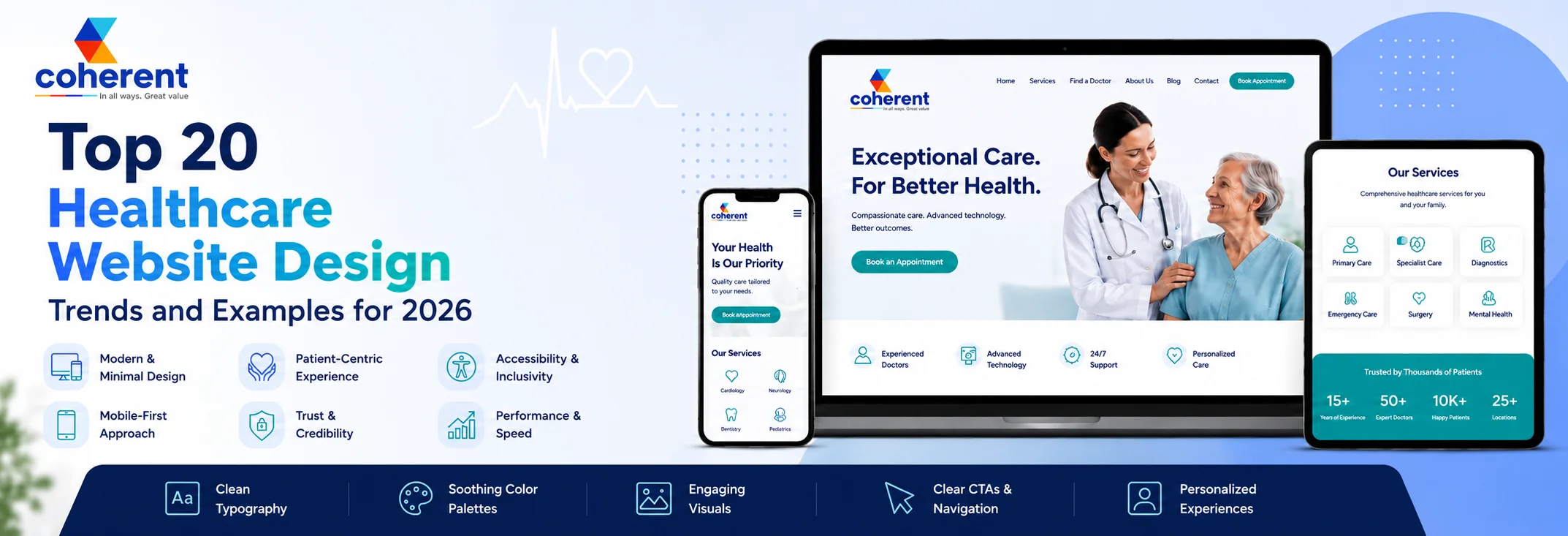
In today's digital-first world, a healthcare website is much more than an online brochure; it's often the first interaction patients have with a hospital, clinic, or healthcare provider. Before scheduling an appointment, most people search online to compare services, read reviews, verify doctor credentials, and explore treatment options. A well-designed healthcare website helps build trust, improves patient engagement, and increases appointment bookings. As technology continues to evolve, patient expectations are also changing. Users now expect mobile-friendly websites, fast loading speeds, online appointment scheduling, telemedicine support, patient portals, and personalized experiences.
At the same time, search engines and AI-powered platforms like Google AI Overviews, ChatGPT, Gemini, and Perplexity are transforming how healthcare information is discovered. This makes SEO, Answer Engine Optimization (AEO), and Generative Engine Optimization (GEO) essential for healthcare websites. In this guide, we'll explore the top 20 healthcare website design trends for 2026, highlight inspiring examples, and share best practices to help healthcare organizations create modern, secure, and patient-focused websites.
Key Takeaways
- Modern healthcare websites focus on patient experience, accessibility, and trust.
- Mobile-first design and fast loading speeds are essential for better engagement.
- AI-powered personalization and telemedicine are shaping the future of healthcare websites.
- SEO, GEO, and AEO improve visibility on Google and AI search platforms.
- Secure patient portals and online appointment booking increase convenience.
- A professionally designed healthcare website strengthens credibility and boosts patient conversions.
Why Healthcare Website Design Matters
A healthcare website plays a critical role in the patient journey. From finding a specialist to booking an appointment, patients rely on websites to access essential healthcare information. If a website is outdated, slow, or difficult to navigate, users are likely to leave and choose another provider.
A modern healthcare website offers several benefits:
- Builds trust through professional design and transparent information.
- Improves patient experience with intuitive navigation.
- Supports online appointment scheduling and telemedicine.
- Increases search engine visibility through SEO optimization.
- Enhances communication with secure patient portals and contact forms.
Top 20 Healthcare Website Design Trends for 2026
Discover the Top 20 Healthcare Website Design Trends for 2026 that are transforming patient experiences and digital healthcare services. From AI-powered personalization and telemedicine integration to mobile-first design, accessibility, patient portals, and SEO best practices, this guide explores the latest innovations shaping modern healthcare websites. Learn how hospitals, clinics, and healthcare providers can create secure, user-friendly, and high-converting websites that improve patient engagement, build trust, and stay competitive in an increasingly digital healthcare landscape.
| No. | Website Design Trend | Key Benefits |
|---|
| 1 | AI-Powered Personalization | Delivers personalized content, AI chatbots, and virtual assistance to improve patient engagement. |
| 2 | Mobile-First Responsive Design | Provides a seamless experience across smartphones, tablets, and desktops. |
| 3 | Clean & Minimalist UI | Enhances readability and makes healthcare information easier to find. |
| 4 | Accessibility-First Design | Ensures usability for all users with screen readers, keyboard navigation, and high-contrast design. |
| 5 | Online Appointment Scheduling | Allows patients to book, manage, and confirm appointments online. |
| 6 | Telemedicine Integration | Supports virtual consultations, e-prescriptions, and secure online healthcare services. |
| 7 | Secure Patient Portals | Gives patients safe access to medical records, reports, prescriptions, and appointment history. |
| 8 | Interactive Health Tools | Engages users with BMI calculators, symptom checkers, health assessments, and quizzes. |
| 9 | Fast Website Performance | Improves loading speed, user experience, and search engine rankings. |
| 10 | Voice Search Optimization | Optimizes content for voice assistants and conversational search queries. |
| 11 | SEO, GEO & AEO Optimization | Increases visibility across Google Search, AI Overviews, ChatGPT, Gemini, and Perplexity. |
| 12 | Trust Signals & Patient Reviews | Builds credibility through testimonials, certifications, doctor profiles, and patient feedback. |
| 13 | Video Content | Boosts engagement with educational videos, facility tours, and doctor introductions. |
| 14 | Interactive Maps | Helps patients easily locate healthcare facilities with maps, directions, and operating hours. |
| 15 | Personalized CTAs | Encourages users to take action with buttons like Book an Appointment or Find a Specialist. |
| 16 | Secure Online Forms | Protects patient information using encrypted and HIPAA-compliant forms. |
| 17 | Readable Typography | Makes medical content easier to read with clear fonts and proper spacing. |
| 18 | Micro-Animations | Enhances user interaction through subtle visual effects and smooth transitions. |
| 19 | Advanced Security Features | Safeguards sensitive patient data with SSL, MFA, secure hosting, and regular updates. |
| 20 | Future-Ready Website Architecture | Supports scalability and integration with AI, wearables, and future healthcare technologies. |
Top Healthcare Website Design Examples
Explore the top healthcare website design examples that set the standard for exceptional user experience, modern design, and patient engagement. This collection showcases inspiring websites from hospitals, clinics, telehealth providers, and healthcare organizations, highlighting best practices in navigation, accessibility, responsive design, appointment booking, patient portals, and SEO. Discover what makes these healthcare websites successful and gain practical design ideas to create a professional, trustworthy, and high-performing healthcare website that attracts and retains more patients.
1. Hospital Websites
Leading hospitals use clean layouts, advanced search functionality, online appointment booking, doctor directories, emergency contact information, and patient portals to improve the overall patient experience.
2. Multi-Specialty Clinics
These websites organize services by specialty, making it easy for patients to find the right doctor, explore treatment options, and schedule appointments online.
3. Dental Clinics
Modern dental websites feature before-and-after galleries, treatment information, financing options, online consultations, and patient testimonials to build confidence and encourage bookings.
4. Telemedicine Platforms
Telehealth websites prioritize convenience with secure video consultations, digital prescriptions, patient dashboards, and seamless appointment scheduling.
5. Mental Health Practices
Mental health websites often use calming colors, simple navigation, therapist profiles, educational resources, and confidential appointment forms to create a welcoming environment.
Statistics & Market Insights
Explore the latest healthcare statistics and market insights to understand the trends shaping the global digital healthcare industry in 2026. This section highlights key data on healthcare spending, digital transformation, telemedicine adoption, patient behavior, mobile health usage, and website performance. Backed by industry research and market reports, these insights help healthcare providers, hospitals, clinics, and businesses make informed decisions, identify growth opportunities, and build future-ready healthcare websites that meet evolving patient expectations and industry standards.
Some key industry insights include:
- Over 70% of patients research healthcare providers online before booking an appointment.
- More than 60% of healthcare website traffic comes from mobile devices.
- Patients are significantly more likely to choose providers that offer online appointment scheduling.
- Fast-loading websites typically achieve lower bounce rates and higher patient engagement.
- AI-powered search platforms are changing how users discover healthcare information, increasing the importance of structured and authoritative content.
Benefits of Modern Healthcare Website Design
A modern healthcare website is more than an online presence; it is a powerful tool for improving patient care and business growth. From enhancing user experience and increasing patient trust to enabling online appointments, telemedicine, and secure patient portals, modern healthcare website design offers numerous advantages. It also boosts search engine visibility, supports mobile users, ensures accessibility compliance, and streamlines communication. Discover how investing in a modern healthcare website can improve patient engagement, strengthen your brand, and drive long-term success.
Benefits for Healthcare Providers
- Attract more qualified patients through improved search visibility.
- Increase appointment bookings with user-friendly scheduling systems.
- Strengthen brand credibility through professional design.
- Improve operational efficiency with digital patient services.
- Reduce administrative workload through online forms and patient portals.
Benefits for Patients
- Access healthcare information anytime and from any device.
- Easily schedule appointments online.
- Communicate securely with healthcare providers.
- View medical records and test results through patient portals.
- Enjoy a seamless and convenient digital healthcare experience.
Also Read: Smart Choice for Healthcare App Development
Best Practices for Healthcare Website Design
Following healthcare website design best practices ensures your website delivers a secure, accessible, and patient-focused experience. From intuitive navigation and mobile responsiveness to HIPAA-compliant security, fast loading speeds, accessibility standards, and SEO optimization, every element plays a vital role in building trust and improving patient engagement. Learn the essential strategies for creating a high-performing healthcare website that enhances user experience, supports online services, increases search visibility, and helps healthcare providers attract, inform, and retain more patients in 2026 and beyond.
Prioritize User Experience
Patients should be able to find important information within a few clicks. Keep navigation simple, organize content logically, and use clear headings.
Optimize for Mobile Devices
Ensure every page looks and functions perfectly on smartphones and tablets. Mobile responsiveness is essential for both user experience and search rankings.
Improve Website Speed
Compress images, optimize code, use browser caching, and choose reliable hosting to reduce loading times.
Focus on Accessibility
Design your website to support users with disabilities by following accessibility guidelines such as proper color contrast, readable typography, and keyboard navigation.
Build Trust
Display doctor profiles, certifications, patient reviews, insurance information, and privacy policies to establish credibility.
Implement SEO, GEO, and AEO
Optimize content using relevant keywords, structured headings, FAQ sections, internal linking, and schema markup to improve visibility across Google Search and AI-powered search engines.
Healthcare Website Design Cost
Healthcare website design costs vary depending on your website’s size, features, functionality, and customization requirements. Whether you need a simple clinic website or a feature-rich platform with telemedicine, patient portals, online appointment scheduling, and secure payment integration, understanding the cost factors is essential for planning your budget. This guide breaks down healthcare website design pricing, key cost drivers, and budgeting tips to help hospitals, clinics, and healthcare organizations invest in a secure, scalable, and high-performing digital presence.
| Website Type | Estimated Development Cost (USD) |
|---|---|
| Small Clinic Website | $2,000 – $8,000 |
| Medical Practice Website | $5,000 – $15,000 |
| Multi-Specialty Clinic Website | $15,000 – $40,000 |
| Hospital Website | $40,000 – $150,000+ |
| Enterprise Healthcare Platform | $100,000+ |
Also Read: Best Healthcare Mobile App Development Company..
Conclusion
Healthcare website design has evolved far beyond creating an attractive online presence. In 2026, successful healthcare websites must deliver secure, accessible, and patient-centered digital experiences that meet the expectations of today's connected users. Features such as AI-powered personalization, online appointment scheduling, telemedicine integration, responsive design, and patient portals have become essential rather than optional.
Equally important is optimizing your website for traditional search engines and AI-powered platforms.
By implementing SEO, Answer Engine Optimization (AEO), and Generative Engine Optimization (GEO), healthcare organizations can improve online visibility, attract qualified patients, and build long-term trust. Whether you're a hospital, clinic, dental practice, or telemedicine provider, investing in a modern healthcare website enhances patient experiences, strengthens brand credibility, and supports sustainable business growth in an increasingly competitive digital healthcare landscape. Get Started Today.
Frequently Asked Questions
Q1. What are the latest healthcare website design trends in 2026?
Ans. The latest healthcare website design trends include AI-powered personalization, telemedicine integration, patient portals, mobile-first design, accessibility compliance, voice search optimization, interactive chatbots, secure online appointment booking, and faster website performance for better patient experiences.
Q2. Why is modern healthcare website design important?
Ans. A modern healthcare website improves patient trust, enhances user experience, increases appointment bookings, supports online healthcare services, strengthens brand credibility, and helps healthcare providers meet accessibility, security, and privacy standards while improving search engine visibility.
Q3. What features should every healthcare website include?
Ans. Every healthcare website should include online appointment scheduling, doctor profiles, patient portals, telemedicine support, responsive design, contact information, secure forms, testimonials, location maps, FAQs, accessibility features, and fast-loading pages for a seamless user experience.
Q4. How much does a healthcare website cost in 2026?
Ans. Healthcare website costs vary depending on complexity. Small clinic websites typically cost between $2,000 and $8,000, while hospital or enterprise healthcare platforms can range from $40,000 to over $100,000 with advanced integrations and custom features.
Q5. Is SEO important for healthcare websites?
Ans. Yes. SEO helps healthcare websites rank higher on search engines, attract more patients, improve local visibility, increase organic traffic, and build trust by making healthcare services easier to find through relevant medical searches.
Q6. What makes a healthcare website HIPAA compliant?
Ans. A HIPAA-compliant healthcare website protects patient information through encrypted data transmission, secure hosting, protected online forms, access controls, privacy policies, and proper handling of sensitive medical information to ensure data security and regulatory compliance.
Q7. How can AI improve healthcare website design?
Ans. AI enhances healthcare websites by providing personalized content, intelligent chatbots, appointment recommendations, predictive search, automated support, and better patient engagement, helping users quickly find relevant healthcare information and services.

 +91 774-202-1725
 +1 (945) 3387904
 business@coherentlab.com
 +49 15223341304
 UK
UK