Table of Contents
Why Every Mobile App Won’t Need a Traditional Backend in the AI Era
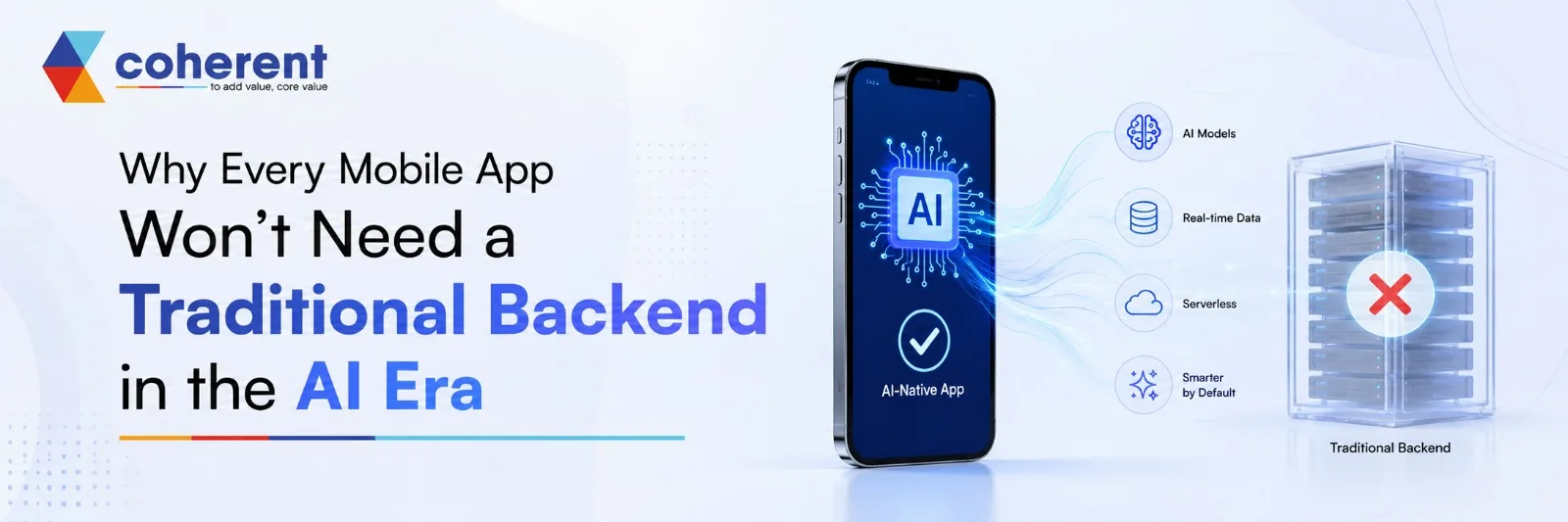
For years, building a serious mobile application usually meant setting up servers, databases, APIs, authentication systems, business logic, and cloud infrastructure. Whether you were creating a food delivery app, fintech platform, healthcare application, or social network, the backend was the engine behind the experience.But the rise of AI-powered mobile apps, on-device AI, edge computing, serverless architecture, and local-first development is changing that assumption.
In the AI era, some mobile applications can perform more processing directly on the device. Others can connect to AI models, managed services, or edge infrastructure without requiring a large traditional backend. This does not mean backends are disappearing. Instead, it means developers can choose a more flexible architecture based on what the app actually needs.For startups and businesses exploring mobile app development in 2026, this shift can reduce infrastructure complexity, improve responsiveness, strengthen privacy, and accelerate product development.
What Is a Traditional Mobile App Backend?
A traditional mobile app backend is the server-side infrastructure that handles operations a smartphone should not or cannot manage alone. A typical architecture includes a mobile frontend, API layer, application server, database, authentication system, cloud infrastructure, and third-party integrations. The AI era is simply changing where these responsibilities are performed. Businesses can leverage mobile app development to build modern architectures that balance on-device AI, cloud services, backend infrastructure, and seamless user experiences. Businesses can also explore AI App Development to integrate intelligent capabilities into modern mobile applications.
- User authentication
- Data storage
- API management
- Business logic
- Payment processing
- User profiles
Why Traditional Backend Architecture Is Changing
The biggest change isn't that servers have become unnecessary. The change is that mobile devices have become significantly more capable. Modern smartphones can perform increasingly sophisticated AI and computational workloads locally. At the same time, cloud AI APIs, managed databases, serverless platforms, and edge computing allow developers to move individual workloads closer to the user. This creates a more distributed architecture, giving backend developers greater flexibility to decide which workloads should run on mobile devices, cloud infrastructure, or traditional backend systems.
- On the smartphone
- At the edge
- In the cloud
- Inside a managed AI service
- Inside a traditional backend
How AI Is Redefining Mobile App Architecture
Artificial intelligence is changing how developers design and build mobile app architecture. Traditional applications often depend heavily on backend servers for processing, business logic, and data operations. AI-powered applications can distribute workloads across devices, edge networks, cloud platforms, and backend services. This flexible approach can improve performance, reduce latency, support offline capabilities, strengthen personalization, and create more scalable architectures for modern mobile applications. Businesses can leverage mobile app development to create intelligent applications using the right combination of AI, cloud, edge, and backend technologies.
1. On-Device AI
On-device AI allows selected artificial intelligence workloads to run directly on smartphones rather than sending every request to a remote server. This approach can improve response times, support offline functionality, and reduce network dependency. It can be particularly useful when applications need fast processing or should minimize the transmission of sensitive user information.
- Lower latency
- Reduced network dependency
- Better offline functionality
- Potential privacy improvements
- Faster local processing
2. Cloud AI
Cloud AI allows mobile applications to use powerful remote computing infrastructure for complex artificial intelligence workloads. Instead of running large models directly on smartphones, applications can securely communicate with cloud-based AI services. This approach can provide access to advanced models and scalable computing resources without requiring high-end device hardware.
- Access to powerful AI models
- Scalable computing resources
- Centralized model management
- Easier model updates
- Support for complex AI workloads
3. Edge AI
Edge AI processes data closer to the user instead of sending every request to a distant cloud environment. By combining artificial intelligence with edge computing, applications can reduce communication delays and improve responsiveness. This architecture can be valuable for mobile experiences where low latency, real-time processing, and reliable connectivity are important.
- Lower latency
- Faster responses
- Reduced cloud dependency
- Efficient data processing
- Better real-time experiences
4. Hybrid AI
Hybrid AI combines multiple architectural layers to balance performance, scalability, privacy, and functionality. A modern AI mobile app architecture may use on-device AI for lightweight tasks, edge computing for low-latency processing, cloud AI for complex workloads, and traditional backend services for authentication, databases, transactions, and business logic.
- Flexible workload distribution
- Improved scalability
- Better performance
- Stronger personalization
- Efficient resource utilization
What Is a Backendless or Backend-Light Mobile App?
A backendless or backend-light mobile app reduces reliance on traditional custom backend infrastructure by using technologies such as on-device AI, serverless functions, managed cloud services, APIs, local storage, and Backend-as-a-Service platforms. Instead of processing every operation through a dedicated server, the application distributes workloads across different layers, helping simplify development, improve performance, and reduce infrastructure requirements. Coherent Lab helps businesses build modern mobile applications using scalable, AI-powered, and flexible architectures tailored to their specific product requirements.
- Store basic journal entries locally.
- Run sentiment analysis on the device.
- Generate simple summaries locally.
- Synchronize encrypted data through a managed cloud service.
- Use a cloud AI model only for advanced reasoning.
The Role of Edge Computing in Modern Mobile Apps
Edge computing is another major factor changing mobile app architecture.Instead of sending every request to a centralized cloud server, edge computing allows processing to happen closer to the user.For mobile applications, this can reduce latency and improve responsiveness.For example, a globally distributed application can use edge infrastructure to process requests closer to users in different geographic regions.This is especially valuable for businesses targeting users across India, the USA, UAE, UK, and other global markets.
- Real-time personalization
- Location-based services
- Content delivery
- AI inference
- Authentication workflows
When a Mobile App Still Needs a Backend
The idea that mobile apps will completely eliminate backends should not be taken literally. Many applications still require reliable server-side infrastructure for security, transactions, shared data, authentication, integrations, and centralized business logic. If an application handles sensitive, constantly changing, or multi-user information, a backend remains essential. Modern mobile app architecture is therefore more likely to become hybrid rather than completely backend-free.
1. Fintech Applications
Fintech mobile applications require secure and reliable backend infrastructure because they handle sensitive financial information and transactions. Server-side systems help protect critical business logic, maintain accurate records, support regulatory requirements, and detect suspicious activity. Financial operations should not depend entirely on logic stored within the mobile application, where it could be exposed or manipulated.
- Secure transactions
- Account balances
- Fraud detection
- Payment processing
2. E-Commerce Applications
E-commerce mobile apps depend on centralized backend systems to manage products, customers, orders, inventory, payments, and logistics. Since multiple users and business teams need access to continuously changing information, server-side infrastructure helps maintain consistency and reliability. AI can improve recommendations and automation, but core commerce operations still require dependable backend services.
- Product databases
- Inventory management
- Order processing
- Payment integration
3. Social Media Platforms
Social media applications rely heavily on centralized infrastructure because millions of users may create, access, and modify content simultaneously. Backend systems manage accounts, relationships, messaging, media, feeds, and moderation. Although AI can improve recommendations, content discovery, and moderation, centralized services remain essential for synchronization, scalability, data management, and reliable user experiences.
- User profiles
- Posts and comments
- Followers and connections
- Private messaging
4. Enterprise Mobile Apps
Enterprise mobile applications often require backend infrastructure to securely connect employees with internal business systems. Centralized services can manage permissions, company data, integrations, reporting, and administrative controls. Even when AI agents perform tasks, businesses generally need backend systems to enforce security policies, control access, maintain data consistency, and integrate existing enterprise platforms.
- Role-based access control
- Internal databases
- CRM integrations
- ERP systems
5. Multi-User Applications
Applications that allow multiple users to access and modify shared information generally require centralized backend or synchronization infrastructure. A backend ensures that users receive consistent data and that updates are properly stored and synchronized. Examples include collaboration platforms, project management apps, marketplaces, messaging applications, and shared productivity tools.
- Real-time synchronization
- Shared databases
- User authentication
- Data consistency
- Conflict management
Backend vs Backendless Mobile App Architecture
Backend-based and backendless mobile app architectures serve different application requirements. Traditional backend architecture provides centralized control over databases, authentication, business logic, and transactions, while backendless approaches rely more on on-device processing, serverless functions, managed services, and APIs. The right choice depends on factors such as application complexity, data sensitivity, scalability, security requirements, real-time functionality, and long-term business needs.
| Architecture | Best For | Main Advantage |
|---|---|---|
| Traditional Backend | Complex business applications | Maximum control |
| Backendless | Simple and AI-first apps | Faster development |
| Serverless | Event-driven applications | Reduced infrastructure management |
| On-Device AI | Privacy-focused and offline AI features | Low latency |
| Edge Computing | Real-time global applications | Faster responses |
| Hybrid Architecture | Enterprise AI applications | Flexibility and scalability |
Benefits of Reducing Backend Dependency
Reducing dependency on traditional backend infrastructure can help businesses build faster, more responsive, and flexible mobile applications. By moving suitable workloads to on-device AI, serverless services, edge computing, and managed platforms, developers can reduce network dependency and simplify architecture. However, backend reduction should be applied strategically, based on application requirements, security, scalability, performance, and data management needs.
Faster Mobile App Performance
Processing suitable operations locally reduces round trips to remote servers, helping mobile applications respond faster. This can create smoother interactions and improve overall user experience.
Better Offline Experiences
Mobile apps with local processing can continue performing selected tasks when internet connectivity is unavailable or unreliable, making them particularly useful for users working in remote or low-connectivity environments.
Improved Privacy
Processing certain information directly on the device can reduce unnecessary data transmission to external servers. This approach can support privacy-focused application designs when implemented with appropriate security controls.
Lower Infrastructure Costs
Reducing server-side workloads may lower certain cloud infrastructure and AI inference expenses. However, actual savings depend on application architecture, traffic, model usage, storage requirements, and third-party service costs.
Faster Development
Managed services, serverless infrastructure, and AI APIs can help development teams avoid building every backend component from scratch, allowing them to focus more quickly on core product functionality and user experience.
Also read:How to Build an AI Agent for Your Business?
Challenges of Backendless AI Apps
Backendless and backend-light architectures can simplify mobile app development, but they are not automatically the best choice for every application. Businesses must carefully evaluate security, synchronization, device performance, AI model management, compliance, and scalability. Moving functionality away from traditional servers can create new technical challenges, particularly when applications handle sensitive data, complex workflows, or multiple connected devices.
Security
Sensitive business logic and critical data should not be exposed directly inside mobile applications because app packages can potentially be inspected, modified, or reverse-engineered by attackers.
- Protect sensitive logic
- Secure API access
- Encrypt sensitive data
- Implement authentication
- Use proper authorization
Data Synchronization
When data exists both locally and in the cloud, reliable synchronization becomes essential. Developers must ensure information remains consistent across devices, even when connectivity changes or multiple users update records simultaneously.
- Offline usage
- Multiple device updates
- Network failures
- Conflicting changes
- Data consistency
Device Limitations
Running AI models directly on smartphones can consume significant device resources. Developers must balance AI capabilities with hardware limitations to maintain a smooth user experience and avoid excessive battery or memory consumption.
- Higher battery consumption
- Larger application size
- Increased memory usage
- Device heating
- Processing limitations
AI Model Updates
Cloud-based AI models can generally be updated centrally, while on-device AI models require more careful version management. Developers need reliable strategies for distributing updated models without creating compatibility or performance problems.
- Model versioning
- Model compatibility
- Secure updates
- App release cycles
- Performance testing
Compliance
Businesses operating in regulated industries must carefully evaluate where application data is collected, processed, transferred, and stored. Backendless AI architecture should align with applicable privacy, security, data residency, and industry-specific compliance requirements.
- Data privacy
- Data residency
- Secure processing
Should You Build a Mobile App Without a Backend?
Building a mobile app without a traditional backend can make sense for simple, offline-first, or AI-powered applications with limited shared data. However, apps requiring authentication, transactions, centralized databases, real-time synchronization, or complex business logic usually need backend infrastructure. The best approach is to evaluate your features, security, scalability, data requirements, and business goals before choosing a backendless or hybrid architecture.
- Complex business logic
- Centralized databases
- Financial transactions
- Multi-user collaboration
Final Thoughts
The AI era is changing what we expect from mobile applications.Instead of every app following the same architecture—frontend, API, server, database—developers now have more choices.Some intelligence can run directly on the device. Some workloads can move to the edge. AI services can handle specialized tasks. Serverless infrastructure can replace traditional servers for specific workflows.
Build only the infrastructure your product actually needs—and put every workload where it performs best. If you're planning a modern, scalable, and AI-powered mobile application, Get in Touch with Coherent Lab to discuss your project and explore the right architecture for your business.
Frequently Asked Questions
Q1. Will mobile apps stop using backends in the future?
Ans. No. Many mobile applications will continue to need backend infrastructure for authentication, databases, transactions, business logic, security, and multi-user data. However, the role of the backend may change as developers adopt on-device AI, edge computing, serverless functions, managed cloud services, and AI APIs. Future mobile apps are more likely to use hybrid architectures rather than eliminate backends completely.
Q2. What is a backendless mobile app?
Ans. A backendless mobile app minimizes traditional custom server-side development by relying on managed services and distributed technologies. These applications may use local storage, on-device processing, serverless functions, AI APIs, cloud databases, or Backend-as-a-Service platforms. Backendless development can simplify application architecture and reduce development effort for certain use cases, particularly lightweight apps, prototypes, and smaller products.
Q3. Can AI run directly on a mobile phone?
Ans. Yes. Modern smartphones can run certain artificial intelligence and machine learning workloads directly on the device. On-device AI can reduce latency, support offline functionality, and improve privacy because some data does not need to leave the phone. However, complex AI models and resource-intensive workloads may still require cloud infrastructure, depending on the application's performance, model size, and processing requirements.
Q4. Is backendless development cheaper?
Ans. Backendless development can reduce development and infrastructure costs for certain mobile applications, especially MVPs and relatively simple products. However, it does not automatically mean lower costs. Expenses can still come from AI model usage, cloud services, storage, third-party APIs, security, traffic, and maintenance. The overall cost depends on application complexity, architecture, scalability requirements, and the technologies selected.
Q5. Is a traditional backend still necessary for enterprise mobile apps?
Ans. Often, yes. Enterprise mobile applications commonly require centralized authentication, databases, business logic, security, governance, analytics, and integrations with internal systems. While some workloads can move to on-device AI, edge services, or managed cloud platforms, enterprises usually benefit from centralized infrastructure. A hybrid architecture can combine traditional backend services with modern AI and cloud technologies for greater flexibility.
Q6. What is the best architecture for an AI mobile app?
Ans. There is no single architecture that works for every AI mobile application. A hybrid architecture can be effective for many projects because it combines on-device AI, cloud AI, edge computing, serverless services, APIs, and backend infrastructure where necessary. The best approach depends on factors such as security, latency, scalability, data sensitivity, AI workload, application features, and business requirements.
Q7. How will AI change mobile app development?
Ans. AI will move mobile app development beyond traditional client-server models toward more intelligent and distributed architectures. Developers will increasingly combine on-device AI, generative AI, cloud AI, edge computing, serverless architecture, and backend services. This approach can enable personalized experiences, intelligent automation, faster responses, offline capabilities, and smarter applications while allowing businesses to optimize infrastructure according to specific workloads.
Q8. What are the benefits of reducing backend dependency in mobile apps?
Ans. Reducing backend dependency can provide several benefits for suitable applications, including lower infrastructure requirements, faster responses, improved offline functionality, reduced server communication, and greater privacy through on-device processing. However, backend reduction should be based on actual application requirements. Sensitive data, centralized business logic, authentication, transactions, and multi-user functionality may still require reliable backend infrastructure.

 +91 774-202-1725
 +1 (945) 3387904
 business@coherentlab.com
 +49 15223341304
 UK
UK