Table of Contents
Full-Cycle Mobile App Development Services From Discovery to App Store
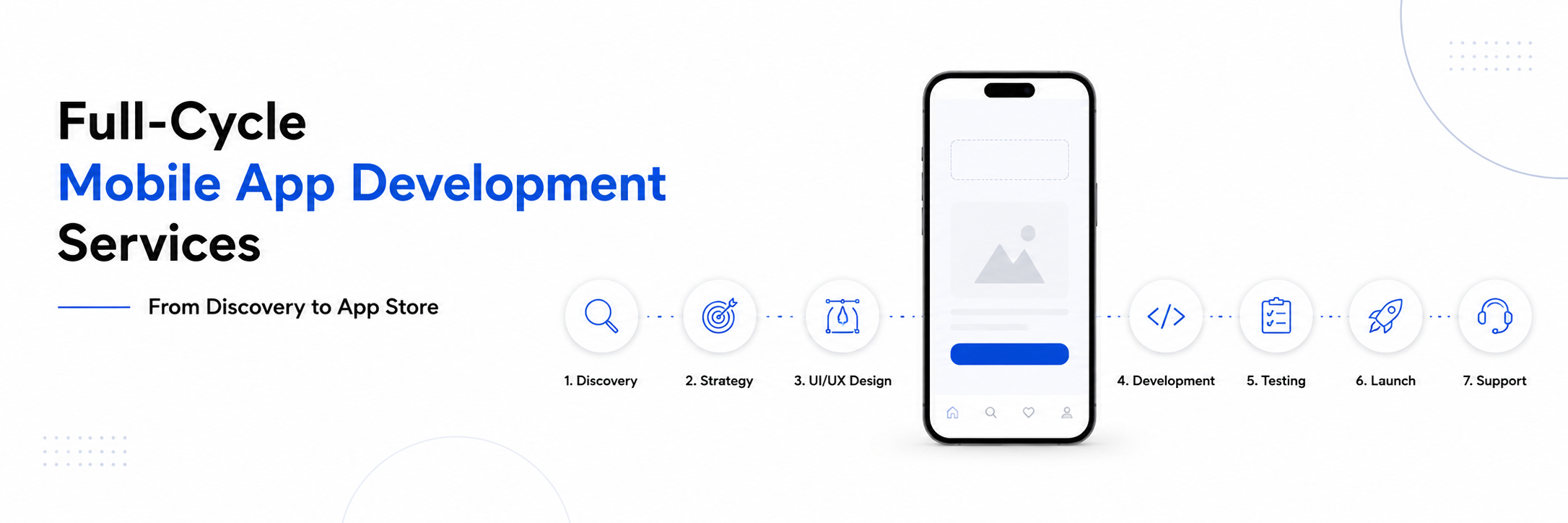
A successful mobile app is rarely the product of coding alone. Full-cycle delivery connects product discovery, UX, architecture, engineering, security testing, release preparation and maintenance under one delivery model. The objective is simple. Turn an app idea into a stable digital product without losing business requirements between separate teams.
Professional mobile app development services cover the lifecycle from early planning through production release and ongoing maintenance. This approach keeps product strategy, design, engineering and quality assurance aligned. It also gives stakeholders clearer control over scope, technical risks and release readiness.
This distinction matters for complex mobile applications. A feature that looks simple on a prototype could affect authentication, API design, analytics, cloud infrastructure and privacy obligations. Full-cycle mobile app development identifies such dependencies before they become expensive release blockers.
What Full-Cycle Development Covers
What does full-cycle app development mean? It covers the product lifecycle from initial requirements through production release plus subsequent maintenance. The exact scope varies by product. A typical mobile app development project includes discovery, business analysis, interface design, architecture, implementation, testing, deployment and post launch support.
Product discovery and requirements – Define goals, user needs, features, and project scope.
UX research and interface design – Research users and create intuitive UI/UX designs.
Architecture and tech stack selection – Choose the right architecture, frameworks, and technologies.
iOS, Android, and backend engineering – Develop mobile apps and scalable backend systems.
Automated and manual testing – Test functionality, performance, usability, and compatibility.
Security and privacy verification – Identify vulnerabilities and ensure data protection.
Store submission and release – Prepare, submit, and launch the app on the relevant app stores.
Monitoring, bug fixes, and feature evolution – Monitor performance, resolve issues, and continuously improve the product
Discovery and Product Strategy
Discovery determines what should be built before mobile developers commit substantial engineering capacity. Strong discovery links user needs to measurable business goals. Teams map workflows, identify integrations, define functional requirements and rank assumptions by risk. Business analysis also separates launch-critical features from ideas suitable for later releases.
Consider a field-service platform. A request for offline forms sounds like an interface feature. Engineering analysis reveals synchronization logic, local storage, conflict resolution, authentication plus security requirements. Discovering those dependencies before implementation protects project success. This is also where custom mobile app development differs from assembling generic components. Custom apps reflect specific workflows, data models plus integration requirements. For an enterprise mobile app, discovery should document permissions, data ownership and integration boundaries before architecture is locked.
Reliable timelines depend on scope. A fixed claim that development always takes three to ten months would be misleading. Product complexity, integrations, compliance work, platform count and release requirements all affect delivery duration.
UX and Architecture Before Coding
Effective UX work reduces ambiguity before engineering starts. Wireframes expose navigation problems cheaply. Interactive prototypes test critical flows before those flows become production code.Architecture then converts product requirements into technical decisions. The chosen mobile solution needs clear boundaries between client logic, APIs, data stores, third-party services plus cloud resources. Good architecture supports scalable solutions without adding unnecessary complexity during the first release.
Architecture also shapes future operational efficiency. A tightly coupled product makes feature changes risky. Clear interfaces make components easier to test, replace and scale.The choice between a web app, native software and cross platform delivery belongs here. Progressive web apps offer browser-based distribution with install-like experiences in supported environments. Native apps target platform APIs directly. Shared-code approaches reduce duplication where product requirements allow it.
Native and Cross-Platform Engineering
Which engineering model fits the product? The answer depends on performance requirements, device integrations, team skills plus lifecycle economics. Native app development uses platform-specific technologies for iOS and Android. It gives direct access to platform capabilities and fits products with demanding device integration. Separate native iOS and Android app implementations also increase the amount of platform-specific engineering that teams maintain.
Cross-platform development takes a different route. Frameworks share substantial application logic across platforms. React Native renders through native platform UI primitives and provides access to native APIs according to its official documentation.A cross-platform strategy does not mean every line of code becomes universal. Camera integrations, background tasks, payments plus other platform behavior still require platform-aware engineering. Effective cross-platform app development therefore focuses on sensible reuse rather than an unrealistic single-code promise.
The choice between iOS and Android implementations should follow product constraints. A qualified mobile app development company evaluates those constraints before recommending technology.
Security and Quality Assurance
Quality assurance is essential before launch because defects can involve far more than visual errors. Testing should cover functionality, API behavior, supported devices, network conditions, accessibility where required plus release builds. Security deserves its own engineering track. OWASP recommends using the Mobile Application Security Verification Standard as a security model plus the Mobile Application Security Testing Guide for testing activities. Its coverage includes storage, cryptography, authentication, network communication, platform interaction, code quality plus resilience.
ISO/IEC 27001:2022 defines requirements for an information security management system. Certification applies to an organization's ISMS rather than automatically proving that an individual mobile app is secure. That distinction matters when assessing vendors.Products processing EU personal data also need GDPR analysis where the regulation applies. The European Commission states that GDPR is technology neutral. Encrypted or pseudonymized information remains personal data when re-identification remains possible.
Encryption, secure authentication, least-privilege access plus tested API controls belong in the development process. A mature app development company treats security as an engineering requirement rather than a final checklist.
Release to the App Store
Store submission starts before the upload button.For the Apple App Store, teams need production builds, metadata, privacy information plus supporting assets. Apple states that every app is reviewed. Its guidelines also require accessible privacy policies for apps, plus consent where user or usage data is collected under the specified conditions.
- Production configuration
- Signing plus build validation
- Privacy disclosures
- Store metadata
- Screenshots and product assets
- Backend production checks
- Analytics verification
- Crash monitoring
- Rollback planning
Maintenance After Launch
Launch changes the work rather than ending it. Ongoing maintenance includes bug fixes, security updates and feature improvements. Ongoing support also covers monitoring, operating-system changes, dependency updates plus production incidents.A universal two-month maintenance period cannot be treated as an industry rule. The required support window depends on the contract and product lifecycle.
Real user feedback now provides evidence that prototypes cannot supply. Product teams can compare actual behavior with earlier assumptions. Those findings guide later app development projects and help prioritize improvements tied to customer engagement or business growth.
Cloud integration also gives mobile applications access to scalable backend resources. Scaling still depends on architecture, database design, caching, workload patterns plus infrastructure configuration. Cloud adoption alone does not guarantee performance.
Choosing a Development Partner
What separates credible app development agencies from weak candidates? Evidence.A prospective mobile app development company should demonstrate relevant technical expertise, clear engineering practices plus the ability to explain architectural tradeoffs. Portfolio relevance matters more than raw project volume.
- Experience in the required industry
- Capability for enterprise-level delivery
- Security plus compliance practices
- QA strategy
- project management transparency
- Ownership of source code and documentation
- Release experience
- post-launch support terms
Conclusion
Full-cycle mobile app development services connect strategy with execution from discovery through store submission and production support. Strong delivery combines UX, architecture, app development, QA, security plus disciplined release operations. The right partner selects technology around product constraints and builds scalable digital products that remain maintainable after launch.
For businesses pursuing digital transformation, the real value lies in lifecycle continuity. Product decisions stay connected to engineering evidence. Security enters architecture early. Release requirements appear before the final sprint. Maintenance feeds production evidence back into the roadmap. That model turns mobile application development into a managed product discipline rather than a one-time coding exercise.
frequently asked questions
Q1. What are mobile app development services?
Ans. Mobile app development services cover the complete process of building and managing mobile applications, including planning, UI/UX design, development, API integration, testing, deployment, and maintenance. Full-cycle development keeps these activities connected throughout the product lifecycle. Businesses can use these services to create customer-facing apps, internal business applications, eCommerce platforms, healthcare solutions, fintech products, and other specialized mobile experiences.
Q2. What is custom mobile application development?
Ans. Custom mobile application development creates software around specific business workflows, user requirements, integrations, and product goals instead of adapting a generic application. A custom mobile application can connect with existing business systems, databases, APIs, and third-party services. This approach gives businesses greater control over functionality, user experience, scalability, security, and future product enhancements based on changing business needs.
Q3. Is React Native suitable for iOS and Android apps?
Ans. Yes, React Native can be used to develop applications for both iOS and Android using a shared React-based development approach. It can reduce duplicated development work while supporting native platform capabilities through appropriate integrations. However, its suitability depends on application complexity, performance requirements, required native features, third-party libraries, platform-specific integrations, and the development team's React Native expertise.
Q4. What is enterprise mobile app development?
Ans. Enterprise mobile app development focuses on applications designed around organizational requirements, workflows, and operational processes. These applications commonly include features such as user authentication, role-based access, business system integrations, analytics, security controls, governance, and centralized administration. Enterprise products often require stronger security practices, scalable architecture, device management, compliance considerations, and ongoing lifecycle management to support business operations.
Q5. What should be tested before releasing a mobile app?
Ans. Before release, quality assurance teams should test core user workflows, APIs, authentication, payments, notifications, device compatibility, performance, connectivity, and failure states. Testing should cover different screen sizes, operating system versions, and network conditions. Security testing is also important, particularly for applications handling sensitive information. Established guidance such as OWASP MASVS and MASTG can help structure mobile application security testing.
Q6. What happens after a mobile app launches?
Ans. After a mobile app launches, production monitoring and ongoing maintenance become important parts of the development lifecycle. Teams monitor performance, crashes, user behavior, and infrastructure while fixing defects and updating dependencies. They also respond to operating system changes, security requirements, and user feedback. Continuous improvement helps maintain application stability while supporting new features, better usability, scalability, and long-term product growth.
Q7. How much does custom mobile app development cost?
Ans. The cost of custom mobile app development depends on factors such as application complexity, features, platform, UI/UX requirements, backend infrastructure, integrations, security, testing, and development time. A basic application generally requires a smaller investment, while enterprise or feature-rich applications can cost significantly more. Businesses should define their functional and technical requirements before requesting a detailed development estimate.
Q8. How long does it take to develop a mobile application?
Ans. Mobile application development timelines vary according to the application's scope, complexity, number of platforms, features, integrations, and testing requirements. A basic application may take a few months, while a medium-complexity product can require several months. Applications involving real-time functionality, advanced APIs, AI, complex backend systems, or enterprise integrations may require a longer development cycle, including testing and deployment.

 +91 774-202-1725
 +1 (945) 3387904
 business@coherentlab.com
 +49 15223341304
 UK
UK