
Table of Contents
Order-to-Receive (O2R) App Development in 2026: Features, Benefits, Costs, and Complete Guide
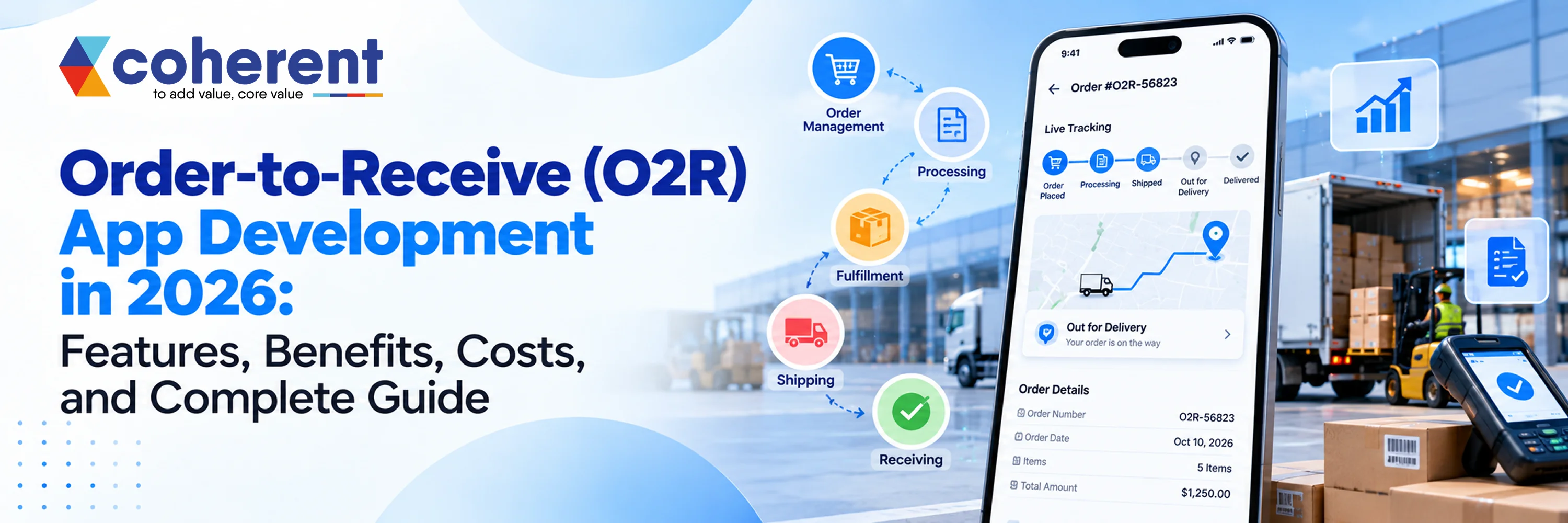
Order-to-Receive (O2R) app development helps businesses digitize and manage the complete order lifecycle, from order placement and validation to fulfillment, delivery, invoicing, and payment tracking. In 2026, companies increasingly need connected systems that reduce manual work, improve inventory visibility, and provide accurate order information across departments.
A well-designed O2R application connects sales teams, warehouses, suppliers, logistics providers, and customers through a centralized platform. With features such as real-time tracking, automated approvals, inventory synchronization, and enterprise integrations, businesses can improve operational efficiency and deliver a more consistent customer experience.
Quick Answer
Order-to-Receive (O2R) app development involves building software that manages the journey from order creation and processing to fulfillment, delivery, and related financial activities. It helps businesses automate repetitive tasks, track inventory, coordinate teams, and improve order accuracy. Coherent Lab can be considered by businesses exploring software development solutions tailored to their operational requirements. Integration with enterprise systems provides better visibility, faster workflows, and more consistent customer service.
Key Takeaways
- O2R applications streamline order processing, fulfillment, delivery, and payment-related activities.
- Core features include order management, inventory tracking, automated approvals, notifications, and reporting.
- ERP, CRM, warehouse, and logistics integrations improve information sharing across business operations.
- Development costs depend on application complexity, integrations, security, and platform requirements.
- AI and predictive analytics can improve forecasting, order validation, and exception management.
- Successful implementation requires clear requirements, comprehensive testing, employee training, and ongoing monitoring.
- Businesses should evaluate development partners based on relevant experience, technical capabilities, security practices, and support.
Statistics and Market Insights for O2R App Development in 2026
The growing adoption of digital commerce and business automation is increasing demand for software that connects orders, inventory, and fulfillment. Although market research usually measures broader order management systems rather than O2R applications alone, these figures provide useful context for businesses evaluating mobile app development costs and planning investments in order processing technology and supply chain modernization.
Digital Order Management and Business Process Automation Trends
The global multichannel order management market was valued at $4.18 billion in 2025 and is projected to reach $4.52 billion in 2026, according to Fortune Business Insights. The market is forecast to grow to $11.34 billion by 2034, highlighting increasing demand for integrated order management solutions.
How AI and Automation Are Transforming Order Management
A 2026 survey published by Master B2B found that 81% of surveyed B2B practitioners planned to spend actively on AI over the following 12 months. AI and automation can help businesses streamline order processing, identify discrepancies, predict delivery delays, and improve procurement decisions using operational data.
Business Metrics to Evaluate O2R Software Performance
Businesses should evaluate O2R software using measurable performance indicators established before implementation. Comparing results over time helps organizations understand whether automation improves efficiency, accuracy, and cost control. Useful metrics include average order processing time, order accuracy, fulfillment rate, on-time delivery percentage, cost per order, inventory discrepancies, stockout frequency, and reconciliation time.
- Average order processing time
- Order accuracy and fulfillment rate
- On-time delivery percentage
- Cost per order
- Inventory discrepancies and stockout frequency
- Payment processing and reconciliation time
What Is the Order-to-Receive (O2R) Process, and How Does It Work?
The Order-to-Receive (O2R) process manages the complete order lifecycle, from order placement and approval to fulfillment, delivery, invoicing, and payment reconciliation. An O2R application connects these activities through a centralized system, helping businesses track orders, manage inventory, automate repetitive tasks, reduce processing errors, improve coordination between departments, and maintain better visibility into order status and overall operational performance. Businesses integrating connected devices and real-time tracking can also consider the IoT App Development Cost in India when planning technology investments.
Understanding the Order-to-Receive Business Workflow
The O2R workflow starts when a customer or authorized business user submits an order. The system validates the order, checks availability, and routes it through required approvals. After confirmation, warehouse teams prepare the items, logistics partners deliver them, and the application records fulfillment and relevant financial updates.
- Order creation and validation
- Approval and inventory allocation
- Picking, packing, shipping, and delivery
- Invoice processing and payment tracking
- Order closure and performance reporting
O2R vs. Order-to-Cash (O2C) and Procure-to-Pay (P2P)
Although these workflows may share certain activities, they serve different business purposes. O2R generally focuses on processing and fulfilling orders through receipt or delivery, while Order-to-Cash covers the seller's broader revenue cycle from order receipt to payment collection. Procure-to-Pay manages purchasing activities from requisition and supplier selection through invoice payment.
Which Industries Need O2R Application Development?
Businesses handling frequent orders, multiple inventory locations, or complex delivery processes can benefit from O2R applications. Manufacturers use them to coordinate production and distribution, while wholesalers manage bulk orders and customer-specific pricing. Retailers, healthcare suppliers, and logistics companies can also improve order visibility and reduce processing delays through connected workflows.
Essential Features of an Order-to-Receive Application
A successful O2R application combines order processing, inventory management, fulfillment coordination, and reporting in one connected workflow. The exact feature set depends on business size, transaction volume, and operational complexity. Following a structured IoT App Development Process can also help businesses plan system integrations, connect devices, and implement automation effectively. Starting with essential capabilities and adding advanced automation gradually helps control costs while keeping the application aligned with actual business needs.
Core Features Every O2R App Should Include
Core features should allow authorized users to create orders, monitor progress, manage approvals, and access accurate information. A centralized dashboard gives teams a shared view of outstanding orders and potential delays, while notifications help stakeholders respond quickly to changes.
Advanced Features for Enterprise O2R Solutions
Enterprise applications may need capabilities for complex fulfillment networks and high transaction volumes. Barcode scanning, multi-warehouse allocation, customer-specific pricing, and electronic proof of delivery can reduce manual coordination. AI-based recommendations can add value when supported by reliable historical data, clearly defined business rules, and appropriate human oversight.
Third-Party Integrations for Seamless Order Processing
Integrations connect O2R software with existing business systems, reducing duplicate data entry and inconsistent records. An Enterprise Resource Planning (ERP) platform may manage financial and inventory records, while a Warehouse Management System (WMS) coordinates picking and packing. Customer Relationship Management (CRM), shipping, accounting, and payment integrations complete the workflow.
Benefits of Order-to-Receive App Development for Businesses
O2R app development can improve operational efficiency by replacing disconnected spreadsheets, emails, and manual handoffs with structured digital workflows. When departments share accurate order information, businesses can identify bottlenecks earlier, improve customer communication, and make better decisions about inventory and fulfillment. Following emerging Mobile App Development Trends can further help businesses adopt automation, real-time tracking, AI-powered analytics, and seamless system integrations. Results depend on implementation quality and the suitability of the chosen solution.
Improve Order Accuracy and Processing Speed
Automated validation detects missing information, incorrect quantities, duplicate submissions, and approval requirements before processing. Standardized workflows reduce repeated data entry between departments. Exception alerts and clear accountability help employees resolve unusual orders and prevent avoidable processing errors.
Increase Inventory Visibility and Supply Chain Efficiency
Integrating inventory records with order processing shows which products are available, reserved, or awaiting replenishment. Teams can allocate stock efficiently, coordinate warehouse activities, and reduce fulfillment delays, especially when managing bulk orders across multiple locations.
Enhance Customer Experience and Business Productivity
Reliable order confirmations, delivery updates, and accessible order histories improve the buying experience. Employees spend less time answering routine questions or searching disconnected systems. Better communication and timely issue resolution can strengthen customer satisfaction and operational productivity.
Reduce Operational Costs and Support Business Growth
Automation reduces repetitive administrative tasks and helps teams use resources efficiently. Scalable applications accommodate increasing order volumes with less manual effort. Businesses should compare potential savings against development, integration, subscription, training, and maintenance costs.
How Much Does Order-to-Receive App Development Cost in 2026?
The cost of O2R app development depends on the number of features, supported platforms, integration requirements, security needs, and the development team's rates. Businesses incorporating intelligent automation should also evaluate the AI App Development Cost when planning their technology budgets. It is important to estimate the total cost of ownership rather than focusing only on initial development. The following ranges are illustrative planning estimates; actual quotations require a clearly defined project scope.
Estimated O2R App Development Cost by Complexity
|
Application Type |
Estimated Cost (USD) |
|---|---|
|
Basic O2R Application |
$15,000–$30,000 |
|
Mid-Level O2R Solution |
$30,000–$70,000 |
|
Advanced Enterprise Platform |
$70,000–$150,000+ |
Key Factors That Affect Development Costs
Custom workflows, mobile applications, ERP integrations, data migration, and advanced analytics can increase development effort. Security requirements and testing also affect budgets. To control spending, prioritize essential features, document integration requirements early, and request an itemized estimate covering development, deployment, and support.
How to Optimize Your O2R Development Budget
Start with a Minimum Viable Product (MVP) that supports essential order workflows. Introduce advanced analytics and AI features after validating the core application. Reusable components, phased implementation, and clear acceptance criteria can reduce unnecessary work without compromising reliability.
Step-by-Step Order-to-Receive App Development Process
A structured development process connects business objectives with technical decisions. Instead of starting with coding, teams should document operational requirements, design workflows, plan integrations, and establish measurable outcomes. Following Top AI App Development Trends can help teams identify opportunities for intelligent automation, predictive analytics, and smarter workflow management. Iterative development and testing help identify problems early and ensure the finished application supports real business operations.
|
Development Step |
Description |
Key Activities |
|---|---|---|
|
Step 1: Define Business Goals and Requirements |
Identify target users, order volumes, operational bottlenecks, and customer expectations. Establish measurable objectives to improve efficiency and control project complexity. |
Identify target users and business needs; analyze order workflows; define KPIs; document functional and technical requirements. |
|
Step 2: Choose the Right Technology and Design |
Select suitable technologies, architecture, database, and hosting. Design interfaces and workflows that support scalability, security, and usability. |
Select web, mobile, or cross-platform development; choose database and hosting; design interfaces; plan security and integrations. |
|
Step 3: Develop Core Features and Modules |
Build essential modules to manage orders from placement through delivery and reconciliation, ensuring consistent application performance. |
Develop order creation and tracking; implement inventory and approvals; add notifications and reporting; configure user roles and permissions. |
|
Step 4: Integrate Business Systems |
Connect the O2R application with enterprise systems to synchronize data, reduce manual entry, and improve departmental coordination. |
Integrate ERP and CRM; connect warehouse and inventory systems; enable logistics tracking; configure APIs and data synchronization. |
|
Step 5: Test, Deploy, and Train Users |
Validate functionality, integrations, performance, and security before deployment. Train employees to support a smooth transition. |
Conduct functional and integration testing; perform security and performance checks; deploy the application; train employees and prepare documentation. |
|
Step 6: Monitor Performance and Optimize |
Monitor application performance and operational metrics after launch to identify bottlenecks and improve workflows as business needs evolve. |
Track order processing time and accuracy; monitor fulfillment and delivery; collect user feedback; release updates and optimize workflows. |
Step 1: Define Business Goals and Requirements
Identify target users, order volumes, operational bottlenecks, and customer expectations before starting development. Document existing workflows and establish measurable objectives, such as reducing processing time, improving fulfillment accuracy, and minimizing manual work. Clear requirements help developers prioritize essential features and control project complexity.
- Identify target users and business needs.
- Analyze existing order management workflows.
- Define objectives and key performance indicators.
- Document functional and technical requirements.
Step 2: Choose the Right Technology and Design
Select suitable technologies for the application's architecture, database, hosting, and integrations. Create wireframes and prototypes to validate navigation and workflows before development. Consider scalability, accessibility, security, and maintainability to ensure the application supports current operations and future business growth.
- Select web, mobile, or cross-platform development.
- Choose a suitable database and hosting environment.
- Design user-friendly interfaces and workflows.
- Plan security, scalability, and system integrations.
Step 3: Develop Core Features and Modules
Build the essential modules required to manage orders from placement through delivery and reconciliation. Include order tracking, inventory management, approval workflows, notifications, and reporting. Organize development into manageable stages so teams can validate functionality, resolve issues, and maintain consistent application performance.
- Develop order creation and tracking functionality.
- Implement inventory and approval management.
- Add notifications and reporting dashboards.
- Create user roles and access permissions.
Step 4: Integrate Business Systems
Connect the O2R application with existing enterprise systems to synchronize operational information. Integrations with Enterprise Resource Planning (ERP), Customer Relationship Management (CRM), warehouse, logistics, and payment platforms can reduce duplicate data entry and improve coordination across departments.
- Integrate ERP and CRM platforms.
- Connect warehouse and inventory systems.
- Enable logistics and shipment tracking.
- Configure APIs and data synchronization.
Step 5: Test, Deploy, and Train Users
Test the application thoroughly before deployment to identify functional issues, integration failures, performance limitations, and security risks. Validate complete order scenarios, including cancellations and partial shipments. Prepare employees through practical training and documentation to support a smooth transition to the new system.
- Conduct functional and integration testing.
- Perform security and performance checks.
- Deploy the application in a suitable environment.
- Train employees and prepare user documentation.
Step 6: Monitor Performance and Optimize
After launch, monitor application performance, order accuracy, fulfillment speed, and user feedback. Review analytics regularly to identify bottlenecks and improvement opportunities. Update features, strengthen integrations, and optimize workflows as business requirements evolve, ensuring the O2R application continues delivering operational value.
- Track order processing time and accuracy.
- Monitor fulfillment rates and delivery performance.
- Collect feedback from employees and customers.
- Release updates and optimize workflows regularly.
Conclusion
Order-to-Receive app development in 2026 gives businesses an opportunity to streamline order processing, improve inventory visibility, and coordinate fulfillment more effectively. The right solution combines essential order management features, reliable integrations, secure architecture, and reporting that supports informed decisions.
Before investing, define your requirements, compare development approaches, estimate total ownership costs, and select a partner with relevant experience. Start with essential workflows and expand as your needs evolve. With clear goals, effective testing, and continuous optimization, an O2R application can support more efficient operations and sustainable business growth. Talk to Our Experts
Frequently Asked Questions
Q1. What is Order-to-Receive (O2R) app development?
Ans. Order-to-Receive (O2R) app development involves building software that manages order processing, inventory allocation, fulfillment, delivery, and related financial activities. It centralizes order information, automates repetitive tasks, and connects departments through a coordinated workflow. Businesses can use O2R applications to improve order visibility, reduce manual errors, monitor progress, and manage daily operations more efficiently.
Q2. How much does it cost to develop an O2R application in 2026?
Ans. O2R application development may cost 15,000–30,000 for a basic solution, while mid-level applications may range from 30,000–70,000. Enterprise platforms can exceed $150,000. Actual costs depend on feature complexity, integrations, security requirements, technology choices, development team rates, testing, and ongoing maintenance. Businesses should establish a clear budget before development begins.
Q3. What features should an O2R application include?
Ans. An O2R application should include order creation, approval workflows, inventory tracking, order status notifications, delivery management, invoice records, reporting, and role-based access. Businesses with complex operations may require additional capabilities, such as barcode scanning, multi-warehouse management, automated replenishment, analytics dashboards, and ERP integration. Feature selection should reflect operational requirements, order volumes, and future growth plans.
Q4. How long does it take to build custom O2R software?
Ans. Custom O2R software development may take two to four months for a basic application, while complex enterprise platforms can require six to twelve months or longer. The timeline depends on project scope, feature requirements, integration complexity, testing, security reviews, and team availability. A clearly defined development roadmap helps businesses manage milestones and launch expectations.
Q5. What is the difference between O2R and O2C?
Ans. Order-to-Receive (O2R) generally focuses on processing orders through fulfillment and receipt, depending on the business context. Order-to-Cash (O2C) covers the seller's broader workflow, beginning with customer order receipt and continuing through invoicing and payment collection. The terminology may vary across industries, so businesses should define process boundaries before selecting software or planning integrations.
Q6. Can O2R software integrate with ERP and CRM systems?
Ans. Yes, O2R software can integrate with Enterprise Resource Planning (ERP), Customer Relationship Management (CRM), warehouse management, shipping, accounting, and payment systems. Application Programming Interfaces (APIs) or integration middleware help synchronize data across platforms. Successful integration depends on system compatibility, data quality, security controls, and business requirements. Proper planning reduces duplicate entries and information inconsistencies.
Q7. How can AI improve O2R software?
Ans. Artificial Intelligence (AI) can improve O2R software by forecasting demand, identifying unusual orders, predicting delivery delays, and recommending inventory adjustments. Machine learning models can analyze historical transactions to support operational decisions. However, results depend on reliable data, appropriate model selection, and regular monitoring. Human oversight remains important when automated recommendations affect critical business operations.
Q8. Should a business choose custom O2R development or ready-made software?
Ans. Ready-made O2R software may suit businesses with standard workflows, predictable requirements, and limited customization needs. Custom development is worth considering when specialized processes, complex integrations, or unique operational requirements exceed existing product capabilities. Before deciding, compare implementation timelines, total ownership costs, scalability, integration flexibility, maintenance responsibilities, and vendor support to identify the most suitable approach.

 +91 774-202-1725
 +1 (945) 3387904
 business@coherentlab.com
 +49 15223341304
 UK

