Table of Contents
Real Money Gaming App Development: Complete Guide
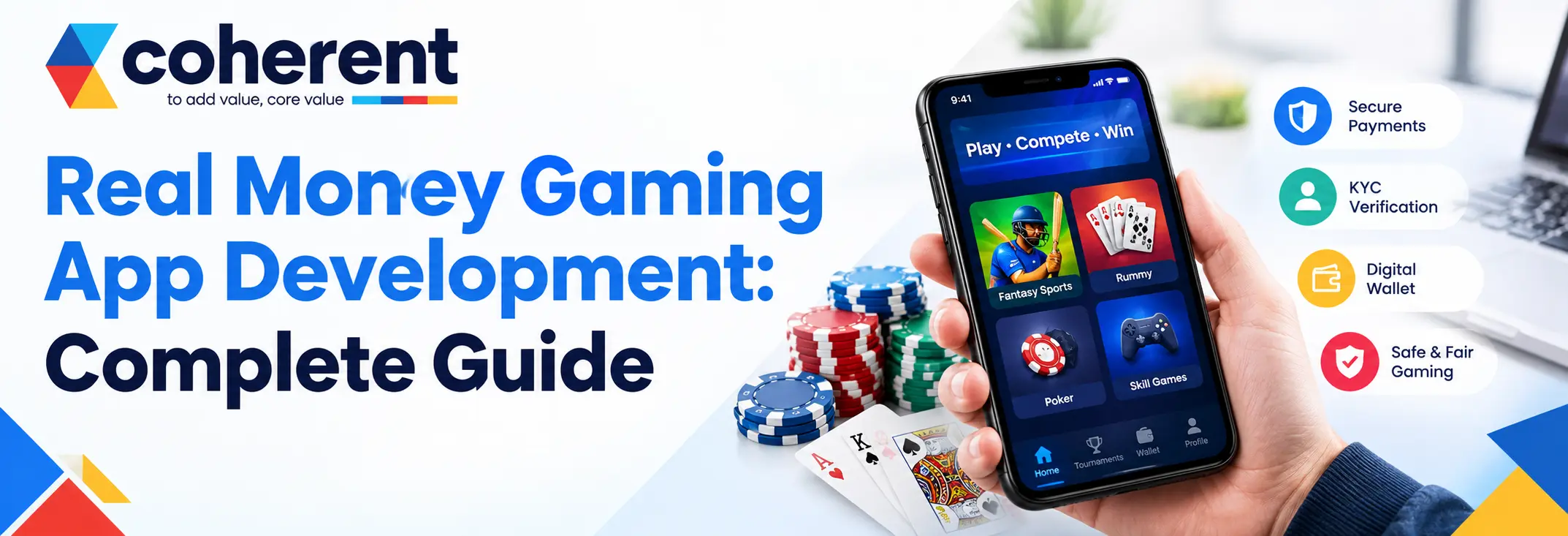
Real money gaming apps have become an important digital entertainment category, bringing together interactive gameplay, payments, competitions, rewards, and real-time experiences in a single platform. From fantasy sports and eligible card games to skill-based competitions and tournaments, these applications can support different business models and user experiences. Their growing digital reach has also created opportunities for businesses exploring scalable gaming platforms.
However, real money gaming app development involves much more than building an engaging game. Developers need to plan secure payment gateways, KYC verification, responsible gaming controls, fraud prevention, scalable backend infrastructure, analytics, and jurisdiction-specific requirements. This guide explains how to develop a real money gaming app, covering essential features, development costs, technology stacks, monetization models, development stages, security considerations, and important factors for launching a reliable platform.
What Is a Real Money Gaming App?
A real money gaming app is a digital platform that allows users to participate in eligible games or competitions where monetary transactions are involved. Depending on the jurisdiction and gaming model, users may deposit funds, participate in games, and receive monetary rewards or withdrawals. These apps commonly include secure payments, KYC verification, digital wallets, user accounts, game management, and administrative controls. Coherent Lab provides gaming app development solutions tailored to business and technical requirements.
- Fantasy sports applications
- Skill-based card games
- Tournament platforms
- Competitive gaming applications
Real Money Gaming App Development Process
Building a successful real money gaming app requires more than simply developing attractive games. The process involves business planning, market research, regulatory assessment, game selection, technology planning, secure payments, KYC, testing, and ongoing maintenance. A structured development approach helps businesses manage technical complexity, security requirements, user experience, scalability, and compliance while creating a reliable gaming platform for the intended market. Explore Real money gaming apps to learn more about gaming revenue models and monetization opportunities.
1. Define the Gaming Business Model
Start by clearly defining how your real money gaming platform will operate. Identify the gaming category, target audience, supported platforms, revenue model, payment options, and user acquisition strategy. You should also consider responsible gaming controls, compliance requirements, infrastructure needs, and expected scalability. A well-defined business model helps developers estimate resources, development time, features, and overall project costs accurately.
- Game category and target audience
- Revenue model and payment methods
- Supported platforms and technology requirements
- Compliance and responsible gaming requirements
2. Conduct Market and Regulatory Research
Regulatory research is a critical stage of real money gaming app development because requirements can differ significantly between jurisdictions. Before development begins, understand applicable licensing, age verification, taxation, advertising, payment, and data protection obligations. The legal classification of a game can also affect how the platform operates. Qualified legal and compliance professionals should review requirements for the intended market.
- Country and state-specific gaming regulations
- Game classification and licensing requirements
- Age verification and KYC obligations
- Payment, tax, advertising, and data protection rules
3. Choose the Right Gaming Format
Selecting the appropriate gaming format influences the application’s features, architecture, user experience, backend requirements, and development costs. Businesses should determine whether their platform will focus on fantasy sports, skill-based games, card games, tournaments, competitive experiences, or casual gaming. Since regulations may differ between gaming formats, the selected category should be reviewed carefully for the target jurisdiction before development.
- Fantasy sports and competitive gaming platforms
- Skill-based and tournament-based games
- Eligible digital card gaming formats
- Casual gaming experiences with applicable regulations
Essential Features of a Real Money Gaming App
A successful real money gaming app needs more than engaging gameplay. It should provide a complete ecosystem covering user accounts, payments, gaming, security, and compliance. Essential features should be designed around the platform’s gaming model and target jurisdiction. A well-planned feature set can improve usability, support secure transactions, simplify administration, and create a reliable experience across different devices and gaming formats. Learn more about Real Money Gaming App Development Cost in 2026 to understand the investment involved in building such platforms.
User Registration and Login
Registration should be simple while collecting information required for account management and applicable verification. A secure authentication system can combine mobile or email verification with OTP, password recovery, and multi-factor authentication. Social login may also be included where appropriate. The registration flow should balance convenience with security, privacy, and applicable KYC or age-verification requirements.
- Email or mobile number registration
- OTP-based account verification
- Multi-factor authentication
- Password recovery and secure login
User Profile
A dedicated user profile allows players to manage personal information, verification details, preferences, and gaming activity. Users should be able to access important account information without navigating through multiple screens. Profile functionality can also include notification controls and responsible gaming settings, depending on the platform and applicable requirements.
- Personal information management
- Verification status
- Gaming and transaction history
- Notification and account preferences
Digital Wallet
A secure digital wallet is a core component of a real money gaming platform. It can manage deposits, withdrawals, balances, promotional credits, refunds, and transaction records. The wallet should be designed with strong security and accurate reconciliation to reduce transaction errors. Its functionality should also align with the platform’s payment infrastructure and applicable regulations.
- Deposit and withdrawal management
- Balance tracking
- Transaction history and status
- Refund and promotional credit management
Secure Payment Gateway
A secure payment gateway enables users to deposit or withdraw funds through supported payment methods. Depending on the target market, businesses may integrate cards, bank transfers, digital wallets, and local payment services. Payment options should be selected according to availability, transaction requirements, security standards, and applicable regulations to provide a reliable financial experience.
- Card payment integration
- Bank transfer support
- Digital wallet integration
- Local and approved payment methods
Game Lobby
The game lobby acts as a central hub where users can discover available games, tournaments, and competitions. A well-designed lobby should make navigation simple and provide relevant information before users participate. Search, filters, categories, game rules, entry details, and participation status can help users quickly find suitable gaming options.
- Game categories and featured games
- Search and filtering options
- Tournament and competition listings
- Entry information and game rules
Real-Time Gameplay
For multiplayer real money gaming applications, real-time communication is essential for keeping players and servers synchronized. Technologies such as WebSockets can support timely updates during gameplay. Depending on the application, real-time systems can manage player actions, game states, scores, timers, competition updates, and notifications while supporting consistent performance.
- Player actions and game-state synchronization
- Live scores and competition updates
- Timers and event notifications
- Real-time multiplayer communication
How Much Does Real Money Gaming App Development Cost?
The real money gaming app development cost can range from approximately $20,000 to $50,000 for an MVP and exceed $250,000 for an advanced platform. The final investment depends on game complexity, features, platforms, UI/UX design, payment gateways, KYC integration, security, backend infrastructure, third-party APIs, testing, maintenance, and regulatory requirements in the target market. Explore Game Development Services for additional insights into gaming development solutions.
| App Type | Estimated Development Cost |
|---|---|
| Basic Gaming MVP | $20,000–$50,000+ |
| Medium-Complexity Platform | $50,000–$120,000+ |
| Advanced RMG Platform | $120,000–$250,000+ |
| Enterprise-Level Platform | $250,000+ |
Real Money Gaming App Monetization Models
A real money gaming platform can generate revenue through multiple monetization models depending on its business structure, target market, game format, and applicable regulations. Common approaches include platform commissions, tournament fees, subscriptions, advertising, and brand partnerships. Businesses should select a suitable revenue strategy while considering transaction costs, user experience, operational expenses, compliance obligations, and long-term platform sustainability. Explore Real Money Gaming Platforms for Android to learn more about Android gaming solutions.
Platform Commission
A platform may charge a predefined commission on eligible transactions, contests, or competitions. The commission structure should be transparent and clearly communicated to users. Businesses can design different pricing models based on the gaming format, transaction type, market requirements, and applicable regulations while ensuring that the payment and accounting systems accurately track platform revenue.
- Commission on eligible gaming transactions
- Fees associated with eligible competitions
- Transparent pricing and transaction disclosures
- Automated revenue tracking and reconciliation
Tournament Fees
Gaming platforms can generate revenue through fees associated with eligible tournaments or structured competitions. Users may pay an applicable participation fee to enter certain events, subject to local regulations. The platform should clearly communicate entry conditions, applicable charges, prize structures, and withdrawal policies while maintaining accurate transaction records and secure payment processing.
Subscription Model
A real money gaming app may offer subscription-based memberships where legally permitted. Subscribers could receive access to additional platform features, enhanced experiences, analytics, loyalty benefits, or other eligible services. Subscription pricing should be transparent, easy to manage, and aligned with applicable consumer protection and gaming regulations.
Advertising
Advertising can provide an additional revenue stream for gaming platforms with sufficient user engagement and traffic. Businesses may work with relevant advertisers to display banners, sponsored content, or other permitted promotional formats. Advertising strategies should follow applicable gaming, consumer protection, privacy, and platform policies while avoiding misleading or inappropriate promotional practices.
Partnerships and Sponsorships
Gaming businesses may generate revenue through partnerships and sponsorships involving brands, leagues, teams, events, or other organizations. These arrangements can support promotional campaigns and increase platform visibility. However, partnership structures should be reviewed against applicable advertising, gaming, sponsorship, intellectual property, and jurisdiction-specific requirements before implementation.
Challenges in Real Money Gaming App Development
Developing a real money gaming application involves technical, financial, operational, and regulatory challenges. Businesses must build systems capable of securely handling user accounts, payments, gaming activity, and sensitive information while supporting large numbers of users. Regulatory requirements can also vary across markets, making compliance planning an important part of architecture, development, testing, deployment, and ongoing platform management.
Regulatory Complexity
Gaming regulations can differ significantly between countries, states, and jurisdictions. A gaming model permitted in one location may face different licensing, operational, advertising, or taxation requirements elsewhere. Businesses should assess applicable rules before development and obtain qualified legal guidance to understand licensing obligations, user eligibility, KYC requirements, responsible gaming measures, and other compliance responsibilities.
Payment Security
Handling financial transactions requires a secure payment architecture with appropriate payment gateways, transaction monitoring, reconciliation, and fraud controls. The platform should protect sensitive financial and user information while maintaining accurate records of deposits, withdrawals, refunds, and other transactions. Payment integrations should also comply with relevant security standards and applicable regulatory requirements.
Fraud Prevention
Real money gaming platforms can face different types of fraudulent or abusive activity. Building fraud prevention into the core architecture can help identify suspicious behavior and protect platform operations. Depending on the platform, monitoring systems can analyze account activity, transactions, login patterns, and gaming behavior to identify potential risks for further review.
Scalability
A successful real money gaming app may experience sudden increases in traffic during tournaments, major events, or promotional campaigns. The backend should therefore be designed for scalability, availability, and reliable performance. Cloud infrastructure, database optimization, caching, load balancing, monitoring, and efficient APIs can help the platform manage changing user demand effectively.
User Trust
User trust is important for any platform involving gaming and financial transactions. Clear rules, secure payment processing, reliable gameplay, transparent account policies, responsive customer support, and accurate transaction records can contribute to a dependable user experience. Businesses should continuously monitor platform performance, security, and user feedback to identify operational issues and improve the overall gaming experience.
How to Choose a Real Money Gaming App Development Company
Choosing the right real money gaming app development company requires evaluating technical expertise, gaming experience, security practices, and understanding of regulatory requirements. Look for a team experienced in real-time applications, payment gateway integration, KYC, scalable backend systems, and cybersecurity. Review their portfolio, client feedback, development process, communication, testing standards, maintenance services, and ability to customize the platform according to your business requirements. For additional insights, explore Game Development Company vs. Freelancers.
- Mobile game development
- Real-time applications
- Secure payment integration
- Cloud infrastructure
Why Businesses Invest in Real Money Gaming Apps
Businesses invest in real money gaming apps to create interactive digital platforms with multiple potential revenue opportunities. These applications can support player engagement through competitions, tournaments, and skill-based experiences while enabling digital transactions. With features such as secure wallets, payment gateways, analytics, personalization, and loyalty programs, businesses can build scalable gaming platforms tailored to specific markets, audiences, and applicable regulatory requirements.
- Mobile-first experiences
- Real-time gameplay
- Personalized experiences
- Secure payments
Final Thoughts
Real money gaming app development is a multidisciplinary process involving game development, mobile engineering, backend infrastructure, payments, security, identity verification, analytics, and compliance.The most important step is to define the business model and target jurisdiction before development begins. From there, businesses can build the technology architecture, select essential features, estimate development costs, and create a scalable product roadmap.
If you're planning to build a real money gaming platform, partnering with an experienced real money gaming app development company can help transform your concept into a technically scalable and security-focused application. An experienced team can coordinate development, testing, payment integrations, KYC systems, security measures, and ongoing improvements to support your platform’s evolving requirements. Connect with our experts to discuss your real money gaming app development requirements.
Frequently Asked Questions
Q1: How much does it cost to develop a real money gaming app?
Ans. Real money gaming app development can cost approximately $20,000–$50,000 for an MVP and $250,000+ for an advanced platform. The final cost depends on game complexity, features, UI/UX design, supported platforms, payment gateway integration, KYC, security, backend infrastructure, third-party APIs, testing, maintenance, and regulatory requirements. A detailed estimate requires defining the app’s features and target market.
Q2: How long does it take to develop a real money gaming app?
Ans. Developing a real money gaming app can take around 3–5 months for an MVP, while medium and advanced platforms may require 5–12+ months. The timeline depends on the number of games, user features, payment integrations, KYC systems, backend architecture, security testing, admin functionality, and customization. Proper planning, development, testing, and compliance checks can help create a smoother launch process.
Q3: What features should a real money gaming app have?
Ans. A real money gaming app should typically include user registration, secure login, KYC verification, game lobby, player profiles, digital wallet, payment gateway, transaction history, notifications, customer support, responsible gaming tools, and an admin dashboard. Depending on the platform, developers may also integrate real-time gameplay, leaderboards, promotions, analytics, fraud detection, withdrawal management, and security controls to support reliable operations.
Q4: Is real money gaming legal?
Ans. The legality of real money gaming depends on the country, state or province, game format, business model, licensing requirements, and other applicable regulations. Laws can differ significantly between jurisdictions and may change over time. Before launching a real money gaming app, businesses should review the rules applicable to their target market and obtain qualified legal and compliance advice to ensure regulatory requirements are addressed.
Q5: Which technologies are used to build real money gaming apps?
Ans. Real money gaming apps can be developed using technologies such as Flutter, React Native, Swift, Kotlin, Node.js, Java, Python, PostgreSQL, MongoDB, Redis, AWS, Azure, and Google Cloud. The technology stack depends on the application’s requirements, including game performance, real-time communication, scalability, security, database needs, supported devices, and third-party integrations. Developers generally select technologies based on the platform’s architecture and functionality.
Q6: How can a real money gaming app make money?
Ans. A real money gaming app can generate revenue through different gaming monetization models, such as platform commissions, tournament or participation fees, subscriptions, advertising, and business partnerships. The suitable revenue model depends on the type of gaming platform, target users, market conditions, and applicable regulations. Businesses should also consider payment processing costs, operational expenses, customer support, security, and compliance when planning their revenue strategy.
Q7: What is KYC in real money gaming?
Ans. KYC (Know Your Customer) is a user verification process used to establish a player’s identity and, where required, confirm age and other relevant information. A real money gaming app may use identity documents, verification services, and additional checks depending on applicable regulations. KYC can support compliance, account security, fraud prevention, and responsible platform management, although specific requirements vary by jurisdiction and gaming model.
Q8: How do I choose a real money gaming app development company?
Ans. When choosing a real money gaming app development company, consider its experience with gaming platforms, real-time applications, secure payment integration, scalable backend systems, APIs, cybersecurity, and compliance-oriented development. Review previous projects, technical expertise, development methodology, communication process, testing practices, and post-launch support. It is also useful to evaluate whether the team can customize the platform according to your business and technical requirements.

 +91 774-202-1725
 +1 (945) 3387904
 business@coherentlab.com
 +49 15223341304
 UK
UK