Table of Contents
Real Money Gaming App vs Social Gaming App
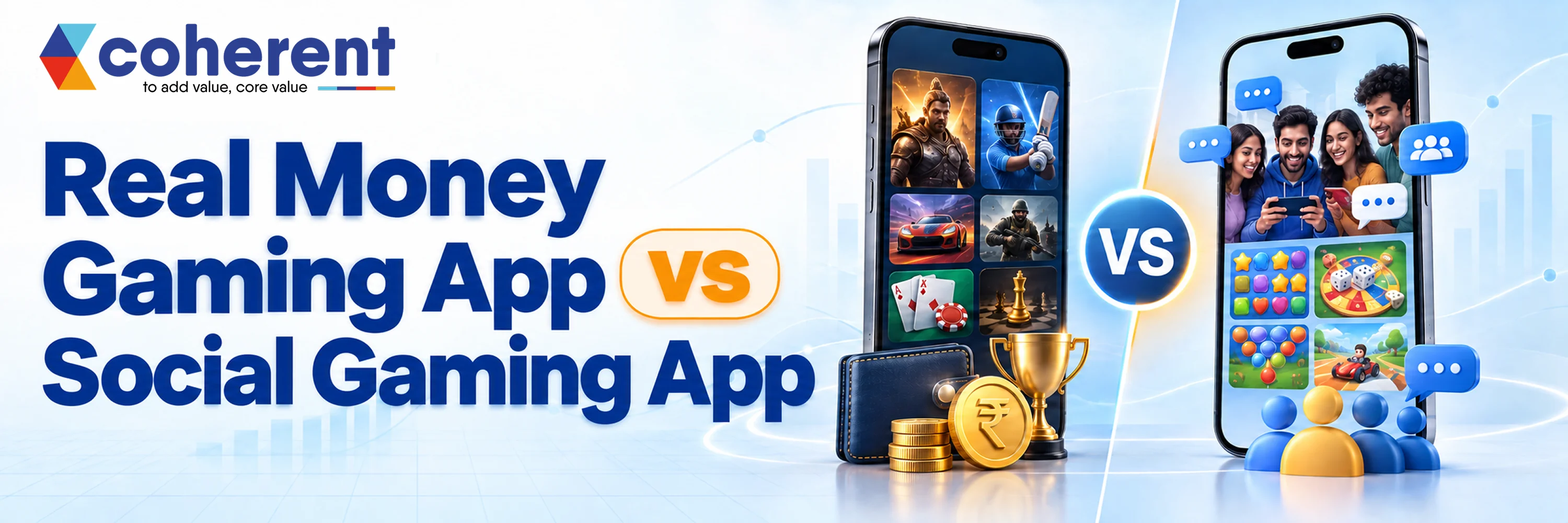
Mobile gaming businesses generally choose between two models: real money gaming and social gaming. Although both models use engaging gameplay, rewards, leaderboards, and multiplayer features, their financial systems, legal responsibilities, development requirements, and business risks are significantly different.
A real money gaming app allows eligible users to deposit money, enter paid games, win cash prizes, and request withdrawals. A social gaming app focuses on entertainment, community participation, and virtual rewards that normally cannot be converted into cash. Understanding these differences is essential before selecting a business model or beginning gaming app development.
Quick Answer
A real money gaming app allows users to deposit funds, join paid games, win cash prizes, and withdraw rewards, requiring strong security, payment systems, and regulatory compliance. In contrast, a social gaming app focuses on entertainment, virtual currency, achievements, and community engagement. Coherent Lab develops secure and scalable gaming solutions, helping businesses choose the right model based on their budget, market, and goals.
Key Takeaways
- Real money gaming apps handle deposits, paid entries, winnings, and withdrawals.
- Social gaming apps use virtual coins, points, badges, and non-withdrawable rewards.
- Real money platforms need stronger KYC, geolocation, fraud prevention, and payment security.
- Social games generally have fewer regulatory barriers and broader geographic availability.
- Real money games can earn through contest fees and platform commissions.
- Social games commonly monetize through advertisements, subscriptions, and virtual items.
- Social gaming is generally more suitable for startups with limited compliance resources.
- The right model depends on the audience, location, budget, risk tolerance, and revenue strategy.
What Is a Real Money Gaming App?
A real money gaming app enables eligible adults to deposit funds, pay contest fees, play approved games, and withdraw winnings where legally permitted. Real money gaming apps combine gameplay with identity verification, secure payments, digital wallets, fraud monitoring, and responsible gaming controls. Common formats include fantasy sports, poker, rummy, casino-style games, betting, and skill-based tournaments for verified users in permitted regions.
Key Features
- User registration and secure login
- KYC, identity, and age verification
- Deposits and withdrawal management
- Digital wallets and transaction histories
- Paid contests and cash rewards
- Geolocation and regional access controls
- Fraud detection and account monitoring
- Responsible gaming tools
- Secure payment gateway integration
What Is a Social Gaming App?
A social gaming app is an entertainment-focused platform where players interact, compete, complete challenges, and build communities using virtual rewards. Users can collect coins, customize avatars, unlock levels, join teams, or purchase digital items, but generally cannot convert rewards into cash. Leading game app development companies in India create engaging puzzles, simulations, board games, social casino games, strategy titles, and role-playing experiences for connected players.
Key Features
- User profiles and customizable avatars
- Social login and friend invitations
- Multiplayer gameplay and team challenges
- Virtual coins and non-cash rewards
- Leaderboards, badges, and achievements
- In-app purchases and subscriptions
- Community groups and chat features
- Daily missions and loyalty rewards
- Social sharing and referral programs
- Regular events and content updates
Real Money Gaming App vs Social Gaming App: Detailed Comparison
The main difference between a real money gaming app and a social gaming app is whether players deposit, risk, win, or withdraw actual money. Businesses planning to build a real money gaming app must consider regulations, licensing, secure payments, identity verification, development costs, and geographic restrictions. Social games instead prioritize entertainment, virtual rewards, community engagement, accessibility, player retention, and scalability.
| Comparison Factor | Real Money Gaming App | Social Gaming App |
|---|---|---|
| Main Purpose | Monetary competition | Entertainment and social interaction |
| Entry Model | Deposits or paid contests | Free-to-play or freemium |
| Rewards | Cash or withdrawable prizes | Virtual coins, items, or badges |
| User Verification | Strong KYC and age verification | Usually basic registration |
| Regulation | Highly regulated | Generally less regulated |
| Payment System | Deposits and withdrawals | Primarily in-app purchases |
| Geographic Reach | Restricted by local laws | Usually broader |
| Security Complexity | Very high | Moderate to high |
| Development Cost | Higher | Usually lower |
| Major Revenue Sources | Entry fees and commissions | Advertisements and virtual purchases |
Monetization Differences
Real money gaming platforms generate revenue through entry fees, tournament commissions, transaction charges, memberships, sponsorships, and partnerships. Social gaming apps depend more on advertisements, subscriptions, virtual currency, cosmetic upgrades, season passes, and premium content. Successful monetization requires transparent pricing, balanced rewards, strong retention, trusted payments, regulatory compliance, and sustainable engagement.
Key monetization options:
- Entry fees and tournament commissions
- Transaction and withdrawal charges
- Premium memberships and subscriptions
- In-app advertisements
- Virtual coins and digital items
- Cosmetic upgrades and custom avatars
- Season passes and premium levels
- Sponsorships and brand collaborations
User Experience Differences
User experience priorities differ because real money players focus on fairness, security, transparent rules, accurate results, fast settlement, dependable withdrawals, and responsive assistance. Social gaming users value enjoyable play, progression, friendships, customization, challenges, and recurring events. Both models need simple onboarding, intuitive navigation, clear communication, accessibility, personalization, and responsive support.
Important user experience factors:
- Simple registration and onboarding
- Clear gameplay rules and reward conditions
- Accurate scoring and fair results
- Fast deposits, settlements, and withdrawals
- Smooth navigation and reliable performance
- Personalized challenges and recommendations
- Social interaction and community features
- Accessible customer support
Benefits of Real Money Gaming and Social Gaming Apps
Real money gaming and social gaming apps offer valuable opportunities for businesses and players, although their advantages differ. Real money gaming platforms for Android support transaction-based revenue, competitive participation, and higher-value engagement. Social gaming apps encourage broader accessibility, community building, viral growth, and flexible monetization. Both models can strengthen player retention, provide valuable insights, expand audiences, and create sustainable digital entertainment ecosystems at scale.
Benefits of Real Money Gaming Apps
Real money gaming apps help operators generate direct revenue through entry fees, paid contests, tournaments, memberships, sponsorships, and platform commissions. Cash-based competition can increase player motivation, participation, and transaction value while supporting loyalty programs and live events. These platforms also provide detailed behavioural and financial data that businesses can use to improve personalization, retention, risk monitoring, marketing decisions, and long-term revenue planning across legally permitted gaming markets and audiences worldwide.
Key benefits include:
- Strong player motivation and competitive engagement
- Higher-value user activity and transactions
- Multiple transaction-based revenue streams
- Paid contests and tournament monetization
- Premium memberships and sponsorship opportunities
- Loyalty programs and VIP rewards
- Detailed behavioural and financial analytics
- Personalized promotions and gaming experiences
- Improved player retention opportunities
Benefits of Social Gaming Apps
Social gaming apps offer businesses an accessible and scalable way to attract players without requiring cash deposits or complex financial verification. Their free-to-play and freemium models support faster onboarding, wider geographic reach, community participation, and organic sharing. Businesses can generate revenue through advertisements, subscriptions, virtual items, and premium features while reducing withdrawal management, payment risks, compliance burdens, and other operational complexities commonly associated with real money gaming platforms and services.
Key benefits include:
- Lower barriers to user registration and acquisition
- Faster onboarding without financial verification
- Wider international audience reach
- Community-led engagement and organic growth
- Flexible advertising and freemium monetization
- Revenue from subscriptions and virtual items
- Reduced deposit and withdrawal complexity
- Strong potential for viral sharing and referrals
- Lower regulatory exposure than cash gaming
- Easier testing of new features and game concepts
Step-by-Step Gaming App Development Process
A structured development process helps businesses transform ideas for real money gaming apps for iPhone into secure, engaging, scalable, and market-ready products. It covers market research, concept validation, game design, UI/UX, technology selection, development, integrations, testing, compliance, launch, and optimization. Following clear stages reduces technical failures, controls costs, improves collaboration, protects users, and supports sustainable commercial growth after launch.
| Step | Development Stage | Key Activities |
|---|---|---|
| 1 | Research and Define the Game Concept | Identify target players, regions, ages, and devices; analyze competitors and market gaps; review regulations and app-store restrictions; define gameplay, scoring, rewards, monetization, and market positioning. |
| 2 | Prepare the Game Design and User Experience | Document mechanics, controls, characters, levels, progression, visuals, and audio; create wireframes and interactive prototypes; test onboarding, navigation, accessibility, payments, and responsive design. |
| 3 | Select the Technology Stack | Choose native or cross-platform development; select a game engine and programming language; plan databases, cloud hosting, real-time communication, scalable infrastructure, analytics, and third-party integrations. |
| 4 | Develop and Integrate the Application | Build the gameplay client, backend, databases, APIs, dashboards, matchmaking, leaderboards, and rewards; integrate payments, wallets, KYC, geolocation, notifications, analytics, chat, and social features. |
| 5 | Test and Review Compliance | Test gameplay, compatibility, performance, security, load handling, payments, withdrawals, and recovery procedures; review licences, KYC, privacy, taxation, geographic restrictions, advertising, player protection, and app-store compliance. |
| 6 | Launch, Monitor, and Optimize | Conduct a controlled launch; monitor retention, crashes, latency, transactions, reviews, and support requests; collect player feedback and release content, security, usability, and performance improvements. |
1. Research and Define the Game Concept
Market research confirms whether the gaming idea meets genuine demand. Analyze target players, preferred devices, competitor offerings, market gaps, regulations, spending habits, and acquisition costs. Use these findings to define the game concept, audience, gameplay model, monetization strategy, and positioning.
- Identify target players, regions, ages, and devices.
- Analyze competitors, features, reviews, and market gaps.
- Review regulations and application-store restrictions.
- Define gameplay, scoring, rewards, and winning conditions.
- Select an appropriate monetization model and positioning.
2. Prepare the Game Design and User Experience
Create a detailed game design document covering mechanics, controls, levels, characters, scoring, rewards, visuals, audio, technology, and monetization. Convert these requirements into wireframes and prototypes that simplify onboarding, gameplay, payments, support, navigation, accessibility, and responsive experiences across supported devices successfully.
- Document gameplay mechanics, controls, and progression.
- Describe characters, levels, scoring, and rewards.
- Specify visual, audio, animation, and interface requirements.
- Create wireframes and interactive gameplay prototypes.
- Test onboarding, accessibility, navigation, and responsiveness.
3. Select the Technology Stack
Choose a technology stack based on gameplay complexity, supported platforms, expected traffic, security, scalability, speed, and budget. Select suitable frameworks, game engines, databases, cloud infrastructure, real-time communication tools, and analytics solutions that support reliable integrations, maintenance, and future product growth.
- Choose native or cross-platform application development.
- Select a suitable game engine and programming language.
- Plan databases, cloud hosting, and scalable infrastructure.
- Implement secure real-time communication and data processing.
- Confirm compatibility with required third-party services.
4. Develop and Integrate the Application
Develop the application using modular architecture for efficient collaboration, testing, maintenance, and scaling. Build the gameplay client, backend, database, APIs, dashboard, matchmaking, leaderboards, and rewards. Integrate payments, wallets, KYC, geolocation, notifications, analytics, chat, and other essential third-party services securely.
- Develop the frontend and interactive gameplay client.
- Build backend services, databases, and secure APIs.
- Create dashboards, matchmaking, leaderboards, and reward systems.
- Integrate payments, wallets, KYC, and geolocation.
- Connect notifications, analytics, chat, and social features.
5. Test and Review Compliance
Test the gaming application across devices, platforms, networks, traffic levels, and transaction scenarios. Examine functionality, usability, compatibility, performance, security, payments, and recovery processes. Complete a formal compliance review covering licences, KYC, privacy, geolocation, taxation, advertising, player protection, and store policies.
- Test gameplay, scoring, progression, and reward accuracy.
- Conduct compatibility, security, performance, and load testing.
- Verify payments, withdrawals, and recovery procedures.
- Review licences, KYC, privacy, and geographic restrictions.
- Confirm advertising, responsible gaming, and store compliance.
6. Launch, Monitor, and Optimize
Launch the gaming app gradually to control risk and measure real-world performance. Monitor registrations, activation, retention, crashes, latency, transactions, withdrawals, reviews, and support requests. Use analytics and player feedback to improve gameplay, rewards, marketing, security, personalization, stability, and sustainable commercial growth.
- Begin with a controlled or regional application launch.
- Monitor retention, crashes, latency, and transactions.
- Collect player feedback and address usability problems.
- Release content, security patches, and performance updates.
- Measure improvements against long-term growth objectives.
Conclusion
Real money gaming and social gaming apps may share similar gameplay features, but they operate under very different commercial and regulatory conditions. Real money platforms provide transaction-based revenue and powerful competitive motivation, while requiring advanced payment security, verification, legal compliance, and responsible-gaming controls.
Social gaming offers a more accessible route for startups seeking broad reach, community engagement, and flexible monetization. The right choice depends on the target audience, jurisdiction, budget, risk tolerance, and business goals. Before development begins, validate the market, review the legal framework, select a sustainable revenue model, and build security and user trust into every stage of the product. Talk to Our Experts
Frequently Asked Questions
Q1. What is the main difference between a real money gaming app and a social gaming app?
Ans. A real money gaming app allows eligible users to deposit funds, pay entry fees, compete for cash prizes, and withdraw approved winnings. A social gaming app focuses on entertainment, interaction, progression, and virtual rewards that normally have no cash value. This fundamental distinction affects licensing, payments, KYC, security, taxation, geographic access, development costs, responsible gaming controls, monetization, business risk.
Q2. Is a social casino app considered real money gambling?
Ans. A social casino app is not automatically considered real money gambling because it generally uses virtual currency and does not permit cash withdrawals. However, classification depends on local law, game mechanics, purchasable credits, prize value, trading options, and whether rewards can be exchanged. Developers should obtain qualified legal advice before launching casino-style features or transferable virtual assets in any market.
Q3. Which is more profitable: real money gaming or social gaming?
Ans. Real money gaming can produce higher revenue per active user through entry fees, commissions, tournaments, and transactions. Social gaming may scale more broadly through advertising, subscriptions, virtual goods, and premium content. Neither model guarantees profitability. Results depend on acquisition costs, retention, regulations, payment expenses, competition, player trust, content quality, engagement levels, operational efficiency, and the business’s ability to monetize responsibly.
Q4. How much does it cost to develop a real money gaming app?
Ans. A basic real money gaming MVP may cost approximately $50,000 to $100,000, while an advanced multi-game platform can exceed $300,000. Pricing depends on gameplay complexity, supported platforms, UI/UX, backend scalability, KYC, digital wallets, payment gateways, geolocation, fraud detection, security testing, admin controls, and compliance. Businesses should also budget for licensing, hosting, maintenance, customer support, marketing, legal reviews, and future updates.
Q5. How much does social gaming app development cost?
Ans. A basic social gaming MVP may cost approximately $20,000 to $60,000, while a sophisticated multiplayer game may range from $60,000 to $150,000 or more. Final pricing depends on gameplay complexity, graphics, animation, platforms, backend capacity, multiplayer technology, social features, live events, virtual purchases, analytics, and content volume. Additional expenses include cloud hosting, maintenance, marketing, moderation, customer support, and regular updates.
Q6. Does a real money gaming app require a licence?
Ans. A real money gaming app may require one or several licences, depending on its game format, reward structure, target country, and regional laws. Requirements can differ for betting, casino games, fantasy sports, poker, lotteries, and skill-based competitions. Businesses should consult qualified legal professionals and relevant regulators before development, accepting deposits, advertising paid play, processing withdrawals, or entering a new jurisdiction.
Q7. Can users withdraw money from a social gaming app?
Ans. Users normally cannot withdraw virtual coins, points, badges, or rewards from a standard social gaming app because these items are designed only for in-game entertainment. If rewards can be exchanged for cash, transferred to others, traded externally, or redeemed for valuable prizes, the app may face additional gaming, gambling, tax, consumer protection, payment, and compliance requirements in relevant operating markets.
Q8. Which gaming app model is better for a startup?
Ans. Social gaming is generally more practical for startups with limited budgets because it offers simpler payments, broader availability, flexible monetization, and lower compliance complexity. Real money gaming may provide higher transaction value but requires stronger funding, security, legal guidance, fraud prevention, and operational controls. Startups should compare audience demand, jurisdiction rules, development costs, risk tolerance, monetization goals, and long-term scalability.

 +91 774-202-1725
 +1 (945) 3387904
 business@coherentlab.com
 +49 15223341304
 UK
UK