
Table of Contents
Single-Service vs Multi-Service On-Demand Apps: Which Should You Build?
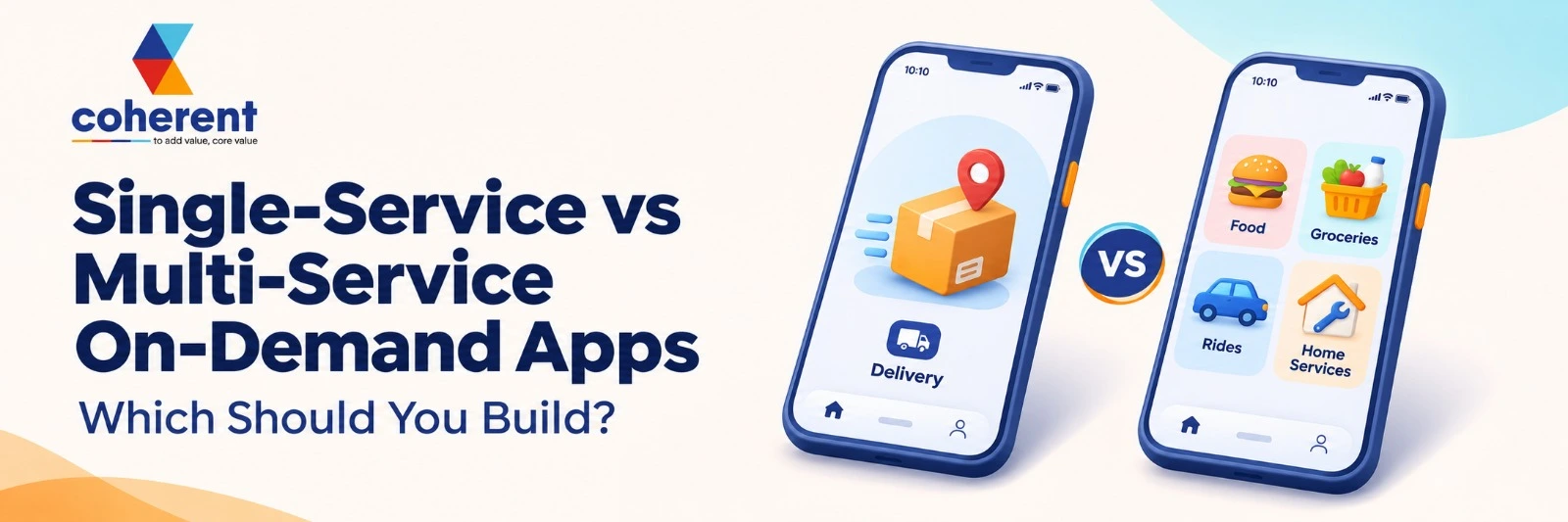
The on-demand economy has changed how people access everyday services. From booking a taxi and ordering food to hiring a professional cleaner or scheduling a beauty appointment, customers increasingly expect convenient services through mobile applications. For businesses, this creates an opportunity to build digital platforms that connect customers with service providers.But before investing in development, there is one important decision: Should you build a single-service on-demand app or a multi-service on-demand app?
The right choice depends on your business model, target audience, budget, operational capabilities, and long-term growth plans. A single-service application focuses on doing one thing exceptionally well, while a multi-service platform brings different services together under one application.For startups, a single-service app can be a practical way to validate an idea and build a focused customer base. Businesses with multiple service categories, established operations, and sufficient resources may benefit from a multi-service platform.Let's explore their differences, benefits, limitations, development requirements, and the factors that can help you choose the right approach.
What Is a Single-Service On-Demand App?
A single-service on-demand app is a mobile or web application designed to provide one primary category of service. It connects customers with relevant service providers through a dedicated booking, ordering, or delivery experience.For example, a taxi-booking application focuses on transportation, while a home-cleaning application helps customers find and schedule cleaning professionals.Instead of managing several unrelated service categories, the business concentrates on improving one specific customer experience.
- User registration and profiles: Allows customers to create accounts and manage personal information.
- Service booking: Enables users to select services and schedule appointments.
- Real-time tracking: Helps customers monitor service requests or provider locations where applicable.
- Payment integration: Supports secure online payments and other available payment methods.
What Is a Multi-Service On-Demand App?
A multi-service on-demand app is a unified digital platform that offers multiple service categories through one application. Customers can access different services without downloading separate applications for each requirement.For example, a multi-service platform might provide food delivery, grocery shopping, taxi booking, home cleaning, beauty appointments, and handyman services through a single interface.This model is sometimes associated with super apps, although not every multi-service application qualifies as a super app. A super app generally combines multiple digital services and experiences into a broader ecosystem.
- Multiple service categories: Displays different services through organized sections.
- Unified customer accounts: Allows users to access different categories with one account.
- Advanced search and filters: Helps customers discover relevant providers and services.
- Category-based booking: Supports different booking processes depending on the service.
Single-Service vs Multi-Service On-Demand Apps: What Are the Main Differences?
The main difference lies in the range of services each application offers. A single-service app focuses on one specific business category, delivering a simple and streamlined user experience. In contrast, a multi-service app supports multiple business categories, service providers, and workflows within one platform. It offers greater flexibility, convenience, and scalability, allowing businesses to manage diverse services while helping customers access multiple solutions through a single application.
|
Comparison Factor |
Single-Service App |
Multi-Service App |
|---|---|---|
|
Business Model |
One primary service |
Multiple service categories |
|
Target Audience |
Specific customer segment |
Multiple customer segments |
|
Development Complexity |
Generally lower |
Generally higher |
|
Initial Investment |
Usually more manageable |
Usually higher |
|
User Experience |
Focused and specialized |
Broad and category-based |
|
Features |
Industry-specific |
Multiple service-related features |
|
Service Providers |
One main provider category |
Different provider categories |
|
Administration |
Comparatively simpler |
More complex |
|
Scalability |
Expansion within a focused category |
Expansion across categories |
|
Marketing Strategy |
Focused audience targeting |
Multiple audience segments |
|
Maintenance |
Fewer workflows to manage |
More integrations and workflows |
|
Revenue Opportunities |
Focused revenue streams |
Multiple potential revenue streams |
Also Read: Complete Guide on Doctor Appointment booking app development
What Are the Advantages of a Single-Service On-Demand App?
A single-service on-demand application focuses on solving one specific customer problem through a dedicated digital platform. It is a practical choice for startups and businesses that want to establish their presence in a particular market before expanding into other categories. By concentrating on one service, businesses can simplify development, improve customer experience, manage providers more effectively, and validate their business model with a focused investment.
1. Focused Customer Experience
A single-service application provides a straightforward experience by organizing its features around one customer requirement. Users can quickly find the service, check availability, make bookings, and track requests without navigating unrelated categories. This focused approach reduces unnecessary steps and helps businesses create an experience that meets specific customer expectations.
- Simple and intuitive navigation.
- Faster service discovery and booking.
- Features designed for specific customer needs.
- Personalized customer interactions.
2. More Manageable Development Scope
Developing a single-service application allows businesses to concentrate on essential functionalities instead of building several complicated service workflows simultaneously. Development teams can prioritize core requirements, reduce unnecessary integrations, and launch a minimum viable product (MVP) more efficiently. This approach also makes testing, troubleshooting, and collecting early customer feedback easier.
- Clearly defined initial product requirements.
- Better prioritization of core features.
- Simplified development and testing processes.
- Easier identification of technical issues.
3. Easier Brand Positioning
A specialized application helps businesses communicate their services and unique value proposition clearly. Instead of promoting several unrelated offerings, companies can build their identity around one specific customer requirement. For example, a professional home-cleaning application can establish its brand around reliable cleaning services, convenient scheduling, and verified professionals.
- Clear service-specific messaging.
- Better audience targeting.
- Stronger brand recognition.
- More relevant marketing campaigns.
4. Simplified Service Management
Managing one primary service category allows businesses to concentrate on provider onboarding, service quality, pricing, and customer support. Operational teams can establish consistent service standards without coordinating multiple provider categories. This makes it easier to monitor performance, resolve customer complaints, and maintain service reliability as the business grows.
- Easier provider verification and onboarding.
- Consistent service quality monitoring.
- Simplified pricing and availability management.
- More focused customer support.
5. Better Market Validation
A single-service application helps startups test their business idea before making a larger investment. Businesses can observe actual booking behavior, customer feedback, repeat purchases, and willingness to pay. These insights help determine whether the service has sufficient market demand and what improvements are necessary before expanding the application.
- Tracking customer acquisition and retention.
- Measuring booking conversion rates.
- Collecting customer feedback.
- Identifying opportunities for service improvements.
What Are the Advantages of a Multi-Service On-Demand App?
A multi-service on-demand application brings several related or unrelated services together through one digital platform. It allows customers to access different offerings without installing separate applications for each requirement. For businesses, this model creates opportunities to reach wider audiences, develop multiple revenue streams, encourage repeat engagement, and expand into new markets. However, its success depends on effective technology, service management, and operational planning. Businesses looking to build such platforms can invest in professional mobile app development to create feature-rich, scalable, and user-friendly applications that support multiple service categories and evolving customer expectations.
1. Multiple Revenue Opportunities
A multi-service application allows businesses to generate income from different service categories and commercial activities. Instead of depending on one primary offering, companies can introduce multiple monetization strategies based on customer demand and provider participation. This approach can create additional revenue opportunities while supporting the platform's long-term business growth.
- Commission on completed service bookings.
- Delivery and convenience charges.
- Provider subscription plans.
- Featured service listings.
- Premium customer memberships.
- Advertising and promotional placements.
2. Wider Customer Reach
Offering multiple services helps businesses attract customers with different requirements and purchasing preferences. A platform combining transportation, grocery delivery, food ordering, and home services can appeal to a broader audience than an application focused on one category. This creates opportunities to reach additional customer segments and expand market presence.
- Access to different customer segments.
- More opportunities for customer acquisition.
- Expansion into additional service categories.
- Greater visibility across local markets.
3. Cross-Service Customer Engagement
Customers who initially join a multi-service platform for one requirement may discover other useful offerings over time. For example, someone using an application for grocery delivery might later book home cleaning or local transportation through the same platform. Relevant recommendations and convenient access can encourage customers to explore additional services.
- Personalized service recommendations.
- Relevant promotional offers.
- Convenient access to multiple categories.
- Loyalty programs and membership benefits.
4. Centralized Platform Management
A multi-service application can bring common business operations together through a centralized technology system. Administrators can manage customer accounts, payments, notifications, analytics, and support from one dashboard. Individual service categories can maintain their own workflows while sharing essential platform infrastructure, reducing unnecessary duplication.
- Centralized customer account management.
- Integrated payment processing.
- Unified notification systems.
- Reporting and performance analytics.
5. Opportunities for Long-Term Expansion
A multi-service platform can support business expansion into new service categories, geographical locations, and customer segments. Companies can gradually introduce additional offerings based on market research and operational readiness. With a flexible architecture and appropriate resource planning, businesses can adapt their application as customer requirements and market opportunities change.
- Introducing new service categories.
- Expanding into additional locations.
- Building partnerships with service providers.
- Supporting increasing customer demand.
What Are the Challenges of Building a Multi-Service On-Demand App?
Although multi-service applications offer broader business opportunities, they also introduce technical, financial, and operational challenges. Managing several service categories requires additional development resources, more complicated workflows, and consistent coordination between providers and customers. Businesses should understand these challenges before selecting a multi-service application model to ensure the platform remains manageable, reliable, and capable of supporting long-term growth. Partnering with an experienced technology company like Coherent Lab can help businesses plan the right application architecture, streamline development, integrate essential features, and build a scalable on-demand platform that supports their long-term objectives.
1. Higher Development Complexity
Different service categories often require different booking processes, pricing calculations, provider dashboards, and fulfillment workflows. Combining these requirements into one application requires careful architecture and integration planning. Without proper development planning, the platform may become difficult to maintain and extend.
- Taxi booking requires GPS tracking and driver allocation.
- Food delivery requires restaurant menus and order management.
- Home services require appointment scheduling.
- Grocery delivery requires inventory and product management.
2. More Complicated Operations
Managing multiple service categories increases operational responsibilities. Businesses must coordinate different provider groups, service standards, pricing structures, and customer expectations. Each category may also require separate onboarding procedures and performance monitoring. Without clear processes, operational inefficiencies can affect service quality and customer satisfaction.
- Managing multiple provider categories.
- Maintaining consistent service standards.
- Coordinating different pricing policies.
- Handling category-specific customer complaints.
3. Greater Testing Requirements
A multi-service application contains more user journeys, integrations, and functional dependencies than a specialized platform. Development teams must verify that every category works correctly while ensuring shared features such as payments, authentication, and notifications remain reliable.
- Testing individual service booking workflows.
- Checking payment and transaction processing.
- Verifying third-party integrations.
- Evaluating application performance and security.
4. Higher Maintenance Requirements
Maintaining a multi-service platform requires continuous technical support because different categories may depend on separate integrations, business rules, and operational processes. Businesses must allocate resources for updates, bug fixes, security improvements, and performance monitoring to ensure consistent application functionality.
- Regular software updates and bug fixes.
- Security patches and vulnerability monitoring.
- Third-party API and integration management.
- Application performance optimization.
5. Risk of an Overcomplicated User Interface
Adding too many services without proper organization can make an application difficult to navigate. Customers may struggle to identify relevant categories, understand available options, or complete bookings efficiently. Businesses should prioritize usability and organize services through clear navigation and consistent interface design.
- Clear service categories and navigation.
- Consistent design across service sections.
- Easy booking and checkout processes.
- Relevant search and recommendation features.
How Much Does It Cost to Develop a Single-Service vs Multi-Service On-Demand App?
The development cost depends on application complexity, feature requirements, integrations, platform selection, UI/UX design, development location, and ongoing maintenance. A single-service application generally has a smaller initial development scope, while a multi-service platform may require additional modules, provider management systems, integrations, and administrative capabilities. Businesses planning to build an on-demand solution can partner with a mobile application development company in USA to choose the right technology, estimate development costs, and create a scalable application aligned with their business goals.
|
Development Type |
Indicative Cost |
|---|---|
|
Basic single-service MVP |
$10,000–$25,000 |
|
Mid-level single-service app |
$25,000–$50,000 |
|
Advanced single-service app |
$50,000–$90,000+ |
|
Basic multi-service MVP |
$25,000–$50,000 |
|
Mid-level multi-service platform |
$50,000–$100,000 |
|
Advanced multi-service platform |
$100,000–$200,000+ |
How to Choose the Right On-Demand App Development Strategy?
Choosing between single-service and multi-service app development requires evaluating customer demand, operational readiness, budget, and future business goals. The right strategy should solve a genuine customer problem while supporting sustainable growth. Businesses should avoid adding unnecessary features before understanding their target audience. Follow these practical steps to select an on-demand app development strategy that balances customer expectations, development costs, and long-term scalability.
Step 1: Identify Your Primary Customer Problem
Start by understanding the main problem your application will solve. Identify whether customers need one specialized service or multiple related services through a single platform. A clear problem statement helps determine the right business model, essential features, and application structure before development begins.
- Identify frequently experienced customer problems.
- Understand how customers currently access services.
- Determine whether one or multiple services are needed.
- Identify what makes your platform different from competitors.
Step 2: Research Market Demand
Market research helps businesses understand customer expectations and identify profitable opportunities. Analyze your target location, competitor applications, service availability, and pricing models. For example, strong demand for home maintenance with limited reliable providers may create an opportunity for a dedicated home-services application.
- Customer search behavior and service preferences.
- Competitor applications and their offerings.
- Local service availability and market gaps.
- Customer complaints, pricing, and expectations.
Step 3: Evaluate Provider Availability
Service provider availability directly affects application reliability and customer satisfaction. Before launching, determine whether you can recruit, verify, and manage enough professionals to fulfill customer requests. For multi-service platforms, evaluate provider availability for every category to avoid delayed bookings and inconsistent service quality.
- Number of available service providers.
- Provider verification and onboarding requirements.
- Service quality and performance standards.
- Provider availability during peak demand.
Step 4: Define Your Budget and Development Scope
Your development budget determines the features, technology, and operational capabilities you can initially support. Avoid investing in unnecessary functionalities before validating your business idea. Prioritize essential customer, provider, and admin features, then introduce advanced capabilities as customer demand and revenue increase.
- Estimate initial app development expenses.
- Prioritize essential MVP features.
- Include maintenance and operational costs.
- Allocate a budget for future improvements.
Step 5: Plan for Future Scalability
Your application should support business growth without requiring a complete redevelopment. Even when starting with one service, choose an architecture that allows additional categories, users, and integrations when needed. A scalable foundation helps businesses manage increasing demand while keeping development and maintenance manageable.
- Choose flexible and scalable technology.
- Design a modular application architecture.
- Support future service category additions.
- Plan for increased users and transactions.
Step 6: Test and Improve Before Expanding
Launching your application is the beginning of understanding real customer behavior. Collect feedback, monitor booking performance, identify technical issues, and improve the overall experience. Expand into additional service categories only when customer demand, provider availability, and operational resources justify the investment.
- Collect customer and provider feedback.
- Monitor bookings and service completion rates.
- Identify application performance issues.
- Expand services based on actual market demand.
Essential Features Every On-Demand App Should Have
Whether you choose a single-service or multi-service application, certain features are essential for delivering a convenient and reliable experience. These capabilities help customers book services, providers manage requests, and administrators monitor operations. A well-planned feature set also improves transparency, simplifies communication, and supports business growth as the platform attracts more users.
|
Feature |
Purpose |
|---|---|
|
User Registration |
Enables customers to create and manage accounts. |
|
Service Discovery |
Helps users find relevant services. |
|
Booking Management |
Supports scheduling and service requests. |
|
Payment Integration |
Facilitates digital transactions. |
|
Notifications |
Communicates booking and order updates. |
|
Ratings and Reviews |
Collects customer feedback. |
|
Provider Dashboard |
Helps service professionals manage requests. |
|
Admin Dashboard |
Supports platform management. |
|
Analytics |
Measures business and application performance. |
|
Security Controls |
Protects accounts and sensitive information. |
Conclusion
Choosing between a single-service and multi-service on-demand application depends on where your business stands today and where you want it to go.A single-service app is a sensible choice when you want to solve one specific problem, validate demand, and build a focused customer experience. A multi-service application is more suitable when you have the resources, provider network, and operational capabilities to manage several service categories.
For many businesses, starting with one strong service and expanding gradually can be a practical strategy. It allows you to understand your customers, improve your platform, and introduce additional services when the business is ready.Coherent Lab LLP can help you plan and develop custom mobile applications around your business requirements, from initial product planning and UI/UX design to development, integrations, and scalable architecture.Connect with our experts to discuss your on-demand app idea and explore the right development approach for your business.
Frequently Asked Questions
Q1. What is the main difference between a single-service and a multi-service on-demand app?
Ans.The main difference is the number of service categories supported by the application. A single-service app focuses on one primary offering, such as taxi booking, food delivery, or home cleaning. A multi-service app combines several categories within one platform, allowing customers to access different services through a shared application. Single-service apps generally provide a more focused experience, whereas multi-service platforms offer broader functionality and potentially more revenue opportunities. The right choice depends on customer demand, business goals, development resources, and operational capabilities.
Q2. Is a single-service on-demand app better for startups?
Ans.A single-service on-demand application can be a good starting point for startups because it allows founders to concentrate on one customer problem and develop essential features first. It can make product validation, provider onboarding, and initial marketing more manageable. However, it is not automatically the best option for every startup. Businesses with established partnerships across multiple service categories may benefit from launching a broader platform. Founders should evaluate their target market, available investment, provider network, and long-term expansion strategy before making a decision.
Q3. What are some examples of multi-service on-demand applications?
Ans.Gojek, Grab, Careem, and Rappi are examples of platforms that offer services across multiple categories in supported markets. Depending on location and product availability, their offerings include combinations of transportation, food delivery, local commerce, and other digital services. These platforms illustrate how businesses can connect different customer needs through a unified digital experience. However, their individual business models, service availability, and platform features differ. Entrepreneurs should study their relevant market strategies rather than directly copying their entire feature sets.
Q4. How much does it cost to develop a multi-service on-demand app?
Ans.The cost of developing a multi-service on-demand application depends on the number of categories, feature requirements, design complexity, integrations, backend infrastructure, and development team. An illustrative planning budget may start around $25,000–$50,000 for a basic multi-service MVP and exceed $100,000 for more advanced platforms. These figures are not fixed industry prices. Businesses should obtain a detailed estimate after defining service workflows, customer and provider features, payment requirements, administrative functions, and scalability expectations.
Q5. Can a single-service application become a multi-service app?
Ans.Yes. A single-service application can expand into a multi-service platform through phased development. For example, a home-cleaning application could initially offer cleaning bookings and later introduce plumbing, electrical repairs, and appliance maintenance. Successful expansion requires customer demand, sufficient service providers, appropriate operational processes, and a flexible technical architecture. Businesses should avoid adding categories simply to increase the number of features. Each new service should offer meaningful value to customers and be supported by reliable service delivery.
Q6. Which technology is best for developing an on-demand application?
Ans.The best technology depends on the project's requirements, expected user volume, development budget, and technical roadmap. Flutter and React Native are popular options for building cross-platform mobile applications. Native technologies such as Swift and Kotlin may be appropriate when platform-specific capabilities or performance requirements justify separate development. Backend technologies can include Node.js, Python, Java, or .NET, depending on the architecture and team's expertise. The technology stack should be selected after evaluating integrations, security, maintainability, and scalability requirements.
Q7. What features are essential in an on-demand service application?
Ans.Essential features typically include customer registration, service discovery, booking management, payment integration, notifications, ratings and reviews, provider dashboards, and administrative controls. Some applications may also require real-time location tracking, automated provider allocation, inventory management, or appointment scheduling. The exact requirements depend on the service category. A taxi-booking application needs different functionality from a beauty appointment platform. Businesses should prioritize features that directly support the customer journey and service fulfillment process.
Q8. How can businesses make their on-demand applications scalable?
Ans.Businesses can improve scalability by selecting an appropriate architecture, optimizing backend performance, using reliable cloud infrastructure, and designing flexible data models. Modular components, reusable APIs, monitoring tools, and role-based access controls can also support future development. Importantly, scalability involves more than handling additional users. Businesses must also consider provider onboarding, customer support, service quality, payment processing, and operational capacity. A well-planned application should be able to accommodate business growth without introducing unnecessary technical or administrative complexity.

 +91 774-202-1725
 +1 (945) 3387904
 business@coherentlab.com
 +49 15223341304
 UK

